
Circular Economy Leaders: How Companies Are Eliminating Waste
Digital Windmill Editorial Team
Editorial Team
Our team covers renewable energy, conservation, and technology to help readers understand and act on sustainability challenges.
The End of Linear
For most of industrial history, the dominant economic model has been linear: extract raw materials, manufacture products, sell them, and dispose of the waste. This "take-make-dispose" approach worked when resources seemed infinite and landfill space was cheap. Neither assumption holds any longer.
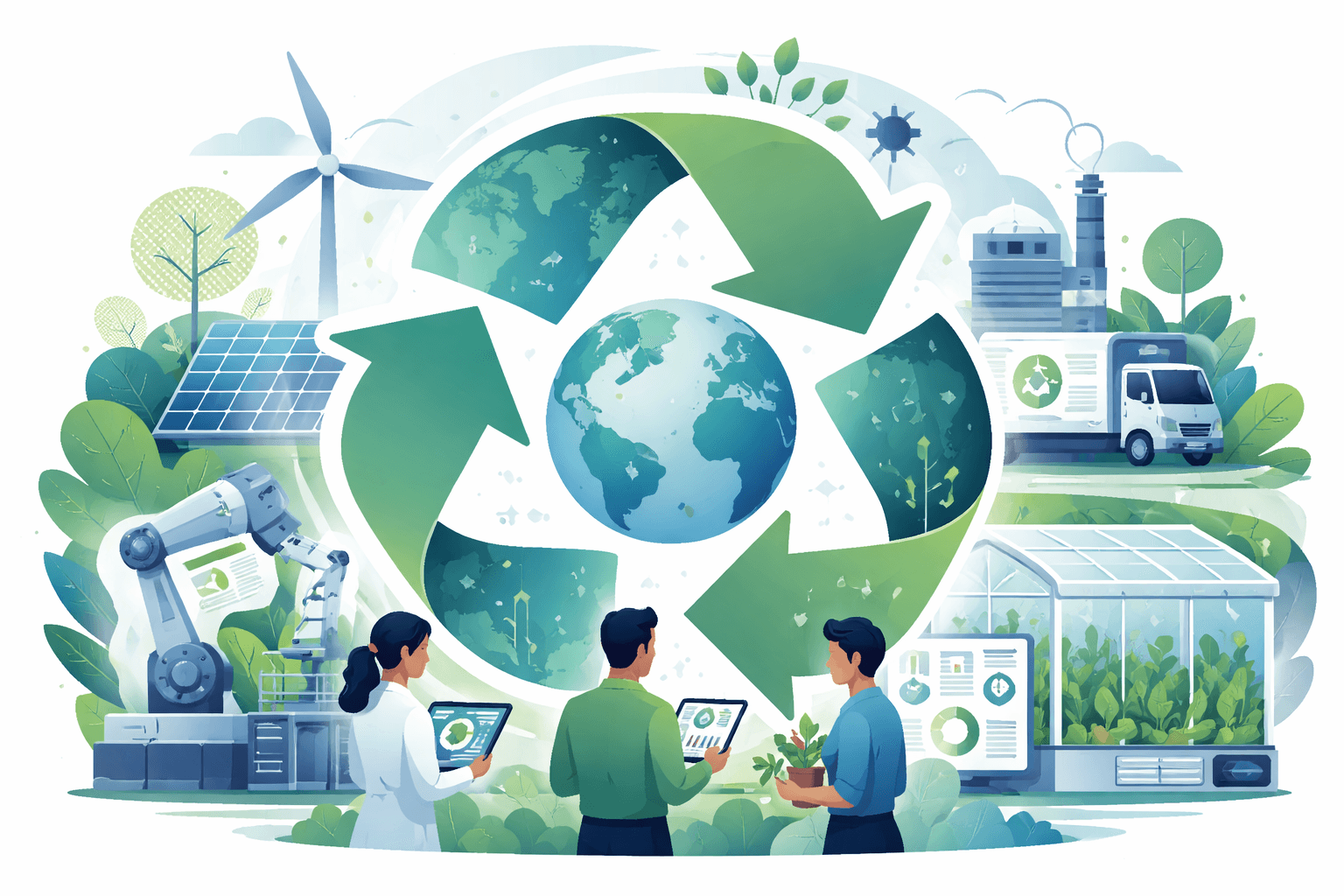
The circular economy offers a fundamentally different model. Products and materials are designed to circulate through the economy at their highest value for as long as possible. Waste is not managed — it is designed out of the system entirely. The Ellen MacArthur Foundation, the leading organization promoting circular economics, frames it around three principles: eliminate waste and pollution, circulate products and materials, and regenerate nature.
This is not theoretical. Companies across sectors are proving that circular models work at scale — and that they can be more profitable than the linear systems they replace.
The Economics: Why Circular Is Gaining Ground
McKinsey & Company estimates that the circular economy represents a $4.5 trillion economic opportunity globally by 2030. The economic logic is straightforward:
- Material costs are volatile and rising. Companies that reduce virgin material dependency insulate themselves from commodity price swings and supply chain disruptions.
- Waste disposal costs are increasing. Landfill taxes in Europe now exceed EUR 100 per ton in several countries. China's 2018 import ban on foreign recyclables forced a global reckoning with waste management costs.
- Customer demand is shifting. Nielsen reported that 73% of global consumers say they would change their consumption habits to reduce environmental impact. This translates into willingness to pay premiums for durable, repairable, and recyclable products.
- Regulation is tightening. The EU's Ecodesign for Sustainable Products Regulation (ESPR), taking effect in phases from 2024, mandates repairability, recyclability, and recycled content requirements across product categories.
Patagonia: The Pioneer of Product Longevity
Patagonia has been the most visible champion of circular business practices for decades, and its approach continues to evolve.
Worn Wear is Patagonia's trade-in and resale program. Customers return used Patagonia garments, which are cleaned, repaired if necessary, and resold at reduced prices. The program processes over 130,000 garments per year and has become a significant revenue stream rather than a cost center. Worn Wear items sell at 40-60% of original retail price, with gross margins comparable to new product sales because there are no manufacturing costs.
Repair infrastructure: Patagonia operates the largest garment repair facility in North America, completing over 100,000 repairs per year at its Reno, Nevada hub. The company offers free repairs for Patagonia products and publishes repair guides on its website. This directly extends product lifespan — a repaired jacket might serve another 5-10 years rather than entering the waste stream.
Material innovation: Patagonia's NetPlus material, made from recycled fishing nets collected from coastal communities in South America, now features in multiple product lines. The company uses recycled polyester (from post-consumer plastic bottles) in roughly 87% of its polyester products.
Patagonia's famous "Don't Buy This Jacket" advertisement was dismissed by some as marketing stunt when it ran in 2011. But the company's revenue has tripled since then. The message resonated precisely because it was backed by real circular infrastructure — repair, resale, and recycled materials.
Interface: Proof That Manufacturing Can Go Circular
Interface, the world's largest modular flooring manufacturer, provides perhaps the most compelling industrial case study for circular economics.
Under the late founder Ray Anderson's "Mission Zero" initiative (launched in 1994), Interface set out to eliminate its negative environmental impact entirely by 2020. The results were remarkable:
- 96% reduction in greenhouse gas emissions from manufacturing (1996 to 2020)
- 89% reduction in waste-to-landfill intensity
- 46% reduction in water usage per unit of production
- 75% of energy from renewable sources
Interface's ReEntry program collects used carpet tiles from commercial customers, separates the yarn from the backing, and recycles both streams into new products. The nylon yarn is depolymerized back to its chemical building blocks and re-spun into new fiber — true closed-loop recycling rather than downcycling.
The company's Carbon Neutral Floors program certifies that the full lifecycle carbon footprint of its products — from raw material extraction through manufacturing, use, and end-of-life — is offset. More importantly, Interface's "Climate Take Back" mission (the successor to Mission Zero) aims to make the company carbon negative — actually sequestering more carbon than it emits.
The financial case is clear: Interface's operating margins improved during its sustainability transformation, not despite it. Material efficiency, waste reduction, and energy savings directly reduced costs. Premium pricing for sustainable products increased revenue.
Loop: Reinventing Packaging as a Service
Loop, developed by TerraCycle founder Tom Szaky, represents the most ambitious attempt to make reusable packaging mainstream in consumer goods.
The concept is simple: instead of buying products in disposable packaging, consumers purchase them in durable, reusable containers. When the product is consumed, the empty container is collected, professionally cleaned, refilled, and recirculated. The packaging never becomes waste.
Loop launched with major brand partners including Procter & Gamble (Tide, Pantene), Unilever (Dove, Hellmann's), Nestlé (Häagen-Dazs), and PepsiCo. Products come in stainless steel, glass, and engineered plastic containers designed for 100+ use cycles.
The model has faced challenges. Consumer adoption requires behavior change — returning empty containers is less convenient than tossing them in the recycling bin. Logistics costs for collection, cleaning, and redistribution are significant. Loop's direct-to-consumer model pivoted to in-store partnerships with retailers like Carrefour and Tesco to reduce friction.
Despite the challenges, Loop's underlying insight is sound: packaging is a service, not a product. When the packaging cost is borne by the brand (amortized over 100 reuse cycles) rather than externalized as waste, the economic incentive shifts toward durability rather than disposability.
Design for Disassembly: Building Products That Come Apart
The circular economy requires products designed from the outset for end-of-life recovery. Design for disassembly is the engineering discipline that makes this possible.
Fairphone, the Dutch smartphone manufacturer, designs its phones with modular components that users can replace themselves. A cracked screen, worn battery, or outdated camera module can be swapped in minutes with a standard screwdriver. This extends phone lifespan from the industry average of 2-3 years to 5+ years and enables component-level recycling at end of life.
Caterpillar's Reman division remanufactures heavy equipment components — engines, transmissions, hydraulic cylinders — to original specifications at 40-60% of the cost of new components. This requires designing products so that critical components can be accessed, removed, and rebuilt without destroying the surrounding assembly.
IKEA has invested heavily in designing furniture for disassembly, enabling its buyback and resale programs. The company's circular product design guidelines mandate that materials can be separated for recycling and that components can be replaced individually.
Industrial Symbiosis: One Company's Waste Is Another's Input
Industrial symbiosis creates networks where the waste output of one company becomes the raw material input for another. The most famous example is the Kalundborg Symbiosis in Denmark, operating since the 1970s.
In Kalundborg, an oil refinery, power plant, pharmaceutical manufacturer, plasterboard factory, and several other companies exchange waste streams in a closed network. Excess heat from the power plant warms 3,500 homes and a fish farm. Fly ash from coal combustion becomes raw material for cement. Sludge from the pharmaceutical plant fertilizes local farms. The network saves participating companies an estimated EUR 24 million per year while eliminating over 635,000 tons of CO2 emissions.
Modern industrial symbiosis platforms like Synergie (UK) and NISP (National Industrial Symbiosis Programme) use data matching to identify waste-to-resource opportunities across regions. The model is being replicated in industrial parks in China, South Korea, and the Netherlands.
Barriers to Scaling
Despite these successes, the circular economy faces significant barriers:
- Economics of virgin materials. Fossil fuel subsidies make virgin plastic cheaper than recycled alternatives. Until externalities are priced in, circular models fight an uphill economic battle.
- Consumer convenience. Linear consumption is frictionless. Returning, repairing, and refilling require effort that most consumers resist.
- Infrastructure gaps. Collection, sorting, and reprocessing infrastructure for circular material flows is underdeveloped in most countries.
- Regulatory fragmentation. Product design regulations, extended producer responsibility schemes, and waste classifications vary by jurisdiction, complicating global circular supply chains.
The Direction of Travel
The circular economy is not an alternative to the mainstream economy — it is becoming the mainstream economy, driven by regulation, resource scarcity, and competitive advantage. The EU's Circular Economy Action Plan, China's circular economy legislation, and corporate commitments from companies representing trillions in combined revenue all point in the same direction.
The companies profiled here are not outliers. They are early movers in a transition that will reshape every sector. The question for business leaders is not whether to adopt circular principles, but how quickly they can redesign their operations before competitors and regulators force the issue.
More in Green Business
- Circular Economy Business Models: How Companies Create Value by Doing More with Less
- Why the Circular Economy Pays Off: Economic, Environmental and Social Benefits
- Zero Waste Lifestyle: A Practical Guide to Reducing Household Waste
- How to Recycle Effectively: Practical Guidance to Reduce Waste and Avoid Contamination