
Home Solar Battery Storage: Complete Buyer’s Guide & Cost Calculator
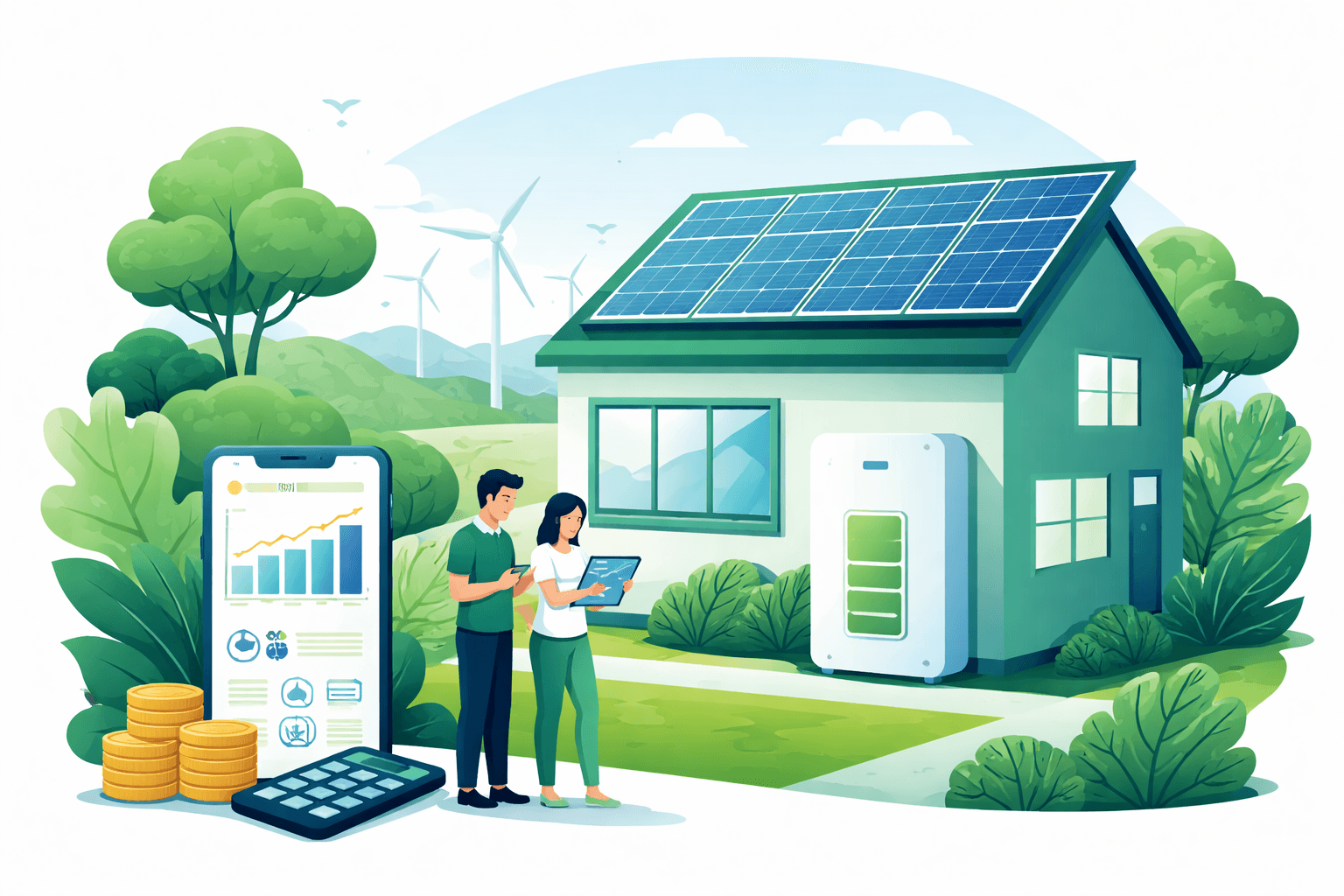
Home solar battery storage has shifted from niche to mainstream as time-of-use (TOU) rates widen and outages become more common. The U.S. Energy Information Administration (EIA) reports Americans experienced about 5.5 hours of power interruptions in 2022 on average, while California’s export compensation under NEM 3.0 makes self-consumption far more valuable than daytime exports. With a 30% federal tax credit now covering standalone batteries, home solar battery storage can reduce bills, keep essential loads powered, and future‑proof your energy.
This guide covers the benefits, how systems work, battery chemistry, sizing, costs and incentives, payback math, key features, installation, and how to compare quotes—plus a step‑by‑step sizing and cost calculator you can use today.
By the numbers: Why home storage is surging
- 30% federal tax credit: The Investment Tax Credit (ITC) now applies to standalone storage placed in service after 2022 (U.S. Treasury/IRS guidance under the Inflation Reduction Act).
- 5.5 hours: Average U.S. outage duration in 2022 (EIA reliability metrics), with wide regional variation and increasing extreme-weather events.
- 85–95%: Typical round‑trip efficiency for lithium-ion home batteries, depending on coupling and inverter topology (NREL technical benchmarks).
- 10–15 years: Typical warranty term guaranteeing ~60–70% remaining capacity at end‑of‑warranty (manufacturer specs vary).
- $900–$1,300 per kWh installed: Typical turnkey cost range for residential lithium systems before incentives; 10–20 kWh systems commonly run $9,000–$22,000 before credits.
1) Why add a home solar battery? Benefits, use cases, and who should consider one
Home solar battery storage provides three primary value streams:
- Backup power resilience: Keep critical loads running during outages (refrigerator, lighting, Wi‑Fi, medical devices, well pump). Batteries provide silent, instant backup with no fuel or exhaust. Transfer times are typically under 1 second; some systems can be sub‑100 milliseconds to avoid rebooting electronics.
- Bill optimization: Time-shifting solar or off-peak energy to peak periods lowers bills when TOU spreads are large. Under export regimes like California’s NEM 3.0, batteries help maximize self-consumption and avoid low export credits.
- Grid programs and future-ready homes: Utilities increasingly offer virtual power plant (VPP) or demand response incentives that pay homeowners for dispatching stored energy a few times per year. Batteries also support EV charging, electrified heating, and overall home electrification plans.
Who benefits most:
- Homes with frequent or long outages, medical or business continuity needs, well pumps, or sump pumps.
- Customers under TOU or demand charges, or low daytime export rates (e.g., NEM 3.0 in CA).
- Solar homes seeking whole‑home backup without a generator, or hybrid generator+battery setups to reduce runtime and fuel.
- Off-grid or remote homes, cabins, and ADUs seeking multi-day autonomy.
CTA: Comparing quotes from multiple vetted installers typically saves 15–25% on total system cost. Ask for proposals that model TOU, outage coverage, and incentives side-by-side.
2) How home battery storage works: AC vs DC coupling, hybrid inverters, and core components
A solar-plus-storage system has three electrical “planes”: the DC side (solar modules and DC batteries), the AC side (your home loads), and the grid. Power electronics convert and direct energy among them.
Solar Electricity Handbook - 2023 Edition: A simple, practical guide to solar energy – designing and installing solar photovoltaic systems: Boxwell, Michael
Solar Electricity Handbook - 2023 Edition: <strong>A simple, practical guide to solar energy – designing and installing solar photovoltaic systems</strong> [Boxwell, Michael] on Amazon.com. *FREE* shi
Check Price on Amazon- AC-coupled systems: Solar panels feed an AC inverter (or microinverters on the roof). The battery has its own bidirectional inverter/charger connected on the AC side. Pros: Easy retrofit to existing PV, flexible expansion, microinverter compatibility. Cons: Two conversion steps (DC→AC→DC and back) reduce round‑trip efficiency; typical whole-system efficiency 85–92%.
- DC-coupled systems: Solar and battery both sit on the DC bus via a hybrid inverter/charger. Pros: Fewer conversions, usually higher efficiency; good for new builds. Cons: Retrofitting existing AC-only PV can be more complex; compatibility matters.
- Hybrid inverters: These manage PV, battery charging/discharging, grid interaction, and backup transfer. Key specs include continuous and surge power (kW), battery voltage compatibility, islanding/transfer time, and UL certifications.
Core components:
- Battery pack (cells + modules) and Battery Management System (BMS)
- Inverter/charger (standalone or hybrid)
- Critical loads subpanel or whole‑home backup switchgear
- Gateway/controller and monitoring app
- Safety equipment: rapid shutdown devices, disconnects, breakers, and code-compliant enclosure/clearances
For a deeper primer on storage technologies and grid roles, see Energy Storage Explained: Types, Costs, and How It Powers the Grid (/ai-technology/energy-storage-explained-types-costs-grid).
3) Battery types & chemistry: NMC vs LFP vs lead‑acid
Lithium-ion dominates home storage. Two leading chemistries are NMC (nickel manganese cobalt) and LFP (lithium iron phosphate). Lead‑acid (flooded and AGM) still appears in off-grid or budget builds but has lower energy density and cycle life.
NMC (Li‑ion):
- Pros: High energy density; compact footprint.
- Performance: Good power capability; round‑trip efficiency typically 90%+.
- Safety: Greater thermal runaway risk than LFP; modern packs rely on robust BMS, thermal management, and UL 9540A tested enclosures.
- Lifespan: Common warranties assure ~70% capacity at 10 years, often with 3,000–6,000 cycle limits (varies by manufacturer and usage profile).
- Sustainability: Contains cobalt/nickel; recycling pathways exist and are expanding, led by firms adopting hydrometallurgical processes. Collection networks are improving, but infrastructure is still maturing (IEA and U.S. DOE tracking).
LFP (LiFePO4):
- Pros: Excellent thermal stability and lower fire propagation risk; no cobalt; often longer cycle life (4,000–8,000+ cycles claimed) and broader operating windows.
- Performance: Slightly lower energy density than NMC, so systems can be larger/heavier per kWh; round‑trip efficiency often 92–96% at the DC level.
- Lifespan: Many warranties also target ~70–80% capacity at 10–12 years with generous cycle counts. LFP’s flatter voltage curve can simplify pack management.
- Sustainability: Easier material profile; recycling is growing though economics depend on volumes and metals recovery.
Lead‑acid (flooded/AGM/gel):
- Pros: Low upfront cost; widely available; predictable behavior.
- Cons: Low depth of discharge (50% typical), heavier and bulkier, shorter cycle life (hundreds to low thousands), lower round‑trip efficiency (70–85%). Ventilation and maintenance (for flooded) are required.
- Best for: Cost-constrained off-grid, infrequent cycling, or transitional systems. Most grid‑interactive homes now favor lithium due to performance and space constraints.
Safety and codes:
- Look for UL 9540 (energy storage system) certification and UL 9540A (fire propagation test) data. Many AHJs reference NFPA 855 for siting (e.g., garage or exterior, not sleeping rooms), spacing, and ventilation.
- The National Electrical Code (NEC) includes Article 706 (Energy Storage Systems) and rapid shutdown provisions affecting PV+storage designs.
4) Sizing your battery: a step‑by‑step calculation plus examples
A correctly sized battery must satisfy both energy (kWh) and power (kW) needs. Follow these steps.

EF ECOFLOW Smart Home Panel 2, the Center of the Whole
Alternatively connect <strong>3 x EcoFlow DELTA Pro 3 units with 6 x Extra Batteries for energy storage up to 36kWh</strong>. It's not just for longer backup but lets you to control and run every
Check Price on AmazonStep 1: Define your goal
- Bill optimization and self‑consumption: Right‑size to cover your evening/peak shoulder loads most days (often 5–15 kWh usable per day).
- Backup for critical loads: Size for X hours/days of autonomy at your critical load level (kWh/day), plus inverter power capacity to start/serve peak loads.
- Off‑grid: Combine multi‑day autonomy with seasonal solar production and generator strategy. See Off‑Grid Solar: Complete Buyer’s Guide (/renewable-energy/off-grid-solar-complete-buyers-guide).
Step 2: Gather data
- Utility bill: Daily or monthly kWh use; TOU schedule and peak/off‑peak rates.
- Load inventory: List essential circuits (refrigerator, lights, networking, garage door, well/sump pump, furnace fan, CPAP, etc.) with watt ratings and hours/day.
- Solar production profile (if you have PV): Your monitoring app or installer can provide hourly output.
Step 3: Calculate energy needs
- For backup: Critical loads average power (W) × hours = daily Wh, divide by 1,000 to get kWh.
- For bill optimization: Estimate peak‑period kWh you’d like to cover daily.
Step 4: Adjust for efficiency and depth of discharge (DoD)
- Let η be your round‑trip efficiency (e.g., 0.9 for 90%).
- Usable DoD is the portion of capacity you can reliably use (e.g., 0.8 for 80% usable without voiding warranty).
- Required nameplate capacity (kWh) = Desired usable kWh ÷ (DoD × η).
Step 5: Check power (kW) and surge
- Continuous inverter power must cover steady loads; surge rating should handle motor start currents (refrigerator/well pumps can require 3–6× startup for <1 second). Consider soft‑start devices for large HVAC.
Two worked examples
- Evening TOU shifting:
- Target: 10 kWh of peak usage shifted daily.
- Assume DoD = 90% usable on spec sheet, η = 90%.
- Required nameplate = 10 ÷ (0.9 × 0.9) = 12.35 kWh. A 13–14 kWh unit is a good fit. Continuous power: if evening peak loads average 2–4 kW with brief spikes, a 5–7.5 kW inverter is sufficient.
- 24-hour critical‑load backup:
- Critical loads: 150 W fridge average, 100 W lights/devices, 80 W networking, 500 W well pump averaging 1 hour/day run time (but 1.5 kW surge), 100 W furnace fan averaging 4 hours/day =
- Daily energy = (150×24 + 100×5 + 80×24 + 500×1 + 100×4) Wh
- = (3,600 + 500 + 1,920 + 500 + 400) Wh = 6,920 Wh ≈ 6.9 kWh/day
- With η = 90%, DoD = 80%, nameplate needed = 6.9 ÷ (0.8×0.9) ≈ 9.6 kWh.
- Inverter power: Choose ≥5 kW continuous with ≥7–10 kW surge to start the well pump and fridge simultaneously. If your HVAC is included, size up substantially or isolate it.
Rule-of-thumb checks
- Most grid-tied homes choose 10–20 kWh usable for daily cycling and short outages.
- Whole‑home backup (including central AC or heat pump, electric range, dryer) often requires 20–40+ kWh plus higher‑power inverters or multiple units.
5) Costs, savings & payback: upfront, incentives, TOU value, and ROI scenarios
Upfront costs (before incentives)
- Installed cost: $900–$1,300 per kWh is common in 2025 for lithium systems; a 13.5 kWh unit might be $12,000–$17,000 turnkey depending on labor, main panel upgrades, and balance of system.
- Adders: Critical loads subpanel ($500–$2,000), service panel upgrade ($1,500–$4,000), trenching or exterior mounting ($500–$3,000), whole‑home ATS/switchgear (varies).
- O&M: Minimal. Firmware updates are remote. Plan on eventual replacement after warranty life if you require the same level of backup.
Incentives
- Federal ITC: 30% off installed cost for standalone or solar‑paired storage (no minimum solar charge requirement under IRA for standalone). Tax liability limits apply—consult a tax professional.
- State/utility programs (examples; verify current terms):
- California SGIP: Upfront rebates per kWh for residential and equity/resilience customers; incentive levels adjust with budget steps and program category.
- Northeast “ConnectedSolutions”/demand response: MA, RI, CT, VT, NH utilities often pay $100–$400 per kW of battery contribution per year for summer events; some include winter payments.
- New York NYSERDA incentives: Upfront storage incentives exist for certain territories and program blocks.
- Additional local property/sales tax abatements may apply.
Bill savings and backup value
- TOU arbitrage example: Off‑peak rate $0.20/kWh; peak $0.50/kWh; spread $0.30. Discharging 10 kWh/day at 90% efficiency saves about 10 × $0.30 = $3/day, or ~$1,095/year. Factor in minor degradation and seasonal variation.
- Export value boost: If daytime exports pay $0.05–$0.10/kWh while retail import is $0.30–$0.60, shifting solar to evening can double or triple per‑kWh value of your PV. This is especially relevant in California; see our state-specific context in Tesla Powerwall in California: Cost, Availability & Is It Worth It? (/renewable-energy/tesla-powerwall-in-california-cost-availability-worth-it).
- Backup value: Outage mitigation has real but variable economic value (avoided food spoilage, sump pump operation, work continuity). EIA reports average outage durations vary by state; if you face frequent 4–12 hour outages, backup value can rival energy savings.
Simple payback scenarios (after 30% ITC)
- Scenario A: 13.5 kWh installed at $15,000 → net $10,500 after ITC. TOU savings $1,100/yr + demand response $250/yr = ~$1,350/yr → ~7.8‑year simple payback, excluding backup value.
- Scenario B: Same system without DR, lower spread ($0.15/kWh): 10 kWh/day × $0.15 = $1.50/day = ~$550/yr → ~19‑year simple payback; users in this case often value backup/resilience most.
- Scenario C: High-NEM penalty/low export credit area, larger spread ($0.40/kWh) and 8 kWh/day: $3.20/day ≈ $1,170/yr; net cost $10,500 → ~9‑year payback, improved if paired with DR.
Note: These are illustrative. Use your actual rates, solar profile, and incentives. Many households pair batteries primarily for resilience and consider energy savings a bonus.
6) Top features to compare in a home storage system
- Usable capacity (kWh): Check “usable” vs “nameplate.” Some vendors advertise gross capacity; warranties are tied to usable. Aim to cover your target daily cycling and outage window.
- Power rating (kW): Continuous and peak/surge. Determine if you need whole‑home or critical‑loads backup. Two 5–7.6 kW inverters can support many homes; large HVAC may require more.
- Round‑trip efficiency: DC‑coupled and LFP systems often show higher lab efficiencies; whole-system AC performance depends on topology. Differences of a few percentage points affect annual savings.
- Warranty terms: Years, cycles, retained capacity (often 60–70%), and throughput limits (MWh). Read what voids coverage (ambient temperature, improper ventilation, excessive cycling profile).
- BMS and thermal management: Cell-level monitoring, active vs passive cooling/heating, cold‑weather performance, and software controls (backup reserve percentages, storm mode).
- Expandability: Modular stacks vs fixed packs; AC‑coupled systems are often easier to add later. Confirm parallel inverter support and service upgrades if whole‑home is a goal.
- Fire safety and certifications: UL 9540/9540A, NFPA 855 siting, and AHJ requirements. LFP chemistries provide added headroom on thermal stability; regardless of chemistry, certified enclosures and code‑compliant installs are paramount.
- Software and integrations: Load control, EV charging coordination, tariff optimization, outage forecasting, and VPP enrollment.

Anker SOLIX F3800 120V/240V Home Backup Kit, 7.68kWh Portable Power Station with Transfer Switch Kit, LiFePO4 Battery, 6000W AC Output, Solar Generator for Home Use, RV, Emergencies, & Outages : Patio, Lawn & Garden
Dual-Voltage for Any Appliance: No more limitations when you're powering your dryer. The <strong>120V/240V and 6,000W AC output runs everything in your home</strong>. If you need more power, add
Check Price on AmazonIf you’re comparing specific brands and models, see Solar Battery Buying Guide: Choose the Best Home Battery in 2026 (/renewable-energy/solar-battery-buying-guide-2026) for spec-by-spec comparisons.
7) Installation, maintenance & permitting
What to expect
- Site survey: Assess panel space, service equipment, internet connectivity, clearances, and siting (garage/exterior wall). Check for main panel upgrades.
- Design and permitting: 1–4 weeks typical, longer in complex jurisdictions. Plans show one‑line diagrams, load calcs, and code references (NEC 706, NEC 705 interconnection).
- Utility interconnection: 2–8 weeks depending on utility. Some utilities fast‑track battery additions to existing PV.
- Installation day(s): 1–3 days for battery + subpanel + controls; longer with trenching or main panel/service upgrades. Expect brief planned outages during switchover.
- Commissioning: Firmware updates, app setup, backup reserve settings, and tariff configuration.
Maintenance and best practices
- Keep firmware current to benefit from performance and safety improvements.
- Maintain clearances; avoid blocking vents or enclosing the unit beyond listing conditions.
- In cold climates, consider conditioned space or insulated garage; batteries derate below freezing without thermal management.
- Annual checkup: Visual inspection for corrosion/damage, verify breakers/labels, test backup transfer.
Common pitfalls
- Undersized inverter power leading to nuisance trips during surges.
- Overpromised whole‑home backup without load management or sufficient capacity.
- Ignoring code siting rules; always follow AHJ guidance and listing instructions.
- Not modeling your actual TOU tariff and export rules—savings assumptions can swing payback by years.
8) How to choose a system & get quotes
Checklist for comparing vendors
- Show your goals: resilience vs savings vs both, and any must‑run loads.
- Request both AC‑ and DC‑coupled options if retrofitting PV; compare efficiency and costs.
- Demand transparent specs: usable kWh, continuous/peak kW, round‑trip efficiency (system level), warranty terms (years/cycles/throughput), UL/NFPA compliance, and monitoring features.
- Have installers model your exact tariff (including seasonal/weekday variations) and export compensation. Ask for 8760-hour simulations if available.
- Confirm expandability: additional batteries/inverters, service panel capacity, standby generator compatibility, and EV charger coordination.
- Ask about utility/VPP enrollment support and any participation payments.
- Verify installer credentials: manufacturer certifications, NABCEP PV/Storage certifications, proof of insurance, and local reference projects.
Validation tips
- Read the warranty: Does capacity retention guarantee apply regardless of cycle depth, or are there throughput caps? Are labor and shipping included for warranty replacements?
- Safety documentation: Request UL 9540/9540A reports or data sheets and proposed siting compliant with NFPA 855.
- Performance assumptions: Ensure degradation, temperature derates, and inverter efficiency are included in models.
Simple sizing and cost calculator (plug in your numbers)
- Determine daily target usable kWh (UT). Examples: 8–12 kWh for TOU shifting; or your critical‑loads kWh/day for backup.
- Pick round‑trip efficiency (η) and DoD. Example: η = 0.90, DoD = 0.85.
- Nameplate capacity (kWh) = UT ÷ (η × DoD).
- Estimate installed cost = Nameplate kWh × cost per kWh installed. Use $900–$1,300/kWh; adjust for adders.
- Apply incentives: Net cost = Installed cost × (1 – 0.30) – upfront rebates (if any).
- Annual arbitrage savings ≈ Daily shifted kWh × rate spread × 365.
- Add annual DR/VPP payments (if you’ll enroll).
- Simple payback (years) = Net cost ÷ (Annual savings + DR payments).
Example: UT = 10 kWh; η = 0.9; DoD = 0.9 → Nameplate = 12.35 kWh. At $1,050/kWh, installed ≈ $12,968. After 30% ITC → $9,078. If spread = $0.30 and you shift 10 kWh/day: $1,095/yr. Add $250 DR → $1,345/yr. Payback ≈ 6.7 years.
CTA: Get at least three itemized quotes. Homeowners who compare multiple bids typically save 15–25% and get clearer modeling of TOU savings, outage coverage, and incentives. Ask for both critical‑loads and whole‑home options.
Practical implications for homeowners and policymakers
- Consumers: Batteries shine where TOU spreads are large, export credits are low, or outages are frequent. LFP chemistries and UL 9540A‑validated systems offer strong safety profiles. Consider modular systems that can grow with EVs or electrified heating.
- Businesses/installers: Demand is shifting toward bundled solar‑plus‑storage with tariff‑aware controls and VPP enrollment. Clear customer education on power vs energy sizing reduces callbacks.
- Policymakers/utilities: Well‑designed demand response and VPP programs can turn thousands of home batteries into firm, dispatchable capacity that lowers peak demand and supports renewables integration (IEA and NREL analyses show distributed storage provides system‑level reliability when aggregated). Incentives that reward dispatch and resilience can be cost‑effective compared with peaker plants.
Where this is heading
Battery prices have trended down long‑term, and LFP continues to gain market share thanks to safety, cost, and abundant materials. Standards like UL 9540A and NFPA 855 are improving siting consistency, and utility programs are scaling aggregation. Expect smarter controls that coordinate PV, batteries, EVs, and heat pumps; more homes will operate as flexible micro‑hubs that support the grid while cutting bills.
For detailed model comparisons and buying advice, read Solar Battery Buying Guide: Choose the Best Home Battery in 2026 (/renewable-energy/solar-battery-buying-guide-2026). For off‑grid autonomy planning, see Off-Grid Solar: Complete Buyer’s Guide (/renewable-energy/off-grid-solar-complete-buyers-guide). To understand how residential batteries fit into broader storage trends, visit Energy Storage Explained: Types, Costs, and How It Powers the Grid (/ai-technology/energy-storage-explained-types-costs-grid).
Recommended Products
Solar Electricity Handbook - 2023 Edition: A simple, practical guide to solar energy – designing and installing solar photovoltaic systems: Boxwell, Michael
Solar Electricity Handbook - 2023 Edition: <strong>A simple, practical guide to solar energy – designing and installing solar photovoltaic systems</strong> [Boxwell, Michael] on Amazon.com. *FREE* shi
EF ECOFLOW Smart Home Panel 2, the Center of the Whole
Alternatively connect <strong>3 x EcoFlow DELTA Pro 3 units with 6 x Extra Batteries for energy storage up to 36kWh</strong>. It's not just for longer backup but lets you to control and run every
Anker SOLIX F3800 120V/240V Home Backup Kit, 7.68kWh Portable Power Station with Transfer Switch Kit, LiFePO4 Battery, 6000W AC Output, Solar Generator for Home Use, RV, Emergencies, & Outages : Patio, Lawn & Garden
Dual-Voltage for Any Appliance: No more limitations when you're powering your dryer. The <strong>120V/240V and 6,000W AC output runs everything in your home</strong>. If you need more power, add