
Carbon Capture Technology Costs: What Drives Them and How They Compare
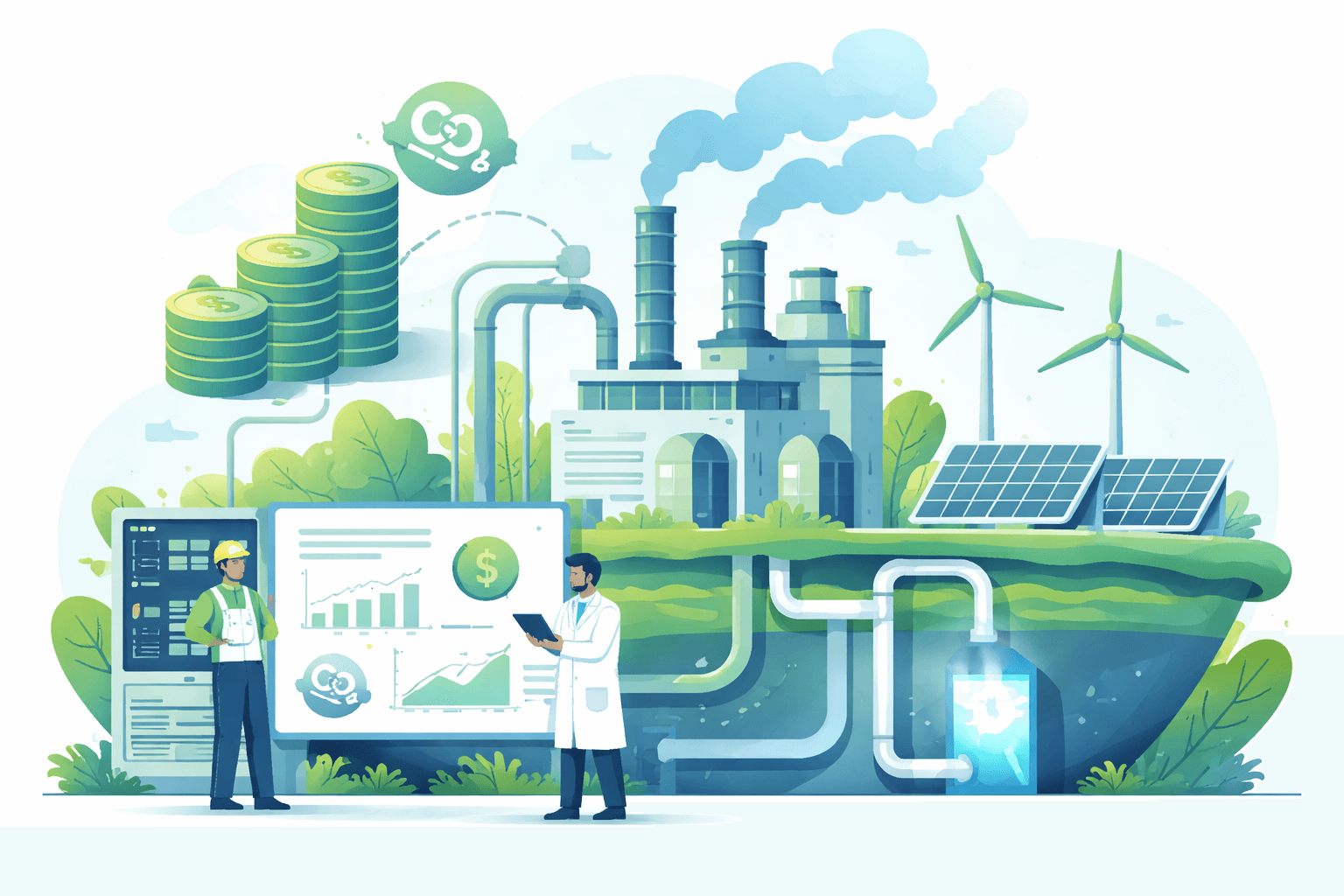
Carbon capture technology costs are under intense scrutiny as countries scale carbon capture, utilization, and storage (CCUS) and carbon dioxide removal. The International Energy Agency (IEA) estimates about 50 million tonnes of CO2 (MtCO2) per year are currently captured worldwide, with announced projects exceeding 400 MtCO2/yr by 2030. Whether that pipeline gets built will hinge on costs more than anything else — from capture at the smokestack to compression, transport, and storage.
This guide defines what “cost” really includes, compares cost drivers across sectors, explains why estimates vary so widely, and outlines how carbon capture technology costs could change over time.
What “carbon capture technology costs” include
When people quote a single “$ per tonne” number, it usually masks a bundle of capital and operating expenses across four linked steps:

Carbon Capture (The MIT Press Essential Knowledge series): Herzog, Howard J.
In this volume in the MIT Press Essential Knowledge series, Howard Herzog offers <strong>a concise guide to carbon capture, covering basic information as well as the larger context of climate technolo
Check Price on Amazon- Capture: Equipment to separate CO2 from a gas stream (or from ambient air), including absorbers/strippers for amines, oxy-fuel systems, membranes, or solid sorbents. CAPEX covers reactors, heat exchangers, fans/blowers, and balance-of-plant. OPEX includes energy (electricity and heat/steam), sorbent/solvent makeup, maintenance, and labor.
- Compression: CO2 is compressed to supercritical conditions (typically 100–150 bar) for pipeline transport or injection. Compression can add 80–120 kWh per tonne of CO2, depending on final pressure and design.
- Transport: Pipelines are the most common, but trucks, ships, and rail can move CO2 at smaller scales or offshore. Costs depend on distance, diameter, throughput, and permitting.
- Storage (or utilization): Developing a geological storage site (saline aquifer or depleted oil/gas reservoir), drilling injection and monitoring wells, injecting CO2, and long-term measurement/monitoring/reporting (MMV). If CO2 is used (e.g., for synthetic fuels or concrete curing), on-site utilization equipment replaces storage costs but adds its own CAPEX/OPEX.
Project finance, insurance, permitting, interconnection to shared CO2 networks, and contingency also land in the final cost. Analysts distinguish three related metrics:
- Cost per tonne captured: $/tCO2 at the capture unit boundary (excludes downstream transport/storage).
- Cost per tonne avoided: $/tCO2 considering how capture changes the underlying process’s emissions (e.g., efficiency penalty at a power plant). This is the right metric for comparing climate impact across options.
- Cost per tonne removed: $/tCO2 for net removal from the atmosphere (e.g., direct air capture with storage, or BECCS), accounting for the project’s own lifecycle emissions.
Major cost drivers by sector and technology
The concentration of CO2 in the gas stream, process integration, and energy intensity dominate sector-by-sector differences.

Carbon Capture: Wilcox, Jennifer
This <strong>comprehensive textbook on carbon dioxide capture</strong>, the first one ever, has arrived at a pivotal moment. Removing carbon dioxide from gas mixtures in new and cheaper ways is the ke
Check Price on AmazonPower plants (post-combustion on coal and gas)
- Coal-fired power (post-combustion amine capture): Capture costs commonly fall in the $40–$110/tCO2 captured range, with avoided costs higher ($60–$160/tCO2) due to the efficiency penalty and residual emissions. U.S. DOE/NETL studies show capture raises the levelized cost of electricity (LCOE) by 60–80% for typical retrofits at ~90% capture.
- Natural gas combined cycle (NGCC): Lower flue-gas CO2 concentration (3–5% vs. 12–14% for coal) makes capture harder. IEA and NETL analyses place capture costs typically $70–$160/tCO2 captured, depending on capture rate, energy prices, and integration. Avoided costs are higher than capture costs for the same reasons as coal.
Technical note: Amine-based systems often require 3.0–3.6 GJ of heat per tonne of CO2 (reboiler duty) and 100–200 kWh/t for auxiliaries and compression. Energy prices therefore swing costs significantly.
Cement
Cement plants emit process CO2 from calcination that is hard to eliminate. Post-combustion capture, oxy-fuel, and emerging calcium looping are options. IEA and industry pilot data indicate capture costs around $60–$160/tCO2 captured. Project specifics (kiln type, waste-heat recovery, and new-build vs. retrofit) drive the variance.
Iron and steel
Options include capturing from blast furnace gas, basic oxygen furnace off-gas, or shifting to direct-reduced iron (DRI) with CCS on the reformer. Reported capture-cost ranges are typically $80–$150/tCO2 for blast-furnace routes. New DRI with CCS can be competitive where low-cost natural gas and CO2 storage are available, but costs vary widely with plant design and fuel pricing.
Refining and hydrogen (SMR/ATR)
Hydrogen from steam methane reforming (SMR) or autothermal reforming (ATR) produces a high-CO2 “syngas” stream that is relatively concentrated. Capturing from this stream is cheaper than flue-gas capture. IEA and industry assessments place capture costs in the $40–$80/tCO2 range for the syngas stream; capturing additional CO2 from heaters’ flue gas raises the blended cost.
Natural gas processing and ethanol
CO2 removal is often already part of gas processing (to meet pipeline specs) or ethanol production (fermentation off-gas is ~99% CO2). Incremental capture costs can be as low as $15–$30/tCO2 captured, per IEA and Global CCS Institute case studies — the global low end for point-source capture.
Direct air capture (DAC)
Capturing CO2 from ambient air is inherently energy-intensive because CO2 is only ~0.04% by volume. Current commercial DAC projects report costs in the $600–$1,200/tCO2-removed range, depending on technology (solid sorbent vs. liquid solvent) and energy source. The U.S. Department of Energy’s Carbon Negative Shot targets <$100/tCO2 removed at scale; nearer-term independent estimates cluster in the $250–$600/t range with substantial learning and cheap clean energy. IPCC assessments bracket DAC’s long-run potential costs broadly, reflecting technology uncertainty.
Transport and storage adders
Downstream of capture, transport and storage typically add $10–$30/tCO2 combined under favorable conditions:
- Pipeline transport: ~$2–$14/tCO2 for 100–500 km at scale, depending on throughput and terrain, per IEA’s CO2 transport analyses.
- Geological storage: ~$5–$20/tCO2 for site development, injection, and MMV, with costs lower in prolific basins (e.g., U.S. Gulf Coast, North Sea) and higher in frontier regions or for small projects.
Factors that most affect affordability
- Scale and learning: First-of-a-kind (FOAK) projects carry higher EPC, contingency, and integration risks. Moving to nth-of-a-kind (NOAK) designs, standardization, and modularization historically cut costs materially in energy technologies.
- Energy requirements and fuel prices: Capture is mostly an energy problem. Heat and electricity requirements dominate OPEX for amine and DAC systems. Switching to low-cost waste heat, electrified heat, or low-cost renewables can lower $/t materially.
- CO2 concentration and partial pressure: Higher concentration streams are cheaper to capture from (ethanol, NG processing, SMR syngas) than dilute streams (NGCC flue gas, air). This single parameter often explains order-of-magnitude differences in costs.
- Capture rate: Pushing from ~90% to 95–98% capture reduces emissions but raises marginal cost because the last percentages are harder to strip from gas.
- Location and infrastructure: Being near a CO2 hub or trunkline, with characterized storage, reduces both capex and schedule risk. Projects far from storage face higher pipeline, permitting, and marine shipping costs.
- Retrofit vs. new-build: Retrofitting around existing layouts and duty cycles is generally costlier than designing CCS into a new plant.
- Capacity factor: Power plants with low annual run-hours spread fixed costs over fewer tonnes, raising $/tCO2.
- Policy incentives and carbon pricing: The U.S. 45Q tax credit pays up to $85/tCO2 for point-source capture with geological storage and up to $180/tCO2 for DAC with storage (Internal Revenue Service guidance post–Inflation Reduction Act). The EU ETS carbon price traded roughly €60–€100/tCO2 between 2023 and 2025; national support schemes (e.g., the UK’s CCUS business models and industrial carbon contracts for difference) also shape economics.
For context on how capture interacts with markets and compliance systems, see Carbon Credits Explained: How Emissions Trading Markets Actually Work (/sustainability-policy/carbon-credits-explained-emissions-trading-markets).
Current cost ranges and how they are measured
Most studies present ranges because site and design choices matter. Representative 2023–2025 literature values from the IEA, Global CCS Institute, IPCC assessments, and DOE/NETL analyses indicate:
Carbon Dioxide Capture and Storage: Special Report of the Intergovernmental Panel on Climate Change: IPCC
<strong>IPCC Report on sources, capture, transport, and storage of CO2, for researchers, policy-makers and engineers</strong>. Publisher : Cambridge University Press · Publication date : Decem
Check Price on Amazon- Natural gas processing, ethanol: ~$15–$30/tCO2 captured
- Hydrogen (SMR/ATR) syngas: ~$40–$80/tCO2 captured (higher if also capturing flue gas)
- Coal power (post-combustion): ~$40–$110/tCO2 captured; ~$60–$160/tCO2 avoided
- Gas power (post-combustion): ~$70–$160/tCO2 captured; ~$90–$200/tCO2 avoided
- Cement: ~$60–$160/tCO2 captured (process- and site-dependent)
- Steel: ~$80–$150/tCO2 captured (route-dependent)
- Transport + storage: ~$10–$30/tCO2 typical (pipeline + saline storage)
- Direct air capture: ~$600–$1,200/tCO2 removed today; credible medium-term estimates $250–$600/t with scale; DOE target <$100/t long-term
Why the wide bands?
- Boundary choices: Whether studies report $/t captured, avoided, or removed; whether they include T&S; and the assumed capture rate.
- Energy prices and source: Gas at $3/MMBtu vs. $10/MMBtu or electricity at $30/MWh vs. $100/MWh swing costs dramatically.
- Financing assumptions: Weighted average cost of capital (WACC), debt tenor, and construction schedule risk can move levelized costs by tens of dollars per tonne.
- FOAK vs. NOAK: Learning-by-doing, standardization, and clustered infrastructure can shift projects from the high to the low end of ranges.
- Local factors: Labor, permitting timelines, access to storage reservoirs, and integration opportunities (e.g., waste heat) vary by region.
Measuring costs apples-to-apples
- $/t captured: Appropriate for equipment benchmarking or where T&S are provided by a third party.
- $/t avoided: Best for comparing climate effectiveness of options within a sector (e.g., CCS on NGCC vs. renewables plus storage). It accounts for efficiency penalties and residual emissions.
- $/t removed: Required for CDR pathways (DACCS, BECCS). It subtracts life-cycle emissions (construction, energy supply) from gross capture.
Analysts also use “levelized cost of CO2 capture” (LCCC), an all-in cost over plant life analogous to levelized cost of energy (LCOE). Transparent assumptions on capacity factor, energy prices, and WACC are critical to interpret these numbers.
By the numbers
- ~50 MtCO2/yr: Global capture operating today (IEA CCUS tracking, 2024).
400 MtCO2/yr: Announced capture capacity for 2030 (IEA project pipeline).
- 3.0–3.6 GJ/tCO2: Typical reboiler heat for amine systems; 100–200 kWh/t for auxiliaries and compression (DOE/NETL).
- $15–$30/tCO2: Lowest-cost capture in high-CO2 streams (ethanol, NG processing).
- $40–$110/tCO2: Coal post-combustion capture; $70–$160/tCO2 for gas.
- $10–$30/tCO2: Typical combined transport and storage.
- $600–$1,200/tCO2: Current DAC removal cost; DOE target <$100/t.
- $85/tCO2 and $180/tCO2: U.S. 45Q credits for point-source with storage and for DAC with storage, respectively.
Practical implications for companies and policymakers
- Industrial plants with high-CO2 streams (ethanol, NG processing, SMR/ATR) are near-term CCUS sweet spots; costs can be covered by a mix of tax credits and compliance/voluntary markets.
- Power-sector retrofits are highly site-specific. Plants with high capacity factors, low-cost low-carbon heat, and proximity to storage fare best.
- Shared CO2 networks (pipelines, hubs) reduce per-ton transport and storage costs and de-risk schedules — a central design feature of U.S. Gulf Coast and North Sea strategies.
- For hard-to-abate sectors (cement, steel), policy support like carbon contracts for difference, free-allocation phaseout schedules, and hub funding can bridge the gap between cost and carbon price.
- For carbon removal procurements, buyers should distinguish $/t removed vs. captured, durability of storage, and life-cycle emissions. See Innovations in Climate Tech: Breakthroughs, Barriers, and Paths to Scale (/sustainability-policy/innovations-in-climate-tech-breakthroughs-barriers-paths-to-scale) for how learning can bend cost curves.
For a wider view of how CCS and CDR fit alongside renewables, efficiency, and nature-based options, see Climate Change Mitigation Techniques: Practical, Scalable Strategies (/sustainability-policy/climate-change-mitigation-techniques-practical-scalable-strategies).
How costs are expected to change
Several forces are likely to lower carbon capture technology costs over the next decade, though the magnitude differs by pathway.
- Learning-by-doing and standardization: As with other energy technologies, early projects carry integration and contingency premiums. Repetition, modular skid designs, and standardized project delivery can reduce EPC and O&M. Literature on energy infrastructure typically observes double-digit percentage cost declines from FOAK to NOAK.
- Solvent and sorbent advances: Lower-energy solvents (e.g., advanced amines, biphasic systems) and novel sorbents can cut reboiler duty and solvent degradation, tackling the biggest OPEX line item.
- Heat integration and electrification: Using waste heat, heat pumps, or low-cost renewable electricity for compression and low-temperature process heat reduces exposure to fossil fuel prices and improves net abatement.
- Larger and shared CO2 networks: Building trunk pipelines and multiuser storage hubs spreads fixed costs, shortens timelines, and reduces counterparty risk. IEA’s CO2 transport and storage analyses emphasize network effects as a key cost lever.
- Policy durability and bankability: Predictable, bankable incentives turn expected credits into financeable cash flows. In the U.S., 45Q (with direct pay/transferability), coupled with hub funding from the Bipartisan Infrastructure Law, is already moving projects from studies to FIDs. In the EU and UK, carbon prices plus industrial CCfDs and hub support serve a similar role.
- Carbon pricing and offtake markets: Higher and more stable carbon prices in compliance markets, and long-term offtake for durable removals, can close the gap to project breakeven. Corporate buyers are signing multi-year DAC offtakes at hundreds of dollars per tonne today, providing early demand signals even before costs fall.
Expectations by pathway:
- Point-source capture on high-CO2 streams should remain at the low end ($15–$60/t captured) and could decline modestly with solvent and compression improvements.
- Cement and steel capture can fall into the mid-range (perhaps $60–$120/t captured) with large-scale demos, heat integration, and hub access.
- Power-plant capture costs could decline 10–30% with standardization and low-carbon heat, but fuel prices and capacity factors will continue to dominate outcomes.
- DAC has the largest headroom for cost reduction. Moving from bespoke FOAK plants to modular, mass-manufactured units and cheap clean energy could bring costs into the $250–$600/t range over the next decade, with longer-term aspirations near $100–$200/t contingent on major breakthroughs and very low-cost energy. DOE’s Carbon Negative Shot and large public-private pilots are designed to accelerate this trajectory.
Comparing options: when does capture make sense?
- If your facility already handles a high-CO2 stream (e.g., fermentation, SMR/ATR), CCUS is often the cheapest abatement tool available.
- If you’re in power generation, compare “$ per tonne avoided” across portfolios: CCS retrofit vs. renewables + storage vs. demand-side measures. Avoided-cost metrics ensure fair comparisons.
- If your goal is net removal, weigh DACCS and BECCS against land-based removals on durability and measurement. Cost per tonne removed and verifiability are critical.
- If you’re far from storage, joining or advocating for a CO2 hub could be the difference between feasible and uneconomic.
The road ahead
IEA scenarios that reach net zero rely on a mix of point-source capture (especially in cement, chemicals, and refining) and carbon removal (including DACCS) to handle residual emissions from hard-to-abate sectors. The global project pipeline shows momentum, but the decisive factor remains cost — and the ability to finance that cost with a blend of policy support, carbon prices, and offtake agreements.
The playbook is becoming clear: target low-cost streams first, build shared CO2 networks in the right geologies, deploy standardized capture kits, and fund high-ambition DAC and cement/steel demos to push learning forward. With credible policy and markets, carbon capture technology costs can fall from today’s wide ranges toward bankable, repeatable numbers — unlocking the scale implied by 2030 announcements and, more importantly, the climate impact they promise.
Recommended Products
Carbon Capture (The MIT Press Essential Knowledge series): Herzog, Howard J.
In this volume in the MIT Press Essential Knowledge series, Howard Herzog offers <strong>a concise guide to carbon capture, covering basic information as well as the larger context of climate technolo
Carbon Capture: Wilcox, Jennifer
This <strong>comprehensive textbook on carbon dioxide capture</strong>, the first one ever, has arrived at a pivotal moment. Removing carbon dioxide from gas mixtures in new and cheaper ways is the ke
Carbon Dioxide Capture and Storage: Special Report of the Intergovernmental Panel on Climate Change: IPCC
<strong>IPCC Report on sources, capture, transport, and storage of CO2, for researchers, policy-makers and engineers</strong>. Publisher : Cambridge University Press · Publication date : Decem
More in AI & Technology
- Direct Air Capture Technology: How It Works, Why It Matters, and Its Limits
- Strategies to Offset Your Carbon Footprint: Practical, Credible Approaches for Individuals and Businesses
- Innovations in Climate Tech: Breakthroughs, Barriers, and Paths to Scale
- Carbon Credits Explained: How Emissions Trading Markets Actually Work