
Direct Air Capture Technology: How It Works, Why It Matters, and Its Limits
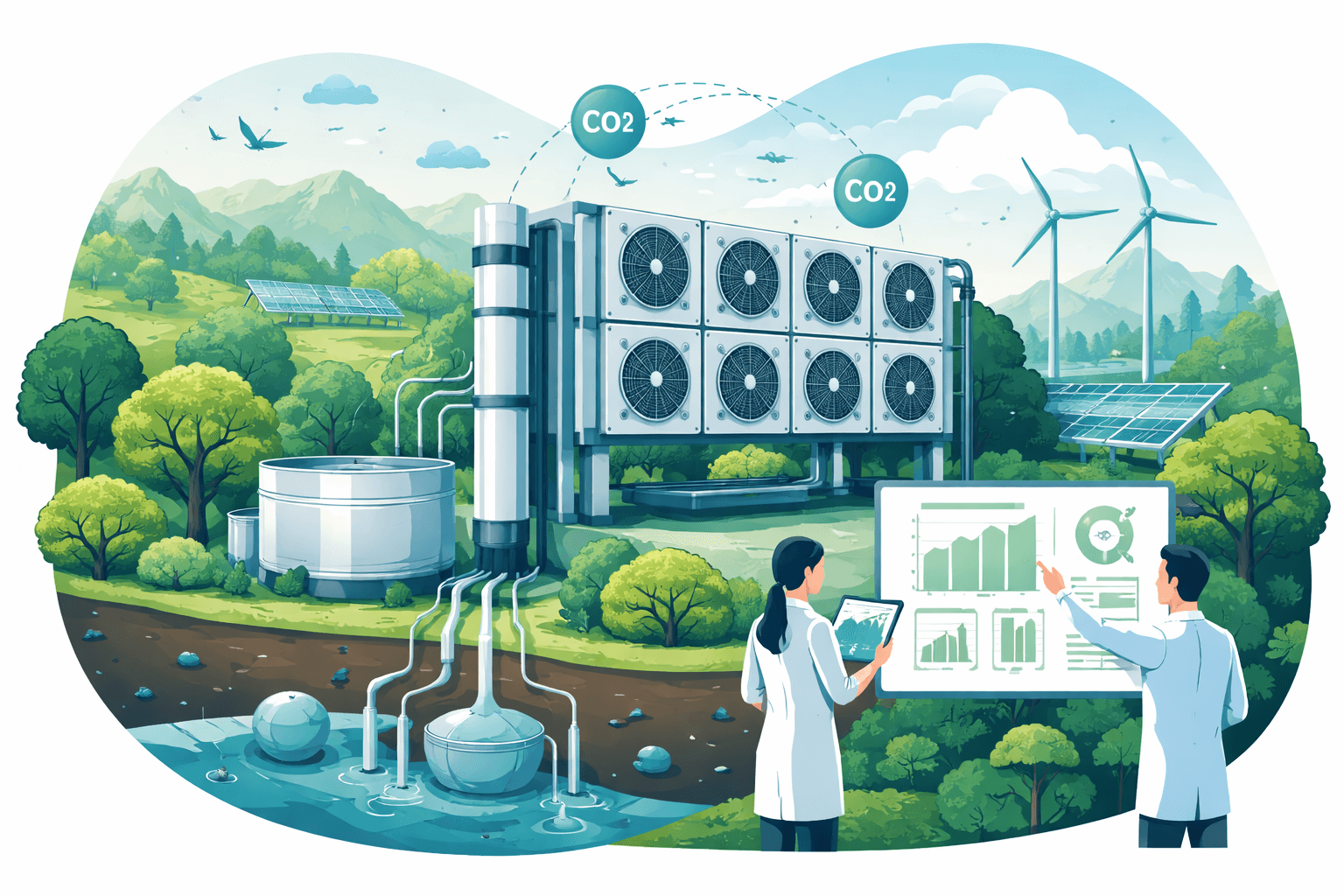
Direct air capture technology is moving from lab benches to large pilot plants, but it remains orders of magnitude from the climate scale some scenarios require. The International Energy Agency (IEA) estimates today’s installed direct air capture (DAC) capacity at only tens of thousands of tons of CO2 per year—roughly 0.01–0.02 MtCO2/yr across a few dozen facilities—compared with more than 36 GtCO2 emitted annually worldwide. Yet in the IEA’s Net Zero Emissions scenario, DAC rises to around 1 GtCO2/yr by 2050. That ambition frames why DAC matters now: it could provide durable carbon removal for hard-to-abate emissions, but only if technology, energy systems, and costs improve substantially.
This explainer unpacks how direct air capture technology works, where it fits in climate strategy, and the technical and economic constraints that will shape its future.
What is direct air capture (DAC)?
Direct air capture removes carbon dioxide directly from ambient air (around 420 parts per million CO2) using engineered systems—fans, contactors, and chemical sorbents or solvents—rather than capturing CO2 at a smokestack. DAC differs from point-source carbon capture and storage (CCS), which targets concentrated flue gases at power plants or industrial facilities. Because the atmosphere is a uniform mixing reservoir over time, CO2 removed anywhere provides a global benefit—provided the CO2 is stored durably (for centuries to millennia) and the process uses low-carbon energy.

Carbon Capture (The MIT Press Essential Knowledge series): Herzog, Howard J.
In this volume in the MIT Press Essential Knowledge series, Howard Herzog offers <strong>a concise guide to carbon capture, covering basic information as well as the larger context of climate technolo
Check Price on AmazonKey attributes:
- Ultra-dilute feedstock: Atmospheric CO2 is ~0.04% of air by volume, so DAC must move and process massive volumes of air.
- Engineered chemistries: Liquid solvents (e.g., alkaline solutions) or solid sorbents (e.g., amine-functionalized materials) selectively bind CO2.
- Durable storage is essential: To qualify as carbon removal, captured CO2 should be stored in deep geologic formations or mineralized into stable carbonates; short-lived uses (e.g., beverages) do not deliver lasting climate benefit.
How direct air capture technology works
At a high level, all DAC systems follow four steps:
- Air contact: Large fans pull ambient air through a contactor where a capture medium binds CO2.
- CO2 release (regeneration): The capture medium is heated or depressurized (or both) to release concentrated CO2.
- Purification and compression: The CO2 stream is dried and compressed to pipeline pressures (generally 80–150 bar) for transport or on-site injection.
- Storage or utilization: CO2 is injected into saline aquifers, depleted oil and gas fields, or reactive rock formations for mineralization; alternatively, it may be used to make e-fuels or materials, with varying permanence.
Two main DAC approaches
Liquid solvent (alkaline) systems: Often based on potassium hydroxide (KOH) solutions that absorb CO2 to form potassium carbonate. A calcium cycle regenerates the KOH: calcium carbonate (CaCO3) is calcined at high temperature (~900 °C) to release pure CO2 and produce calcium oxide (CaO), which is rehydrated and reacted to reform the sorbent. This is the pathway piloted at large scale by Carbon Engineering (now part of Occidental’s 1PointFive). It requires high-temperature heat for calcination.
Solid sorbent systems: Typically use amine-functionalized porous materials (on silica, polymer resins, or metal-organic frameworks) that chemisorb CO2 at ambient temperatures and release it when heated to ~80–120 °C and/or subjected to vacuum. Climeworks and Heirloom (a hybrid mineral looping approach using calcium oxide) are prominent developers. Solid systems generally use lower-temperature heat and more electricity for vacuum and air handling.
Energy needs and process integration
Separating a trace gas from air is energy-intensive. The IEA and U.S. DOE report current DAC systems typically require on the order of 5–10 GJ of heat and 0.5–2 MWh of electricity per ton of CO2 captured, depending on design, ambient conditions, and heat-integration choices. Solvent systems lean toward higher-temperature heat but somewhat lower electricity; solid sorbent systems lean toward low-temperature heat plus more electricity for vacuum and fans.
Because the climate benefit hinges on net removal, the energy supplying DAC must be very low carbon. Developers are pairing DAC with geothermal heat (Climeworks in Iceland), waste heat, dedicated renewables plus high-temperature heat pumps or electrified calciners, and—in some proposals—natural gas with carbon capture on the calciner exhaust. Life-cycle analysis is essential to verify net removal.
From concentrated CO2 to durable storage
After capture, CO2 is:
- Dehydrated and compressed for pipeline transport or on-site injection.
- Injected into deep saline aquifers or basaltic formations where it is trapped structurally, residually, dissolved, and/or mineralized over time. Projects like CarbFix in Iceland accelerate mineralization in reactive basalt, measuring conversion to solid carbonates on timescales of years.
- Monitored using pressure, seismic, and geochemical tools to verify containment (measurement, reporting, and verification—MRV). Global geologic storage capacity is estimated in the thousands of gigatons of CO2, according to the IPCC and the Global CCS Institute, though practical developable capacity depends on permitting, infrastructure, and local geology.
Where DAC fits in climate strategy
Direct air capture technology serves distinct roles within a broader decarbonization portfolio:
- Permanent carbon removal: DAC can deliver high-durability removal (>1,000 years) when paired with geologic storage or in-situ mineralization, unlike many nature-based options whose permanence may be vulnerable to fire or land-use change.
- Balancing hard-to-abate emissions: Aviation, maritime shipping, some industrial process emissions, and dispersed sources may remain even with aggressive mitigation. The IPCC’s 1.5 °C-consistent pathways rely on a portfolio of carbon dioxide removal (CDR), including DAC, to neutralize residuals and, in some scenarios, draw down legacy CO2.
- Feedstock for synthetic fuels and materials: CO2 captured from air can be combined with green hydrogen to produce e-kerosene or methanol. When fuels are burned, the CO2 returns to the atmosphere, so this pathway is carbon-neutral at best, not net-negative, but it can enable low-fossil aviation fuels if powered by clean energy.
Importantly, DAC is not a substitute for rapid emissions cuts. Near-term, the cheapest ton of CO2 is the one not emitted—via efficiency, renewables, electrification, and process innovation. But to reach net-zero and net-negative trajectories, particularly after 2050, most analyses (IEA, IPCC, National Academies) envision a meaningful role for engineered removals alongside nature-based solutions. For a broader mitigation context, see our overview of Climate Change Mitigation Techniques: Practical, Scalable Strategies for Energy, Nature, Policy & Technology.
By the numbers
- 36–37 GtCO2: Annual global CO2 emissions in recent years (Global Carbon Project, 2023–2024).
- ~0.01–0.02 MtCO2/yr: Current global DAC capture across operational plants (IEA, 2023–2024 status).
- ~1 GtCO2/yr: DAC deployment in 2050 in IEA’s Net Zero Emissions scenario; tens of MtCO2/yr by 2030.
- $600–$1,000+ per tCO2: Typical present-day cost ranges reported by developers and assessed by the IEA and DOE for first-of-a-kind DAC; significant uncertainty remains.
- $180/tCO2: U.S. 45Q tax credit for DAC with dedicated geologic storage, as expanded by the Inflation Reduction Act; $130/tCO2 for DAC paired with EOR.
- 5–10 GJ heat + 0.5–2 MWh electricity: Approximate current energy demand per ton CO2, depending on technology and operating conditions (IEA/DOE).

SAF Aranet4 Home: Wireless Indoor Air Quality Monitor ...
View on AmazonFor a deeper look at what drives costs for capture technologies and how DAC compares, see Carbon Capture Technology Costs: What Drives Them and How They Compare.
Benefits of DAC—and why it attracts investment
- Location flexibility: DAC can be sited near storage basins, minimizing CO2 transport, or co-located with clean heat and power sources.
- High-durability removal: When coupled with secure geologic storage, DAC offers quantifiable, meterable removal with robust MRV, appealing to compliance regimes and high-integrity voluntary markets.
- System balancing: As grids decarbonize and sectors electrify, DAC provides an option to counter residual emissions and potentially remove historical CO2 in later decades.
- Industrial learning potential: Chemistries, modularization, and supply chains could unlock cost declines analogous to those seen in renewables if deployment scales.
Limits and challenges
- Energy intensity and clean power needs: At current energy intensities, capturing 1 GtCO2/yr might require hundreds of gigawatts of dedicated clean electricity plus large amounts of low-carbon heat. Powering DAC with fossil energy erodes or negates climate benefits.
- Cost and financing: Today’s costs are hundreds to more than a thousand dollars per ton. The U.S. DOE’s Carbon Negative Shot targets $100/t for durable CDR by 2032—an aggressive goal that presumes major learning and cheap, clean energy.
- Scale and supply chains: Sorbent materials (amines, supports), high-temperature reactors, fans, compressors, and CO2 transport/storage infrastructure must scale dramatically. Sorbent longevity and replacement rates materially affect operating costs.
- MRV and permanence standards: While DAC-to-geology is comparatively measurable, consistent global standards and long-term liability frameworks are still emerging.
- Social license and siting: Large DAC hubs require land, transmission, and CO2 injection wells. Community engagement, environmental justice, and transparent monitoring are essential.
These hurdles argue for a portfolio approach: accelerate least-cost abatement while maturing DAC for the specific roles where it adds the most value. For how DAC fits into the broader innovation landscape, see Innovations in Climate Tech: Breakthroughs, Barriers, and Paths to Scale.
Real-world deployment today
- Climeworks (Iceland): Orca (operational since 2021) is designed to capture ~4,000 tCO2/yr; Mammoth, which began commissioning in 2024, targets up to ~36,000 tCO2/yr. Both use modular solid sorbent units and inject CO2 with CarbFix into basaltic rock, where it mineralizes.
- 1PointFive/Carbon Engineering (U.S.): The “Stratos” plant in Texas aims for 500,000 tCO2/yr using a KOH solvent and high-temperature calcination, with initial operations targeted mid-decade and plans for dedicated saline storage. Large corporate offtakes have been announced to underwrite capacity.
- Heirloom (U.S.): Opened a first-of-a-kind DAC facility in California in 2023 using a mineral looping process with calcium oxide; early deployments demonstrate capture at pilot scale with some CO2 mineralized into concrete via partners.
Beyond these, the IEA tracks more than a hundred announced DAC projects globally at various stages of development, many organized into regional DAC hubs to share CO2 transport and storage infrastructure. In the U.S., the Department of Energy selected initial DAC hubs in Louisiana and Texas in 2023, committing more than $1 billion to catalyze large-scale demonstrations.
Technology details: what determines performance and cost
- Air contactors and pressure drop: Lower pressure drop reduces fan energy but must balance with sufficient contact time for CO2 capture. Contactor geometry and packing materials are key design variables.
- Sorbent/solvent kinetics and stability: Fast CO2 uptake/desorption and resistance to oxidative, thermal, and moisture degradation increase throughput and reduce replacement costs. Sorbent capacity (mol CO2/kg) and cycle life drive capex and opex.
- Heat integration: Using low-grade waste heat, geothermal, or high-temperature heat pumps can cut operating costs and decarbonize regeneration. In solvent systems, electrifying calcination is an R&D frontier.
- Modularization and manufacturing: Factory-built contactors and skids can shorten construction schedules and lower costs through repetition and learning-by-doing.
- System boundaries and LCA: Net removal must subtract all upstream emissions (energy, chemicals, construction) from gross capture. Independent verification underpins high-integrity credits and compliance recognition.
How DAC compares to other removals
- Durability: DAC with geologic storage is among the highest-durability options (>1,000 years), similar to bioenergy with carbon capture and storage (BECCS) and in-situ mineralization.
- Land and water: DAC’s physical footprint can be modest for the plant itself, but supplying dedicated renewable power and heat increases land needs offsite. Water needs vary by process and climate; some designs can be net-water-neutral, while others require makeup water.
- Cost trajectory: Near-term DAC is costlier than many nature-based removals but may benefit from stronger learning curves and is less exposed to land-use and permanence risks. Policy support and procurement can bridge early gaps. For cross-technology cost drivers, see Carbon Capture Technology Costs: What Drives Them and How They Compare.
Policy, markets, and MRV—shaping the path to scale
- Policy incentives: The U.S. 45Q credit, state procurement, and DOE grants (DAC Hubs) have catalyzed the first commercial plants. The EU is developing accounting rules for carbon removals and considering targets for industrial carbon management. The UK is creating business models (contracts for difference) for engineered removals.
- Corporate demand: Long-term offtake agreements from companies pursuing net-zero targets (e.g., tech, aviation) are underpinning financing. Consortia such as Frontier have committed hundreds of millions of dollars to early CDR purchases to spur learning.
- Standards and registries: Emerging protocols focus on net removal, durability, leakage risk, and monitoring with conservative accounting. DAC-to-fuel pathways should be clearly distinguished from DAC-to-storage in crediting frameworks.
What needs to improve for meaningful DAC scale
- Cheaper, cleaner heat: Decarbonized high-temperature heat (electrified calciners, advanced heat pumps, geothermal, clean hydrogen) is pivotal for both solvent and solid systems.
- Materials innovation: More durable, higher-capacity sorbents; cheaper alkaline cycles; reduced degradation from oxygen and moisture; recyclable supports.
- System efficiency: Lower pressure drop, better heat recovery, optimized cycle times, and integrated compression can cut energy per ton.
- Manufacturing scale: Gigafactory-style production of contactors, skids, and calciners can drive down capex via standardization.
- Storage buildout: Streamlined permitting for Class VI wells (U.S.), robust MRV, community benefits, and regional CO2 pipeline networks.
- Demand signals: Public procurement of durable removals, compliance markets, and floor-price contracts can derisk first-of-a-kind projects and enable bankable financing.
Practical implications
- For policymakers: Target incentives at durable DAC-to-storage, ensure life-cycle accounting, and pair support with rapid grid decarbonization and storage permitting reform. Consider portfolio standards for high-durability removals.
- For businesses: Treat DAC as part of a long-term net-zero strategy for hard-to-abate residuals. Near term, prioritize deep emissions cuts and energy efficiency; evaluate DAC offtakes for additionality, durability, and MRV integrity. Our overview of Using Technology for Environmental Protection: Tools, Impacts, and Practical Guidance provides broader context on technology choices.
- For investors and developers: Focus on unit manufacturability, reliable low-carbon heat/electricity contracts, and co-location with storage to minimize transport risk; diligence sorbent lifetimes and replacement curves.
Outlook: credible role, contingent on rapid learning
Direct air capture technology is no silver bullet, but it can be a critical tool if it achieves substantial cost and energy-intensity reductions while the grid decarbonizes. The technical pathways are clear: better sorbents and solvents, smarter thermal integration, standardized modules, and rapid buildout of secure storage. The policy scaffolding is emerging, and early corporate demand is testing the market. The unanswered question is speed: can DAC move from kilotons to megatons this decade, setting up a credible path to hundreds of megatons by the 2040s? If the answer is yes, DAC will help society finish the job after the bulk of emissions cuts—providing the durable, verifiable carbon removal needed to close the final gap to net-zero and beyond.
Recommended Products
Carbon Capture (The MIT Press Essential Knowledge series): Herzog, Howard J.
In this volume in the MIT Press Essential Knowledge series, Howard Herzog offers <strong>a concise guide to carbon capture, covering basic information as well as the larger context of climate technolo
SAF Aranet4 Home: Wireless Indoor Air Quality Monitor ...
Shop portable air quality testers featuring CO2 detection, temperature monitoring, and humidity tracking for healthier indoor spaces.
More in AI & Technology
- Carbon Capture Technology Costs: What Drives Them and How They Compare
- Innovations in Climate Tech: Breakthroughs, Barriers, and Paths to Scale
- Strategies to Offset Your Carbon Footprint: Practical, Credible Approaches for Individuals and Businesses
- Climate Change Mitigation Techniques: Practical, Scalable Strategies for Energy, Nature, Policy & Technology