
What Happens to Solar Panels at End of Life? Recycling, Reuse & Disposal
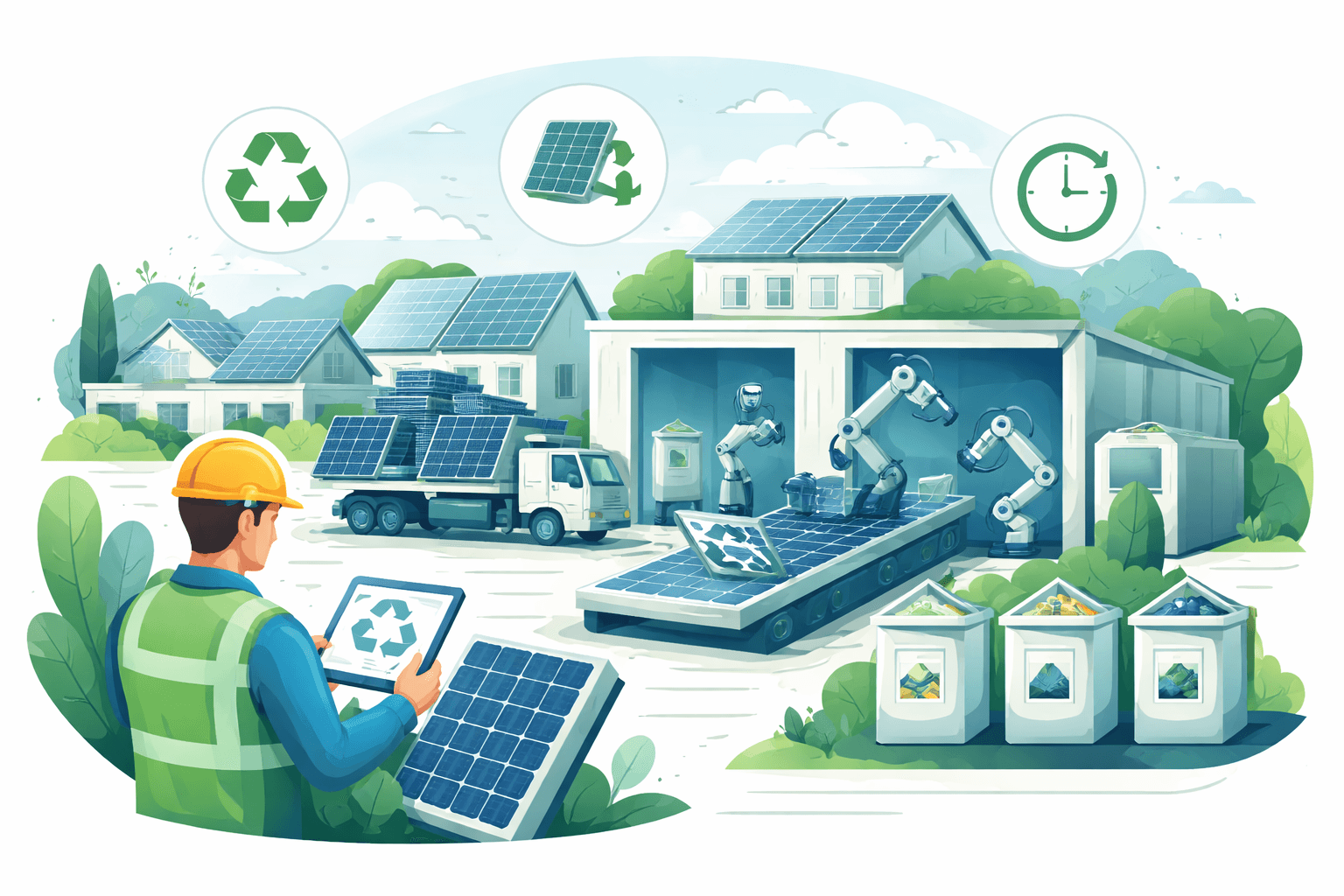
Global solar capacity has crossed the terawatt threshold—IRENA estimates cumulative PV surpassed 1.6 TW in 2025—bringing clean power to grids and rooftops worldwide. As installations from the 2000s and early 2010s age, many readers are asking what happens to solar panels at end of life. The short answer: a growing mix of reuse, repair, and increasingly sophisticated recycling is replacing disposal, driven by regulations and economics. This guide walks through lifespans, decommissioning, recycling technologies, second-life options, environmental risks, policy frameworks, costs, and practical steps.
If you want a refresher on how modules are built and what’s inside them, see How Do Solar Panels Work? A Clear, Data-Driven Guide (/renewable-energy/how-do-solar-panels-work-guide).
By the numbers: PV end-of-life in context
- 1.6+ TW: Estimated global cumulative PV capacity by 2025 (IRENA)
- 60–78 million metric tons: Cumulative global PV waste projected by 2050 (IRENA/IEA-PVPS)
- 25–40 years: Typical service life in the field, depending on environment and maintenance (NREL, IEA-PVPS)
- ~0.5%/year: Median performance degradation rate across module vintages; best modern modules show ~0.2–0.3%/year (NREL meta-analyses)
- 75–80%: Share of a standard crystalline silicon (c‑Si) module by weight that is glass; aluminum frames add ~6–10% (IEA-PVPS Task 12)
90% by mass: Recovery potential for glass and aluminum with mature processes (EU WEEE, PV CYCLE)
90%: Share of semiconductor and glass recovered in First Solar’s thin-film (CdTe) closed-loop process (First Solar sustainability reports)
- $12–$25: Typical fee to recycle a c‑Si panel in the U.S., excluding transport (SEIA/NREL)
- $1–$5: Typical landfill disposal fee per panel in the U.S. (NREL), not including transport or hazardous classification where applicable
- $2.7B in 2030 → $80B in 2050: Potential global value of recovered PV materials as volumes scale and silver/silicon are recaptured (Rystad Energy)
Handbook of Photovoltaic Science and Engineering: Luque, Antonio, Hegedus, Steven
by Antonio Luque (Editor), Steven Hegedus (Editor) See all formats and editions · Handbook of Photovoltaic Science and Engineering <strong>incorporates the most recent technological advances and resea
Check Price on AmazonWhat happens to solar panels at end of life?
End of life is rarely a single moment. Most modules don’t fail catastrophically; they slowly lose output or are replaced early during “repowering” projects. At end of life, panels typically follow one of four paths, often in sequence: assessment and potential repair; reuse in a second application; materials recycling; or, if no better option is feasible, disposal. Increasingly, policy pushes the system toward reuse and recycling to keep materials in circulation.
1) How long do solar panels last? Typical lifespans and performance degradation
- Warranties vs. real-world life: Standard product warranties cover 10–15 years against defects; performance warranties typically guarantee 80–92% of rated output after 25–30 years. Field studies from NREL and IEA-PVPS show many c‑Si modules remain in service 30+ years, especially in temperate climates.
- Degradation rates: NREL’s large-scale meta-analysis finds a median degradation rate of ~0.5% per year across vintages and technologies, with modern mono PERC, TOPCon, and heterojunction modules increasingly clustering around ~0.2–0.4%/year under standard test conditions. Degradation mechanisms include light-induced degradation (LID), potential-induced degradation (PID), UV and thermal stress on encapsulants, and moisture ingress.
- Climate and maintenance matter: Hot, humid, or high-UV environments accelerate wear. Proactive upkeep—such as periodic inspections and cleaning where soiling is severe—helps preserve output. See Solar Panel Maintenance Tips: Maximize Output & Lifespan (/renewable-energy/solar-panel-maintenance-tips) for a data-driven upkeep checklist.
- Technology trajectory: New backsheets, bifacial glass-glass laminates, and better cell passivation improve durability. For a deeper look at materials and cell architectures that influence lifetime, see Solar Panel Technology in 2026: A Complete Guide to Modern Photovoltaics (/renewable-energy/solar-panel-technology-2026-complete-guide).
2) Decommissioning: removal, transport, and safety considerations
Removing PV safely is non-trivial because modules generate electricity whenever illuminated.
- Make it electrically safe: Follow NFPA 70 (NEC) and site lockout/tagout procedures. De-energize combiner boxes, isolate inverters, and cover modules or disconnect strings to eliminate open-circuit voltage exposure. Even a small residential string can exceed 300–600 VDC in sunlight.
- Protect workers and equipment: Use PPE for glass handling; cracked modules can shed shards and expose sharp edges. Avoid flexing frames to prevent microcracks. For rooftop arrays, ensure fall protection and verify structural loads during staging.
- Document condition: Record serial numbers and take photos. I–V curve traces or electroluminescence (EL) imaging help decide if modules are suitable for resale, refurbishment, or should go straight to recycling.
- Package for purpose: Intact, reusable modules should be palletized with corner protectors and interleaf to prevent abrasion. End-of-life or broken modules destined for recycling need secure packaging to contain glass and prevent further breakage during transport.
- Transport: In most jurisdictions, intact PV is shipped as general freight. Broken modules may be handled as electronic waste; if classified hazardous under local rules, they must go to appropriate facilities. Carriers may require special declarations for damaged goods.
3) Recycling: processes, materials recovered, and current recovery rates
Most installed PV is crystalline silicon (roughly 90–95% of the market), with the rest being thin-film (e.g., cadmium telluride, amorphous silicon, CIGS). Recycling flows differ by type.
Crystalline silicon (c‑Si) modules
- Disassembly: Remove the aluminum frame and copper-containing junction box; these high-value fractions can be directly recycled. Frames alone can account for ~6–10% of module mass and are easily >95% recyclable.
- Delamination: The glass–cell–backsheet laminate is the main challenge. Approaches include mechanical shredding and separation; thermal delamination (pyrolysis at ~450–600°C) to burn off encapsulants like EVA; and solvent-based or supercritical fluid processes to separate layers without damaging cells.
- Material recovery: Mature lines recover glass (often as cullet for container glass or insulation), aluminum, copper, and sometimes silicon wafers and silver. Typical mass recovery focused on glass and aluminum exceeds 80–90% by weight. Advanced “high-value” recycling adds hydrometallurgy to leach and refine silver and copper and can reclaim silicon for re-melting or feedstock, with pilot lines in Europe reporting silver and copper purity >99% and silicon reuse after reconditioning.
- Quality of outputs: Recovered glass often downgrades to lower-spec uses unless delamination preserves sheet glass quality. Emerging processes aim to keep glass in flat-glass markets and to maintain higher-value silver and silicon streams, which drive profitability.
Thin-film modules (e.g., CdTe)
- Closed-loop recovery: Leading CdTe manufacturers operate dedicated facilities that crush, separate lamination materials, and use chemical baths to liberate and refine cadmium and tellurium, along with glass. Producer-reported data indicate recovery of >90% of the semiconductor and ~90% of the glass by weight, which is then reintroduced into new modules.
Current performance and scaling
- EU WEEE-compliant processes often achieve overall recovery rates by mass above 80–90% for c‑Si modules (dominated by glass and aluminum). High-value metal recovery is improving but not yet universal. PV CYCLE and several European plants have demonstrated dedicated PV lines with significantly higher recovery rates for silver and silicon than generic e‑waste facilities.
- Economics are evolving: As volumes grow and silver content in older modules becomes accessible, analysts expect recycling revenue to rise. Rystad Energy projects recovered-PV materials reaching ~$2.7 billion of value in 2030 and ~$80 billion by 2050, assuming improvements in silver and silicon recovery.
4) Second-life options: reuse, repowering, and battery pairing
- Reuse markets: Many modules retired from utility or commercial sites still produce 80–90% of nameplate power. After test-and-grade (I–V tracing, insulation resistance, visual inspection), they can be resold for off-grid, agricultural, or community applications. Quality assurance is critical; reputable refurbishers provide graded output, serial traceability, and limited warranties.
- Repowering: Developers replace 10–15-year-old 200–300 W modules with higher-efficiency 450–600 W modules on the same racking footprint, boosting capacity and improving inverter loading. Decommissioned modules are candidates for reuse or recycling depending on condition and PPA or interconnection constraints.
- Battery pairing to extend utility: For aging residential systems, adding storage or smart inverters can improve self-consumption and maintain economic value even as panels lose a few percent of output. While not strictly an end-of-life pathway, these upgrades can defer replacement by years, reducing waste and lifecycle emissions.
Victron Energy SmartSolar MPPT Solar Charge Controller ...
View on Amazon5) Landfill and environmental risks: hazardous materials and contaminant concerns
- What’s in a module: c‑Si modules are mostly glass, aluminum, copper, silver, silicon, and polymers. Some older modules use lead-based solder; backsheets are often fluoropolymers (PVF/PVDF). Thin-film CdTe modules contain cadmium and tellurium in a stable compound matrix.
- Leaching risk: Studies referenced by the U.S. EPA and IEA-PVPS show many intact c‑Si modules pass TCLP (Toxicity Characteristic Leaching Procedure) thresholds, meaning they do not classify as hazardous waste. Breakage and prolonged exposure to acidic leachates can increase lead release from older soldered joints. Most modern lined landfills greatly reduce off-site contamination risk, but disposal still forfeits valuable materials and can generate fluorinated emissions if backsheets are incinerated for energy recovery.
- Thin-film stability: Manufacturer and third-party testing indicate CdTe is chemically stable as a compound in landfills, with very low leachability compared to elemental cadmium. Nevertheless, dedicated recycling is strongly preferred to avoid cumulative heavy metal disposal and to recover scarce tellurium.
- The bigger risk is lost value: From a circular-economy perspective, landfilling strands aluminum, silver, copper, and high-quality glass—materials with substantial embedded energy and emissions from original production.
6) Regulations and programs: EPR, take-back schemes, and global differences
- European Union: PV modules fall under the WEEE Directive, making producers responsible for collection and recycling (extended producer responsibility, EPR). Targets require high collection and recovery rates, and most manufacturers fund compliance schemes such as PV CYCLE. France applies eco-modulated fees that reward more recyclable designs.
- United States: There is no federal EPR for PV. A patchwork is emerging:
- Washington State adopted a PV module stewardship and take-back requirement for manufacturers (program rollout began mid-2020s).
- California classifies PV as universal waste, simplifying handling and enabling more recycling pathways while maintaining environmental safeguards.
- New Jersey has directed state agencies to develop a statewide PV recycling program. Several other states are studying EPR or have issued guidance for decommissioning plans in utility-scale permits.
- Industry initiatives like the Solar Energy Industries Association (SEIA) National PV Recycling Program pre-qualify recyclers and provide aggregation logistics.
- Japan and South Korea: National guidelines promote reuse and recycling; South Korea operates a government-backed PV recycling center and is exploring mandatory recovery targets.
- India: The 2022 E‑Waste (Management) Rules brought PV modules and cells under EPR obligations, phasing in collection and recycling requirements for producers.
- Australia: Several states have banned PV from landfills or set e-waste restrictions; a national product stewardship scheme for solar is advancing, with industry-led programs piloting aggregation and recycling.
7) Costs, market barriers, and incentives driving end-of-life solutions
- Today’s cost reality: In the U.S., typical c‑Si panel recycling fees run ~$12–$25 per module, excluding shipping; landfill tipping fees are often $1–$5 per module (NREL, SEIA). Hazardous classification, where applicable, drives fees much higher and limits destination facilities. Transport can exceed processing costs due to weight and breakage risk.
- Why recycling isn’t universal yet: Commodity prices, throughput scale, and process choices determine economics. “Baseline” recycling that captures only aluminum and glass yields low revenue. The real value sits in silver and high-purity silicon—small fractions by mass but large by value—requiring higher-tech processes.
- Market signals improving: Projected waste volumes (IRENA’s 60–78 Mt by 2050) justify investment in dedicated lines. Analysts expect recovered materials to displace part of virgin demand; Rystad projects value hitting ~$80B by 2050. Producer EPR fees in the EU internalize end-of-life costs, making circular designs and take-back the default.
- Design for recycling: Screwed, not glued, frames; reversible encapsulants; backsheets without fluoropolymers; and standardized module bills of materials can cut process energy and raise recovery quality. Some European firms already market modules with easier delamination.
- Policy levers that work: Landfill bans for PV, eco-modulated EPR fees, minimum recycled-content targets, and procurement standards (e.g., EPEAT, public tenders) help flip the economics. Research funding—by the EU, U.S. DOE/NREL, and national labs—continues to reduce the cost of silver and silicon recovery.
8) What homeowners and businesses should do: step-by-step checklist and resources
Homeowners
- Check your warranty and installer contract: Many panel failures are covered for 10–15 years (product) and 25–30 years (performance). Contact the manufacturer or installer first.
- Assess condition: Request an inspection. A licensed electrician or solar technician can test strings, identify hot spots, and confirm if a single component (e.g., optimizer, inverter) is at fault rather than the module.
- Decide on path: If panels still produce well, consider leaving them in place or relocating them within your property. If replacement is planned, evaluate reuse against recycling.
- Prepare for safe removal: Ensure your contractor follows NEC de-energizing and uses proper PPE. Ask them to keep modules intact if reuse is likely.
- Choose a reputable outlet:
- Reuse: Ask refurbishers for testing documentation and a graded output report.
- Recycling: Ask your installer to use a SEIA-qualified recycler (U.S.) or WEEE-compliant scheme (EU). Request a certificate of recycling or destruction.
- Keep records: Save serial numbers, chain-of-custody, and any certificates; these can matter for home sales or incentives.
- Think life extension: If your system is healthy but underperforming due to dirt or shading, start with upkeep. See Solar Panel Maintenance Tips (/renewable-energy/solar-panel-maintenance-tips).

FLIR C5 Compact Thermal Imaging Camera with Wifi: ...
View on AmazonBusinesses and project owners
- Start early: Include end-of-life plans in procurement and O&M—define reuse, recycling preference, and reporting. For ground-mount sites, verify decommissioning bonds and local requirements.
- Inventory and test: Serial-level inventories and EL/I–V sampling support triage into reuse vs. recycling streams and improve resale value.
- Engage take-back programs: In the EU, enroll with your producer’s WEEE scheme. In the U.S., use SEIA’s program to pre-qualify recyclers and consolidate volumes.
- Specify outcomes: In contracts, favor high-value recycling that recovers silver/silicon where feasible. Require mass-balance reporting on recovered materials.
- Optimize logistics: Consolidate pallets near sites to reduce truck rolls. Protect intact panels to avoid downgrading to “broken glass” streams.
- Track ESG impacts: Report avoided landfill, recovered material tonnage, and Scope 3 emissions benefits. Many lenders and offtakers increasingly favor projects with documented circularity.
Practical implications for consumers, businesses, and policymakers
- Consumers: Most homeowners will face one or two replacement decisions over a system’s lifetime. Warranty claims, reuse where appropriate, and reputable recycling are practical, affordable options—especially as local aggregation improves.
- Businesses: Proactive EOL planning reduces risk and cost. Repowering can materially increase site output; recovered or resold modules offset decommissioning costs.
- Policymakers: EPR, landfill restrictions, and grants for high-value recycling plants accelerate circularity and reduce future cleanup liabilities while creating local jobs.
Where the technology and policy are heading
- High-value recovery at scale: Expect more dedicated PV recycling plants that preserve sheet glass, recover >90% of silver, and return solar-grade silicon to ingot casting. Public research (NREL, Fraunhofer ISE) and private startups are closing the cost gap with process intensification and solvent recovery.
- Smarter design: Module bills of materials are moving toward easier delamination and non-fluorinated backsheets, with digital product passports enabling fast identification of materials for recycling.
- Rising reuse quality: Better grading standards, UL/IEC retesting protocols for refurbished modules, and performance-based resales will make second-life more bankable for community projects.
- Policy convergence: The EU’s WEEE model and eco-modulation are influencing programs in Asia-Pacific and U.S. states. As volumes climb in the 2030s, more jurisdictions are likely to require take-back and minimum recovery standards.
For readers exploring the front end of the lifecycle—how modules are built and which designs last longer—see Solar Panel Technology in 2026: A Complete Guide (/renewable-energy/solar-panel-technology-2026-complete-guide). If you’re still deciding whether to install solar and want a primer on how PV converts light to power, start with How Do Solar Panels Work? (/renewable-energy/how-do-solar-panels-work-guide)
The bottom line: As deployments soar, the answer to what happens to solar panels at end of life is quickly shifting. What was once mostly disposal is becoming a circular materials system—reuse first, then high-value recycling—underpinned by better design, smarter policy, and economies of scale that keep valuable metals and glass in the clean energy economy.
Recommended Products
Handbook of Photovoltaic Science and Engineering: Luque, Antonio, Hegedus, Steven
by Antonio Luque (Editor), Steven Hegedus (Editor) See all formats and editions · Handbook of Photovoltaic Science and Engineering <strong>incorporates the most recent technological advances and resea
Victron Energy SmartSolar MPPT Solar Charge Controller ...
Mppt · 30 Amp · Lifepo4 · 100 Amp · Bluetooth · 48v · Wifi · Victron · Pwm See more · Eligible for Free Shipping · Free Shipping by Amazon · Get FREE Shipping on eligible orders shipped by Amazon · De
FLIR C5 Compact Thermal Imaging Camera with Wifi: ...
<strong>One - Thermal Imaging Camera for iOS Smartphones (iPhone 15 and Newer w/USB-C), 240x180 Super Resolution (80x60 Native IR)</strong> · One - Thermal Imaging Camera for Android Smartphones (USB-