
Solar in Michigan: Costs, Incentives & Top Installers (2026)
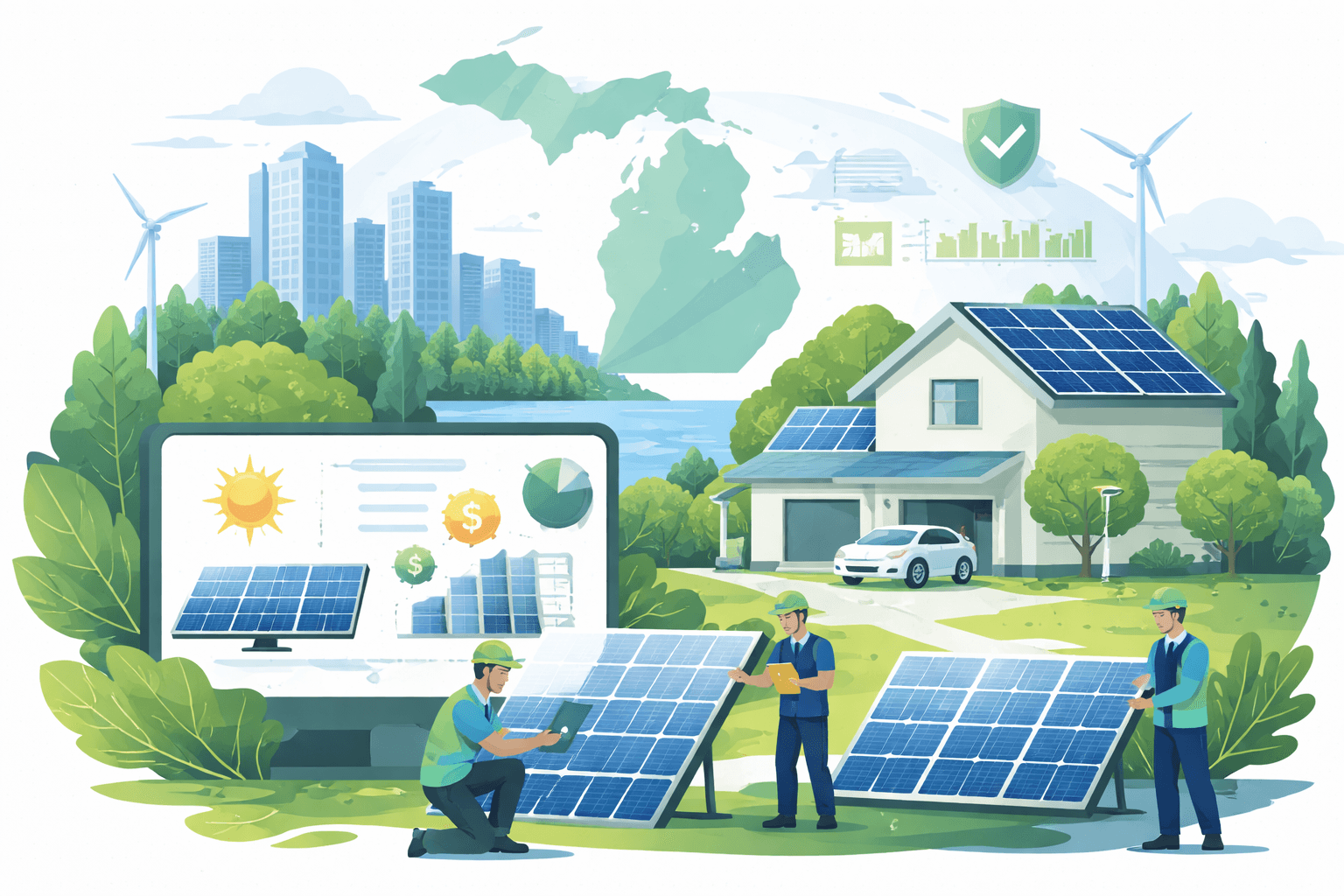
Michigan homeowners are asking whether solar in Michigan pencils out under the state’s current rules. The short answer: yes, for many rooftops — especially with the 30% federal tax credit in place — but the math hinges on your utility’s credit rate for exported power. With average residential electricity at roughly 18–20¢/kWh in 2023 (U.S. EIA), modern panels, and smart system design, typical payback times land around 10–13 years.
By the numbers: Michigan solar at a glance
- Peak sun hours (annual average): ~3.5–4.0 per day (NREL PV resource)
- Typical residential capacity factor: 14–18% (NREL modeling for Midwest rooftops)
- Installed cost (before incentives): $2.50–$3.30 per watt for turnkey residential systems (LBNL “Tracking the Sun” + Midwest market data)
- Federal tax credit (ITC): 30% through 2032 (Inflation Reduction Act; IRS Form 5695)
- Export credit under Michigan’s Distributed Generation (DG) program: typically ~7–10¢/kWh, utility-specific (MPSC approved tariffs)
- Typical system size: 7–10 kW
- Expected annual production for a 7 kW system: ~7,500–9,000 kWh (NREL PVWatts)
- Typical simple payback: ~10–13 years (assumes retail self-consumption + DG export credit)
Solar Electricity Handbook - 2023 Edition: A simple, practical guide to solar energy – designing and installing solar photovoltaic systems: Boxwell, Michael
Solar Electricity Handbook - 2023 Edition: <strong>A simple, practical guide to solar energy – designing and installing solar photovoltaic systems</strong> [Boxwell, Michael] on Amazon.com. *FREE* shi
Check Price on AmazonSolar energy potential in Michigan: sun hours, irradiance, and climate factors
Michigan sits squarely in the U.S. Midwest solar belt. While it doesn’t match the Southwest, the state’s annual global horizontal irradiance averages around 3.5–4.2 kWh/m²/day, translating to roughly 3.5–4.0 peak sun hours per day. NREL’s PVWatts modeling for cities like Detroit, Grand Rapids, and Traverse City typically yields 1,050–1,300 kWh of annual energy per installed kilowatt for a south-facing array at a 25–35° tilt.
Cold weather helps. Photovoltaic (PV) modules are more efficient at lower temperatures, so Michigan’s cool, sunny spring and fall days often deliver strong output. Snow matters, but less than many expect. Studies in northern states find annual production losses from snow cover commonly in the 1–5% range when arrays are tilted 25°+ and racking allows snow to shed. Designing for Michigan’s heavier snow loads (structural calculations, higher tilt, and adequate row spacing) is standard practice.
Shading is the bigger risk. Dormers, chimneys, and trees can clip winter sun at low angles. Module-level power electronics — microinverters or DC optimizers — typically reduce shade losses 5–25% versus string-inverter-only designs, with the added benefit of panel-level monitoring.
For regional context on similar climates and markets, see our neighboring state deep-dives: Solar in Illinois: Costs, Incentives & Top Installers (2026) and Solar in Indiana: Costs, Incentives & Top Installers (2026).
Solar in Michigan: costs and price-per-watt breakdown
Price-per-watt (PPW) is the cleanest way to compare quotes. In 2025–2026, competitive turnkey pricing for residential solar in Michigan generally falls between $2.50 and $3.30 per watt before incentives, depending on equipment, roof complexity, and installer scale. That implies:
- 6 kW system: $15,000–$19,800 before incentives; $10,500–$13,860 after the 30% federal ITC
- 8 kW system: $20,000–$26,400 before; $14,000–$18,480 after ITC
- 10 kW system: $25,000–$33,000 before; $17,500–$23,100 after ITC
What drives the range?
- Equipment tier: Premium panels (higher efficiency, better warranties) and microinverters carry a premium of 10–25¢/W versus standard gear.
- Roof factors: Steeper pitches, multiple planes, or re-roofing add labor and balance-of-system costs.
- Permitting/engineering: Michigan’s snow and wind loading can require additional structural review in some jurisdictions.
- Supply chain and labor: Prices eased from 2022 highs as polysilicon and freight costs dropped, but local labor rates and demand still matter.
To stretch value in Michigan’s winter-light conditions, many homeowners pick high-efficiency, half-cut, n-type modules paired with module-level power electronics. Based on current efficiency ratings and dependable warranties, the REC Alpha Pure-R or Qcells Q.TRON represent strong value for residential installations.
Michigan solar incentives: state tax credits, rebates, net metering, and SRECs
Michigan’s incentive landscape is straightforward — and different from classic “net metering” states.
- State income tax credits: None. As of 2026, Michigan does not offer a statewide personal income tax credit for residential solar (DSIRE; Michigan state tax code).
- Sales tax exemption: Michigan does not provide a uniform statewide sales tax exemption for residential PV equipment.
- Property tax: Treatment of PV in property assessments can vary by jurisdiction. Some local assessors consider solar as a normal home improvement; others apply limited or no added assessment depending on use. Check with your county assessor before you sign. DSIRE maintains current policy summaries for Michigan.
- Utility rebates: Utility-run solar rebates are not common in Michigan. Periodic pilots may appear (e.g., low-income programs or solar-plus-storage resilience pilots), but availability is limited and often capped.
- Net metering: Closed to new customers. Michigan replaced traditional retail-rate net metering with the Distributed Generation (DG) “inflow/outflow” program in 2019 under Michigan Public Service Commission (MPSC) orders. New residential systems interconnect under DG.
- DG inflow/outflow credits: You buy all electricity you consume at your standard retail rate (inflow). Any excess you export is credited at a utility-specific outflow rate based on power supply costs or locational marginal prices — commonly around 7–10¢/kWh. Credits roll over month to month and reduce your bill, but they generally don’t match full retail value. This structure makes right-sizing your array for on-site consumption more valuable than oversizing for large exports.
- SRECs: Michigan does not operate a statewide, tradable Solar Renewable Energy Certificate (SREC) program for residential customers. Some utilities procure renewable energy credits (RECs) to meet portfolio requirements, but there is no common consumer SREC marketplace akin to states like New Jersey.
- Financing support: Michigan Saves — the state’s green bank — regularly partners with lenders to offer low-interest financing for home energy projects, including solar and batteries. While not a rebate, cheaper financing can materially improve cash flow.
Bottom line: The most important “incentives” for solar in Michigan are the 30% federal ITC and your utility’s outflow credit rate under DG.
The federal ITC and how it applies to Michigan homeowners
The federal Residential Clean Energy Credit — commonly called the Investment Tax Credit (ITC) — covers 30% of qualified project costs for systems placed in service through 2032 (Inflation Reduction Act; IRS). Eligible costs include:
- Solar panels, inverters, racking, wiring, balance-of-system
- Energy storage batteries (stand-alone or paired with solar) of 3 kWh or greater
- Roof work strictly necessary for the solar installation (e.g., structural upgrades for mounting), but not a full elective re-roof
- Permitting, engineering, and labor
Key points for Michigan filers:
- It’s a credit, not a deduction: It directly reduces your federal income tax liability. If your credit exceeds your tax bill, the unused amount can typically carry forward to future years (see IRS Form 5695 instructions; consult a tax professional).
- No cap: There is no dollar cap on the 30% credit.
- Batteries qualify: Storage can substantially increase self-consumption and reduce winter evening grid imports. The 30% credit applies to eligible batteries whether or not they’re charged exclusively from solar.
Given Michigan’s DG outflow structure, pairing solar with storage can improve economics on some rate plans by time-shifting solar into evening peaks and minimizing low-value exports. The Enphase IQ Battery or a Tesla Powerwall are widely used systems; compare usable capacity, round-trip efficiency, and warranty cycle life to pick the right fit.
Best solar installers and companies serving Michigan
The best installer is one with proven workmanship, responsive service, and a track record navigating Michigan’s DG interconnection and winterized design. Evaluate companies using these criteria:
- NABCEP certifications and Michigan electrical licensing
- At least 3–5 years of in-state installation history and verifiable references
- Clear production estimates using NREL PVWatts or equivalent modeling with shading analysis
- Snow load and wind engineering stamped by a Michigan PE when required
- Robust warranties: workmanship (10+ years), roof penetration (10+), equipment (25-year panel performance; 10–25-year inverter)
- Transparent DG interconnection handling (application, meter swap, and PTO timeline)
Local and regional installers to research (verify current service areas in 2026):
- Michigan Solar Solutions (SE Michigan; residential and commercial)
- Strawberry Solar (Detroit-area residential)
- The Green Panel (statewide focus; residential/commercial)
- CBS Solar (northwest Lower Peninsula)
- Harvest Solar (southern Michigan; agricultural/commercial with residential in some areas)
- Peninsula Solar (Upper Peninsula; off-grid and grid-tied)
National providers may also serve parts of Michigan, sometimes via certified dealer networks. Whether you choose local or national, insist on site-specific shade measurements, a module-level rapid-shutdown solution compliant with current NEC, and a written escalation path for service.
Equipment picks for Michigan roofs
- Panels: High-efficiency n-type modules with strong cold-weather performance. The REC Alpha Pure-R and Qcells Q.TRON combine competitive efficiency with reputable long-term warranties.
- Inverters: Module-level power electronics help with winter shade and snow partial-coverage. Enphase IQ8 Microinverters or DC optimizers paired with a SolarEdge inverter are common choices in the region.
ROI and payback period for solar in Michigan
Because DG outflow credits pay less than retail rates, Michigan homeowners maximize savings when they consume more of their solar on-site. A battery can help, but even without storage, daytime loads like EV charging, heat pump water heating, and smart thermostats can increase self-consumption.
Illustrative 7 kW rooftop system
- Installed cost at $2.90/W: $20,300
- Federal ITC (30%): −$6,090
- Net upfront after ITC: $14,210
- Annual production (PVWatts, south-facing, mild shade): ~8,050 kWh
- Self-consumption share: 65–75% typical without storage; assume 70% (5,635 kWh)
- Retail rate for self-consumed energy: $0.19/kWh (EIA MI avg 2023)
- Exported share: 30% (2,415 kWh) credited at $0.08/kWh (illustrative DG outflow)
Annual bill reduction
- Retail-offset savings: 5,635 kWh × $0.19 = $1,071
- Export credits: 2,415 kWh × $0.08 = $193
- Total first-year savings: ~$1,264
Simple payback: $14,210 / $1,264 ≈ 11.2 years
Sensitivity
- Higher self-consumption (e.g., with a battery or shifting loads): faster payback
- Higher utility rates or faster rate escalation: faster payback
- Lower outflow rates or heavy shading: slower payback
- Adding a battery: increases cost but can improve bill savings on time-of-use (TOU) rates and provides backup for outages
Non-financial value
- Emissions: Michigan’s grid carbon intensity varies by region and season, but a typical 8,000 kWh/year of solar can avoid roughly 3–5 metric tons of CO₂ annually (EPA eGRID regional factors), equivalent to the tailpipe emissions of ~700–1,200 gallons of gasoline.
- Resilience: Storm-related outages are a recurring risk. A solar-plus-battery system can keep critical loads running — sump pumps, refrigeration, communications — even during multi-day events.
Michigan-specific permitting, HOA rules, and interconnection process
Permitting is local in Michigan, with building and electrical permits issued by city or township authorities. Expect:
- Structural review: Roofs must meet local snow and wind load requirements; engineers may provide stamped calculations.
- Electrical: NEC-compliant rapid shutdown and proper labeling are required; most residential systems use UL 1741-listed inverters and adhere to IEEE 1547 interconnection standards.
- Timeline: 2–8 weeks from contract to install is common, depending on jurisdictional permit queues and utility availability for meter work; busy seasons can run longer.
HOAs and solar rights
- Michigan does not have a strong, statewide “solar rights” statute that universally limits HOA restrictions. Many HOAs require design approval and can set reasonable placement guidelines. To reduce friction, propose designs that preserve street-facing aesthetics (where feasible) and provide data on low-glare modules and flush racking.
Interconnection under Michigan’s DG program
- Program: Michigan’s DG (Distributed Generation) replaced net metering in 2019 via MPSC orders. Customers take service under a DG tariff with “inflow/outflow” billing.
- Sizing: Residential systems are typically allowed up to a percentage of the customer’s annual usage; utilities also use category thresholds (e.g., Category 1 up to 20 kW; Category 2 >20 kW up to 150 kW). Check your utility’s latest DG tariff and caps.
- Caps: Each utility maintains a DG cap (often expressed as a percent of peak load). Availability varies; popular service territories can near their caps. Ask your installer to confirm space under the cap before proceeding.
- Process steps:
- Pre-application and single-line diagram submission
- Utility technical review and DG program enrollment
- Installation and municipal inspection
- Utility meter swap and Permission to Operate (PTO)
- Timing: Utilities often complete final PTO within 10–45 days after inspections, but timelines vary by season and workload. The MPSC publishes interconnection rules and dispute resolution pathways.
Practical strategies to boost Michigan solar savings
- Right-size your array: Target 90–110% of annual on-site usage rather than large overproduction, given lower export credits.
- Add smart loads: Shift EV charging, heat pump water heating, and laundry to daytime to raise self-consumption.
- Consider storage: Batteries can reduce exports by time-shifting to evenings and add outage protection. Evaluate TOU rates if offered.
- Winter tilt and snow management: A 30–40° tilt and a clear lower roof edge can help snow shed faster. Avoid parapets that trap snow.
- Module-level electronics: Microinverters or optimizers mitigate shade from trees and dormers during low winter sun angles.

Emporia Gen 2 Smart Home Energy Monitor with 16 50A Circuit Level Sensors | Real Time Electricity Monitor/Meter | Solar/Net Metering - Amazon.com
View on AmazonFAQ: common questions about going solar in Michigan
Does Michigan have net metering in 2026? No. Traditional net metering is closed to new customers. New systems enroll in the Distributed Generation program with inflow/outflow billing. Exports earn a utility-specific outflow credit typically below retail.
Can I get paid for SRECs in Michigan? Michigan does not have a standard, statewide SREC market for homeowners. Some utilities procure RECs internally; this generally doesn’t translate into consumer SREC payments.
Is solar worth it in Michigan’s cloudy winters? Yes for many homes. Annual output is what matters, not winter alone. Michigan’s spring, summer, and fall deliver the bulk of production. Cold temperatures improve panel efficiency, and snow-related annual losses are often modest (1–5%) with proper tilt.
How long do panels last in Michigan? Most tier-one panels carry 25-year performance warranties and 10–25-year product warranties. Inverters typically carry 10–25-year warranties (longer for microinverters). Systems routinely produce well past 25 years with gradual degradation (~0.3–0.6% per year).
Do I need to replace my roof first? If your asphalt roof has less than 8–10 years of life, replacement before solar can be cost-effective. Some installers coordinate re-roofing. The ITC can apply to roof work strictly required for the solar installation, but not to elective re-roofing; discuss with a tax professional.
Will solar increase my home’s value? Multiple studies (e.g., Zillow, Lawrence Berkeley National Laboratory) have found resale premiums for owned solar. Michigan’s actual premium varies by market and appraisal practice. Talk to a local realtor familiar with energy features.
Should I choose microinverters or a string inverter? In Michigan’s shade-prone, snow-affected contexts, microinverters (panel-level MPPT and rapid shutdown) often yield higher uptime and easier troubleshooting. String inverters with DC optimizers are also effective. Compare warranties and monitoring features.
What about batteries — do they pay off? Batteries add resilience and can improve bill savings on TOU rates or by increasing self-consumption. Purely on bill savings under flat rates, paybacks are longer. The 30% ITC helps; also consider outage risk, medical needs, sump pumps, and remote work requirements.
How do I pick equipment? Prioritize high-efficiency, reputable panels with strong temperature coefficients and 25-year performance warranties. For inverters, look for UL 1741 SA/IEEE 1547 compliance and panel-level shutdown. Based on current specs and value, the REC Alpha Pure-R, Qcells Q.TRON, and Enphase IQ8 Microinverters are strong candidates for Michigan roofs.
How long from contract to PTO? Commonly 6–12 weeks: 1–3 weeks for design and permitting, 1–2 days for installation, 1–4 weeks for inspections and utility PTO. Seasonal backlogs can extend timelines.
Where Michigan solar is heading
- Utility-scale growth: Michigan utilities continue adding utility-scale solar to meet clean energy targets and replace retired coal capacity. That broader build-out supports grid familiarity with PV and can stabilize component supply.
- Smarter tariffs: Expect more time-varying rates and possibly enhanced DG frameworks over time. If evening rates rise relative to daytime, batteries gain more value.
- Electrification synergy: As more households adopt EVs and heat pumps, daytime and shoulder-season loads will rise — a boon for self-consumption under the DG structure.
For neighbors considering regionally similar markets, see our state breakdowns for Solar in Illinois and Solar in Indiana.

Enphase ENPHASE IQ8PLUS-72-2-US IQ8+ ...
View on AmazonRecommended Products
Solar Electricity Handbook - 2023 Edition: A simple, practical guide to solar energy – designing and installing solar photovoltaic systems: Boxwell, Michael
Solar Electricity Handbook - 2023 Edition: <strong>A simple, practical guide to solar energy – designing and installing solar photovoltaic systems</strong> [Boxwell, Michael] on Amazon.com. *FREE* shi
Enphase ENPHASE IQ8PLUS-72-2-US IQ8+ ...
Enphase · 240v · Solar · Hoymiles · Iq8 See more · Eligible for Free Shipping · Free Shipping by Amazon · Get FREE Shipping on eligible orders shipped by Amazon · Delivery Day · Get It by Tomorrow · D
Emporia Gen 2 Smart Home Energy Monitor with 16 50A Circuit Level Sensors | Real Time Electricity Monitor/Meter | Solar/Net Metering - Amazon.com
See how much electricity your home is using anywhere, anytime. ... <strong>Add individual 50A sensors to your Vue to monitor up to 16 individual circuits</strong> — providing accurate energy use for t