
Solar in Illinois: Costs, Incentives & Top Installers (2026)
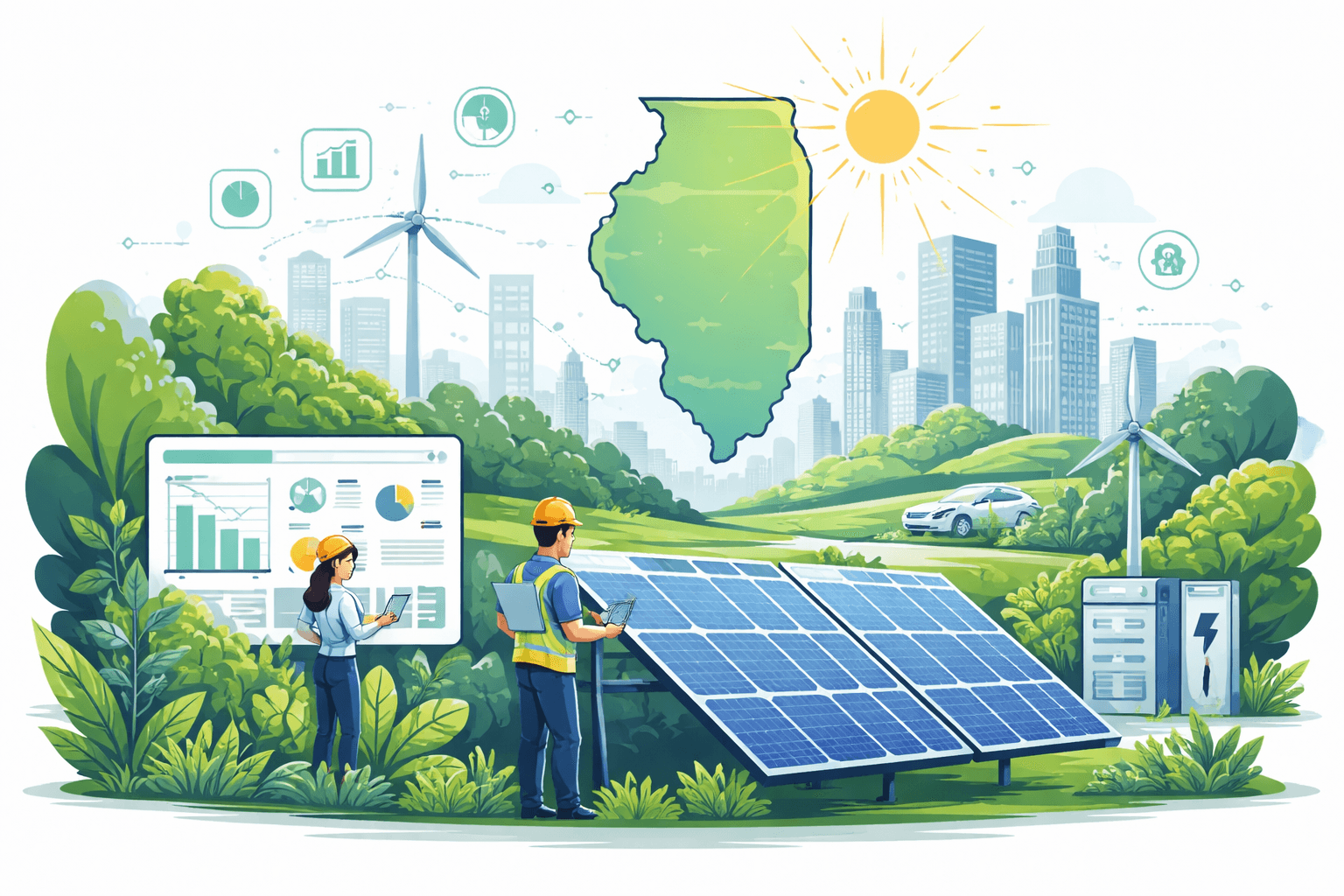
Solar in Illinois is having a moment. Falling equipment prices and revived state incentives under the Climate and Equitable Jobs Act (CEJA) have brought installed costs to roughly $2.60–$3.20 per watt before incentives in 2026, according to recent NREL cost benchmarks and Midwest installer quotes. For a typical 7 kW system, that’s $18,000–$22,000 before incentives — with Illinois Shines (the state’s REC incentive) and the 30% federal tax credit often cutting the net price by 35–55%.
This guide breaks down Illinois sun potential, current pricing, incentives (Illinois Shines and Illinois Solar for All), net metering and interconnection rules, payback math, and reputable installers serving the state.
By the Numbers (Illinois, 2026)
- Average residential solar cost: $2.60–$3.20/W before incentives (NREL U.S. PV Cost Benchmark; Midwest installer data)
- Typical 7 kW system price: $18,000–$22,000 before incentives; $8,000–$12,000 net after Illinois Shines + 30% ITC (range varies by utility, roof, and REC block)
- Expected annual output (fixed tilt): ~1,250–1,400 kWh per kWdc (NREL PVWatts), or ~8,800–9,800 kWh for 7 kW
- Capacity factor: ~16–18% for fixed-tilt rooftop (NREL PVWatts)
- Residential electricity price: ~16–18¢/kWh statewide average (U.S. EIA range for recent Illinois years)
- Simple payback: ~6–10 years depending on incentives, rates, shading, and system cost
Solar energy potential in Illinois: sun hours, irradiance, and climate factors
Illinois doesn’t have Arizona’s desert sun, but modern PV modules perform well in the Midwest. NREL’s PVWatts tool estimates a fixed-tilt array in:
- Chicago: ~1,250–1,350 kWh per kWdc per year
- Springfield/Peoria: ~1,300–1,380 kWh per kWdc per year
- Carbondale/Metro East: ~1,350–1,420 kWh per kWdc per year
Solar Electricity Handbook - 2023 Edition: A simple, practical guide to solar energy – designing and installing solar photovoltaic systems: Boxwell, Michael
Solar Electricity Handbook - 2023 Edition: <strong>A simple, practical guide to solar energy – designing and installing solar photovoltaic systems</strong> [Boxwell, Michael] on Amazon.com. *FREE* shi
Check Price on AmazonAt 7 kWdc, that’s roughly 8,800–9,900 kWh annually — often enough to offset 70–110% of a typical home’s usage, depending on efficiency and electrification.
Key performance drivers in Illinois
- Irradiance and tilt: A 25–35° tilt facing south (±30°) typically maximizes yield. East/west roofs still perform well, often within 10–15% of a south-facing array.
- Cold weather advantage: Solar cells operate more efficiently in cooler temperatures. Illinois’ winters can boost voltage and partially offset shorter days.
- Snow: NREL and peer-reviewed studies suggest annual snow losses for pitched roofs average around 1–5% in the Midwest. Dark-framed modules, steeper pitches, and occasional brushing (if safe) reduce losses.
- Shading and trees: Even light shading can shrink output. Module-level power electronics (MLPE) such as microinverters or DC optimizers help mitigate partial shading.
Average cost of solar panels in Illinois and price-per-watt breakdown
Based on the NREL U.S. Solar Photovoltaic System Cost Benchmark (latest through 2024) and recent Midwest bids, residential systems in Illinois typically price at $2.60–$3.20 per watt before incentives in 2026. That range reflects roof complexity, equipment selection, interconnection fees, and soft costs.
Typical 7 kW price example (pre-incentive)
- Equipment (modules, inverters, racking): $7,500–$10,500
- Balance-of-system + labor: $5,000–$7,000
- Overhead, design, permitting, and margin: $5,500–$7,500
- Total: $18,000–$22,000 ($2.60–$3.20/W)
Equipment choices that affect price
- Modules: Tier-1, 400–450 W panels with 20–22.5% efficiency command a premium but can reduce array size. High-efficiency heterojunction or TOPCon panels cost more than standard PERC.
- Inverters: Microinverters or DC optimizers improve shade performance and monitoring granularity; a central string inverter typically costs less.
- Add-ons: Critter guards, upgraded racking, snow guards, or a heavy-up on the main electrical panel increase cost.
Technology picks worth considering
- High-efficiency modules: Based on published efficiency ratings, REC Alpha Pure and Qcells Q.TRON panels offer strong value for space-constrained roofs. If you want an excellent price–performance balance, the Qcells Q.PEAK DUO BLK is a frequently recommended choice among Illinois installers.
- Microinverters: For complex or shaded roofs, Enphase IQ8 microinverters provide module-level optimization and rapid shutdown compliance — a common pick in the Midwest.
- Monitoring and load control: Pairing solar with a smart energy monitor like the Emporia Vue can help right-size your system and prioritize daytime loads to capture more on-site value.
Illinois solar incentives: state tax credits, rebates, net metering, and SRECs
Illinois Shines (Adjustable Block Program, ABP)
- What it is: A state-administered market for Solar Renewable Energy Credits (SRECs), known as RECs in Illinois. Residential systems sell 15 years of expected RECs to the program via an Approved Vendor.
- How it’s paid: Incentives are typically front-loaded — either as an upfront discount or multi-year payments — and are commonly passed through by your installer/Approved Vendor as a line-item price reduction.
- Typical value: For small distributed generation (<25 kW), the Illinois Power Agency (IPA) publishes incentive prices by utility territory and program block. For 2026, many Illinois homeowners see ABP incentives offset roughly $0.60–$1.20 per watt, depending on location, REC category, and block availability. Actual values vary; ask your installer which block and rate apply.
- Why it matters: ABP can reduce a $20,000 system by several thousand dollars before the federal tax credit.
Illinois Solar for All (ILSFA)
- Income-qualified option: Designed to ensure equitable access, ILSFA provides greater incentives for income-eligible households and often enables $0 upfront cost with guaranteed bill savings. Program availability and waitlists vary by utility and funding year.
Property tax treatment
- Special assessment: Illinois provides a special assessment for solar energy systems (35 ILCS 200/10-5), effectively preventing an increase in assessed value due to the solar upgrade. Check with your county assessor on documentation required.
Sales tax
- As of 2026, Illinois does not have a universal statewide sales tax exemption for residential PV equipment. Local taxes and interpretations can vary; confirm on your proposal.
Net metering and net billing in Illinois
- Investor-owned utilities (ComEd, Ameren, MidAmerican) offer net metering up to 2 MW systems. Historically, customers received retail-rate credits for exported energy until a 5% program cap by utility was reached.
- Status in flux: Under CEJA and Illinois Commerce Commission (ICC) guidance, utilities transitioning after the 5% cap may move new customers to “net billing” (crediting exports at a supply-only rate). Existing net metering customers are typically grandfathered for a term defined by tariff (commonly up to 15 years). The exact status can change by utility and year.
- What to do: Ask your installer which tariff you’ll be on at interconnection approval: full retail net metering or net billing. Clarify credit rates, annual true-up rules, and whether credits roll over month to month.
Community solar (alternative to rooftop)
- If your roof isn’t suitable, Illinois supports robust community solar subscriptions under Illinois Shines. Subscribers receive bill credits for their share of a local solar farm’s output, often with 5–20% bill savings without installing panels.
Federal ITC and how it applies to Illinois homeowners
The federal Investment Tax Credit (ITC) remains 30% for residential solar through at least 2032 under the Inflation Reduction Act. It applies to the net system cost you pay out-of-pocket (including equipment, labor, and eligible adders like integrated storage). You need enough tax liability to claim the credit; unused portions can roll forward to future years.
- Example: A $20,000 project that benefits from a $6,000 Illinois Shines upfront REC discount results in a $14,000 basis for the ITC. The 30% ITC then reduces federal taxes by $4,200, bringing the effective net cost to $9,800.
- Storage: Standalone batteries also qualify for the 30% ITC, whether or not they are paired with PV.
For a fuller walkthrough of eligibility, timing, and what expenses qualify, see our explainer: Solar Tax Credit Explained: Save on Solar with the Federal ITC and our primer on how PV systems work: Solar Power Explained: How It Works, Costs, and Climate Benefits.
Best solar installers and companies serving Illinois
How to evaluate installers
- NABCEP credentials: Look for North American Board of Certified Energy Practitioners certifications (PV Installation Professional or PV Technical Sales).
- Equipment transparency: Reputable firms specify panel and inverter models, efficiency ratings, degradation rates, and warranty terms (product + performance + workmanship).
- Local interconnection expertise: Illinois utilities and municipalities differ on metering, permit drawings, and structural sign-offs. Track records matter.
- Financial stability and service: Review service response times and long-term warranty support — not just the sticker price.
Notable Illinois installers to consider
- Certasun (Chicago metro): Known for clear proposals, in-house crews, and premium module options. Strong Chicago-area footprint.
- StraightUp Solar (Metro East/Southern IL & MO): Longtime regional EPC with residential and commercial portfolios; emphasizes service and education.
- GRNE Solar (statewide/neighboring states): Midwestern installer with residential and C&I experience; offers a range of module and inverter packages.
- Windfree Solar (Chicago): Focus on bespoke rooftop and architectural solutions; experienced with city permitting nuances.
- Rethink Electric (Northern IL): Residential specialist offering MLPE options and Illinois Shines expertise.
This is not an exhaustive list, and we don’t accept compensation for inclusion. Always obtain 2–3 quotes, compare same-for-same equipment, and confirm your utility’s net metering/billing status before signing.
ROI and payback period for solar in Illinois
Base case scenario (illustrative)
- System size: 7.0 kWdc
- Installed price: $20,300 before incentives ($2.90/W)
- Illinois Shines REC incentive: −$5,300 (actual value varies by utility and block)
- Federal ITC (30% of net): −$4,500 (on $15,000 basis)
- Net homeowner cost after incentives: ≈$10,500
- Annual production: 9,200 kWh (NREL PVWatts mid-range for IL)
- Retail electricity rate: $0.17/kWh (EIA-residential average range)
- First-year bill reduction: ≈$1,560 (before any net billing adjustments and modest degradation)
Simple payback estimate: $10,500 / $1,560 ≈ 6.7 years. If your utility credits exports at supply-only rates (net billing), payback could extend to 8–10 years depending on your ability to self-consume energy during solar hours.
Tips to strengthen ROI in Illinois
- Load shifting: Run dishwashers, laundry, and EV charging during sunny hours to capture more on-site value, especially under net billing.
- Electrification: Pair solar with a high-efficiency heat pump water heater or air-source heat pump to displace gas and use more of your PV output.
- Equipment selection: On shaded or east/west roofs, MLPE (e.g., microinverters) can boost usable generation and resilience.
- Community aggregation: Some municipalities negotiate supply rates. If your export credit is tied to supply rates, monitor pricing changes.
For a broader framework on solar economics, see: The Complete Guide to Solar Energy: How It Works, Costs, and Benefits.
Illinois-specific permitting, HOA rules, and interconnection process
Permitting
- Municipal variation: Chicago and many suburbs require structural letters, site plans, and electrical one-lines. Expect 1–4 weeks for permit approval in most jurisdictions; complex roofs can take longer.
- Inspections: Post-install, expect electrical and structural inspections before your utility meter swap.
HOA rules
- Homeowners’ Solar Rights: Under Illinois law (765 ILCS 165/), homeowners associations cannot prohibit solar installations outright. They may impose reasonable aesthetic guidelines that do not effectively prevent or significantly impair performance. Submit designs early to meet review timelines.
Interconnection
- Governing rules: ICC interconnection standards outline a Level 1 (≤25 kW) fast-track process and higher levels for larger systems. Level 1 reviews often complete within a few weeks barring grid constraints.
- Steps and timeline: Application > utility technical review > conditional approval > installation > inspection > permission to operate (PTO). End-to-end: commonly 6–12 weeks, depending on permitting queue and utility workload.
- Net meter and PTO: Your installer coordinates the bi-directional meter swap and PTO request. Don’t energize until PTO is issued; doing so can jeopardize incentives and safety.
FAQ: common questions about going solar in Illinois
How much does solar cost in Illinois in 2026? Most quotes fall between $2.60 and $3.20 per watt before incentives. A typical 7 kW system is $18,000–$22,000 pre-incentive, with Illinois Shines and the 30% ITC often cutting that by 35–55%.
What incentives are available besides the federal tax credit? Illinois Shines (ABP) provides REC-based incentives that significantly reduce upfront price. Income-qualified households may access Illinois Solar for All, often enabling no-upfront-cost projects with guaranteed bill savings. Solar systems also receive favorable property tax treatment via special assessment.
Does Illinois have net metering? Yes, but details vary by utility and year. ComEd, Ameren, and MidAmerican historically offered retail-rate net metering up to a 5% cap. After caps are reached, new customers may receive export credits based on supply-only rates (net billing), while existing net metering customers are generally grandfathered for a term defined in tariffs. Confirm your exact tariff before you sign.
Is my roof good for solar if it faces east or west? Often yes. East/west arrays in Illinois usually generate within 85–90% of a south-facing system. Microinverters or optimizers can improve energy capture on complex roofs.
What about batteries in Illinois? Batteries qualify for the 30% ITC and provide backup power during outages. Illinois does not currently offer a statewide battery rebate, but some utilities and municipalities run limited pilots. Storage can also improve self-consumption under net billing.
How long do solar panels last in Illinois? Quality modules carry 25-year performance warranties (commonly guaranteeing ~84–88% output at year 25) and 12–25-year product warranties. Inverters typically last 12–25 years depending on type.
Will snow damage my system? Modern racking and modules are tested to relevant snow and wind loads. Snow may temporarily cover panels, but typical annual energy loss is modest (1–5%). Never clear snow if it’s unsafe; panels generally shed as temperatures rise.
Can I install solar if I rent? Consider community solar subscriptions, which provide bill credits without rooftop installation. If you rent a single-family home, discuss solar with your landlord; Illinois Shines incentives are also available to property owners.
How do SRECs work in Illinois vs. other states? Illinois’ ABP sets administratively determined REC prices for 15-year contracts rather than a volatile spot market. An Approved Vendor handles the contract and typically applies the incentive as an upfront discount or scheduled payments.
What happens if I move? Solar may boost home value; multiple studies (including Lawrence Berkeley National Laboratory work) find buyers pay a premium for owned PV. If you financed, confirm transfer terms with your lender. Community solar subscriptions can often be moved or canceled per contract rules.
Where Illinois solar is heading Module efficiencies continue to rise while wholesale panel prices remain well below 2022 peaks, according to IEA and industry trackers. Coupled with CEJA’s long-term funding for Illinois Shines, the state’s rooftop and community solar markets are positioned for steady growth through the late 2020s. The biggest variables for homeowner ROI will be utility export credit structures and the pace of household electrification (heat pumps, EVs, induction) that let you use more of your solar on-site.

Emporia Gen 2 Smart Home Energy Monitor with 16 50A Circuit Level Sensors | Real Time Electricity Monitor/Meter | Solar/Net Metering - Amazon.com
View on Amazon
EMPORIA Level 2 EV Charger w/ J1772 Charger, 48 amp ...
View on AmazonRecommended Products
Solar Electricity Handbook - 2023 Edition: A simple, practical guide to solar energy – designing and installing solar photovoltaic systems: Boxwell, Michael
Solar Electricity Handbook - 2023 Edition: <strong>A simple, practical guide to solar energy – designing and installing solar photovoltaic systems</strong> [Boxwell, Michael] on Amazon.com. *FREE* shi
Emporia Gen 2 Smart Home Energy Monitor with 16 50A Circuit Level Sensors | Real Time Electricity Monitor/Meter | Solar/Net Metering - Amazon.com
See how much electricity your home is using anywhere, anytime. ... <strong>Add individual 50A sensors to your Vue to monitor up to 16 individual circuits</strong> — providing accurate energy use for t
EMPORIA Level 2 EV Charger w/ J1772 Charger, 48 amp ...
Explore a wide selection of hardwired Level 2 EV charging stations. Features include 25-foot cables, app control, and weather-resistant construction.