
DIY Solar Battery Installation: Choosing, Sizing & Safely Integrating Home Energy Storage
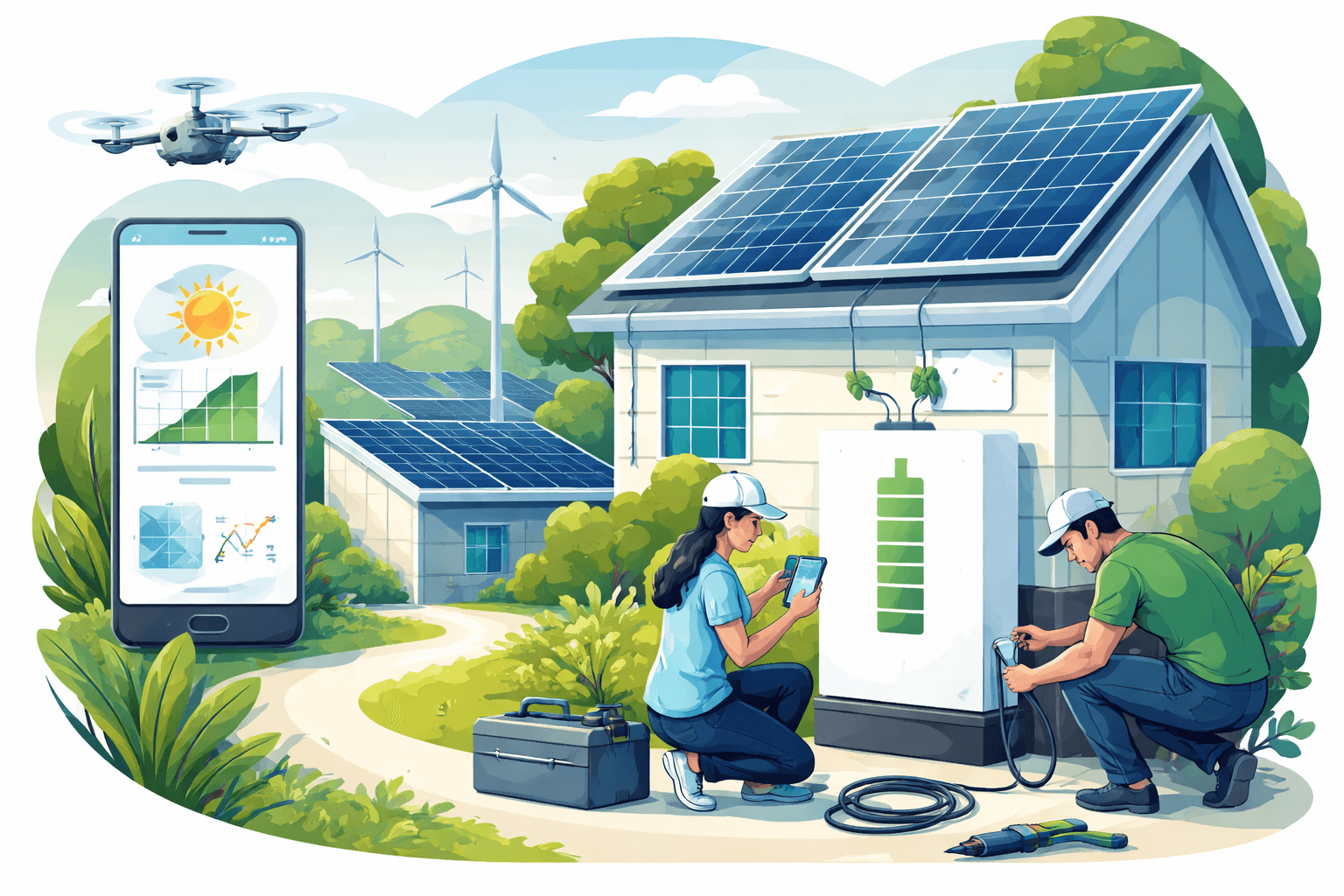
Solar battery prices have fallen sharply—BloombergNEF reports average lithium‑ion pack costs dropped to about $139/kWh in 2023—bringing home energy storage within DIY reach. A well‑planned DIY solar battery installation can shave peak rates, keep critical loads powered during outages, and boost the value of an existing PV system. This guide walks through chemistries, sizing math, code and safety, and practical integration so you can design storage that’s safe, compatible, and future‑proof.
Note: This is a planning and best‑practices guide. Electrical work must comply with your local code and permitting authority. For grid‑tied systems, most jurisdictions require a licensed electrician for interconnection.
Battery chemistries for home storage: trade‑offs that matter
The chemistry you choose sets the tone for performance, cost, safety, and maintenance. Here’s how the main options compare.
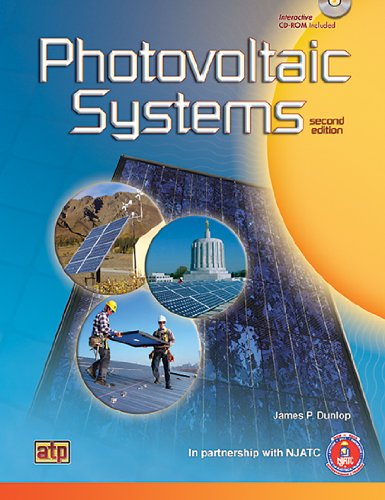
Photovoltaic Systems: Njatc, Cor
Among the topics are <strong>solar radiation, system components and configurations, batteries, inverters, system sizing, mechanical and electrical integration, utility interconnection, and economic an
Check Price on AmazonFlooded lead‑acid (FLA)
- Cost: Low upfront cost per kWh
- Cycle life: ~500–1,200 cycles at 50% depth of discharge (DoD), depending on quality and maintenance (data: NREL technology characterizations)
- Usable DoD: Typically limited to ~50% to preserve life
- Efficiency: 75–85% round‑trip
- Temperature: Can accept low‑temperature charging better than many lithium packs, but capacity still drops in cold; prefers 20–25°C
- Maintenance: Requires watering and periodic equalization; produces hydrogen gas during charging (needs ventilation)
- Safety: Nonflammable electrolyte but emits explosive hydrogen; acid spill risk
- Typical lifespan: 3–7 years in residential cycling
Best for: Very tight budgets and off‑grid systems where users can maintain batteries and accept shorter life.
Sealed lead‑acid (AGM/GEL)
- Cost: Still relatively low, more than flooded
- Cycle life: ~600–1,200 cycles at ~50% DoD (AGM typically higher than GEL)
- Usable DoD: ~50–60%
- Efficiency: 80–90%
- Temperature: Sensitive to heat; cold reduces capacity
- Maintenance: Low maintenance; limited gas emission but still consider ventilation
- Safety: No routine watering; reduced spill risk
- Typical lifespan: 4–8 years
Best for: Backup‑oriented systems with low cycle frequency where maintenance‑free operation is valued.
Lithium‑ion (NMC/NCA)
- Cost: Moderate to high; higher energy density than LFP
- Cycle life: ~2,000–4,000 cycles at 80% DoD (varies widely by brand and management)
- Usable DoD: 80–90% common
- Efficiency: 90–96% round‑trip
- Temperature: Avoid charging below 0°C; performance degrades at high heat
- Maintenance: No routine maintenance; requires a battery management system (BMS)
- Safety: More reactive; higher thermal runaway risk than LFP; must meet safety standards and be paired with listed equipment
- Typical lifespan: 8–12 years depending on cycling and thermal management
Best for: Space‑constrained installations where compactness is paramount and equipment is listed to UL 9540 with robust thermal management.
Lithium iron phosphate (LFP or LiFePO4)
- Cost: Declining quickly; typically mid‑range for stationary storage
- Cycle life: ~3,000–8,000 cycles at 80% DoD reported by manufacturers, with strong calendar life when kept cool (NREL and DOE testing support high cycle stability)
- Usable DoD: 80–100% is common per warranty
- Efficiency: 92–97% round‑trip
- Temperature: Don’t charge below 0°C without a low‑temp cut‑off or active heating; prefers 15–30°C
- Maintenance: No routine maintenance; integrated BMS required
- Safety: Excellent thermal stability relative to NMC/NCA; still requires proper overcurrent protection and certification
- Typical lifespan: 10–15 years depending on cycling and environment
Best for: Most DIY solar battery installation projects looking for long life, high usable capacity, and strong safety characteristics.
What the data says: NREL’s cost benchmarks show installed residential battery systems still carry soft‑cost premiums, but cell/module prices keep falling. For system longevity, LFP’s cycle stability and thermal safety profile make it the default choice for many stationary applications.
Sizing your system and ensuring compatibility
Correct sizing blends your load profile, outage needs, and PV design. The core concepts are usable capacity, power, and days of autonomy.
Key definitions
- Nominal capacity (kWh): Nameplate energy of the battery bank
- Usable capacity (kWh): Nominal × DoD × round‑trip efficiency
- Continuous power (kW): Steady output your inverter/ESS can supply
- Surge power (kW): Short bursts for motor starts (e.g., well pump, HVAC)
- Days of autonomy: How many days you can run without new solar input
A practical target: For outage backup of critical loads (fridge, lights, router, small A/C or heat pump, medical devices), many homes plan 5–15 kWh usable with a 5–10 kW inverter. For whole‑home backup with HVAC, 20–40+ kWh may be needed depending on climate and appliance efficiency.
DIY sizing math step‑by‑step
- Tally your loads
- List each appliance’s watts (W) and estimated daily runtime (hours). Multiply for daily watt‑hours (Wh). Sum to daily kWh.
Example critical loads:
- Refrigerator: 120 W average × 24 h = 2.9 kWh/day
- Wi‑Fi + networking: 30 W × 24 h = 0.72 kWh/day
- LED lighting: 100 W × 5 h = 0.5 kWh/day
- Laptop/phones: 150 W × 4 h = 0.6 kWh/day
- Mini‑split heat pump (1 ton, efficient mode): 700 W × 6 h = 4.2 kWh/day
- Sump or well pump (intermittent): 1,000 W × 1 h = 1.0 kWh/day Total: ~9.9 kWh/day
- Choose days of autonomy
- If you want 1.5 days of autonomy for storm coverage: 9.9 × 1.5 ≈ 14.9 kWh required energy.
- Adjust for chemistry DoD and efficiency
- Assume LFP with 90% usable DoD and 95% round‑trip efficiency: Usable capacity needed = 14.9 ÷ (0.90 × 0.95) ≈ 17.4 kWh nominal bank.
- Confirm inverter power and surge
- If your largest combined load is 4 kW continuous with 7 kW surge (pump start), choose an inverter/ESS rated ≥5 kW continuous and ≥7–10 kW surge for a few seconds.
- Convert to voltage and amp‑hours if building a low‑voltage bank
- For a 48 V LFP bank: Nominal Ah = (17.4 kWh × 1,000) ÷ 48 V ≈ 362 Ah. A common approach is using three 5.12 kWh (48 V, 100 Ah) LFP rack modules in parallel (≈15.4 kWh), or four modules for ~20.5 kWh nominal.
Matching voltage: 12 V vs 24 V vs 48 V
- 12 V: Suitable for very small systems (<1 kW). High currents require very thick cables; not ideal for whole‑home.
- 24 V: Good for 1–3 kW systems; moderate cable sizes.
- 48 V: Preferred for >3 kW inverters; lower current for a given power lowers conductor size, heat, and loss. Many residential all‑in‑one inverter‑chargers and rack batteries are designed for 48 V nominal.
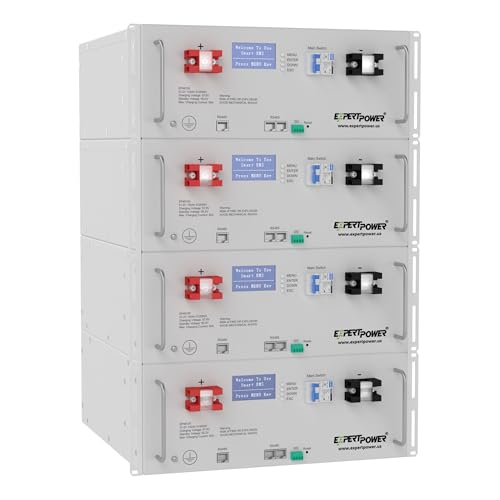
ExpertPower UL1973 48V 100Ah 5KWh Lithium LiFePO4 Deep Cycle Battery | 2500-7000 Life Cycles & 10-Year Lifetime | Built-in BMS & LED Monitor | Home, Cabin, Off-Grid, Solar | 51.2V 16 Cells : Automotive
View on AmazonPV array, charge controllers, and hybrids
- Off‑grid DC‑coupled: PV connects to an MPPT charge controller sized for array power and battery voltage. Ensure controller max input voltage (Voc) exceeds cold‑weather array voltage with margin.
- Grid‑tied hybrid (AC‑coupled or DC‑coupled ESS): Many hybrid inverters integrate MPPTs and battery ports. Compatibility is critical—use batteries listed and certified to work with your inverter (often UL 9540‑listed pairs). Communication via CAN/RS‑485 lets the inverter follow the BMS for safe charge/discharge.
For a deeper dive on system architectures, see our Off‑Grid Solar: Complete Buyer’s Guide (/renewable-energy/off-grid-solar-complete-buyers-guide) and Solar Battery Buying Guide: Choose the Best Home Battery in 2026 (/renewable-energy/solar-battery-buying-guide-2026).
By the numbers
- 92–97%: Typical round‑trip efficiency for lithium‑ion ESS (NREL)
- ~50%: Recommended DoD for long life in many lead‑acid systems (NREL/industry practice)
- 3,000–8,000 cycles: Reported LFP cycle life at 80% DoD under proper thermal management (DOE/NREL literature)
- $139/kWh: Average lithium‑ion pack price in 2023, per BloombergNEF
- ~99%: Lead‑acid battery recycling rate in the U.S. (EPA)
Regulatory, permitting, and safety essentials
DIY solar battery installation must be grounded in code. Requirements vary by jurisdiction; always confirm with your Authority Having Jurisdiction (AHJ).
- National Electrical Code (NEC): Key articles include 706 (Energy Storage Systems), 690 (Solar PV), 705 (Interconnected Power Production Sources), 110 (requirements for electrical equipment), 250 (grounding and bonding), and 480 (storage batteries—especially for lead‑acid). The 2023 NEC refined ESS rules; your area may still be on 2017 or 2020—verify which edition is adopted.
- Fire and building codes: NFPA 855 (Standard for the Installation of Stationary Energy Storage Systems) and the International Fire Code (IFC 2018/2021) set placement, ventilation, separation, and aggregate energy limits for residential ESS. Many jurisdictions cap residential indoor ESS capacity per fire area—often on the order of 20–40 kWh depending on code edition and product listing—so check the limits that apply to you.
- Product safety listings: Favor UL 1973 (batteries), UL 1741 (inverters), UL 9540 (ESS), and UL 9540A (fire propagation test) listed equipment. Some AHJs require UL 9540‑listed, pre‑engineered battery‑inverter combinations.
- Permitting: Grid‑tied ESS typically requires electrical and sometimes building/fire permits and a utility interconnection agreement. Off‑grid installations usually still require electrical permits.
- Ventilation and environment: Lead‑acid banks require ventilation for hydrogen gas. Lithium systems should be in dry, temperature‑controlled spaces, away from ignition sources and with clear working space (NEC 110.26). Avoid living spaces unless explicitly permitted and listed for indoor installation.
- Overcurrent protection and disconnects: Provide properly rated DC fuses or breakers as close to the battery as practicable (often within 18 inches, per best practice and many manufacturer instructions), plus readily accessible disconnects and labeling.
- Grounding and bonding: Follow NEC 250 for equipment grounding conductors, grounding electrode systems, and bonding jumpers. Use listed lugs and torque to spec.
- When to hire a pro: Any service‑entrance work, main panel interconnection (especially line‑side taps), and utility‑interactive wiring generally requires a licensed electrician. If your AHJ or insurer requires UL 9540‑listed systems or PE‑stamped plans, DIY may not be permitted.
For shoppers evaluating DIY versus turnkey systems, our Tesla Powerwall guide outlines installed, listed alternatives and their trade‑offs (/green-business/tesla-powerwall-buyers-guide-cost-installation-alternatives).
Physical installation and electrical integration (conceptual)
Think in layers: mechanical mounting, conductors and protection, power electronics, and control/communications.
Layout and mounting
- Location: Keep batteries off the floor (flood risk), out of direct sun, in a cool, dry room or NEMA‑rated outdoor enclosure. Maintain clearances required by the manufacturer and code.
- Racks and cabinets: Use the manufacturer’s rack/cabinet when provided, anchored to structure. Don’t stack third‑party modules unless expressly allowed.
- Separation: Follow NFPA 855 and listing instructions for spacing from walls, openings, and other combustibles. Avoid bedrooms unless permitted.
Cabling, busbars, and protection
- Conductor sizing: Size battery cables for continuous current at 125% of maximum expected load (NEC design practice) and check ampacity/temperature ratings. Keep voltage drop below ~2–3% on DC runs.
- Overcurrent devices: Use properly rated DC fuses/breakers (Class T or equivalent for high‑fault currents in low‑voltage DC). Place primary battery protection as close to the positive terminal as practicable.
- Disconnects: Provide a lockable DC disconnect and a rapid means to de‑energize per manufacturer and code.
- Torque and lugs: Use listed lugs; torque to manufacturer specs with a calibrated wrench. Re‑torque after thermal cycles per instructions.
- Polarity and pre‑charge: Many inverters and BMS units require a pre‑charge resistor to avoid inrush currents that can damage capacitors. Follow the exact connection sequence in manuals.
BMS and communications
- Built‑in BMS: Most LFP modules include a BMS that manages cell balancing, charge/discharge limits, and temperature cut‑offs.
- External control: Use CAN/RS‑485 communication between the battery and inverter/charger where supported so charge voltages and currents track the BMS in real time. Without comms, set conservative charge voltages and current limits per the battery manual.
- Temperature sensors: Place probes as directed; avoid charging lithium below 0°C unless the battery has internal heating.
Charge controller and inverter interfaces
- DC‑coupled: MPPT charge controller sized for array power and battery voltage. Confirm max PV Voc at the coldest site conditions is below controller limit with a margin (use module TempCo from datasheet).
- AC‑coupled: Add a battery inverter to an existing PV inverter. Ensure frequency‑watt or voltage‑watt controls manage curtailment and that the battery inverter is approved by the PV inverter manufacturer for AC coupling.
- Neutral/grounding: Follow inverter manual for neutral‑to‑ground bonding and transfer switch operation to avoid objectionable currents.
Monitoring and maintenance
- State of charge (SoC): Use the inverter app or a shunt‑based battery monitor for accurate SoC. Calibrate periodically by running a full charge cycle.
- Data logging: Enable event logs and alarms; export data for diagnostics.
- Maintenance: For lead‑acid, check electrolyte levels, equalize when specified, clean terminals, and ventilate. For lithium, inspect for swelling, unusual heat, and retorque connections annually. Keep firmware up to date.
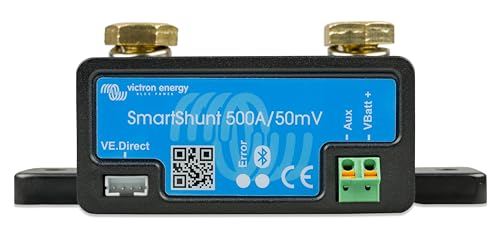
Victron Energy SmartShunt Battery Monitor (Bluetooth) - ...
View on AmazonThermal management and enclosures
- Temperature band: Batteries last longest at ~15–30°C. Every 10°C rise can roughly halve life in many chemistries (Arrhenius behavior).
- Cold climates: Choose batteries with low‑temperature charge protection or integrated heaters. Consider insulated cabinets with modest heating.
- Outdoor installs: Use NEMA 3R/4 enclosures, rodent screens, and sunshades. Provide drainage and seismic anchoring where required.
Costs, procurement, and lifecycle planning
What DIYers actually spend
- Cells/modules: Quality 48 V LFP rack batteries commonly run ~$250–$450 per kWh for modules in 2026 retail channels, depending on brand and warranty.
- Inverter/charger + BOS: A 5–8 kW hybrid inverter, breakers, fuses, racks, wire, conduit, and enclosures can add $2,000–$5,000+.
- Example: A 15–20 kWh LFP bank with a 6 kW hybrid inverter often totals $6,000–$12,000 in DIY hardware before permits and inspection. NREL’s 2023/2024 benchmarks put professionally installed residential storage at roughly $900–$1,500 per kWh all‑in, reflecting labor, overhead, and permitting.
Explore rough sizing and budget ranges with our Home Solar Battery Storage: Complete Buyer’s Guide & Cost Calculator (/renewable-energy/home-solar-battery-storage-buyers-guide-cost-calculator).
Brands, listings, and warranties
- Listings: Prioritize UL 1973 batteries, UL 1741 inverters, and UL 9540 system certification—some AHJs require UL 9540‑listed pairings.
- Warranty terms: Look for 10‑year warranties with cycle and throughput limits spelled out (e.g., 6,000 cycles or X MWh). Verify minimum retained capacity (e.g., 70–80% at 10 years).
- Supply chain: Choose vendors with domestic support and clear documentation. Keep serials and firmware versions on file.
ROI considerations
- Time‑of‑use (TOU) arbitrage: Savings depend on rate spread and round‑trip efficiency. With a $0.20/kWh spread and 95% efficiency, each stored kWh nets ~$0.19 before degradation.
- Backup value: Hard to quantify but critical in outage‑prone areas; consider avoided spoilage, business continuity for home offices, and resilience benefits.
- Incentives: Some regions offer ESS rebates or tax credits. Federal ITC eligibility may depend on coupling with solar and meeting charge‑from‑solar requirements—check current IRS guidance and your AHJ.
End‑of‑life, recycling, and disposal
- Lead‑acid: Mature recycling loop with ~99% recovery in the U.S. (EPA). Always return to an authorized recycler.
- Lithium‑ion: Rapidly scaling recycling infrastructure (e.g., hydrometallurgical recovery of lithium, nickel, cobalt). Many manufacturers participate in take‑back programs; consult local e‑waste rules.
- Safety at disposal: Isolate terminals, ship per hazardous materials rules, and follow recycler instructions.
Troubleshooting and diagnostics: what to be ready for
- Nuisance BMS trips: Often caused by cold charging, overcurrent, or cell imbalance. Check temperature sensors, current limits, and perform a full balance charge per the manual.
- Inverter faults on startup: Suspect missing pre‑charge or reversed polarity. Verify sequence and use a multimeter for open‑circuit checks before closing fuses.
- SOC drift: Without shunt‑based monitoring or BMS comms, SOC can wander. Perform periodic full charges and recalibrate.
- Uneven parallel strings: Avoid mixed‑age/mixed‑brand batteries. If paralleling, match cable lengths to each string and use a common busbar to equalize resistance.
- High heat alarms: Improve ventilation, reduce charge/discharge currents, or relocate to a cooler space. Log temperatures under load to pinpoint hot spots.
- Unexpected shutdowns during outages: Confirm transfer switch wiring, neutral bonding, and that critical loads are on the backed‑up subpanel. Verify firmware settings for backup mode.
DIY solar battery installation: practical steps and checklists
Use this high‑level sequence to keep projects organized. Always defer to manufacturer instructions and code.
- Define goals and constraints
- Backup scope (critical loads vs whole home), TOU savings, budget, space, and code limits on kWh per fire area.
- Audit loads and size the system
- Calculate daily kWh, peak kW, and surge. Choose voltage (48 V for >3 kW), chemistry (often LFP), and nominal capacity using the sizing math above.
- Select compatible, listed equipment
- Prefer UL 9540‑listed battery‑inverter combinations, or confirm documented compatibility and comms support. Verify temperature ratings and enclosure needs.
- Draft a one‑line diagram and equipment layout
- Show battery bank, OCPD, disconnects, inverter/charger, charge controller (if DC‑coupled), PV, and critical loads panel. Include conductor sizes and breaker ratings.
- Pull permits and coordinate inspections
- Submit your plans to the AHJ and utility (for grid‑tied). Expect review of NEC Articles 690/705/706 compliance and NFPA 855 placement rules.
- Install mechanicals and enclosures
- Mount racks/cabinets, pull conduit, and place equipment with clearances.
- Wire DC side with protection and labeling
- Land conductors on busbars, install fuses/breakers at the source, and verify torque. Label per NEC 705/706 and local amendments.
- Commission with a controlled startup
- Verify polarity and insulation resistance. Pre‑charge if required. Power the BMS, then the inverter. Configure charge limits and test with small loads before full operation.
- Program operating modes and TOU schedules
- Set charge windows, backup reserve SOC, and export limits per utility requirements.
- Document and maintain
- Save configuration files, one‑line, permit docs, and warranties. Schedule periodic inspections and firmware updates.
For a broader system context, see How to Go Off‑Grid with Solar: Complete Step‑By‑Step Guide (/renewable-energy/how-to-go-off-grid-with-solar-step-by-step-guide).
What this means for homeowners and policymakers
- Homeowners: DIY is most viable for off‑grid or standalone backup where AHJs allow non‑UL 9540 pairings and you’re comfortable with code and commissioning. For grid‑tied TOU optimization, using UL 9540‑listed combos can streamline permits.
- Installers: Expect more LFP dominance, communications‑driven control, and higher code scrutiny on placement and aggregate capacity. Offering design‑assist or commissioning services for DIYers can enhance safety outcomes.
- Policymakers and AHJs: Clear, performance‑based pathways for UL 9540/9540A‑tested systems and standardized residential limits help ensure safety while expanding resilience.
The road ahead
Storage is scaling fast, with costs down and LFP becoming the workhorse for stationary applications. Expect more factory‑integrated, UL 9540‑listed batteries that simplify permitting and improve safety, plus smarter controls for demand response and virtual power plants. For the motivated homeowner, a data‑driven, code‑compliant DIY solar battery installation can deliver resilient, clean power—and do it safely—when planned with the right chemistry, sizing, and standards in mind.
Recommended Products
Photovoltaic Systems: Njatc, Cor
Among the topics are <strong>solar radiation, system components and configurations, batteries, inverters, system sizing, mechanical and electrical integration, utility interconnection, and economic an
ExpertPower UL1973 48V 100Ah 5KWh Lithium LiFePO4 Deep Cycle Battery | 2500-7000 Life Cycles & 10-Year Lifetime | Built-in BMS & LED Monitor | Home, Cabin, Off-Grid, Solar | 51.2V 16 Cells : Automotive
Certified Safety & Compliance (Now UL1973): Our EP48100 rack battery and its cells are both UL1973 <strong>certified for stationary energy storage</strong>. The cells are UL1642 tested and the pac
Victron Energy SmartShunt Battery Monitor (Bluetooth) - ...
ALL-IN-ONE SMART BATTERY MONITOR: The Victron SmartShunt is <strong>a smart all in one battery monitor that provides detailed battery insights on your phone</strong>. It enables smartfunctionalities a