
Digital Twin for Energy Systems: What It Is and Why It Matters
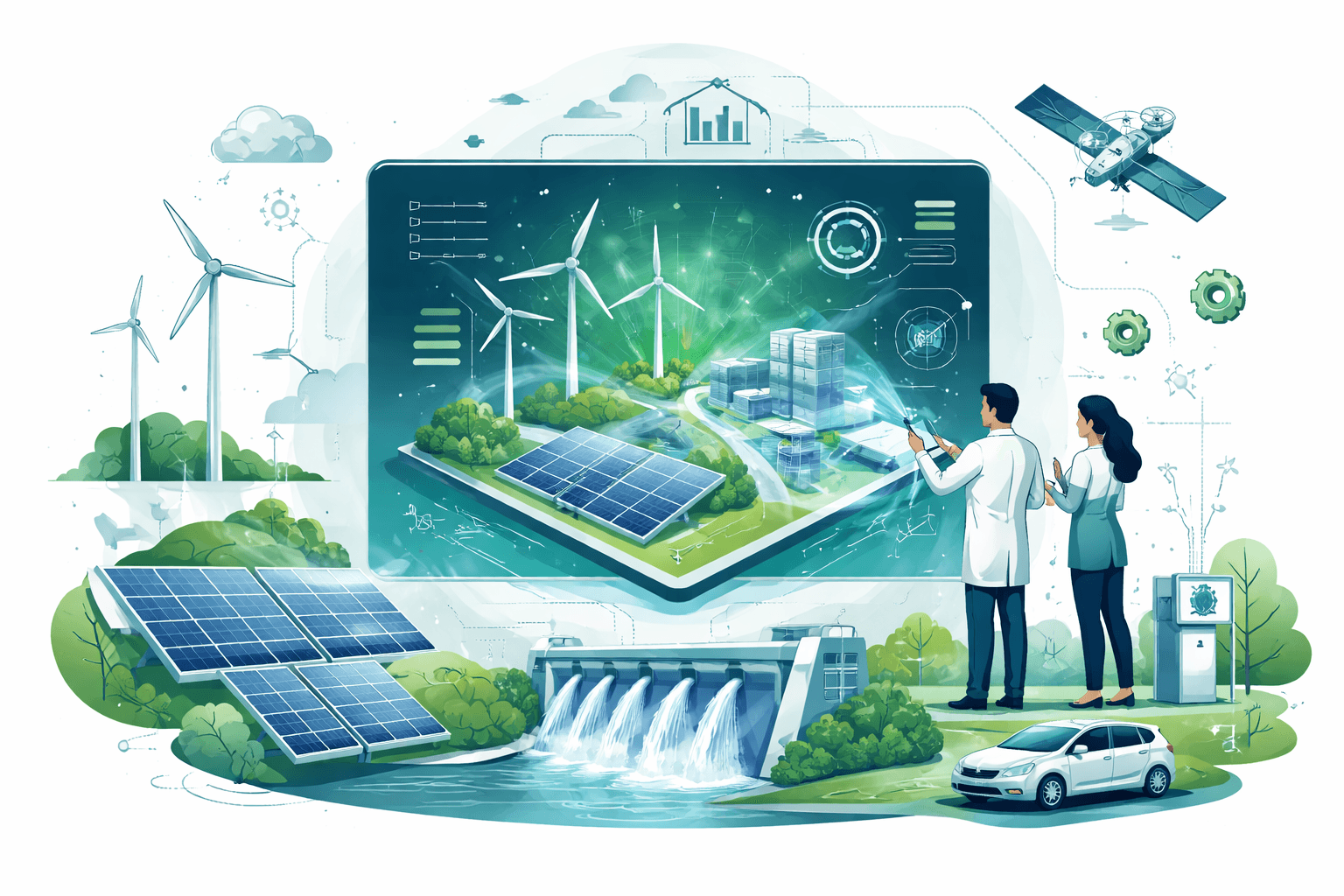
Global power systems are adding record amounts of variable renewables while weather-driven outages rise. The IEA reports renewable additions jumped about 50% in 2023 to roughly 510 GW, led by solar PV, while the U.S. EIA notes the average U.S. customer experienced about 5–6 hours of interruptions in 2022. A digital twin for energy systems—a living, data‑synchronized virtual replica of assets and networks—offers a way to operate more efficiently, integrate renewables reliably, and restore power faster.
This explainer defines what a digital twin is (and isn’t), maps its data and model building blocks, highlights high‑value use cases with measurable impacts, and outlines implementation realities that determine success.
What is a digital twin for energy systems?
A digital twin for energy systems is a continuously updated virtual representation of physical energy assets (turbines, transformers, HVAC plants) and networks (microgrids, distribution feeders, transmission systems) that synchronizes with real‑world data and can simulate, predict, and sometimes control behavior across time horizons—from milliseconds to years.
How it differs from adjacent technologies:
- Monitoring/Dashboards: Show current and historical status (e.g., SCADA trends), but typically do not fuse physics‑based models with forecasting to test “what‑if” scenarios.
- Stand‑alone Simulation: Runs offline with static inputs; a twin ingests live data, learns from history, and stays calibrated to reality.
- SCADA/EMS/DMS: Supervisory systems acquire data and execute control. A digital twin layers predictive analytics and high‑fidelity models on top of those systems to anticipate failures, optimize dispatch, and evaluate scenarios before acting. Many twins read from and write to SCADA/EMS/DMS through defined interlocks.
In short, a digital twin is not just a model or a dashboard—it’s a model‑plus‑data system with a tight, ongoing link to the physical world.
Core components and data inputs
A robust digital twin for energy systems is built from four pillars: data acquisition, models, computing/architecture, and integration/visualization.
Data acquisition: what the twin “senses”
- Field sensors and IoT: Temperatures, pressures, vibrations, electrical waveforms, breaker states, fuel flow, inverter setpoints. For grids, phasor measurement units (PMUs) provide sub‑second voltage and angle data; smart meters and feeder monitors fill in distribution detail. North American utilities have deployed thousands of PMUs (NASPI), creating high‑speed visibility that twins can exploit.
- Asset metadata and topology: Single‑line diagrams, GIS network models, nameplate ratings, protection settings, network impedances.
- Exogenous inputs: Weather (mesoscale wind fields, irradiance, temperature), wildfire risk indices, hydrology, and market conditions (locational marginal prices, reserve requirements).
- Operational history: Work orders, failure logs, maintenance records, outage tickets, curtailment events, control room notes.
- Quality references: Calibration records, sensor accuracy specs, and redundancy rules defining “ground truth.”

Davis Instruments Wireless Vantage Pro2 Weather Station with WeatherLink Console - Metric : Patio, Lawn & Garden
View on AmazonModels: how the twin “thinks”
- Physics‑based models: Thermodynamic cycles (gas/steam plants), aeroelastic turbine models (e.g., NREL OpenFAST), power‑flow and state‑estimation (AC/DC), voltage stability, transient stability, inverter control and protection behavior.
- Data‑driven models: Machine learning for anomaly detection, remaining useful life (RUL) prediction, load and solar/wind forecasting, non‑intrusive load monitoring in buildings.
- Hybrid models: Combine first‑principles physics with ML residuals to capture unmodeled losses or sensor bias.
- Uncertainty models: Probabilistic forecasts, confidence intervals, and Monte Carlo scenario sets for risk‑aware decisions.
Data-Driven Science and Engineering: Machine Learning, Dynamical Systems, and Control: Brunton, Steven L., Kutz, J. Nathan
Data-Driven Science and Engineering: Machine Learning, Dynamical Systems, and Control [Brunton, Steven L., Kutz, J. Nathan] on Amazon.com. *FREE* shipping on qualifying offers. Data-Driven Science and
Check Price on AmazonArchitecture: where and how it runs
- Edge computing: Millisecond‑level analytics for protection, inverter controls, or building HVAC loops.
- Cloud/HPC: Training ML models, running large‑scale power‑flow batches, agent‑based market simulations, or year‑long dispatch studies.
- Data fabric: Time‑series historians, data lakes, and semantic layers that map device tags to a common model (e.g., IEC Common Information Model, CIM).
- Integration APIs: Interfaces to SCADA/EMS/DMS/DERMS, CMMS (maintenance), and market bidding systems with role‑based access controls.

NVIDIA Jetson Orin Nano Super Developer Kit : Electronics
The NVIDIA Jetson Orin Nano Developer Kit <strong>sets a new standard for creating entry-level AI-powered robots, smart drones, and intelligent cameras</strong>,and simplifies getting started with the
Check Price on AmazonVisualization and interaction
- Operator views: Health scores, constraint maps, what‑if scenario sandboxes, and recommended setpoints with explainability.
- Engineering workbenches: Model calibration tools, validation dashboards, and MLOps pipelines.
By the numbers: evidence for value
- Digitalization potential: The IEA (Digitalization and Energy) estimates digital technologies can reduce power‑sector O&M costs by roughly 5–10% and improve asset utilization, deferring some network investments.
- Predictive maintenance: The U.S. Department of Energy’s O&M Best Practices reports predictive maintenance can cut maintenance costs by 25–30%, reduce breakdowns by 70–75%, and lower downtime by 35–45% compared to reactive approaches.
- Wind optimization: NREL and industry field trials of wake steering and control optimization show 1–3% annual energy production gains for wind plants, materially improving project economics.
- Outage management: DOE Smart Grid Investment Grant (SGIG) projects showed fault location, isolation, and service restoration (FLISR) can reduce outage duration and customers affected by 20–50% on automated circuits.
- Forecasting accuracy: Peer‑reviewed studies and the Global Energy Forecasting Competitions (GEFCom) report double‑digit error reductions (often 5–20%) for ML‑enhanced short‑term load and solar forecasts versus traditional baselines.
Key use cases and benefits
Predictive maintenance and asset health
Digital twins fuse sensor data (vibration, temperature, dissolved gas analysis for transformers) with physics models (bearing dynamics, thermal aging) to predict failure modes and remaining useful life. Utilities can shift from calendar‑based to condition‑based maintenance, reducing truck rolls and avoiding catastrophic failures. DOE O&M guidance suggests potential 25–30% maintenance cost reductions and 35–45% less downtime versus run‑to‑failure. For high‑value assets—gas turbines, large transformers, wind gearboxes—the avoided outage and collateral damage can dwarf program costs.
Performance optimization and dispatch
- Wind: Farm‑level twins test wake steering and yaw control strategies under forecasted wind fields, yielding 1–3% annual energy production gains (NREL/industry field data). On a 300 MW plant, a 2% gain is roughly an additional 6 GWh/month at a 35% capacity factor.
- Thermal plants: Heat‑rate twins continuously estimate boiler/turbine efficiency and fouling, recommending soot‑blowing or combustion tuning. Improvements on the order of 0.5–1% in heat rate translate almost one‑for‑one to CO2 and fuel cost reductions.
- Hydropower: Unit commitment twins balance revenue (market prices) and water constraints while protecting fish passages and ramping limits.
- Buildings/campuses: HVAC twins detect faults (stuck dampers, sensor drift) and optimize chilled‑water/air‑side setpoints. U.S. GSA Green Proving Ground pilots report 8–20% HVAC energy savings with automated fault detection and diagnostics.
For building‑scale readers exploring technology choices and integration, see our guide to smart home and building systems: Smart Home Technology for Sustainability: High‑Impact Upgrades, Integration, and Real‑World Guidance (/sustainability-policy/smart-home-technology-for-sustainability-upgrades-integration-guide).
Outage response and resilience
Grid twins integrate weather, vegetation risk, and topology to stress‑test feeders against storms and wildfires. During events, they assimilate PMU/AMI data to localize faults and simulate switching sequences before field execution, accelerating restoration. Post‑event, they quantify thermal and mechanical stress for targeted inspections. DOE SGIG findings show automated switching (FLISR) can reduce outage impacts by 20–50%—a twin provides the scenario intelligence behind those actions.
Load, DER, and renewables forecasting
Short‑term forecasts of load, behind‑the‑meter PV, and wind inform unit commitment and congestion management. Twins combine mesoscale weather with feeder‑level PV adoption profiles, then quantify uncertainty bands operators can act on (e.g., setting reserves). The GEFCom literature shows ML/ensemble methods cut forecast errors by 5–20% relative to traditional approaches. For a 10 GW system, a 10% error reduction in day‑ahead forecasts materially lowers balancing costs.
For more on AI’s role in these models and how to deploy responsibly, see AI in Renewable Energy: Applications, Risks, and a Roadmap for Adoption (/sustainability-policy/ai-in-renewable-energy-applications-risks-roadmap) and Using AI for Energy Efficiency: Use Cases, Benefits, Risks, and How to Start (/sustainability-policy/using-ai-for-energy-efficiency-use-cases-benefits-risks-how-to-start).
Renewable integration and grid stability
High inverter‑based resource (IBR) penetration challenges inertia, voltage control, and protection coordination. Grid‑scale twins can:
- Evaluate dynamic stability (low inertia, weak grid conditions) and set grid‑forming inverter parameters.
- Run probabilistic power‑flow to quantify congestion/voltage risks and size storage or dynamic reactive support.
- Optimize curtailment and storage dispatch under market and reliability constraints, reducing renewable energy spillage.
Scenario testing and planning
Planners use twins to compare DER hosting capacity under different EV/PV growth scenarios, assess wildfire public safety power shutoffs, test non‑wires alternatives, and quantify the resilience value of microgrids. Instead of static studies, a live twin keeps plans aligned with changing adoption and weather patterns.
Implementation considerations: how to get it right
Data quality, observability, and governance
- Sensor fidelity: Specify accuracy/precision suitable for the model’s sensitivity (e.g., 0.1°C for condenser approach control). Use redundant sensing for critical variables.
- Time synchronization: PMUs and high‑speed data require GPS/PTP alignment to avoid phase errors and false alarms.
- Data lifecycle: Define tag naming conventions, lineage, retention, and validation rules; implement automated data quality checks and exception handling.
Interoperability and standards
- Models and topology: IEC CIM (61970/61968) for network models and asset data; MultiSpeak for utility enterprise integration; BIM/IFC for buildings.
- Substation/field: IEC 61850 for protection/automation, GOOSE/Sampled Values; OPC UA for industrial interoperability.
- DER integration: IEEE 1547 and IEEE 2030.5; OpenADR for demand response; OpenFMB for edge interoperability. Standards reduce integration cost and vendor lock‑in while improving auditability.
Cybersecurity and compliance
- Frameworks: Map controls to NERC CIP (bulk system) or IEC 62443 (industrial control), adopt zero‑trust networking, and segment OT from IT with monitored DMZs.
- Secure development: Threat modeling for twin components, code signing for model packages, SBOMs for third‑party libraries.
- Data protection: Encrypt at rest/in transit, least‑privilege access, role‑based control for write‑back to SCADA/EMS.
- Incident readiness: Test playbooks for model rollback and safe‑state reversion if data integrity is compromised.
Model accuracy, validation, and ongoing calibration
- Benchmarks: Back‑test models against holdout historical periods; for ML, use rolling origin evaluation.
- M&V: Establish measurement and verification plans so claimed gains (e.g., 1% heat‑rate improvement) are statistically valid.
- Drift management: Monitor model residuals; recalibrate physics parameters and retrain ML as equipment ages or controls change.
- Explainability: Provide sensitivity analyses and feature attributions so operators trust and understand recommendations.
Organizational readiness
- Skills: Power systems, data engineering, controls, and cybersecurity. Create “mission control” roles combining operations and data science.
- Change management: Introduce decision support first; progress to closed‑loop control after operators trust the twin’s performance and safety interlocks.
- Procurement: Start with high‑value assets or circuits; set success criteria (KPIs), and require open interfaces in RFPs.
Real‑world applications across the energy system
Power generation
- Wind plants: Site‑specific aeroelastic twins ingest SCADA and nacelle‑mounted lidar (where available) to optimize yaw, pitch, and wake interactions. NREL‑validated wake steering strategies have delivered 1–3% AEP gains in field trials.
- Gas/steam plants: Boiler/turbine twins track fouling, leakage, and heat‑rate drift, advising optimal soot‑blow and condenser maintenance windows. A sustained 1% heat‑rate improvement can save millions in annual fuel and avoid equivalent CO2.
- Hydropower: Twins model penstock/transient behavior to prevent water hammer, coordinate unit dispatch with market prices, and protect environmental flows.
Transmission and distribution grids
- State‑aware operations: With PMU‑enhanced state estimation, grid twins detect oscillations and angle instability earlier, and propose safe remedial actions.
- Dynamic line rating (DLR): By fusing weather and conductor models, twins set real‑time ampacity, raising transfer capability by 10–30% under favorable conditions (field projects reported by DOE and CIGRE). This defers upgrades and eases renewable congestion.
- Protection and DER coordination: Twins pre‑validate inverter settings, recloser coordination, and anti‑islanding across high‑PV feeders before field deployment.
- Vegetation and wildfire risk: Integrate satellite/LiDAR, wind forecasts, and dryness indices to prioritize trims and targeted de‑energization, reducing risk while limiting customer impact.
Buildings and campuses
- HVAC and envelope twins integrate Building Automation System (BAS) data with physics‑based thermal models to drive FDD and optimal control, typically delivering 8–20% HVAC energy savings in pilot and portfolio programs (U.S. GSA). For homeowners and small buildings, our practical guidance on connected efficiency upgrades is here: Smart Home Energy Saving: A Practical Guide to Cut Bills with Tech (/sustainability-policy/smart-home-energy-saving-practical-guide).
Microgrids and industrial energy assets
- Microgrids: Twins orchestrate solar, storage, gensets, and critical loads to optimize islanding strategies and black‑start sequences, quantifying resilience value for hospitals, campuses, and defense installations.
- Industrial sites: Process and utility twins co‑optimize steam/electricity cogeneration, compressed air, and heat recovery. Predictive maintenance on large motors and compressors reduces energy waste and unplanned outages.
Practical implications for energy leaders
- Utilities and system operators: Start with grid sections where better situational awareness rapidly pays back—storm‑prone feeders, congested lines suited for DLR, or DER‑heavy circuits needing advanced hosting analysis. Measure SAIDI/SAIFI changes and congestion cost reductions.
- Power producers: Prioritize turbines, boilers, and balance‑of‑plant components with high failure costs and energy penalties. Tie KPIs to AEP, heat rate, and unplanned outage hours.
- Building owners: Use a twin on top of existing BAS and metering to find HVAC faults and continuously recommission. Track normalized energy use intensity (EUI) and comfort complaints.
- Policymakers and regulators: Encourage standards‑based data sharing, fund PMU/AMI deployment to improve observability, and recognize digital performance improvements (e.g., DLR) in planning and interconnection processes.
Where this is heading
Three trends are accelerating the value of the digital twin for energy systems:
- AI‑enhanced physics: Foundation models and physics‑informed ML are improving accuracy and robustness, especially under rare conditions.
- Edge‑to‑cloud control: Cheaper, safer write‑backs will let twins close control loops—first in buildings and microgrids, then in distribution, with strict interlocks.
- System‑of‑systems twins: Interoperable twins that span generation, transmission, distribution, and end‑use will unlock whole‑system optimization—reducing curtailment, improving resilience, and cutting emissions at lower cost.
As grids decarbonize and electrify, operating margin for error shrinks. A well‑implemented digital twin does not eliminate uncertainty, but it helps energy systems anticipate, adapt, and optimize—turning data into dependable, lower‑carbon power at scale.
Recommended Products
Data-Driven Science and Engineering: Machine Learning, Dynamical Systems, and Control: Brunton, Steven L., Kutz, J. Nathan
Data-Driven Science and Engineering: Machine Learning, Dynamical Systems, and Control [Brunton, Steven L., Kutz, J. Nathan] on Amazon.com. *FREE* shipping on qualifying offers. Data-Driven Science and
NVIDIA Jetson Orin Nano Super Developer Kit : Electronics
The NVIDIA Jetson Orin Nano Developer Kit <strong>sets a new standard for creating entry-level AI-powered robots, smart drones, and intelligent cameras</strong>,and simplifies getting started with the
Davis Instruments Wireless Vantage Pro2 Weather Station with WeatherLink Console - Metric : Patio, Lawn & Garden
Mount anemometer up to 12 m from the rest of sensor suite for flexible siting. Rugged, weather-proof housing gives you years of reliable data. Sensor suite is solar-powered with battery back-up; conso
More in AI & Technology
- Renewable Energy Trends 2023: Deployment, Tech Breakthroughs, Policy Shifts and Market Risks
- AI in Renewable Energy: Applications, Risks, and a Roadmap for Adoption
- Green Energy Explained: Types, Benefits, and How to Adopt It
- Virtual Power Plants: How Distributed Energy Resources Become a Grid Asset