
Virtual Power Plants: How Distributed Energy Resources Become a Grid Asset
Why Virtual Power Plant Technology Matters Now
In wholesale power markets from California to Australia, aggregated home batteries, smart thermostats, EV chargers, and flexible commercial loads are already responding to grid signals in seconds—shaving peaks, earning market revenue, and avoiding fossil peaker starts. The U.S. Department of Energy’s 2023 Pathways to Commercial Liftoff analysis concludes that virtual power plants (VPPs) can be deployed faster than traditional generation and at lower system cost, with potential to reduce peak demand and defer billions in grid investments this decade. Meanwhile, market-opening rules like FERC Order 2222 require U.S. wholesale markets to enable distributed energy resource (DER) aggregations, accelerating adoption. That’s the context for virtual power plant technology: a software-and-sensors stack that turns thousands of small devices into one reliable grid asset.

Power after Carbon: Building a Clean, Resilient Grid: Fox-Penner, Peter
In Power after Carbon, Peter Fox-Penner tackles the many thorny questions that arise, presenting a vision for how change is possible, if we rise to the occasion.”―Jeremy Grantham, Cofounder and Chief
Check Price on AmazonThis explainer breaks down what VPPs are, how they work, where they deliver value, and the challenges to scaling them.
What Is a Virtual Power Plant?
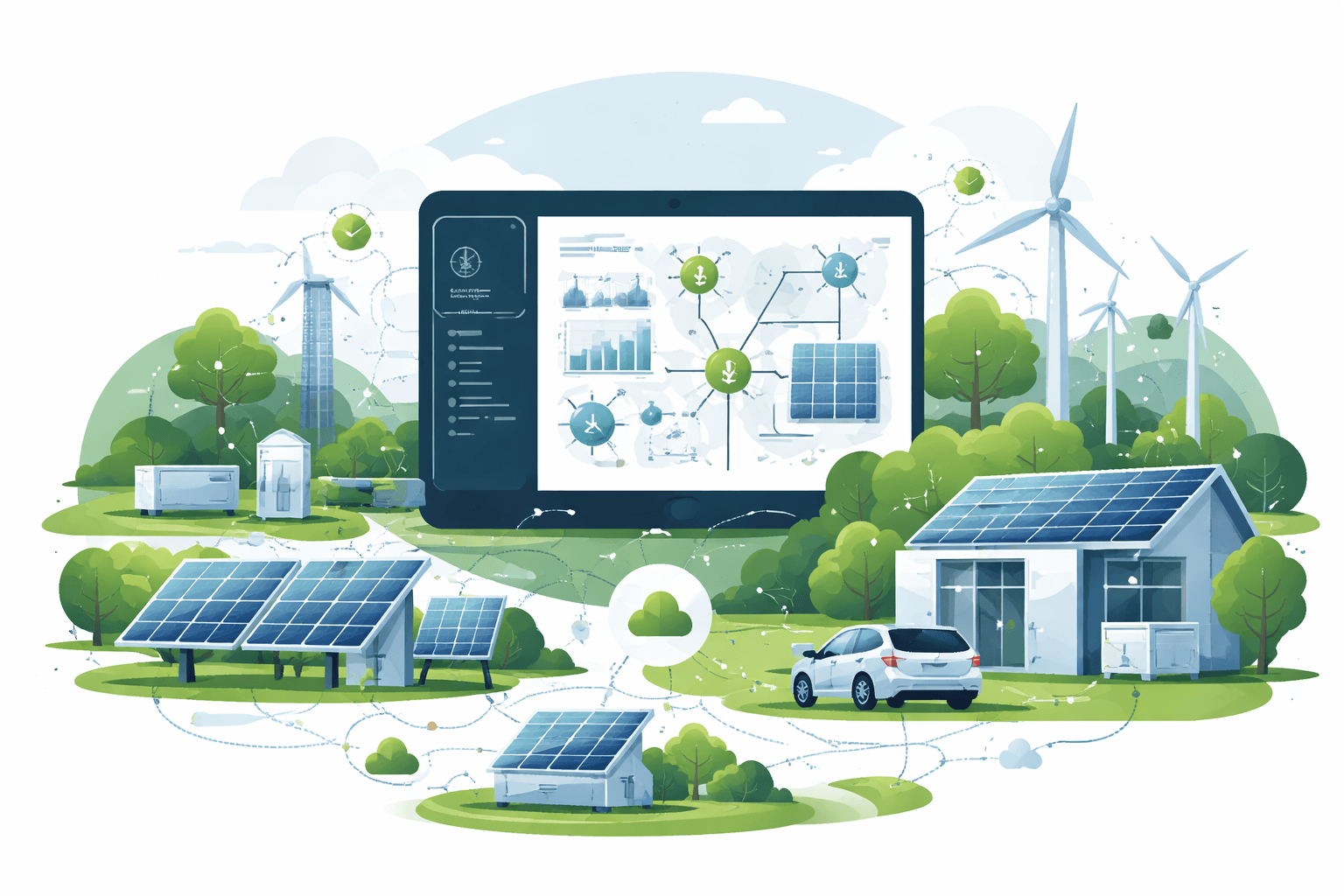
A virtual power plant is a coordinated network of distributed energy resources—such as rooftop solar, behind-the-meter batteries, smart thermostats and water heaters, EV chargers, and flexible industrial loads—that are aggregated and dispatched like a single power plant. Instead of one large generator at a substation, a VPP orchestrates thousands of small, controllable devices across homes and businesses to provide grid services on demand.
Key elements of a VPP:
- Aggregation: Enrolling many devices across many customers into a single portfolio.
- Telemetry: Measuring device status and power flows in near real time.
- Control: Sending secure commands (charge, discharge, pre-cool, curtail) to meet a target power profile.
- Market interface: Bidding and settling in wholesale markets, or delivering utility grid services (e.g., capacity, peak shaving) under contract.
The aim is functional equivalence: the VPP offers a dispatchable capacity and energy profile, complete with performance guarantees, ramp rates, and response times comparable to conventional assets.
The Core Purpose: Balance, Reliability, and Cleaner Kilowatts
Electric grids must continuously balance supply and demand. VPPs enhance that balancing act in three ways:
Peak reduction and capacity: By coordinating flexible loads (e.g., raising a setpoint by 1–2°F for 15–30 minutes) and dispatching batteries, VPPs reduce net load at peak. This can defer or avoid fossil peaker plant operations and distribution upgrades, cutting costs and emissions. Analyses by NREL and RMI indicate VPPs can deliver capacity at a fraction of the cost of new peakers when scaled across large customer fleets.
Fast, precise response: Modern inverters and digital controls can respond in sub-seconds, suitable for frequency regulation and contingency reserves. That speed matters as inverter-based renewables grow and inertia from synchronous generators declines.
Renewable integration: VPPs soak up midday solar (charging batteries, precooling buildings, shifting EV charging) and discharge or curtail loads during evening ramps. This reduces curtailment and reliance on high-marginal-emission generators.
In practice, a VPP might commit 50 MW of capacity to a regional market, deliver frequency regulation at 4-second intervals, and provide local grid relief during a feeder contingency—all using assets behind customers’ meters.
How Virtual Power Plant Technology Works
VPPs are enabled by a layered technology stack spanning edge devices, connectivity, control software, analytics, and market operations.
Edge devices and metering
Smart meters (AMI): Provide interval usage data (typically 5–15 minutes) and, in some jurisdictions, near-real-time telemetry. AMI supports measurement and verification (M&V) for program payments.
Controllable DERs: Inverter-based resources (rooftop PV, batteries), EV chargers, smart thermostats, water heaters, heat pumps, and commercial building automation systems (BAS). Modern inverters that comply with IEEE 1547-2018 can provide volt/VAR support, frequency-watt response, and ride-through capabilities—essential for grid services.
Edge gateways: Local controllers that aggregate device data, execute control logic, and maintain secure communications even during WAN interruptions.
Connectivity and protocols
Device-level: OpenADR (demand response signaling), IEEE 2030.5 (DER communications), SunSpec (inverter interoperability), OCPP (EV charger control), BACnet/Modbus (BAS/industrial), and MQTT/HTTP(S) for lightweight IoT messaging.
Cybersecurity: TLS for encryption in transit, hardware root of trust and secure boot at the edge, certificate-based authentication, and role-based access control aligned with NISTIR 7628 (smart grid cybersecurity) and IEC 62443 (industrial control security) practices.
DERMS and orchestration software
DERMS (Distributed Energy Resource Management System): The control plane that enrolls devices, validates telemetry, enforces constraints, and executes dispatch strategies. A DERMS coordinates across fleets and geographies, respecting feeder and transformer limits to avoid local overloads.
Optimization engine: Solves a multi-objective problem—meeting market commitments, minimizing customer discomfort, respecting device state-of-charge and cycling limits, and avoiding network constraints. Technologies include model predictive control (MPC), stochastic optimization, and reinforcement learning.
Forecasting: Short-term load, PV, and price forecasts at 5–60 minute horizons; day-ahead forecasts for market bidding; seasonal outlooks for resource planning. Weather-normalized baselining is critical for fair settlement.
Market interface: Bidding and scheduling into capacity, energy, and ancillary services markets; telemetry to the ISO/RTO (often 2–6 second intervals for regulation); and settlement data flows.
For more on predictive models and grid-operations AI, see our deep dive on AI in renewable energy (/sustainability-policy/ai-applications-renewable-energy-use-cases-roi) and how digital twins improve planning (/ai-technology/digital-twin-for-energy-systems-what-it-is-and-why-it-matters).
Real-time control and grid integration
Setpoint orchestration: Thermostat adjustments, EV charge rate changes, water heater duty cycling, and battery dispatch are coordinated to match a target dispatch curve.
Feedback and verification: The VPP monitors telemetry to confirm response, adjusts for non-performing assets, and recomputes dispatch every few seconds to minutes.
Grid-aware constraints: Feeder loading limits, voltage bounds, and protection settings are respected using topology-aware models. Increasingly, utilities provide distribution operating envelopes that aggregators must honor.
Resilience modes: During outages, behind-the-meter assets may island to power critical loads. Post-restoration, the VPP stages device reconnection to avoid cold-load pickup surges.
By the Numbers
Response speed: Inverter-based DERs can respond in under 1 second; frequency regulation signals in wholesale markets typically update every 2–6 seconds.
Typical device capacities: Residential batteries are often 5–15 kW (power) with 10–20 kWh energy; smart thermostats can reduce 0.5–2 kW per home during short events; Level 2 EV chargers draw 7–11 kW and can modulate most or all of that load.
Portfolio math: 10,000 homes each providing 2 kW of flexible capacity yields ~20 MW. If half of those homes also have 10 kWh batteries, that adds ~50 MWh of dispatchable energy.
Efficiency and wear: Battery round-trip efficiency is commonly 88–95%; algorithmic constraints limit equivalent full cycles to preserve warranty life (e.g., <150 cycles/year for grid services on residential systems).
Emissions impact: Avoiding a typical gas peaker dispatch can avert 0.4–0.7 tCO2/MWh depending on the region’s marginal generator, according to EPA and ISO emissions factors.
These operational metrics underpin utility and ISO qualification for products like capacity, regulation, spinning reserve, and local non-wires alternatives.
Benefits and Use Cases
For grid operators and utilities
Peak demand reduction and capacity: VPPs reduce peak loads, cutting capacity procurement and distribution upgrade needs. Utility pilots documented by the Electric Power Research Institute (EPRI) show aggregated thermostats and water heaters reliably deliver coincident-peak reductions at scale when paired with robust M&V.
Ancillary services: Fast-responding batteries and controllable loads provide frequency regulation and contingency reserves with high accuracy, improving system stability as inverter-based resources grow.
Non-wires alternatives (NWAs): Targeted dispatch on constrained feeders defers substation upgrades. VPPs can be procured via locational solicitations with clear performance metrics.
Renewable integration: Midday solar absorption (charging) and evening discharge reduce curtailment and smooth ramps, improving renewable utilization and economics.
For businesses and consumers
- Bill savings: Commercial participants can cut demand charges and earn demand response incentives; residential participants receive bill credits or payments for events. Smart EV charging shifts load to off-peak rates automatically.

ecobee Smart Thermostat Premium with Smart Sensor and Air Quality Monitor - Programmable Wifi Thermostat - Works with Siri, Alexa, Google Assistant - Amazon.com
View on AmazonResilience: Homes and facilities with batteries maintain critical loads during outages; VPP participation can offset a portion of battery ownership costs over time. For an overview of home battery options and considerations, see our buyer’s guide (/green-business/tesla-powerwall-buyers-guide-cost-installation-alternatives).
Comfort-aware flexibility: Algorithms prioritize comfort and process constraints—e.g., pre-cooling a building to reduce peak HVAC power with minimal occupant impact.
For clean energy and climate
Faster, cheaper capacity: Studies by DOE, NREL, and the Rocky Mountain Institute indicate VPP capacity can be deployed in months versus years for new peaker plants, at lower levelized capacity costs when scaled.
Emissions reductions: Avoided peaker operations and improved renewable utilization reduce marginal CO2 and local air pollutants (NOx), with public health co-benefits in urban areas.
Electrification enabler: By making flexible load a feature, not a bug, VPPs support the addition of heat pumps and EVs without proportionate peak growth.
Program Designs and Market Participation
Retail programs: Utilities contract aggregators to deliver local capacity, peak shaving, or feeder relief. Customers enroll devices and receive incentives; dispatch is event-based or continuous.
Wholesale aggregation: In ISO/RTO regions implementing FERC Order 2222, aggregators bid into capacity, energy, and ancillary services markets under new DER aggregation rules. Compliance includes telemetry, minimum aggregation sizes, and performance penalties.
Tariffs and rates: Time-of-use and real-time pricing improve VPP economics by aligning dispatch with system value. Dynamic rates increase the value of automated load shifting via thermostats, EVs, and water heaters. For building-side optimization tools that dovetail with VPPs, see AI tools for energy efficiency (/sustainability-policy/ai-tools-for-energy-efficiency-practical-guide).
Measurement, Verification, and Performance Guarantees
Delivering grid value requires rigorous M&V:
Baselines: Weather-normalized usage models estimate what consumption would have been without dispatch. Baseline accuracy directly affects payments and penalties.
Telemetry: Device- or premise-level metering with sufficient granularity (seconds for ancillary services; minutes for capacity and peak shaving) demonstrates delivered kW and kWh.
Availability and response: Contracts specify minimum availability windows, ramp rates, and response accuracy (e.g., ±5% of dispatch target), with clawbacks for underperformance and bonuses for overperformance.
Challenges and Considerations
Cybersecurity: A compromised aggregator or device fleet poses systemic risk. Best practice includes segmentation, least-privilege access, anomaly detection, secure firmware updates, and third-party penetration testing aligned with NIST and IEC standards.
Customer participation and retention: Enrolling enough devices to deliver contracted capacity requires clear value propositions, simple onboarding, and automated control that respects comfort and process constraints. Churn must be offset with continuous recruitment.
Regulatory barriers and market rules: Full implementation of FERC Order 2222 varies by ISO/RTO, with differences in minimum aggregation sizes, telemetry requirements, and distribution-utility coordination. Outside wholesale markets, state rules determine which services aggregators can provide.
Interoperability: Fragmented device ecosystems and proprietary APIs raise costs. Adoption of open standards (OpenADR, IEEE 2030.5, OCPP, SunSpec) and certification programs is critical.
Distribution coordination: Aggregated dispatch must honor feeder and transformer limits. Increasing use of distribution system operator (DSO)-like coordination and operating envelopes is required as penetration rises.
Equity and access: Programs should avoid excluding renters or low-to-moderate income customers and ensure benefits flow to communities historically affected by peaker emissions.
Scalable infrastructure: AMI upgrades, low-latency communications, and utility IT/OT integration are prerequisites for high-quality telemetry and control at scale.
The Technology Roadmap: What’s Next
Market maturation under FERC Order 2222: As U.S. ISOs/RTOs finalize and implement DER aggregation participation models, expect larger VPP portfolios offering multi-product stacks (capacity + regulation + local relief) with locational value.
AI-native orchestration: Improved probabilistic forecasts and reinforcement learning will tighten dispatch accuracy and expand participation to devices with more variable behavior. Explore broader grid AI use cases in our analysis (/sustainability-policy/ai-applications-renewable-energy-use-cases-roi).
Vehicle-to-grid (V2G) and managed charging: Bidirectional EVs will add both flexible load and dispatchable energy; even unidirectional managed charging can shift gigawatts of load when EV adoption is high. Open standards like ISO 15118-20 and maturing OCPP profiles will be key.
Digital twins for planning and operations: High-fidelity distribution twins will help validate VPP dispatch against network constraints, support locational pricing signals, and de-risk NWAs. See our primer on grid digital twins (/ai-technology/digital-twin-for-energy-systems-what-it-is-and-why-it-matters).
Retail-transactive alignment: Dynamic tariffs and retail marketplaces will increasingly align customer incentives with system needs, enabling finer-grained, automated response.
Hardware advances: Next-gen inverters with grid-forming capabilities, higher-efficiency heat pumps with thermal storage integration, and more durable batteries (including LFP and emerging chemistries) expand the reliability and duration a VPP can offer.
What It Means for Stakeholders
Utilities: Treat flexibility as a plan-able, procure-able resource. Build distribution visibility, standardize telemetry, and create clear, bankable performance contracts for aggregators. Target locational needs first for high ROI.
Aggregators and technology providers: Invest in interoperability, cyber-hardening, and rigorous M&V. Stack multiple value streams while respecting customer constraints and grid limits.
Policymakers and regulators: Finalize market access frameworks, streamline device interconnection, enable third-party access to meter data with privacy protections, and design equitable incentives.
Businesses and building owners: Leverage BAS upgrades, thermal storage, and EV fleet management to capture demand charge savings today while preparing to monetize flexibility as VPP markets expand.
Households: Smart thermostats, controllable water heaters, and home batteries can earn payments with minimal lifestyle impact when automated. Enrollment simplicity and transparent incentives drive participation.
Virtual power plant technology is evolving quickly, but the core insight is stable: software-coordinated DERs are now responsive and reliable enough to serve the grid like a power plant—often faster, cleaner, and cheaper than building new peak generation.

JuiceBox 40 Smart Electric Vehicle (EV) Charging Station with WiFi - 40 amp Level 2 EVSE, 25-Foot Cable, UL & Energy Star Certified, Indoor/Outdoor Use (Hardwired Install, Gray) : Automotive
View on AmazonRecommended Products
Power after Carbon: Building a Clean, Resilient Grid: Fox-Penner, Peter
In Power after Carbon, Peter Fox-Penner tackles the many thorny questions that arise, presenting a vision for how change is possible, if we rise to the occasion.”―Jeremy Grantham, Cofounder and Chief
ecobee Smart Thermostat Premium with Smart Sensor and Air Quality Monitor - Programmable Wifi Thermostat - Works with Siri, Alexa, Google Assistant - Amazon.com
ecobee Smart Thermostat Premium with Smart Sensor and Air Quality Monitor - Programmable Wifi Thermostat - <strong>Works with Siri, Alexa, Google Assistant</strong> - Amazon.com
JuiceBox 40 Smart Electric Vehicle (EV) Charging Station with WiFi - 40 amp Level 2 EVSE, 25-Foot Cable, UL & Energy Star Certified, Indoor/Outdoor Use (Hardwired Install, Gray) : Automotive
Buy JuiceBox 40 Smart Electric Vehicle (EV) Charging Station with WiFi - 40 amp Level 2 EVSE, 25-Foot Cable, UL & Energy Star Certified, Indoor/Outdoor Use (Hardwired Install, Gray): Charging Stat