
AI in Renewable Energy: Applications, Risks, and a Roadmap for Adoption
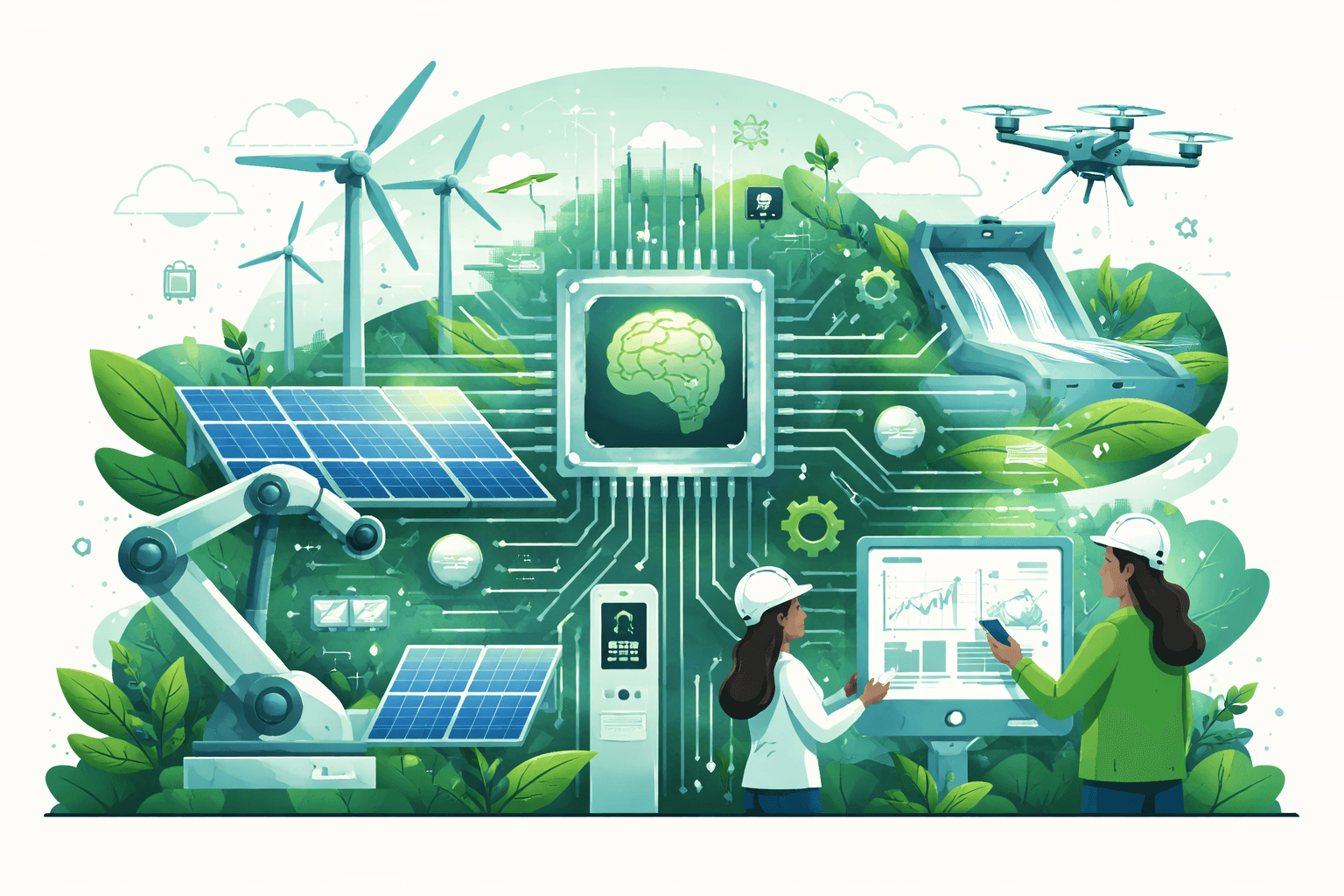
Opening insight: Renewable capacity additions jumped roughly 50% in 2023 to about 510 GW, the fastest growth in at least two decades, according to the IEA. As variable renewables (solar and wind) scale, operators are turning to AI in renewable energy solutions to forecast generation, stabilize grids, and wring more performance from assets without adding steel or silicon. This guide maps where AI is working today, what it takes to deploy safely, and how leaders can build an adoption roadmap that delivers measurable ROI while managing risk. For a primer on technologies in the mix, see our overview of Renewable Energy Sources: A Clear Guide to Solar, Wind & More.
Where AI Creates Value Across the Renewable Lifecycle
Renewable Energy Integration: Practical Management of Variability, Uncertainty, and Flexibility in Power Grids: Jones, Lawrence E.
Renewable Energy Integration: Practical Management of Variability, Uncertainty, and Flexibility in Power Grids, Second Edition, <strong>offers a distilled examination of the intricacies of integrating
Check Price on AmazonShort-term and seasonal forecasting
Short-term forecasts (minutes to days ahead) feed unit commitment, market bids, and reserve scheduling; seasonal forecasts inform maintenance windows and hedging. Machine learning (ML) models that blend numerical weather prediction (NWP) with historical plant output consistently reduce error compared with persistence or single-source NWP.
- Impact: NREL-led studies report 15–30% reductions in 1–6 hour-ahead mean absolute percentage error (MAPE) for solar when ML augments satellite nowcasting and NWP. Several ISOs/TSOs have documented lower balancing costs when forecast error drops by similar margins.
- KPI examples: MAPE and MAE for each forecast horizon; ramp event hit rate and false alarm rate; reduction in regulation/upreserve procurement ($/MWh); realized vs. day-ahead schedule “value capture.”
- Case in point: Google/DeepMind reported increasing the day-ahead market value of a US wind portfolio by ~20% by using improved wind forecasts to shape bids and timing (2019 pilot disclosure).
What’s under the hood: Gradient-boosted trees or random forests frequently outperform for tabular, site-specific forecasting when data is moderate; deep learning architectures (LSTMs, temporal convolutional networks, and increasingly transformers) shine when fusing multi-source spatiotemporal data such as satellite imagery, Doppler radar, and mesoscale NWP ensembles.
Predictive maintenance and reliability analytics
Wind and solar plants already stream high-frequency SCADA data; adding condition-monitoring (gearbox vibration, generator partial discharge, blade acoustic sensors, thermal imagery) enables models to detect incipient faults days to weeks ahead.

FLIR C5 Compact Thermal Imaging Camera with Wifi: ...
View on Amazon- Impact: Industry analyses from DNV, IEA Wind Task forces, and OEM field programs indicate predictive maintenance can reduce O&M costs by 10–20%, cut unplanned downtime by 20–50% for targeted failure modes, and lift fleet availability by 0.5–2 percentage points. Because energy yield is roughly proportional to availability, those percentage points convert directly to MWh.
- KPI examples: Availability (%), forced outage rate (EFOR), mean time between failures (MTBF), lead time to detection, maintenance cost ($/kW-year), MWh lost vs. baseline, model precision/recall for fault detection to minimize truck rolls.
- Techniques: Supervised learning on labeled alarms and failure histories; unsupervised anomaly detection for rare faults; computer vision for drone or fixed-camera blade inspections; physics-informed ML to respect thermal limits and drivetrain dynamics.
Grid optimization and demand response (DR)
As solar and wind shares rise, real-time balancing and flexibility become more valuable. AI helps distribution utilities and aggregators forecast feeder load, detect congestion, and orchestrate flexible demand across commercial buildings, EV chargers, and thermostats.
- Impact: Evaluations by Lawrence Berkeley National Laboratory (LBNL) show automated DR can reduce peak demand for participating commercial buildings by 10–20% with minimal comfort impacts when controls are optimized. At system scale, better net-load forecasting reduces regulation and spinning reserve needs.
- KPI examples: Peak reduction (% and kW), response time (seconds), telemetry accuracy, customer opt-out rate, locational marginal price (LMP) savings, avoided curtailment (MWh) on high-renewable days.
- Methods: Reinforcement learning (RL) policies or model predictive control (MPC) that co-optimize comfort, process constraints, and energy cost/emissions; probabilistic forecasting to quantify uncertainty for operators.
Storage management and asset performance
Battery energy storage systems (BESS) and hybrid plants rely on precise, constraint-aware dispatch to maximize revenue and lifetime. AI policies that consider price, state of charge, temperature, and degradation models can outperform heuristic rules.
- Impact: NREL modeling indicates that optimized dispatch can increase merchant revenue by 5–12% versus simple heuristics and extend battery life by 10–20% via cycle-aware control and thermal management.
- KPI examples: Revenue capture ratio vs. perfect foresight (%), equivalent full cycles, degradation rate (% capacity loss/year), round-trip efficiency, constraint violations (count), state-of-health trend.
- Extensions: Hybrid plant co-optimization (PV + storage + grid services), inverter clipping recovery, curtailment harvesting, and emissions-aware dispatch that targets hours with high marginal grid emissions to amplify CO2 reductions.
Active power control and plant-level optimization
AI is moving from advisory analytics to closed-loop control where regulations permit.
- Wind wake steering: Field trials coordinated by NREL and industry partners have reported 1–3% increases in annual energy production (AEP) by yawing upstream turbines slightly to direct wakes away from downwind units under certain wind conditions. That gain often rivals the energy boost from costly hardware retrofits.
- Solar tracking and soiling: ML models adapt tracker backtracking angles to terrain and shading patterns and optimize wash schedules based on predicted soiling, improving yield by 0.5–1.5% in arid sites.
- Grid support: Fast frequency response and voltage regulation from inverter-based resources increasingly use learning-based controllers, subject to stringent stability testing and grid codes.
For context on wind sector dynamics that make such optimizations valuable, see our analysis of Wind Energy Growth: Analyzing the Global Shift to Offshore Wind Farms.
By the Numbers: What Operators Can Expect
- 15–30% reduction in near-term solar forecast error (MAPE) when ML augments NWP and satellite nowcasting (NREL and TSO/ISO case studies).
- ~20% higher market value for wind portfolios when better forecasts inform day-ahead scheduling (Google/DeepMind pilot).
- 10–20% O&M cost reduction and 0.5–2 percentage-point availability gains from predictive maintenance (DNV, IEA Wind program data, OEM reports).
- 10–20% peak demand reduction for participating commercial sites via automated demand response (LBNL program evaluations).
- 5–12% higher storage revenue and 10–20% longer life from cycle-aware dispatch optimization (NREL modeling).
- 1–3% AEP gains from wind wake steering under favorable conditions (NREL field trials with operators).
Technical and Data Prerequisites
Data sources and required fidelity
- SCADA and historian data: Turbine and inverter telemetry (power, wind speed, rotor speed, yaw/pitch, temperatures, alarms). Typical resolutions: 1-second to 10-minute. Historian platforms (e.g., PI Systems) must expose time-series via secure APIs.
- Condition monitoring and IoT sensors: Vibration (gearbox/bearings), oil particle counts and temperature, electrical partial discharge, acoustic/ultrasound, pyranometers, anemometers, soiling sensors, IR cameras, drone imagery.
- Weather and satellite: NWP (ECMWF, GFS, HRRR), mesoscale reanalysis, geostationary satellite imagery (GOES, Meteosat), lightning data, ceilometers/cloud cameras.
- Market and grid: Day-ahead and real-time LMPs, ancillary service prices, interconnection limits, congestion data; emissions intensity or marginal emissions signals if emissions-aware optimization is a goal.
Data quality requirements: synchronized timestamps (time drift <1 s for control use, <1 min for forecasting), rigorous sensor calibration schedules, metadata for each asset (turbine model, hub height, location, maintenance history), and clear master data management to resolve asset IDs across SCADA, CMMS, and market systems.
Model classes that fit the problems
- Forecasting: Gradient-boosted trees (XGBoost/LightGBM), random forests, generalized additive models for interpretability, and deep learning (LSTM/TCN/transformers) for multivariate spatiotemporal fusion.
- Classification/anomaly detection: One-class SVM, isolation forests, autoencoders, and Bayesian changepoint detection for sensor drift and incipient faults.
- Computer vision: CNNs and vision transformers for blade/solar panel defect detection using RGB, IR, or hyperspectral imagery.
- Control and bidding: Reinforcement learning (policy gradients, DQN variants) and model predictive control (MPC) with embedded degradation and grid constraints.
- Digital twins: High-fidelity physics models of turbines, inverters, and feeders coupled with learned residual models for faster simulation and scenario testing.
Integration with OT/SCADA and cloud/edge platforms
- Protocols and standards: OPC UA; IEC 61400-25 (wind), IEC 61850 (substation automation), DNP3, Modbus. Ensure read-only data diodes for analytics where required and write pathways only for approved control loops.
- Edge vs. cloud: Edge inference for low-latency control (tens of milliseconds to seconds), resilience during backhaul outages, and data minimization. Cloud for training on months-to-years of fleet data and cross-site model generalization.
- Messaging and storage: Time-series databases, MQTT/Kafka for streaming, feature stores for consistent training/serving, and model registries for versioning.
- MLOps: CI/CD for models, shadow mode deployments, canary rollouts, monitoring for data drift, and automated rollback triggers.

NVIDIA Jetson Orin Nano Super Developer Kit : Electronics
View on AmazonScalability and validation
- Statistical validation: Rolling-origin cross-validation for time series; backtesting against multi-year weather regimes; probabilistic calibration checks (sharpness, reliability diagrams) when models output quantiles.
- Operational validation: Run in advisory (shadow) mode for at least one seasonal cycle; A/B test across matched assets; predefine success criteria (e.g., ≥10% forecast MAPE reduction, ≥1% AEP gain) before go/no-go.
- Safety: Hard bounds and interlocks when moving to closed-loop control; independent verification of stability for inverter-based resources under grid codes.
Risks, Barriers, and How to Mitigate Them
Data quality, scarcity, and privacy
- Challenge: Missing or biased labels for failures, sensor drift, and non-stationarity due to repowering or control changes can degrade models. Customer DR data and home energy profiles trigger privacy obligations.
- Mitigation: Data governance with quality SLAs, automated anomaly detection for sensors, rigorous calibration, and augmentation with physics-informed features. Adopt privacy-by-design: data minimization, consent management, and differential privacy or federated learning where raw data cannot leave customer sites.
Cybersecurity in critical infrastructure
- Challenge: AI expands the attack surface by adding data pipelines, APIs, and edge devices to operational technology (OT) networks already targeted by sophisticated threats. Compliance regimes (NERC CIP in North America; IEC 62443 internationally) are tightening.
- Mitigation: Zero-trust architecture, network segmentation, secure boot and code signing for edge devices, software bill of materials (SBOM) for model runtimes, rigorous identity and access management, and continuous vulnerability scanning. Perform red-team exercises and failure-mode analyses before granting write access to controls.
Model explainability and regulatory compliance
- Challenge: Grid operators and regulators require transparent, auditable decisions—especially for market bids, protection settings, and reliability-critical functions. The EU AI Act is introducing risk tiers and documentation duties; market rules (e.g., FERC Order 2222 in the US) enable DER aggregation but impose telemetry and performance requirements.
- Mitigation: Use interpretable models where stakes are high; pair complex learners with SHAP, partial dependence, and counterfactual explanations. Maintain model cards, data lineage, and decision logs. Keep a human-in-the-loop for market and safety-critical actions.
Workforce and capital constraints
- Challenge: Scarce data talent, change-management hurdles for O&M crews, and upfront integration costs.
- Mitigation: Start with highest-ROI use cases; align incentives by tying savings to site teams’ KPIs; upskill technicians as “analytics translators.” For sector career pathways, see our guide to Renewable Energy Job Opportunities: Sectors, Skills, Market Outlook and How to Break In.
Model robustness under climate volatility
- Challenge: Historical weather no longer fully represents future extremes. Models trained on the past may underperform on heat waves, wildfire smoke, or shifting wind regimes.
- Mitigation: Continual learning with online updates, stress testing using climate-conditioned scenarios, and synthetic data to represent rare but consequential events.
Real-World Examples and Forward Signals
Concise case studies with measurable outcomes
- Wind value optimization: Google/DeepMind’s day-ahead forecasting for a US wind portfolio increased realized market value by about 20% by timing commitments to higher-price hours (public pilot report, 2019). This illustrates how better forecasts translate to revenue—not just lower error metrics.
- Fast frequency and system savings: Australia’s Hornsdale Power Reserve (initially 100 MW/129 MWh, later expanded) has provided rapid frequency control and inertia-like services; analyses by the Australian Energy Market Operator and the Australian Energy Regulator estimated consumer savings on the order of A$150 million in the first two years of operation due to reduced reliance on expensive contingency services—enabled by automated control algorithms.
- Wake steering gains: NREL-coordinated field experiments with operators have measured 1–3% AEP improvements by applying data-driven yaw strategies under specific wind conditions, demonstrating plant-level AI control can deliver utility-scale energy gains without new turbines.
- Distribution-level DR: LBNL evaluations of automated DR across commercial portfolios report 10–20% load sheds during events with persistence across multiple seasons when building analytics continuously tune setpoints and pre-cool/pre-heat strategies.
Emerging trends to watch
- Edge AI at the asset and feeder: More inference is moving on-turbine, in-inverter, and at substations to reduce latency and backhaul needs, with ruggedized accelerators and containerized runtimes.
- Federated learning: Fleet operators train shared models across multiple owners or sites without centralizing raw data—boosting accuracy while respecting privacy and data-sovereignty constraints.
- Synthetic data and digital twins: To overcome rare-failure data gaps, operators blend physics-based simulation with generative techniques to produce realistic fault signatures for training and to rehearse extreme grid events.
- Emissions-aware optimization: Incorporating marginal emissions forecasts into dispatch and DR can cut operational CO2 beyond simple kWh savings; analyses by RMI and grid emissions data providers suggest 5–15% additional emissions reduction when flexible loads target the cleanest hours.
- Policy and market design: Implementation of FERC Order 2222 in US wholesale markets expands the revenue stack for AI-orchestrated distributed energy resources (DERs). Grid codes are evolving to standardize performance verification for inverter-based resources, opening more pathways for closed-loop AI control.
AI in Renewable Energy Solutions: A Practical Adoption Roadmap
- Prioritize use cases by quantified value
- Build a merit order: rank forecasting, predictive maintenance, storage optimization, DR, and plant control by expected $/kW-year impact and feasibility. Establish baselines (current MAPE, availability, O&M costs, curtailment).
- Audit data and controls
- Inventory SCADA, historian, CMMS, and market data. Map protocols (OPC UA, IEC 61850/61400-25, Modbus/DNP3). Close gaps in timestamp synchronization and sensor calibration. Define data governance and access controls early.
- Choose the right model and deployment pattern
- Start with interpretable models where stakes are high; graduate to deep learning for multi-source fusion. Train in cloud, infer at the edge for low-latency control. Use a feature store and model registry to keep training/serving consistent.
- Validate with discipline
- Backtest over multiple years; run shadow mode through at least one high-renewable season. Predefine success criteria (e.g., ≥15% forecast error reduction, ≥1% AEP gain, ≥10% DR peak reduction) and require statistical significance.
- Integrate with operations
- Embed outputs into operator tools and maintenance workflows. For closed-loop control, implement guardrails: hard bounds, rate limiters, and human override. Align site-team incentives with the AI’s performance goals.
- Govern, secure, and scale
- Stand up model risk management: documentation, explainability, and periodic revalidation. Embed cybersecurity from day one. Expand across sites via federated learning and templates. Track outcomes on a management dashboard that ties AI performance to cost, revenue, and emissions KPIs.
For a broader view of adjacent innovations that often complement AI—advanced materials, robotics, next-gen storage—see Green Tech Innovations: 10 Technologies Shaping a Sustainable Future.
Practical Implications for Stakeholders
- Plant owners/operators: Expect the fastest payback from forecasting (reduced imbalance costs) and predictive maintenance (avoided failures), followed by storage optimization. Budget for data cleanup and integration; that’s where many timelines slip.
- Utilities and ISOs/TSOs: Prioritize probabilistic forecasts and uncertainty-aware scheduling. Invest in data sharing standards and APIs to enable DER aggregation under evolving market rules.
- Policymakers and regulators: Encourage data transparency (anonymized, privacy-preserving) and performance-based incentives that reward verified reductions in balancing costs, curtailment, and emissions. Clarify AI documentation and testing requirements for grid-critical functions.
- Corporate energy buyers: When procuring VPPA or storage-backed PPAs, request counterparty disclosures on forecasting accuracy, curtailment risk, and emissions-aware dispatch to de-risk performance and climate claims.
AI in renewable energy solutions are maturing quickly from pilots to core operations. The operators that win will combine high-quality data, disciplined validation, and human-centered integration to turn algorithms into reliable capacity, lower costs, and lower emissions.
Recommended Products
Renewable Energy Integration: Practical Management of Variability, Uncertainty, and Flexibility in Power Grids: Jones, Lawrence E.
Renewable Energy Integration: Practical Management of Variability, Uncertainty, and Flexibility in Power Grids, Second Edition, <strong>offers a distilled examination of the intricacies of integrating
FLIR C5 Compact Thermal Imaging Camera with Wifi: ...
<strong>One - Thermal Imaging Camera for iOS Smartphones (iPhone 15 and Newer w/USB-C), 240x180 Super Resolution (80x60 Native IR)</strong> · One - Thermal Imaging Camera for Android Smartphones (USB-
NVIDIA Jetson Orin Nano Super Developer Kit : Electronics
The NVIDIA Jetson Orin Nano Developer Kit <strong>sets a new standard for creating entry-level AI-powered robots, smart drones, and intelligent cameras</strong>,and simplifies getting started with the
More in Sustainability Policy
- AI in Renewable Energy: Use Cases, Measurable Impacts, and How to Deploy
- AI Tools for Energy Efficiency: Practical Guide to Technologies, Benefits, and Real-World Implementation
- Renewable Energy Trends 2023: Deployment, Tech Breakthroughs, Policy Shifts and Market Risks
- Using AI for Energy Efficiency: Use Cases, Benefits, Risks, and How to Start