
Commercial EV Fleet Management: A Practical Guide to Running Electric Fleets
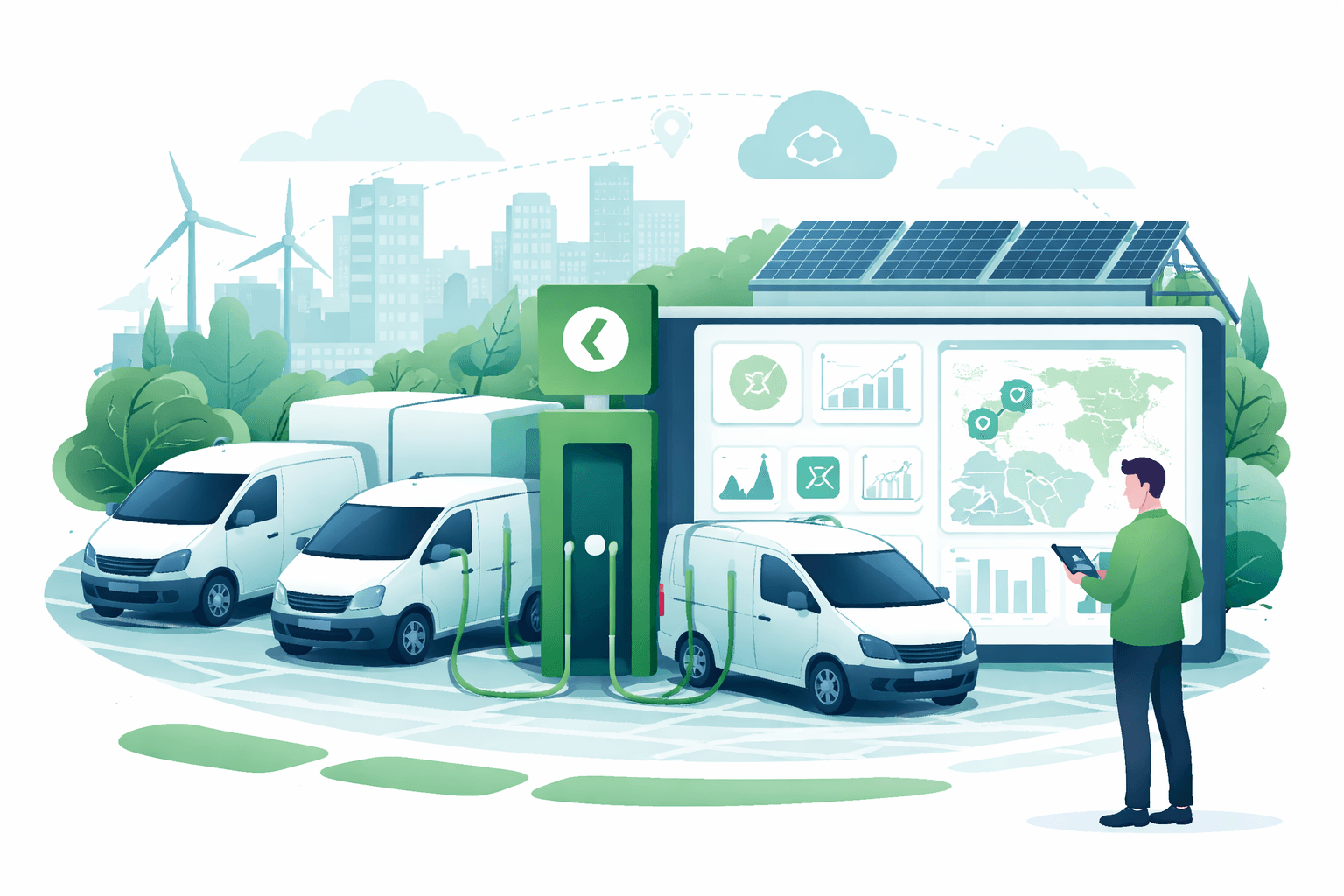
Commercial EV fleet management is moving from pilot to mainstream because the economics are finally compelling. For common light‑ and medium‑duty duty cycles, electricity can cut fuel spending to roughly $0.06–$0.12 per mile versus $0.25–$0.40 per mile for gasoline and diesel, depending on local tariffs and fuel prices (U.S. DOE Alternative Fuels Data Center, NREL). Multiple studies report 30–40% lower maintenance costs for battery‑electric vehicles thanks to fewer moving parts and regenerative braking (DOE, Consumer Reports). Managed charging—software that shifts and throttles charging to cheaper hours—can reduce depot electricity bills by 20–60% under time‑of‑use rates (NREL). This guide explains how commercial EV fleet management works, what to measure, and how to scale reliably and cost‑effectively.
What is commercial EV fleet management—and why it matters
Commercial EV fleet management is the set of strategies, tools, and day‑to‑day practices used to plan, operate, charge, maintain, and optimize a fleet of battery‑electric vehicles (and the charging systems that support them). For organizations transitioning from internal combustion engines (ICE) to electric fleets, it ties together vehicle selection, depot and on‑route charging, energy and maintenance budgeting, driver behavior, and reporting on costs and emissions.
Why it matters now:
- Energy and maintenance savings can push total cost of ownership (TCO) below ICE for many urban and regional use cases, even before accounting for incentives (NREL, ICCT, BNEF).
- Policy is accelerating adoption: jurisdictions such as California have adopted rules steering medium‑ and heavy‑duty fleets toward zero‑emission purchases over time, and the U.S. federal 45W Commercial Clean Vehicle Credit provides up to $7,500 for light‑duty and up to $40,000 for heavier vehicles.
- Customers and investors increasingly expect decarbonization roadmaps; electrifying fleets reduces Scope 1 tailpipe emissions immediately and creates a credible pathway to longer‑term net‑zero goals.
If you need a step‑by‑step program for getting started, see our broader planning overview in Electric Fleet Transition Guide: How to Plan, Launch, and Scale a Successful EV Fleet (/sustainability-policy/electric-fleet-transition-guide-plan-launch-scale-ev-fleet).
By the numbers: EV fleet operations at a glance
- Energy cost per mile: roughly $0.06–$0.12 (2–3 mi/kWh; $0.12–$0.30/kWh), versus $0.25–$0.40 for gasoline/diesel vans and MD trucks ($3.50–$5.00/gal at 10–20 mpg). Sources: DOE AFDC, NREL.
- Maintenance: 30–40% lower scheduled maintenance costs for EVs due to no oil changes, fewer filters, and less brake wear. Sources: DOE, Consumer Reports, NREL.
- Range and weather: Cold conditions can reduce usable range by 20–40% depending on HVAC loads; pre‑conditioning and heat pumps mitigate this. Source: AAA, NREL.
- Managed charging: 20–60% bill savings by shifting to off‑peak and limiting coincident demand. Source: NREL managed charging studies.
- Utility interconnection: Service upgrades for large depots can take 6–24+ months; engage utilities early. Source: SEPA utility surveys and transportation electrification reports.
- Emissions: Battery‑electric trucks and buses can deliver 60–90% lower lifecycle GHG emissions than diesel depending on grid mix and duty cycle. Source: ICCT lifecycle analyses.
Core operational considerations for commercial EV fleet management
Vehicle selection and right‑sizing
- Duty cycle first. Map daily miles, dwell time windows, payload, and auxiliary loads (e.g., PTOs, refrigeration). Urban delivery, service, and shuttle routes with 60–150 miles/day and predictable parking windows are prime candidates.
- Match battery to route, not vice versa. Bigger packs add cost, weight, and charge time. Choose the smallest battery that reliably meets the worst‑case route with weather and degradation buffers.
- Payload and volume. Check gross vehicle weight rating (GVWR) and axle limits; heavier batteries can reduce payload. Many OEMs offer EV variants with reinforced suspensions to maintain usable payload.
- Charging speed compatibility. Ensure vehicle onboard charging hardware supports planned depot Level 2 (AC) or DC fast charging (DCFC) rates.
Charging infrastructure strategy
A resilient charging plan blends depot charging, opportunistic workplace charging, and—where necessary—on‑route DC fast charging.

Wallbox Commander 2 electric vehicle charger: adjustable power up to 22 kW, 5 m type 2 charging cable, 7" touch screen, RFID card reader, wifi and Bluetooth, OCPP : Automotive
View on Amazon- Depot Level 2 (AC, 7–19 kW): Best for overnight charging and long dwell times. Lower equipment and installation costs, easier on the grid and the battery.
- Depot DC fast charging (50–350 kW): Required for quick turnarounds, shift changes, and medium/heavy‑duty (M/HD) applications. Higher capex and potential demand charges.
- On‑route/public DCFC: Useful safety net and for regional duty cycles. Build contingency plans given variable uptime of public networks.
- Power availability. Conduct a load study and coordinate with your utility on service capacity, transformer upgrades, and potential new feeders early in the project timeline.
- Oversubscription with smart charging. Many depots can support 2–4 vehicles per charger when schedules are staggered and charging is actively managed.
For an overview of charger types, costs, and integration with on‑site solar or storage, see EV Charging Stations: What You Need to Know About Types, Costs, Installation, and Renewable Integration (/sustainability-policy/ev-charging-stations-types-costs-installation-renewable-integration) and EV Charging Station Installation Cost: What to Expect and How to Plan (/green-business/ev-charging-station-installation-cost).
Route planning, range, and climate impacts
- Plan for weather. Cold temperatures and cabin heating are the biggest range penalties; pre‑condition while plugged in and use heat pumps where available. Hot weather raises battery cooling loads; provide shaded parking if possible.
- Reserve buffers. Target end‑of‑shift state of charge (SOC) above 10–20% and plan routes with a 15–25% energy contingency for detours and traffic.
- Topography matters. Hilly routes consume more energy uphill and recover some downhill via regenerative braking; telematics energy models should reflect elevation and stop‑and‑go intensity.
- Charging windows. Align routes with charger availability and time‑of‑use (TOU) windows to avoid on‑peak demand. For multi‑shift operations, DCFC or battery swapping can sustain utilization; see Charging the Fleet Revolution: Price Parity, Swapping, Smart Charging and Policy Support Are Converging for Medium‑ & Heavy‑Duty EVs (/renewable-energy/charging-the-fleet-revolution-price-parity-swapping-smart-charging-and-policy-support-are-converging-for-medium-heavy-duty-evs).
Maintenance, reliability, and safety
- Preventive maintenance. EVs eliminate oil changes and reduce brake wear; scheduled maintenance focuses on tires, suspension, cabin air filters, thermal system fluids, and high‑voltage inspections.
- Tires and brakes. Instant torque and higher curb weights can increase tire wear in some vocations; regenerative braking generally reduces brake pad replacements substantially.
- High‑voltage safety. Train technicians and drivers on lockout/tagout, orange‑cable awareness, and emergency response. Follow NFPA 70 (National Electrical Code) and local AHJ requirements for electrical rooms and ventilation.
- Charger uptime. Treat charging hardware like critical equipment with SLAs, spare parts, and remote monitoring. Target 97–99% uptime at depots.
- Public charging reliability. Independent field studies have found meaningful portions of public DC fast chargers nonfunctional at a given time; avoid dependence on public networks for mission‑critical routes by prioritizing depot capacity.

NFPA 70, National Electrical Code Handbook, 2023 Edition: National Fire Protection Association (NFPA)
Only the NEC handbook, 2023 edition, ... to the code with the NEC handbook. The NEC 2023 edition is <strong>completely reorganized with renumbered articles for ease of use</strong>...
Check Price on AmazonFor driver and technician care practices that extend EV life, see Essential Guide to Electric Vehicle Maintenance: Care, Safety, and Battery Longevity (/sustainability-policy/essential-guide-electric-vehicle-maintenance-care-safety-and-battery-longevity).
Energy procurement and cost control
- Time‑of‑use optimization. Schedule charging for off‑peak or super off‑peak hours; stagger charging starts to reduce coincident demand.
- Demand charges. Under commercial tariffs, demand charges can dominate early bills when charger utilization is low. Mitigate with managed charging, power sharing, right‑sizing DCFC, and staged capacity additions.
- On‑site generation and storage. Solar PV can shave energy charges; batteries can reduce peak demand. Model economics carefully; revenue stacking (e.g., demand response) improves payback.
- Utility programs. “Make‑ready” incentives can cover a portion of trenching, conduits, and transformers; some utilities offer EV‑specific commercial rates with lower demand components.
How software, telematics, and data make EV fleets work
Data is the backbone of commercial EV fleet management. Modern telematics, charger management systems, and fleet platforms integrate schedules, energy, and vehicle health into a single operational picture.
Telematics and vehicle data
- Real‑time SOC and energy consumption by route segment enable accurate range prediction and exception handling.
- Battery health tracking (state of health, DCFC session count, temperature exposure) informs warranty management and resale planning.
- Driver behavior insights (acceleration, speed, idling with HVAC on) can change energy use by 10–30% across a fleet; coaching improves consistency.
Charger and energy management software
- Smart charging/EMS. Dynamically allocates power across ports to cap site demand and prioritize vehicles with near‑term departures, minimizing demand charges and ensuring readiness.
- Scheduling integration. Imports route rosters so the system knows each vehicle’s next departure time and required SOC, then automatically sequences charging to the lowest‑cost windows.
- Fault detection and diagnostics. Remote resets, error code triage, and maintenance ticketing minimize downtime.
- Utility integration. Automated demand response and price signals optimize against tariffs in real time.
KPIs to track weekly
- Cost per mile: energy + maintenance + financing/lease per mile.
- Charger utilization: kWh delivered per port/day; peak concurrent ports in use.
- Readiness rate: share of vehicles meeting required SOC by departure time.
- Energy intensity: kWh per mile by route, weather, and driver.
- Depot peak kW: trend versus contracted capacity to avoid upgrades.
- Uptime: charger and vehicle availability.
Financial and regulatory factors
Total cost of ownership (TCO), incentives, and taxes
- TCO modeling. Include vehicle capex (or lease), infrastructure (hardware, construction, utility upgrades), energy (TOU rates + demand charges), maintenance, training, and downtime. Spread infrastructure over useful life and consider oversubscription benefits.
- Federal incentives (U.S.). The Commercial Clean Vehicle Credit (IRC 45W) provides up to $7,500 for qualifying light‑duty EVs and up to $40,000 for M/HD EVs, transferable to monetize at point of sale. Charging infrastructure may qualify for the refueled 30C credit (up to 30% of cost, subject to location and labor rules).
- State and utility programs. Vary widely; many offer vehicle vouchers, infrastructure grants, or reduced EV tariffs for fleets. Stackable incentives can materially change payback.
- Accounting treatment. Clarify whether infrastructure is a building improvement or equipment; coordinate with finance on depreciation schedules and potential bonus depreciation.
For a deeper dive into charger cost planning, see EV Charging Station Installation Cost: What to Expect and How to Plan (/green-business/ev-charging-station-installation-cost).
Emissions goals and sustainability reporting
- Scope 1 and Scope 2. Tailpipe emissions decline to zero (Scope 1) with EVs; electricity use adds to Scope 2. Track kWh by tariff and location to apply grid emission factors (e.g., EPA eGRID or IEA country factors).
- Renewable matching. Contracted renewable energy (PPAs, RECs) can reduce market‑based Scope 2 emissions from charging.
- Disclosure frameworks. GHG Protocol Corporate Standard underpins CDP, SBTi, and many ESG reports; maintain auditable data on vehicle miles, kWh, and emission factors.
For templates and methods, see Carbon Accounting for Small Business: A Practical Guide to Tracking and Reducing Emissions (/sustainability-policy/carbon-accounting-for-small-business-practical-guide).
Workplace and home charging policies
- Home charging reimbursement. Standardize per‑kWh reimbursement via telematics‑verified energy or submeters; account for TOU rates.
- Tax treatment. In some jurisdictions, employer‑paid home electricity for business use may be a non‑taxable reimbursement when documented—confirm with tax counsel.
- Access control and billing. Use RFID or driver app authentication at depot chargers to allocate costs by vehicle or cost center.

Emporia Gen 2 Smart Home Energy Monitor with 16 50A Circuit Level Sensors | Real Time Electricity Monitor/Meter | Solar/Net Metering - Amazon.com
View on AmazonCommon challenges and best practices for scaling EV fleets
Where fleets stumble
- Underestimating utility timelines. Service upgrades can take a year or more; engage utilities at site selection.
- Overbuilding DC fast charging. High‑power hardware that sits idle leads to poor economics; start with a mix and add capacity as utilization grows.
- Ignoring demand charges. First bills surprise many operators; cap peak kW with software and staggered schedules.
- One‑size‑fits‑all vehicles. Different routes need different batteries and chargers; segment duty cycles before procurement.
- Relying on public charging for mission‑critical operations. Public DCFC reliability is improving but remains variable; treat as contingency, not backbone.
Best practices checklist
- Start with a data‑rich pilot covering 10–20% of representative routes across seasons; measure kWh/mile, charger utilization, and readiness.
- Build a phased infrastructure roadmap with clear charger‑to‑vehicle ratios and oversubscription assumptions; lock in conduit capacity for future growth.
- Implement managed charging from day one; integrate route schedules so charging targets are automatic.
- Negotiate EV‑friendly tariffs or riders; explore demand charge holidays or subscription pricing where offered.
- Train drivers on eco‑driving, pre‑conditioning, and charge etiquette; tie incentives to energy intensity and readiness metrics.
- Establish SLAs with charger vendors (remote monitoring, spare parts, response times) and stock critical spares.
- Standardize connectors and authentication; minimize the number of networks and apps drivers must use.
- Plan cold‑weather operations: indoor parking where possible, block heaters for auxiliary systems, and SOC buffers.
- Track battery health and limit routine fast charging to what operations require; target mid‑range SOC (e.g., 20–80%) to extend life unless range needs dictate otherwise.
- Document everything: one‑line electrical diagrams, as‑builts, breaker schedules, and commissioning reports to streamline audits and expansions.
Practical implications for operators
- Urban delivery and service fleets can electrify first. Predictable routes and overnight depots maximize savings and minimize charging complexity.
- Regional M/HD use cases are increasingly viable. With 150–300+ mile tractors and 350‑kW charging, regional haul and drayage are electrifying. Plan DCFC carefully and model demand charges.
- Expect your energy spend to look different. Bills shift from fuel vendors to the utility; procurement should manage TOU exposure like a commodity.
- Uptime is about systems, not just vehicles. The fleet only moves if power, chargers, software, and training all line up; assign clear ownership across facilities, IT, and fleet ops.
Looking ahead: emerging capabilities
- Vehicle‑to‑everything (V2X). Bidirectional charging can support facility backup and grid services. Standards (like ISO 15118‑20) and utility programs are maturing—watch pilots before betting operations on them.
- Battery analytics. More OEMs are exposing state‑of‑health and cell‑level telemetry, enabling predictive maintenance and residual value modeling.
- Faster, smarter depots. Megawatt‑class charging for heavy trucks and integrated microgrids (solar + storage + EMS) will reduce both charging times and peak demand impact.
- Policy tailwinds. Clean vehicle standards, public procurement targets, and grid investment programs are expanding—these can de‑risk long‑term electrification plans.
For broader context on technology and policy shaping heavy fleet charging options, read Charging the Fleet Revolution: Price Parity, Swapping, Smart Charging and Policy Support Are Converging for Medium‑ & Heavy‑Duty EVs (/renewable-energy/charging-the-fleet-revolution-price-parity-swapping-smart-charging-and-policy-support-are-converging-for-medium-heavy-duty-evs).
Commercial EV fleet management is an operational discipline grounded in data. Fleets that treat electricity like a managed fuel, integrate charging with schedules, and phase infrastructure to match utilization will capture the bulk of the savings while improving reliability and meeting emissions goals.
Recommended Products
NFPA 70, National Electrical Code Handbook, 2023 Edition: National Fire Protection Association (NFPA)
Only the NEC handbook, 2023 edition, ... to the code with the NEC handbook. The NEC 2023 edition is <strong>completely reorganized with renumbered articles for ease of use</strong>...
Wallbox Commander 2 electric vehicle charger: adjustable power up to 22 kW, 5 m type 2 charging cable, 7" touch screen, RFID card reader, wifi and Bluetooth, OCPP : Automotive
Buy Wallbox Commander 2 electric vehicle charger: <strong>adjustable power up to 22 kW, 5 m type 2 charging cable, 7" touch screen, RFID card reader, wifi and Bluetooth</strong>, OCPP: Charging S
Emporia Gen 2 Smart Home Energy Monitor with 16 50A Circuit Level Sensors | Real Time Electricity Monitor/Meter | Solar/Net Metering - Amazon.com
See how much electricity your home is using anywhere, anytime. ... <strong>Add individual 50A sensors to your Vue to monitor up to 16 individual circuits</strong> — providing accurate energy use for t
More in Green Business
- Electric Fleet Transition Guide: How to Plan, Launch, and Scale a Successful EV Fleet
- Charging the Fleet Revolution: Price Parity, Swapping, Smart Charging and Policy Support Are Converging for Medium‑ & Heavy‑Duty EVs
- Essential Guide to Electric Vehicle Maintenance: Care, Safety, and Battery Longevity
- How to Charge an Electric Vehicle: Practical Guide to Home, Public, Costs, and Best Practices