
Solar in Alabama: Costs, Incentives & Top Installers (2026)
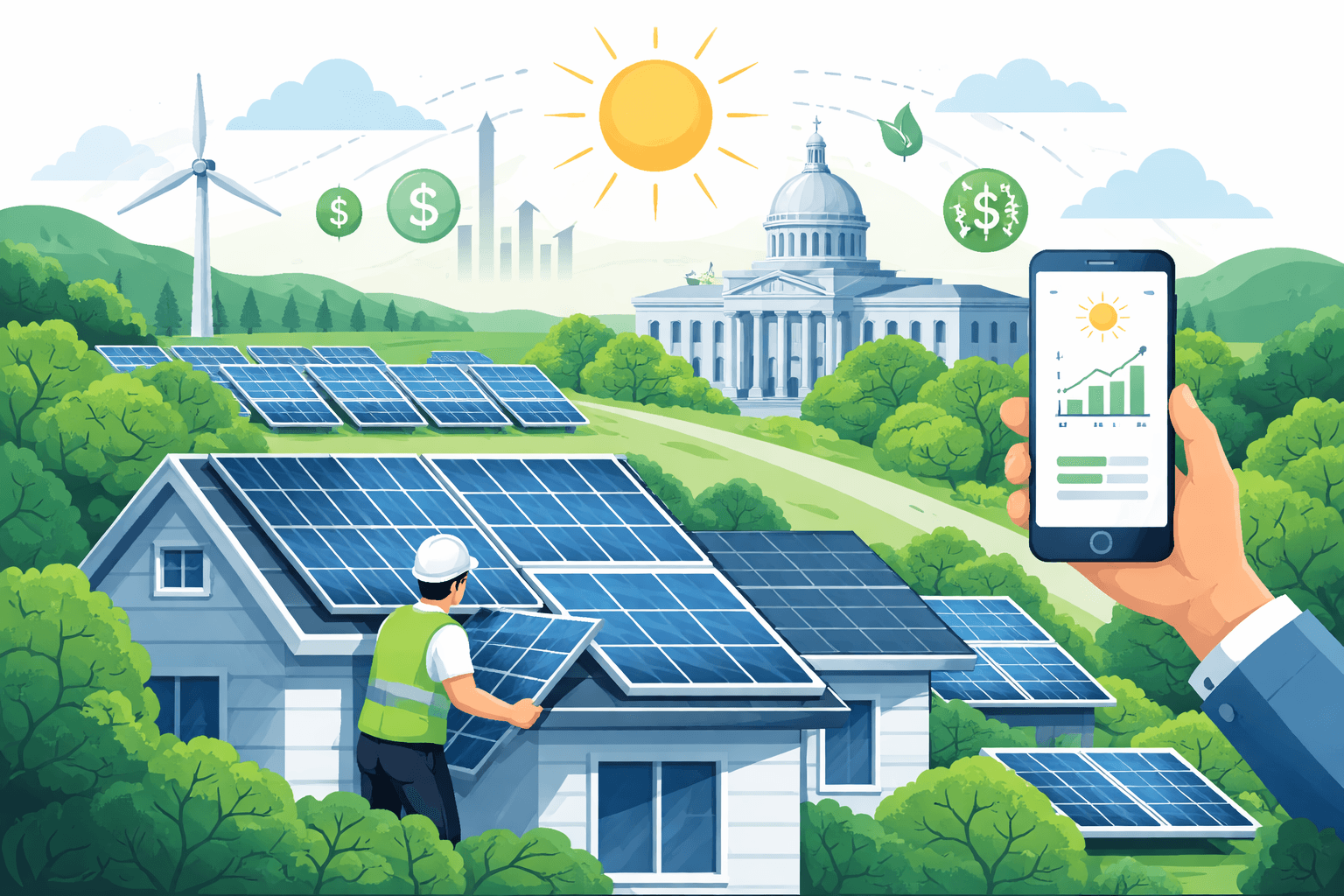
Solar in Alabama is a study in contrasts: the state enjoys roughly 4.7–5.2 peak sun hours per day and mild winters that boost annual output, yet it remains one of the tougher markets for residential rooftop due to limited state incentives and non‑standard utility policies. For many homes—especially those with high summer air‑conditioning loads—solar can still pencil out, but the details of costs, interconnection, and rate structures matter more here than in most states.
This guide uses current data from NREL, EIA, SEIA, DSIRE, and utility filings to help Alabama homeowners make a clear, dollars‑and‑cents decision. If you’re comparing quotes, see our broader Solar Panel Cost Guide for national context and savings tactics.
By the numbers: Alabama solar at a glance
- Solar resource: ~4.7–5.2 peak sun hours/day across most of Alabama; annual fixed‑tilt PV capacity factor typically 16–19% (NREL PVWatts)
- Typical system size: 6–10 kW for single‑family homes (sized to offset 60–100% of use)
- Average household electricity use: ~1,100–1,300 kWh/month (EIA), among the highest in the U.S. due to AC‑driven summer loads
- Average residential rate: ~14–15¢/kWh in 2024–2025 (EIA)
- Installed cost: commonly $2.60–$3.20/W before incentives for turnkey residential systems (regional installer quotes; EnergySage market reports)
- Federal tax credit (ITC): 30% for solar and batteries (≥3 kWh) through 2032 (U.S. DOE/IRS)
- Net metering: No statewide policy; most utilities use net billing or buyback at avoided cost (DSIRE/utility tariffs)
Solar Electricity Handbook - 2023 Edition: A simple, practical guide to solar energy – designing and installing solar photovoltaic systems: Boxwell, Michael
Solar Electricity Handbook - 2023 Edition: <strong>A simple, practical guide to solar energy – designing and installing solar photovoltaic systems</strong> [Boxwell, Michael] on Amazon.com. *FREE* shi
Check Price on AmazonSolar energy potential in Alabama: sun hours, irradiance, and climate factors
Alabama’s solar resource is stronger than many Northeastern and Midwestern states. NREL’s PVWatts modeling shows much of the state averaging around 5.0 kWh/m²/day of global horizontal irradiance (GHI) and roughly 4.7–5.2 peak sun hours per day. In practical terms, each 1 kW of well‑oriented, shade‑free rooftop PV in central Alabama can produce on the order of 1,350–1,550 kWh per year.
- Orientation and tilt: South‑facing arrays at 20–30° tilt typically maximize production. East/west roofs still perform well, often within 10–15% of south‑facing annual output.
- Heat and humidity: High summer temperatures reduce panel efficiency. Most monocrystalline modules have a temperature coefficient around −0.30% to −0.35% per °C above 25°C. Choosing modules with a better (less negative) temperature coefficient and using well‑ventilated racking can mitigate losses.
- Storms and wind: Coastal and central Alabama experience severe thunderstorms, tornadoes, and the fringes of hurricanes. Look for racking designed to your local wind speed rating and modules tested under IEC 61215/61730. Hail resistance is standardized; many Tier‑1 panels withstand 25 mm (1") hail at 23 m/s.
- Shading and trees: Fast‑growing southern vegetation can shade arrays within a few years. Plan selective trimming and use module‑level power electronics (MLPEs) such as microinverters or DC optimizers to reduce mismatch losses.
Product tip: In hot, humid climates, premium modules with strong thermal performance and robust warranties can sustain lifetime yield. Based on independent efficiency data and temperature coefficients, REC Alpha Pure‑R and Qcells Q.TRON BLK represent strong value for residential installations REC Alpha Pure‑R, Qcells Q.TRON BLK. For a current roundup of high‑efficiency options, see our Best Solar Panels 2026 guide.
Average cost of solar panels in Alabama and price‑per‑watt breakdown
Because Alabama’s residential market remains smaller than neighboring states with stronger policies, pricing can vary more by installer and equipment. Recent quotes collected across the Southeast suggest Alabama homeowners typically see:
- Price per watt (turnkey, before incentives): $2.60–$3.20/W for standard monocrystalline panels with microinverters or optimizers
- Example system budgets:
- 6 kW system: $15,600–$19,200 before ITC; $10,920–$13,440 after 30% ITC
- 8 kW system: $20,800–$25,600 before ITC; $14,560–$17,920 after 30% ITC
- 10 kW system: $26,000–$32,000 before ITC; $18,200–$22,400 after 30% ITC
What drives costs in Alabama:
- Equipment choices: High‑efficiency modules, black‑on‑black aesthetics, and premium MLPEs add $0.10–$0.40/W.
- Roof complexity: Steep pitches, multiple planes, or re‑roofing needs add labor and balance‑of‑system costs.
- Market maturity: Fewer installers and limited incentive programs mean less price compression than in highly competitive markets.
If you’re comparing quotes, use our Solar Panel Cost Guide for strategies to lower price per watt—like bundle pricing, simpler racking layouts, and asking for mainstream high‑value modules instead of boutique panels.
Alabama solar incentives: state tax credits, rebates, net metering, and SRECs
- State income tax credit: Alabama does not offer a state personal income tax credit for residential solar (DSIRE database).
- Sales and property tax: As of 2026, Alabama does not have a universal statewide sales tax exemption for residential solar equipment, and there is no dedicated property tax exclusion for added solar value. Because Alabama’s property taxes are relatively low, the difference may be modest, but confirm with your county assessor and installer.
- Utility rebates: Utility‑level rebates for rooftop PV are uncommon in Alabama. Some municipal utilities or TVA‑connected Local Power Companies (LPCs) occasionally offer limited‑time programs for energy efficiency or battery pilots—check your utility’s programs page.
- Net metering and buyback: Alabama has no statewide net metering policy. Most utilities apply net billing (accounting for solar exports and imports separately) with exported energy purchased at an avoided‑cost rate rather than retail. In practice, this means you get full retail value for solar you consume on‑site but only a few cents per kWh for excess sent to the grid. Understanding net billing is essential—see our Net Metering Explained overview for how crediting methods affect payback.
- SRECs: Alabama has no Solar Renewable Energy Credit (SREC) market. You may be able to sell voluntary RECs via brokers, but values are typically low (often $1–$5/MWh) and rarely alter project economics meaningfully.
Note on Alabama Power’s capacity charge: For customers interconnecting behind‑the‑meter solar with Alabama Power, a monthly “capacity reservation charge” is assessed per kW of installed AC capacity under certain residential tariffs. Depending on final approved rates, this fee—often cited in the $5–$6/kW‑month range in recent filings—can materially extend payback. Review your specific tariff, any recent Public Service Commission decisions, and updated utility rate sheets before you sign a contract.
The federal ITC and how it applies to Alabama homeowners
The federal residential clean energy credit (commonly called the ITC) covers 30% of eligible project costs for systems placed in service from 2022 through 2032 (then steps down). Eligible costs include panels, inverters, racking, balance‑of‑system components, labor, permitting, and sales tax paid. Notable details:

EF ECOFLOW Smart Home Panel 2, the Center of the Whole
Alternatively connect <strong>3 x EcoFlow DELTA Pro 3 units with 6 x Extra Batteries for energy storage up to 36kWh</strong>. It's not just for longer backup but lets you to control and run every
Check Price on Amazon- Battery eligibility: Residential batteries ≥3 kWh capacity qualify at 30% whether paired with new solar or installed as standalone storage (for systems placed in service in 2023 or later). This is helpful in Alabama where self‑consumption can be more valuable than export.
- Homes covered: Primary and secondary U.S. residences you own; rentals qualify only for the commercial credit.
- Carryover: Unused credit can roll forward to future tax years if you do not have enough tax liability in year one.
For line‑by‑line examples and IRS documentation, see our Solar Tax Credit Explained guide. Pairing an 8 kW system costing $24,000 with a 10 kWh battery costing $10,000 would yield a $10,200 federal credit (30% of $34,000), dropping net out‑of‑pocket to $23,800 before any utility fees or local incentives.
Affiliate note: If your goal is to increase self‑consumption and ride through summer outages, a high‑cycle lithium‑iron‑phosphate unit with integrated load control—such as the Tesla Powerwall 3 or Enphase IQ Battery 10—can be an economical complement in Alabama’s rate environment Tesla Powerwall 3, Enphase IQ Battery 10. Compare round‑trip efficiency, usable capacity, and warranty throughput. For a deeper comparison, see our Solar Battery Buying Guide: Choose the Best Home Battery in 2026.
Best solar installers and companies serving Alabama
The right installer matters more in Alabama than in many states because interconnection and rate details can swing ROI. Prioritize:
- Alabama electrical contractor licensing and NABCEP PV Installation Professional certification
- Clear modeling of self‑consumption vs. exports under your specific tariff
- Roof and wind‑load engineering to local code; documented AHJ permit experience
- Manufacturer certifications (e.g., Tesla/Enphase/Panasonic/REC) and strong workmanship warranties (10+ years)
Notable Alabama‑based and regional firms to evaluate (verify current service areas and offerings):
- Eagle Solar & Light (Birmingham): Known for residential and commercial PV with a focus on quality components and local permitting expertise.
- Southern Solar Systems (Huntsville area): Regional installer with experience in North Alabama climates; offers solar plus storage.
- Yellowhammer Solar (Central/North Alabama): Alabama‑focused residential provider; ask about module‑level electronics and battery pairings.
- Regional/Southeast options: Some Georgia, Mississippi, and Tennessee firms serve border communities in eastern and northern Alabama; if you’re in a TVA service territory, ask your Local Power Company for a vetted contractor list or search TVA’s quality contractor directories for distributed energy projects.
- National providers: Larger brands sometimes operate in selected Alabama ZIP codes; weigh their financing options against local installers’ often lower labor overhead.
How to compare quotes:
- Ask for price per watt (pre‑ and post‑ITC), projected annual kWh, assumptions (tilt, azimuth, shading), and the modeled self‑consumption percentage.
- Require a tariff‑aware savings model: exported kWh priced at your utility’s avoided cost; any fixed monthly solar charges itemized.
- Check the interconnection timeline and any application or meter fees.
ROI and payback period for solar in Alabama
Payback in Alabama hinges on your utility territory, your ability to use power when the sun is shining (self‑consumption), and whether you add storage. Below are indicative scenarios for a typical, shade‑free, south‑facing home in central Alabama using EIA average rates and NREL yield assumptions.
Assumptions common to all scenarios:
- System: 8 kW DC, fixed‑tilt, producing ~11,600 kWh/year
- Installed cost: $24,000 before ITC; $16,800 after 30% ITC
- Retail electricity price: 14.5¢/kWh; avoided‑cost buyback: 3.5–5.0¢/kWh (varies by utility)
- Favorable crediting (simple monthly netting at retail, no solar‑specific fixed charges)
- Annual bill reduction: 11,600 kWh × $0.145 ≈ $1,682
- Simple payback: $16,800 / $1,682 ≈ 10.0 years
- 25‑year savings (no escalation, panel degradation ~0.5%/yr): ~$20,000–$30,000
- Net billing with avoided‑cost export, no extra fixed charges (60% self‑consumption)
- Value of self‑consumed energy: 6,960 kWh × $0.145 ≈ $1,009
- Value of exports at 4¢/kWh: 4,640 kWh × $0.04 ≈ $186
- Total annual value: ~$1,195
- Payback: $16,800 / $1,195 ≈ 14.1 years
- Net billing with avoided‑cost export plus a solar capacity charge (e.g., ~$5.50/kW‑month)
- Annual charge: 8 kW × $5.50 × 12 ≈ $528
- Net annual savings (from scenario 2): $1,195 − $528 ≈ $667
- Payback: $16,800 / $667 ≈ 25.2 years
- Adding a 10 kWh battery to increase self‑consumption to ~80% (same net billing, no capacity charge)
- Incremental installed cost: +$10,000 (−30% ITC = $7,000 net)
- Value of self‑consumed energy: 9,280 kWh × $0.145 ≈ $1,345
- Exports: 2,320 kWh × $0.04 ≈ $93; total ~$1,438/year
- Combined simple payback on solar + battery: $23,800 / $1,438 ≈ 16.5 years
- Non‑financial: Backup power for storms; better use of high‑AC daytime solar
Takeaways:
- In territories without extra fixed charges, solar can reach 9–12 year paybacks—especially for higher‑use households or those who adopt daytime load shifting (e.g., running laundry, dishwashers, and EV charging mid‑day).
- In territories with solar‑specific capacity charges, economics can be challenging. If you’re an Alabama Power customer, ask your installer to model your exact tariff, and consider strategies to raise self‑consumption (smart thermostats, water heater timers, daytime EV charging, or a right‑sized battery).
- Financing matters: Low‑interest HELOCs or cash purchases produce much better lifetime savings than high‑APR loans with dealer fees.
Alabama‑specific permitting, HOA rules, and interconnection process
Permitting
- Local authority having jurisdiction (AHJ): City or county building department (e.g., Birmingham, Huntsville, Mobile). Most require building and electrical permits; some coastal areas require additional wind‑load engineering.
- Timelines: 2–8 weeks depending on AHJ workload and whether structural review is required.
HOA considerations
- Alabama does not have a comprehensive statewide solar access law protecting the right to install rooftop PV. HOAs may impose aesthetic or location restrictions and, in some cases, deny front‑facing arrays. Before deposit, request HOA architectural approval in writing.
Interconnection steps (typical)
- Pre‑application: Your installer conducts a site survey and reviews your utility tariff and meter configuration.
- Interconnection application: Submit system design, one‑line diagrams, equipment datasheets, site plan, and proof of liability insurance if required.
- Utility review: 2–6 weeks for most residential systems; may require an external AC disconnect switch and a meter upgrade.
- Inspection: AHJ inspects the installation; utility may conduct its own test.
- Permission to operate (PTO): Utility enables net billing or buyback arrangement; you begin operational monitoring.
Fees and insurance
- Expect modest application and meter fees; amounts vary by utility.
- Some utilities request proof of homeowner’s liability insurance; verify limits.
Pro tip: Ask your installer to share their interconnection track record with your specific utility and to include any expected monthly solar charges explicitly in your contract.
FAQ: common questions about going solar in Alabama
Q: Is solar worth it in Alabama? A: For many homes—particularly high‑use households with good south‑facing roof space—yes, especially in territories without solar‑specific fixed charges. In areas with capacity charges and avoided‑cost buyback, the math is tighter; maximizing self‑consumption and considering a right‑sized battery can help.
Q: What size system do I need? A: Divide your annual kWh by ~1,400–1,500 to estimate kW for a south‑facing array in central Alabama. Example: 14,000 kWh/year ÷ 1,450 ≈ 9.6 kW DC. Your installer will refine this with shading and roof orientation.
Q: Does Alabama have net metering? A: No statewide net metering. Most utilities use net billing with exports credited at an avoided‑cost rate. Some territories include additional monthly charges for customer‑sited solar. Review your utility’s tariff.
Q: Do batteries qualify for the 30% federal tax credit in Alabama? A: Yes. Residential batteries ≥3 kWh installed in 2023 or later qualify at 30% whether paired with new solar or added later. This can increase self‑consumption and provide outage backup.
Q: How do storms and hail affect rooftop solar? A: Code‑compliant racking and properly flashed mounts are designed for local wind ratings. Most modern panels are tested to standardized hail impacts. Insist on stamped structural/wind calculations when required by your AHJ.
Q: Will my HOA allow solar? A: Alabama lacks a strong solar access law. Obtain HOA architectural approval before contract signing, and be prepared to discuss placement and aesthetics.
Q: How long does installation take? A: The physical install is typically 1–3 days. Permitting, utility approval, and HOA review can extend total timeline to 4–10 weeks.
Q: Can I go off‑grid in Alabama? A: Technically yes, using larger PV arrays, multi‑day battery storage, and often a backup generator. However, off‑grid systems cost more per kWh than grid‑tied. Some homeowners choose hybrid systems that operate on‑grid daily and provide backup during outages.
Q: What maintenance is required? A: Little. Panels are largely self‑cleaning with rain; inspect annually for debris and check monitoring data. In pollen season, a soft‑wash can recover a few percent of production.
Q: Which panels are best for Alabama’s heat? A: Look for high‑efficiency monocrystalline modules with a strong temperature coefficient (−0.30%/°C or better) and a 25‑year performance warranty. Our Best Solar Panels 2026 guide profiles top options.
Practical next steps for Alabama homeowners
- Audit your utility tariff: Identify your buyback rate for exports, any solar‑specific monthly charges, and whether time‑of‑use options exist.
- Right‑size for self‑consumption: Favor slightly smaller arrays that match daytime loads, or add smart load controls (EV charging, heat‑pump water heaters with timers) to soak up mid‑day solar.
- Consider storage for resilience and economics: Batteries can shift exports to evening use and provide peace of mind for summer storms.
- Compare at least three quotes: Standardize on price per watt, modeled annual kWh, self‑consumption assumptions, and warranty terms.

ecobee Smart Thermostat Premium with Smart Sensor and Air Quality Monitor - Programmable Wifi Thermostat - Works with Siri, Alexa, Google Assistant - Amazon.com
View on AmazonHelpful links on DigitalWindmill:
- Solar Panel Cost Guide: How Much You'll Pay & How to Save
- Net Metering Explained: How Solar Owners Get Credit for Excess Power
- Solar Tax Credit Explained: Save on Solar with the Federal ITC
- Solar Battery Buying Guide: Choose the Best Home Battery in 2026
Affiliate note: Based on Alabama’s climate and rate structures, high‑efficiency panels paired with module‑level power electronics and a moderate‑capacity battery deliver strong all‑around value. For example, pairing REC Alpha Pure‑R with Enphase IQ8 microinverters and a Powerwall 3 balances production, shade tolerance, and backup capability. Always compare multiple quotes and verify current utility tariffs before finalizing your design.
Recommended Products
Solar Electricity Handbook - 2023 Edition: A simple, practical guide to solar energy – designing and installing solar photovoltaic systems: Boxwell, Michael
Solar Electricity Handbook - 2023 Edition: <strong>A simple, practical guide to solar energy – designing and installing solar photovoltaic systems</strong> [Boxwell, Michael] on Amazon.com. *FREE* shi
EF ECOFLOW Smart Home Panel 2, the Center of the Whole
Alternatively connect <strong>3 x EcoFlow DELTA Pro 3 units with 6 x Extra Batteries for energy storage up to 36kWh</strong>. It's not just for longer backup but lets you to control and run every
ecobee Smart Thermostat Premium with Smart Sensor and Air Quality Monitor - Programmable Wifi Thermostat - Works with Siri, Alexa, Google Assistant - Amazon.com
ecobee Smart Thermostat Premium with Smart Sensor and Air Quality Monitor - Programmable Wifi Thermostat - <strong>Works with Siri, Alexa, Google Assistant</strong> - Amazon.com