
Solar in Alaska: Costs, Incentives & Top Installers (2026)
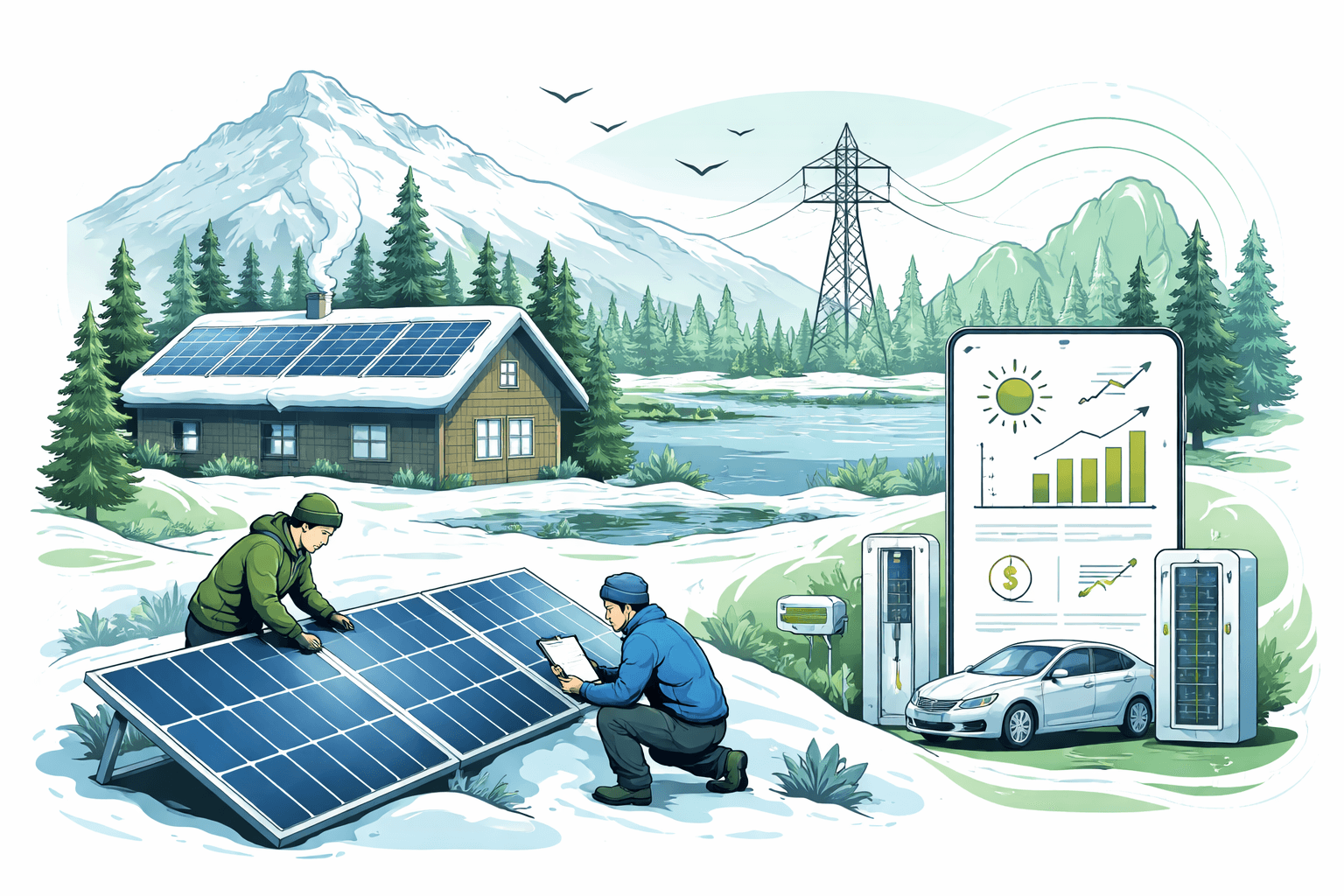
Alaska isn't the first place most people think of for rooftop solar — yet annual production in Anchorage can rival parts of Germany, the country with more than 80 GW of installed PV. Long summer days, cold temperatures, and rising electricity rates are pushing more homeowners to consider solar in Alaska. This guide covers the solar resource, costs, incentives, top installers, permitting, and payback — everything you need to make a confident decision in 2026.
By design, this guide uses the best-available data from sources including NREL (PVWatts and NSRDB), the U.S. Energy Information Administration (EIA), and the Regulatory Commission of Alaska (RCA). If you’re new to solar, you may want to skim our baseline primers: Solar Power Explained: How It Works, Costs, and Climate Benefits and Solar Panel Technology in 2026: A Complete Guide to Modern Photovoltaics.
By the numbers: Solar in Alaska at a glance
- Solar resource (specific yield): 1,000–1,250 kWh per kW of DC capacity per year depending on location and tilt (NREL PVWatts)
- Average residential electricity price: roughly 22–28¢/kWh statewide in 2024–2025 depending on utility (EIA)
- Typical residential system size: 6–10 kW
- Typical installed cost (before incentives): about $3.50–$4.75 per watt DC in urban Railbelt communities; higher in remote areas (NREL benchmarks plus Alaska logistics adders)
- Federal tax credit (ITC): 30% for systems placed in service through 2032 (IRS/Inflation Reduction Act)
- Net metering: Available from most regulated utilities for residential systems up to 25 kW; policy administered by the RCA
Solar Electricity Handbook - 2023 Edition: A simple, practical guide to solar energy – designing and installing solar photovoltaic systems: Boxwell, Michael
Solar Electricity Handbook - 2023 Edition: <strong>A simple, practical guide to solar energy – designing and installing solar photovoltaic systems</strong> [Boxwell, Michael] on Amazon.com. *FREE* shi
Check Price on AmazonSolar energy potential in Alaska: sun hours, irradiance, and climate factors
Alaska’s latitude means extreme seasonal swings. Winter production is low, but summer is exceptionally strong. On an annual basis, NREL’s PVWatts model estimates that a fixed-tilt, south-facing 7 kW system in:
- Anchorage can produce about 7,700–8,400 kWh per year (1,100–1,200 kWh/kW-yr),
- Fairbanks about 7,000–8,000 kWh (1,000–1,150 kWh/kW-yr), and
- Juneau roughly 7,000–8,200 kWh (1,000–1,170 kWh/kW-yr), assuming modern module efficiencies and appropriate tilt.

Enphase ENPHASE IQ8PLUS-72-2-US IQ8+ ...
View on AmazonWhy performance can be better than you’d expect:
- Cold boosts efficiency. Most crystalline-silicon modules have a temperature coefficient of roughly –0.30% to –0.35% per °C. Panels operate well below the 25°C (77°F) “standard test” temperature for much of the year in Alaska, effectively delivering a few percent extra output on clear, cold days (manufacturer datasheets; NREL).
- Long summer days. Late-spring to midsummer irradiance is high — much like high-performing PV regions in the Pacific Northwest or central Europe (NREL NSRDB climatologies).
- Bifacial and albedo gains. Snow can increase reflectivity (albedo), letting bifacial modules capture additional rear-side light. Field studies in snowy climates have documented winter gains of 5–20% for well-sited bifacial arrays (NREL; peer-reviewed snow and bifacial studies).
Considerations for Alaska’s climate:
- Snow losses are real but manageable. NREL snow studies suggest annual production losses of roughly 5–20% in snowy climates depending on tilt, roof geometry, and snow clearing practices. Steeper tilts (40–60°), ground mounts with higher clearance, and dark-framed modules can reduce accumulation.
- Wind and icing loads. Racking must be engineered to local wind/snow load requirements. For roof mounts, a structural assessment is recommended in most municipalities.
- Optimal tilt. A steeper tilt (e.g., latitude minus ~10° for year-round balance) both sheds snow and favors shoulder/winter sun. Adjustable-tilt ground mounts can improve shoulder-season output.
Affiliate pick: Because of cold-weather and snow considerations, bifacial, n-type panels with strong low-light response such as the Qcells Q.TRON NEO bifacial and microinverter architectures like Enphase IQ8 Microinverters perform reliably and minimize partial-snow shading losses.
Average cost of solar panels in Alaska and price-per-watt breakdown
Installed costs in Alaska trend higher than the U.S. average due to shipping, smaller project volumes, and specialized labor. NREL’s national residential benchmark has hovered around $2.90–$3.25/W before incentives in recent years for typical U.S. markets; Alaska quotes commonly come in 10–40% higher, especially outside Anchorage/Mat-Su and Fairbanks-North Star.
What we’re seeing in 2025–2026 homeowner quotes:
- Urban Railbelt (Anchorage, Mat-Su, Fairbanks): roughly $3.50–$4.75 per watt DC
- Southeast (Juneau) and Kenai Peninsula: roughly $3.75–$5.00 per watt DC depending on logistics
- Remote/bush communities: costs vary widely; logistics can add $1–$3/W or more
Example price-per-watt math:
- 7.5 kW at $4.10/W = $30,750 before incentives; $21,525 after the 30% federal ITC
- 10 kW at $3.80/W = $38,000 before incentives; $26,600 after the ITC
What drives cost in Alaska:
- Hardware: Panels, inverters, racking — typically 35–45% of total cost
- Labor and electrical balance-of-system: 25–35%
- Permitting, engineering, interconnection, shipping, and margin: 20–30%
If you’re collecting bids, our Solar Panel Cost Guide: How Much You'll Pay & How to Save walks through line items and negotiation levers.
Affiliate pick: For roof mounts in high-snow zones, heavy-duty racking like IronRidge XR1000 with snow/ice guards represents good value given Alaska’s structural load requirements.
Alaska solar incentives: state tax credits, rebates, net metering, and SRECs
- State tax credits: Alaska currently offers no statewide solar tax credit for residential PV. Some boroughs and cities may occasionally pilot incentives, but these are limited and time-bound.
- Rebates: As of 2026, utility rebates for residential PV are uncommon. Check with your utility for any pilot programs.
- Net metering: The Regulatory Commission of Alaska (RCA) requires most regulated utilities to offer net metering for customer-sited renewable systems. For residential customers, eligible system size is generally up to 25 kW. Credits are typically applied at the retail energy rate and roll over month-to-month. Program terms and participation caps can vary by utility, so confirm specifics with your provider (RCA rules; utility tariffs for Chugach Electric, Matanuska Electric Association, Golden Valley Electric Association, and AEL&P).
- SRECs: Alaska has no Solar Renewable Energy Certificate (SREC) market and no binding statewide Renewable Portfolio Standard that would create one. Some utilities have nonbinding renewable goals.
For a deeper explainer of how monthly credits appear on your bill, read Net Metering Explained: How Solar Owners Get Credit for Excess Power.
Federal ITC and how it applies to Alaska homeowners
The federal Residential Clean Energy Credit (commonly called the Investment Tax Credit, or ITC) provides a 30% credit on the installed cost of eligible solar through 2032, phasing down after that under current law (IRS/Inflation Reduction Act).

EF ECOFLOW Solar Generator 120V/3.6KWh DELTA Pro with 400W Portable Solar Panel, 23% High Efficiency, 5 AC Outlets, 3600W Portable Power Station for Home Backup Outdoors Camping RV Emergency : Patio, Lawn & Garden
Amazon.com : EF ECOFLOW Solar Generator 120V/3.6KWh DELTA Pro with <strong>400W Portable Solar Panel, 23% High Efficiency, 5 AC Outlets, 3600W Portable Power Station for Home Backup Outdoors Camping R
Check Price on AmazonKey points for Alaska:
- Eligibility: Applies to primary and secondary residences you own in the U.S., including cabins. Rentals are treated differently; consult a tax professional.
- Covered costs: Panels, inverters, racking, balance-of-system, sales tax, permitting/engineering fees, and labor for on-site prep and installation. Standalone batteries of 3 kWh+ capacity qualify at 30% starting in 2023 — even without solar.
- Carryforward: If the credit exceeds your tax liability for the year you place the system in service, you can generally carry the remainder forward to future years.
Our step-by-step guide breaks down documentation and timing: Solar Tax Credit Explained: Save on Solar with the Federal ITC.
Best solar installers and companies serving Alaska
Alaska’s market is smaller than Lower 48 states, but there’s a solid bench of local firms with deep cold-climate experience. Always solicit multiple bids, verify licensing and insurance, and look for NABCEP-certified designers/installers.
Examples of active Alaska-focused installers (as of 2026):
- Arctic Solar Ventures (Anchorage): Residential and commercial PV, grid-tied and battery systems; experience with high-snow racking and steep-tilt designs; often uses microinverters for shade/snow resilience. Tesla Powerwall–certified.
- Alaska Solar (Anchorage, statewide projects): Residential and off-grid cabins; offers adjustable-tilt ground mounts and hybrid PV–battery setups tailored for Railbelt and rural applications.
- Renewable Energy Systems of Alaska (Anchorage): Residential/commercial PV and storage; emphasis on structural engineering for snow/wind loads.
- Regional electricians/solar specialists in Fairbanks and Juneau: Several licensed electrical contractors now offer PV as part of their services; look for NABCEP board certification and local utility interconnection experience.
What to look for in your quotes:
- Structural load calculations for your roof and snow/wind design values
- A production estimate generated with NREL PVWatts or equivalent, including snow-loss assumptions
- Clear net metering and interconnection scope (who handles what, and fees)
- Cold-weather equipment choices: module temperature coefficients, microinverters/string inverters with low-temp ratings, and snow-shedding racking
If you’re prioritizing resiliency, compare battery options in our Solar Battery Buying Guide: Choose the Best Home Battery in 2026. For full off-grid systems and cabin setups, see Off-Grid Solar: Complete Buyer’s Guide to Systems, Costs & Setup.
Affiliate pick: Based on field reliability in cold climates and module-level rapid shutdown compliance, Enphase IQ8 Microinverters remain a strong residential choice for Alaska, especially on complex roofs where snow and partial shading occur.
ROI and payback period for solar in Alaska
Calculating ROI in Alaska hinges on three variables: installed cost, your utility’s retail rate, and your site’s production.
Example payback scenario (Anchorage homeowner):
- System: 7.5 kW, south-facing, 45° tilt
- Installed cost: $4.10/W → $30,750 before incentives
- Federal ITC (30%): –$9,225 → net $21,525
- Modeled output (PVWatts, includes 10% snow loss): 8,000 kWh/year
- Retail electricity price: $0.24/kWh (illustrative within EIA’s AK range)
- First-year bill savings: ≈ $1,920
- Simple payback: ≈ 11.2 years
- 25-year lifetime savings (0.5%/yr degradation; 2%/yr utility price escalation): $35,000–$50,000 range
What improves ROI in Alaska:
- Higher retail rates. Railbelt and Interior rates in the mid-20¢/kWh range improve savings relative to many Lower-48 markets (EIA state data).
- Good siting. A clear south-facing aspect at a steep tilt can reduce snow losses and boost winter/shoulder production.
- Self-consumption strategies. Time appliance use (EV charging, laundry, water heating) to daytime peaks in summer. Consider load controllers or smart panels.
What can lengthen payback:
- Shallow or east/west roof pitches with persistent snow cover.
- Remote logistics and small project sizes.
- Lower retail rates in predominantly hydro-powered Southeast communities (e.g., Juneau) where electricity may cost less than Railbelt averages.
Note on batteries and ROI: Batteries add resilience but generally lengthen financial payback when credited at retail net metering rates. If outages are costly or frequent for you — or you’re on a small utility without net metering — a battery can still pencil in terms of avoided generator fuel, comfort, and protecting critical loads. Remember: standalone batteries 3 kWh+ qualify for the 30% ITC through at least 2032.
Alaska-specific permitting, HOA rules, and interconnection process
Permitting
- Jurisdictions: Most projects in Anchorage, Fairbanks North Star Borough, and the City and Borough of Juneau require electrical and, in many cases, building permits. Structural review is common due to snow loads.
- Documents: Site plan, structural calculations or truss letter, single-line electrical diagram, product datasheets, and NEC/UL listings (UL 1703/61730 for modules, UL 1741 SB or UL 1741 SA and IEEE 1547-2018 compliance for inverters where required by the utility).
- Timelines and fees: 1–3 weeks in urban jurisdictions; longer in peak season.
Interconnection and net metering
- Utilities: Chugach Electric Association (CEA), Matanuska Electric Association (MEA), Golden Valley Electric Association (GVEA), Homer Electric Association (HEA), and AEL&P in Juneau each have published interconnection applications and NM tariffs filed with the RCA.
- Steps: Pre-application (optional for larger systems), application with line diagram and equipment cut sheets, approval to install, inspection, utility witness test if required, meter swap for bi-directional net meter, permission to operate (PTO).
- Equipment: Most utilities require certified anti-islanding inverters and rapid shutdown. Some maintain pre-approved inverter lists; confirm before purchase.
- Rural/isolated grids: Independent utilities not under RCA jurisdiction and microgrids may not offer net metering; policies vary.
HOAs and solar access
- Alaska does not have a comprehensive statewide “solar rights” law. Some homeowners associations can restrict placement or require aesthetic review. Engage early with your HOA and submit stamped drawings that address snow-shedding and structural safety.
FAQ: Common questions about going solar in Alaska
Does solar work in winter darkness?
- Yes, but production from November through January is minimal at higher latitudes. Annual performance still pencils because spring through late summer output is strong. Systems are typically sized to maximize annual savings rather than cover 100% of winter loads.
What about snow covering the panels?
- Snow can reduce winter output. Steeper tilts help shedding. Some owners clear lower edges after storms; others accept modest winter losses that are outweighed by long summer days. Bifacial modules can claw back some winter energy via albedo gains.
Are microinverters better for Alaska?
- Often, yes. Microinverters or DC optimizers keep the rest of the array producing even if one module is partially shaded or snow-covered and offer module-level monitoring — useful for diagnosing snow-related issues. Modern string inverters can also perform well when arrays are uniform and unshaded.
Should I add a battery?
- If you value backup power, yes — especially for freezers, heating controls, well pumps, and communications. Purely financial ROI is mixed under retail-rate net metering, but the 30% ITC and avoided generator use make batteries attractive in many homes. See our Solar Battery Buying Guide: Choose the Best Home Battery in 2026.
Is off-grid solar viable for cabins?
- Very. In remote Alaska, the levelized cost of diesel generation can exceed $0.50–$1.00/kWh when fuel transport is included (Alaska Energy Authority reports). A hybrid PV–battery–generator system can slash fuel use and runtime. Start with our Off-Grid Solar: Complete Buyer’s Guide to Systems, Costs & Setup.
How long do permits and interconnection take?
- In urban areas, 2–6 weeks is typical from application to permission to operate, assuming a complete submittal and standard equipment. Rural timelines vary.
Will cold damage panels?
- Quality modules and racking are tested to IEC/UL standards for thermal cycling, mechanical load (snow/wind), and hail. Look for high mechanical load ratings (≥5,400 Pa snow) and low temperature coefficients on the datasheet.
What’s the warranty landscape?
- Tier-1 manufacturers often offer 12–25 years product warranty and 25–30 years performance warranty (e.g., 84–90% output at year 25). Inverters typically carry 10–25 years depending on model; microinverters commonly 20–25 years.
Which financing options work in Alaska?
- Cash, HELOCs, and local credit union loans are common. National third-party ownership (leases/PPAs) is less prevalent than in Lower 48 markets.
How big should my system be?
- Start with your last 12 months of kWh usage, your roof geometry, and a PVWatts run with snow-loss assumptions. Many Alaska homes target 60–90% annual offset, letting summer exports cover part of shoulder-season use.
If I plan to electrify heating, should I oversize?
- Consider a staged approach. Start with PV sized to current loads, then add panels (or a ground mount) when you add a heat pump or EV. High winter loads from heat pumps won’t be fully covered by PV in mid-winter at high latitudes; take advantage of utility net metering and summer surplus.
Where to go next
- Learn the technology and options: Solar Panel Technology in 2026: A Complete Guide to Modern Photovoltaics
- Model your ROI and incentives: Solar Panel Cost Guide: How Much You'll Pay & How to Save and Solar Tax Credit Explained: Save on Solar with the Federal ITC
- Understand bill credits and sizing for your utility: Net Metering Explained: How Solar Owners Get Credit for Excess Power
With the right design — steep tilt, snow-conscious racking, and cold-optimized equipment — solar in Alaska can deliver double-digit IRRs for many homes on the Railbelt while dramatically cutting generator runtime at off-grid cabins. As hardware costs continue to fall and Alaska utilities modernize interconnection, the path to resilient, lower-carbon power at high latitudes is clearer than ever.
Recommended Products
Solar Electricity Handbook - 2023 Edition: A simple, practical guide to solar energy – designing and installing solar photovoltaic systems: Boxwell, Michael
Solar Electricity Handbook - 2023 Edition: <strong>A simple, practical guide to solar energy – designing and installing solar photovoltaic systems</strong> [Boxwell, Michael] on Amazon.com. *FREE* shi
Enphase ENPHASE IQ8PLUS-72-2-US IQ8+ ...
Enphase · 240v · Solar · Hoymiles · Iq8 See more · Eligible for Free Shipping · Free Shipping by Amazon · Get FREE Shipping on eligible orders shipped by Amazon · Delivery Day · Get It by Tomorrow · D
EF ECOFLOW Solar Generator 120V/3.6KWh DELTA Pro with 400W Portable Solar Panel, 23% High Efficiency, 5 AC Outlets, 3600W Portable Power Station for Home Backup Outdoors Camping RV Emergency : Patio, Lawn & Garden
Amazon.com : EF ECOFLOW Solar Generator 120V/3.6KWh DELTA Pro with <strong>400W Portable Solar Panel, 23% High Efficiency, 5 AC Outlets, 3600W Portable Power Station for Home Backup Outdoors Camping R