
Solar in Maine: Costs, Incentives & Top Installers (2026)
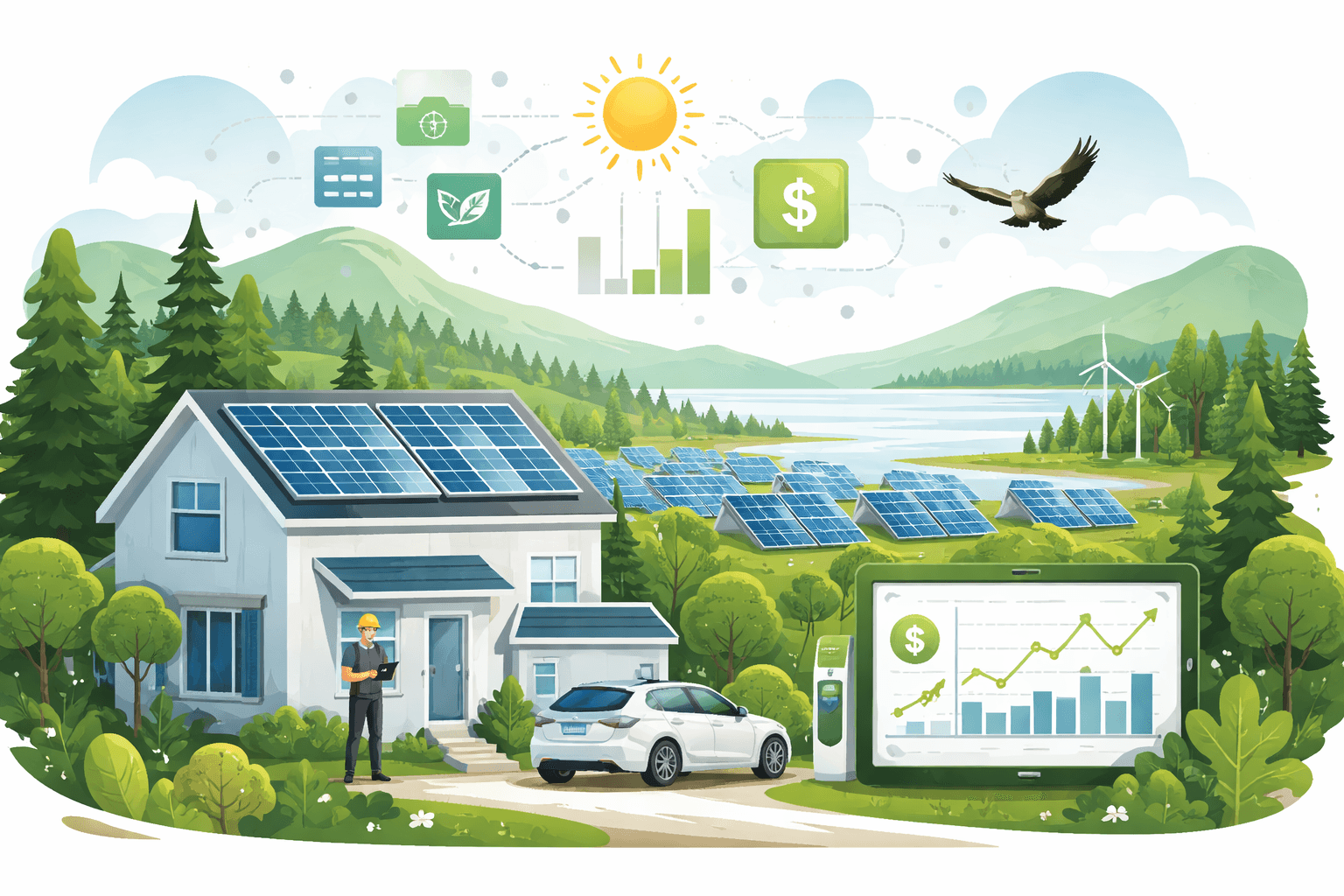
Maine’s electricity prices have hovered near the top of the U.S. for the past few years—residential customers commonly pay around 22–27¢/kWh, according to the U.S. Energy Information Administration (EIA, 2024). Pair that with steady declines in installed solar costs and the 30% federal tax credit, and solar in Maine often pencils out with a 7–11 year simple payback for a well-sited home system. This 2026 guide details solar potential, up-to-date costs, Maine-specific incentives and interconnection rules, ROI math, and vetted installer options.
By the numbers: Solar in Maine (2026)
- Average sun hours (peak sun hours): ~3.7–4.3 kWh/m²/day (higher in southern/coastal Maine; NREL solar resource data)
- Typical system size: 6–9 kW for a single-family home
- Installed price (before incentives): ~$2.70–$3.40 per watt (EnergySage/marketplace averages for Northern New England, 2025–2026)
- Federal tax credit (ITC): 30% through 2032 (Inflation Reduction Act, Section 25D)
- Annual generation: ~1,050–1,250 kWh per kW installed (after realistic losses; NREL PVWatts)
- Typical annual bill savings: $1,500–$2,300 for a 7 kW system at 22–27¢/kWh retail rates
- Simple payback: ~7–11 years (site- and rate-dependent)
Solar Electricity Handbook - 2023 Edition: A simple, practical guide to solar energy – designing and installing solar photovoltaic systems: Boxwell, Michael
Solar Electricity Handbook - 2023 Edition: <strong>A simple, practical guide to solar energy – designing and installing solar photovoltaic systems</strong> [Boxwell, Michael] on Amazon.com. *FREE* shi
Check Price on AmazonSolar energy potential in Maine: sun hours, irradiance, and climate factors
Maine’s solar resource is stronger than many assume. NREL irradiance maps show average daily global horizontal irradiance (GHI) and “peak sun hours” around 3.7–4.3 across the state, comparable to the broader Northeast and only modestly below the U.S. average. In practice, a correctly sized, shade-free system in southern or coastal Maine can produce roughly 1,100–1,250 kWh per kW per year; northern and inland sites may see 1,000–1,150 kWh/kW-year.
Climate helps more than it hurts:
- Cold boosts efficiency: Photovoltaic (PV) modules operate more efficiently in cool air. A panel’s temperature coefficient (the drop in power per degree Celsius above its test condition) means Maine’s colder seasons improve output versus hot climates.
- Snow losses are manageable: NREL field research finds annual energy losses from snow in northern states generally average a few percent, though individual sites can see higher seasonal impacts if snow lingers. A higher roof tilt (30–40°), smooth glass, and dark-framed modules help shedding.
- Wind and storms: Maine’s coastal wind events demand proper racking and anchoring. Look for modules rated ~5,400 Pa front load and racking systems engineered for local wind/snow codes.
Tip: For roof design in Maine, a south-facing array tilted 30–40° is ideal, but east/west orientations can still achieve 80–90% of south-facing output per NREL PVWatts modeling. If trees limit solar access, consider selective pruning or a ground mount where setbacks allow.
What does solar in Maine cost in 2026?
Installed residential solar costs in Maine generally range from about $2.70 to $3.40 per watt (before incentives) for turnkey, grid-tied systems using Tier-1 modules and either microinverters or a string inverter with optimizers. Marketplace data for Northern New England (2025–2026) align with this range.
Price-per-watt breakdown (typical 7 kW home system):
- Hardware (modules, inverters, racking): $6,500–$9,000
- Balance of system (wiring, switches, combiner boxes): $2,000–$3,000
- Labor and overhead: $6,500–$9,500
- Permitting/interconnection/inspection: $200–$800
- Total: ~$18,900–$23,800 before incentives ($2.70–$3.40/W)
Factors that move price up or down:
- Equipment choices: Microinverters and premium bifacial or high-efficiency modules cost more but can boost lifetime production, especially on complex roofs.
- Roof complexity: Multiple roof planes, steep pitches, and service upgrades (e.g., a new 200A panel) add cost.
- Ground mounts and snow loads: Ground systems require posts, trenching, and fencing; heavy-duty racking for snow/wind adds materials but can maximize winter performance.
Based on cold-weather performance and snow-load ratings, high-efficiency HJT or TOPCon modules combined with reliable microinverters are strong value picks for Maine homes. For example, the REC Alpha Pure-R 410W (high efficiency, low temperature coefficient) paired with Enphase IQ8 Microinverters offers robust shade mitigation and module-level monitoring.
Maine solar incentives: state tax credits, rebates, net metering, and SRECs
Maine doesn’t currently offer a state personal income tax credit for residential PV, and statewide cash rebates for home solar are limited. The two big policy drivers for rooftop and small-scale projects are net energy billing (Maine’s version of net metering) and renewable energy credits.
Net Energy Billing (NEB)
- Eligibility and size: Customer-sited PV up to residential scales connects under utility NEB tariffs (CMP and Versant Power). Maine law also supports larger “distributed generation” and shared/community solar up to 5 MW, but home systems are almost always far smaller.
- How credits work: Under Maine’s kWh-credit NEB, exported solar generation earns bill credits that offset your electricity consumption. Credits typically apply against both supply and delivery (T&D) volumetric charges on your bill, rolling over monthly. Many customers effectively see near-retail value for exports; check your exact tariff and utility.
- Annual true-up: Credits usually carry forward for up to 12 months; any excess beyond that window may expire, so it’s wise to size your system near your annual usage (often 90–110% of last year’s kWh consumption).
- Community solar option: If you rent, have shade, or a tricky roof, Maine’s shared distributed generation (community solar) programs let you subscribe and receive bill credits. Typical savings advertised range from 5–15% off supply charges; verify contract terms and escalation.
Maine Public Utilities Commission (MPUC) guidance and CMP/Versant tariffs detail the latest NEB structures; program specifics have evolved since 2019 to manage costs while sustaining deployment.
Renewable Energy Credits (RECs)
Maine participates in the ISO-New England market via the NEPOOL Generation Information System (GIS). Home PV can produce Class I RECs; aggregators can register and sell them for you. REC values vary by year and state demand but often land in the low tens of dollars per MWh in recent New England markets. A 7 kW system generating ~8 MWh/year might see $50–$250/year from RECs—modest, but worth asking installers or aggregators about. Check whether your NEB or financing contract assigns RECs to a third party.
Property and sales tax treatment
- Property tax: Many Maine municipalities treat solar as taxable property improvements, but local practices can differ and some offer exemptions or abatements. Ask your local assessor how PV is handled in your town.
- Sales tax: Maine does not currently offer a blanket residential sales tax exemption for PV equipment; confirm current rules with your installer and keep invoices for tax records.
For incentive updates and municipal nuances, the Database of State Incentives for Renewables & Efficiency (DSIRE) and MPUC are authoritative references.
The 30% Federal ITC and how it applies to Maine homeowners
The Residential Clean Energy Credit (Internal Revenue Code §25D)—revived and extended by the Inflation Reduction Act—provides a 30% federal income tax credit for qualified solar installed through 2032, stepping down after that and expiring in 2035 unless extended.

EF ECOFLOW Smart Home Panel 2, the Center of the Whole
Alternatively connect <strong>3 x EcoFlow DELTA Pro 3 units with 6 x Extra Batteries for energy storage up to 36kWh</strong>. It's not just for longer backup but lets you to control and run every
Check Price on AmazonKey details for Maine households:
- 30% applies to: PV modules, inverters, racking, balance of system, labor, permits, and sales tax paid on the project. Standalone battery storage of 3 kWh+ capacity also qualifies at 30% even without solar.
- Nonrefundable, with carryforward: You need sufficient tax liability to use the credit; unused amounts carry forward to future years.
- Stacking benefits: The ITC applies after subtracting any state or utility rebates (if any). NEB credits and RECs do not reduce the project’s basis for the ITC.
- Home energy storage: Batteries increase resilience against winter outages. Paired systems with Tesla Powerwall 3 or Enphase batteries can time-shift solar and back up critical loads, but they add cost; the 30% credit helps close the gap.
Consult a tax professional to confirm applicability to your situation.
Best solar installers and companies serving Maine
Maine has a mature local solar ecosystem plus several national providers. When comparing quotes, prioritize NABCEP-certified installers, 25-year equipment warranties, proven production estimates (NREL PVWatts-based), and clear O&M support.
Reputable installers active in Maine include:
- ReVision Energy (ME/NH/MA): One of Northern New England’s most established EPCs; strong track record, in-house crews, and battery/EV charger offerings.
- Maine Solar Solutions (Freeport): Local design-build shop with custom roof and ground-mount solutions and multiple inverter options.
- Insource Renewables (Pittsfield): Emphasis on high-quality design and owner education; offers solar-plus-heat-pump strategies.
- Sunrun (national): Large installer offering leases/PPAs and loans; broad equipment lineup; verify local servicing arrangements.
- Tesla (national): Streamlined ordering and pricing; Powerwall integration; third-party partner installers in many Maine zip codes.
- Sundog Solar (Greater Midcoast): Local provider focusing on residential and small commercial systems.
- Assured Solar or Energy Solutions of Maine (regional/local): Regional outfits with roof and electrical expertise; check recent references and NABCEP credentials.
Selection criteria to weigh:
- Equipment lines and warranties: Look for 25-year module and inverter warranties; confirm workmanship coverage of 10+ years.
- Production guarantees and monitoring: Module-level monitoring (e.g., Enphase) helps diagnose snow shading and string issues.
- Service response time: Ask how winter service calls and inverter swaps are handled.
- Financing terms: Compare APRs, fees, prepayment rules; cash or low-fee loans usually beat PPAs over 25 years.
Based on efficiency and durability in cold climates, all-black monocrystalline modules with high snow-load ratings paired with microinverters remain a safe bet. The Enphase IQ8 Microinverters enable rapid shutdown compliance and fine-grained monitoring that’s handy for Maine’s varied roof geometries.
ROI and payback period for solar in Maine
Let’s run a representative scenario using conservative assumptions and NREL PVWatts-style outputs.
- System: 7.0 kW roof mount, south-facing, 35° tilt, minimal shade in southern Maine
- Installed cost (before ITC): $20,300 ($2.90/W)
- Federal ITC (30%): −$6,090
- Net cost after ITC: $14,210
- Annual production: ~8,050 kWh (1,150 kWh/kW-year)
- Retail electricity rate: 25¢/kWh (EIA 2024 Maine average in range)
- First-year bill savings: ~$2,013
- Simple payback: ~7.1 years
Sensitivity analysis:
- If rates average 22¢/kWh: payback ~8.1 years
- If production is 1,050 kWh/kW-year due to shade/snow: payback ~7.8 years
- If installed cost is $3.30/W: payback ~8.1–9.5 years depending on rate
20–25 year outcomes:
- Lifetime energy: ~160,000–190,000 kWh (accounting for 0.5%/year module degradation)
- Lifetime bill savings (no escalation): ~$35,000–$47,000
- Internal rate of return (IRR): commonly 7–12% for cash purchases, depending on site and rate outlook
Batteries improve resilience but extend payback. A 10–13.5 kWh battery might add $9,000–$13,000 before ITC; the 30% credit helps, yet most savings come from avoided outage costs and self-consumption rather than rate arbitrage under Maine’s current tariffs.
Maine-specific permitting, HOA rules, and interconnection process
Permitting
- Authority having jurisdiction (AHJ): In Maine, building and electrical permits are issued by towns/cities. Municipalities that have adopted the Maine Uniform Building and Energy Code (MUBEC) follow state code; others use local ordinances.
- Fire code and setbacks: Most AHJs follow International Fire Code roof access pathways (e.g., perimeter and ridge clearance). Your installer will draw code-compliant layouts.
- Structural review: Snow and wind loads drive racking/attachment choices. Expect stamped structural letters for complex roofs or older homes.
Timeline: Residential permits are often issued within 1–3 weeks after plan submission, though smaller towns can be faster.
HOA and solar rights
Maine does not have a widely cited statewide solar-rights statute preempting HOA restrictions as of 2026. Many associations allow solar with design guidelines (e.g., flush-mount, color-matched conduit). Review your CC&Rs and secure architectural approval early; your installer can provide spec sheets and elevations to streamline this step.
Utility interconnection (CMP and Versant Power)
- Process: Submit a small generator interconnection application (Level 1 for ≤25 kW single-phase is typical), along with a site plan, line diagram, and spec sheets.
- Fees and meters: Expect modest application fees; utilities may require a new meter or meter socket upgrades.
- Timeline: Initial review often completes in 10–20 business days; total timeline from application to permission to operate (PTO) typically lands in 4–10 weeks depending on utility workload, transformer capacity, and season.
- Net Energy Billing enrollment: Your installer enrolls your account in NEB so bill credits start flowing after PTO.
MPUC Chapter 324 rules govern small generator interconnection procedures statewide; your installer should handle filings and utility coordination.
FAQ: common questions about going solar in Maine
Q: Do panels work in winter and with snow on them? A: Yes. Cold improves panel efficiency. Heavy snow reduces production temporarily, but most arrays shed snow within days of sun and thaw cycles, especially at 30–40° tilt. NREL studies suggest annual snow-related losses of a few percent on typical pitched roofs.
Q: Is net metering still available in Maine? A: Maine uses Net Energy Billing (NEB). Exported kWh earn credits that offset your usage on future bills, typically close to retail value, with monthly rollover and an annual true-up. Always confirm your exact utility tariff.
Q: What size system should I get? A: Aim to cover 90–110% of your last 12 months’ kWh use under NEB rules to minimize unused credits. Shade analysis and roof geometry also drive optimal size.
Q: Roof or ground mount? A: Roof mounts are lower cost. Ground mounts cost more but allow ideal orientation/tilt, easy snow clearing, and future expandability—popular on rural lots.
Q: Which panels and inverters are best for Maine? A: High-efficiency monocrystalline modules with robust snow-load ratings (≥5,400 Pa) paired with microinverters or DC optimizers for complex roofs. For value, the REC Alpha Pure-R 410W and Enphase IQ8 Microinverters are strong contenders in cold climates.
Q: Will solar increase my home value? A: Multiple appraisals and studies (e.g., Lawrence Berkeley National Laboratory) find homes with owned PV sell at a premium. Exact value depends on system size, age, and documentation.
Q: Are batteries worth it in Maine? A: If you experience frequent or prolonged winter outages, a 10–20 kWh battery can keep critical loads running. Financial payback is longer than solar-alone, but resilience is the primary benefit. The 30% ITC applies to batteries.
Q: How long do panels last? A: Most Tier-1 panels carry 25-year performance warranties (typically ~84–92% of nameplate power at year 25) and can produce for 30+ years with minimal maintenance.
Q: What maintenance is required? A: Little. Rain cleans panels; annual visual checks and monitoring app alerts are usually sufficient. Inverters may need replacement once over 25 years if using string inverters; microinverters carry 20–25-year warranties.
Q: Can renters go solar? A: You can subscribe to a community solar project under Maine’s shared distributed generation programs and receive bill credits without installing on your roof.
Practical steps for Maine homeowners
- Gather 12 months of bills: Note kWh, not just dollar amounts, and your utility (CMP/Versant) tariff.
- Get three quotes: Ensure they include production estimates (NREL PVWatts-based), equipment spec sheets, and line-item pricing.
- Verify credentials: NABCEP certifications, manufacturer training, and recent Maine references.
- Check your roof: Age, framing, and shingles. If replacement is due in <5–7 years, bundle roof + solar.
- Confirm NEB and PTO timelines: Ask installers about current utility processing times and any known feeder constraints.

Emporia Vue 3 Home Energy Monitor - Smart Home Automation Module and Real Time Electricity Usage Monitor, Power Consumption Meter, Solar and Net Metering for UL Certified Safe Energy Monitoring - Amazon.com
View on AmazonHow Maine compares regionally
Maine’s solar resource is similar to neighboring New England states, and retail rates are high enough that paybacks are often competitive or better. If you’re comparing programs and pricing across state lines, our state-level guides can help; for instance, see Solar in Connecticut for a nearby benchmark on incentives and installer options.
Read: Solar in Connecticut: Costs, Incentives & Top Installers (2026)
Where the policy and technology are heading
Maine’s rapid distributed-solar growth since 2019 was catalyzed by Net Energy Billing and community solar expansion. Policymakers are now refining programs to balance ratepayer impacts and grid needs, with increased attention to siting, hosting capacity, and battery-enabled flexibility. On the technology front, steadily rising module efficiencies (TOPCon/HJT), microinverter reliability, and falling battery prices will keep improving Maine project economics—especially as utilities pilot more time-based or dynamic rates that reward local, clean peak capacity.
For homeowners, the upshot is clear: if your roof has decent sun and you plan to stay put 7–10 years, 2026 remains a strong window to lock in the 30% federal credit, capitalize on high retail rates, and hedge against future volatility with a durable, low-maintenance asset on your roof.
Recommended Products
Solar Electricity Handbook - 2023 Edition: A simple, practical guide to solar energy – designing and installing solar photovoltaic systems: Boxwell, Michael
Solar Electricity Handbook - 2023 Edition: <strong>A simple, practical guide to solar energy – designing and installing solar photovoltaic systems</strong> [Boxwell, Michael] on Amazon.com. *FREE* shi
EF ECOFLOW Smart Home Panel 2, the Center of the Whole
Alternatively connect <strong>3 x EcoFlow DELTA Pro 3 units with 6 x Extra Batteries for energy storage up to 36kWh</strong>. It's not just for longer backup but lets you to control and run every
Emporia Vue 3 Home Energy Monitor - Smart Home Automation Module and Real Time Electricity Usage Monitor, Power Consumption Meter, Solar and Net Metering for UL Certified Safe Energy Monitoring - Amazon.com
<strong>Add individual 50A sensors to your Vue to monitor up to 16 individual circuits</strong> — providing accurate energy use for the appliances and equipment that is important to you. No guesswork.