
Solar Lease vs Buy: Which Option Saves More and Fits Your Goals?

Solar added a record 32–35 GWdc across the U.S. in 2023, with about 6–7 GWdc from homes alone, according to SEIA/Wood Mackenzie. As more households consider rooftop PV, the solar lease vs buy comparison has become the pivotal decision shaping savings, incentives, and long-term flexibility.
This guide translates contracts, incentives, and performance into clear tradeoffs so you can choose an option that matches your budget, risk tolerance, and plans for your home.
The core differences: ownership, payments, and responsibilities
Leasing (including power purchase agreements, or PPAs) and buying both put panels on your roof, but the financial and practical implications are very different.
Solar Electricity Handbook - 2023 Edition: A simple, practical guide to solar energy – designing and installing solar photovoltaic systems: Boxwell, Michael
Solar Electricity Handbook - 2023 Edition: <strong>A simple, practical guide to solar energy – designing and installing solar photovoltaic systems</strong> [Boxwell, Michael] on Amazon.com. *FREE* shi
Check Price on AmazonOwnership
- Buy (cash or loan): You own the system and typically the renewable energy certificates (RECs) unless you sell them. You control warranties, operations, and any incentives.
- Lease/PPA: A third-party owner (TPO) owns the system and usually retains RECs and tax credits. You get the electricity benefits via a contract.
Upfront cost
- Buy (cash): Highest upfront cost; typical installed price for residential PV is roughly $2.50–$4.00 per watt before incentives nationwide (NREL and LBNL datasets), so a 7 kW system might list at $17,500–$28,000 pre-credit.
- Buy (loan): Little to moderate upfront cost; monthly loan payments replace some of your electric bill.
- Lease/PPA: Usually minimal to $0 upfront.
Monthly payments
- Buy (cash): No loan payment; you still have a utility bill for any net consumption.
- Buy (loan): Fixed monthly loan payment for 5–20 years, often lower than your pre-solar bill when paired with good solar resource and retail rates.
- Lease: Fixed monthly lease payment, sometimes with a 1.5–3% annual escalator.
- PPA: Pay per kWh produced, often starting 10–30% below your utility rate; some PPAs escalate annually.
Incentives and tax credits
- Buy: You claim the 30% federal Investment Tax Credit (ITC) through 2032 (per the Inflation Reduction Act/IRS). Many state and utility incentives (e.g., rebates, SRECs) also favor ownership (check DSIRE for state-specific rules).
- Lease/PPA: The third-party owner claims tax credits and may price your contract to pass some benefits through.
Operations and maintenance (O&M)
- Buy: You’re responsible, but O&M for PV is typically low. Expect routine monitoring, an inverter replacement once in 10–15 years (string inverter; $1,000–$3,000 typical), and occasional service. Many panels now carry 25-year performance and 12–25-year product warranties.
- Lease/PPA: O&M is typically included. The provider is responsible for repairs and performance per contract.
Performance risk
- Buy: You bear production variability; warranties cover equipment but not weather.
- Lease/PPA: Contracts often include production guarantees (e.g., credits if output falls below a threshold).
Term and flexibility
- Buy: No term. You can upgrade, add batteries, or sell the system with the home.
- Lease/PPA: Typical terms are 20–25 years with options to renew or buy out; early exit and transfers have defined rules and fees.
Home value
- Buy: Multiple studies led by Lawrence Berkeley National Laboratory (LBNL) have documented sale price premiums for host-owned PV, often on the order of $3–$4 per watt, varying by market. A Zillow analysis (2019) found about a 4% average premium for homes with owned solar.
- Lease/PPA: Effects on value are mixed. Some buyers accept the contract transfer; others may ask for removal or a price concession.
Solar lease vs buy comparison: financial outcomes over time
The most important drivers of long-run savings are upfront price, incentives (ITC and state programs), energy production, your retail electricity rate path, and the contract or loan terms.
Where the dollars come from
- Ownership combines a one-time capital outlay with a 30% federal ITC and any state/utility incentives. Your panels then offset retail electricity—often the most expensive kWh you buy. Under traditional net metering, exported kWh credit one-for-one; under newer “net billing” designs (e.g., California NEM 3.0), export credits are worth less than retail, making self-consumption and storage more valuable.
- Leases and PPAs convert solar into a service. You pay a predictable bill (per month or per kWh), usually lower than your utility bill in year one. Over time, escalators and changing retail rates determine whether savings widen or narrow.
Typical outcomes (ranges reflect market variation)
- Payback period (ownership): Frequently 6–10 years under strong sun and moderate-to-high retail rates; longer in low-rate markets or where export credits are low. LBNL’s analyses of residential PV regularly find paybacks in the high-single to low-double digits depending on incentives and rate structures.
- Lifetime ROI (ownership): After recouping costs, 15–15+ additional years of low-cost generation are common; panels degrade slowly—NREL’s meta-analyses put median module degradation around 0.5%/year.
- Leases/PPAs: Immediate bill reduction with low or no upfront cost. Lifetime savings can be material, but are typically lower than ownership because the third party captures tax benefits and return. Long-run value depends heavily on the escalator vs. your utility’s rate inflation.
A simplified example
Assume a 7 kW system producing 10,000 kWh/year.
- Buy with cash at $3.00/W pre-credit: $21,000 upfront; 30% ITC reduces net to $14,700. If your blended utility rate is $0.20/kWh and solar offsets 80% of usage, annual bill reduction ≈ 8,000 kWh × $0.20 = $1,600. Simple payback ≈ 9.2 years, after which savings accrue for the remaining life. Add potential state incentives to shorten payback.
- 20-year lease at $110/month with 2.5% escalator: Year 1 payments $1,320 vs. $1,600 avoided utility cost → Year 1 savings ≈ $280. If your utility rates rise 2–3%/yr, savings can persist; if your lease escalates faster than utility rates, savings can compress over time.
These are illustrative; your numbers should be modeled with local irradiance, installed price, your tariff, and contract specifics.
Taxes and incentives are decisive
- Federal ITC (30% through 2032): A cornerstone benefit for owners (IRS guidance under the Inflation Reduction Act). If you don’t have enough tax liability in year one, you can usually carry forward.
- State/utility incentives: Markets with SRECs (e.g., parts of NJ, PA, DC) or upfront rebates improve owner economics. In some states, third-party systems can also earn SRECs, but the contract owner keeps them.
- Property and sales tax: Many states exempt solar equipment from sales and/or property tax increases—check state rules (DSIRE).
Financing ownership: cash vs. loan
- Cash maximizes lifetime savings and eliminates interest costs.
- Loans spread costs. Even with interest, many homeowners see positive cash flow if the monthly loan payment is below the pre-solar bill reduction. Compare APRs, dealer fees, and whether the lender assumes you’ll apply the ITC as a principal reduction (common in solar loans).
For deeper cost breakdowns and local variability, see Solar Panel Installation Cost: 2026 Pricing, Breakdown & Savings Guide (/renewable-energy/solar-panel-installation-cost-2026-pricing-breakdown-savings) and Solar Panels for Home: Complete Buying & ROI Guide (2026) (/renewable-energy/solar-panels-for-home-complete-buying-roi-guide-2026).
By the Numbers
- 20–25 years: Typical lease/PPA term; buyout options often available after year 5–7.
- 1.5–3%/year: Common lease/PPA escalators; compare to your utility’s historical rate increases.
- 0.3–0.8%/year: Typical PV module degradation; NREL meta-studies center near 0.5%/year.
- $2.50–$4.00/W: Common pre-incentive residential installed price range (NREL/LBNL datasets); local markets vary.
- 6–10 years: Typical simple payback for ownership in favorable markets; longer where retail rates are low or export credits reduced (LBNL analyses).
- 25 years: Common panel performance warranty; product warranties range 12–25 years, inverters often 10–12 (longer for many microinverters).
Practical tradeoffs: terms, transfers, and performance
Contract length and exit options
- Lease/PPA terms are long. Expect 20–25 years plus 5–10 year renewal options. Early termination often involves a buyout at a scheduled price that declines over time.
- Buying means no contractual term. You can add batteries, replace inverters, or sell the system with the home at any time.
Transferability when selling your home
- Ownership: Systems typically transfer as part of the sale, often boosting value if documented (appraisal addenda, permits, production history). LBNL and Appraisal Institute resources help quantify value.
- Lease/PPA: Buyers must assume the contract, or you must buy out or move/remove the system (if allowed). Lenders may require that the monthly obligation fits borrower DTI ratios, and some buyers may be wary of escalators.
System performance and guarantees
- Ownership: You rely on equipment warranties and your installer’s workmanship warranty. Production risk is yours.
- Lease/PPA: Many contracts include a production guarantee (e.g., if output falls below a stated level, the provider issues credits). Read how shading, roof work, or system downtime are handled.
Repairs and roof work
- Ownership: You coordinate roof repairs and might need to budget for removal/reinstall if reroofing (often $1,000–$3,000+ depending on system size and roof complexity).
- Lease/PPA: Providers typically handle solar-related service; roof work outside of solar is your responsibility. Contracts specify who pays for temporary removal/reinstall.
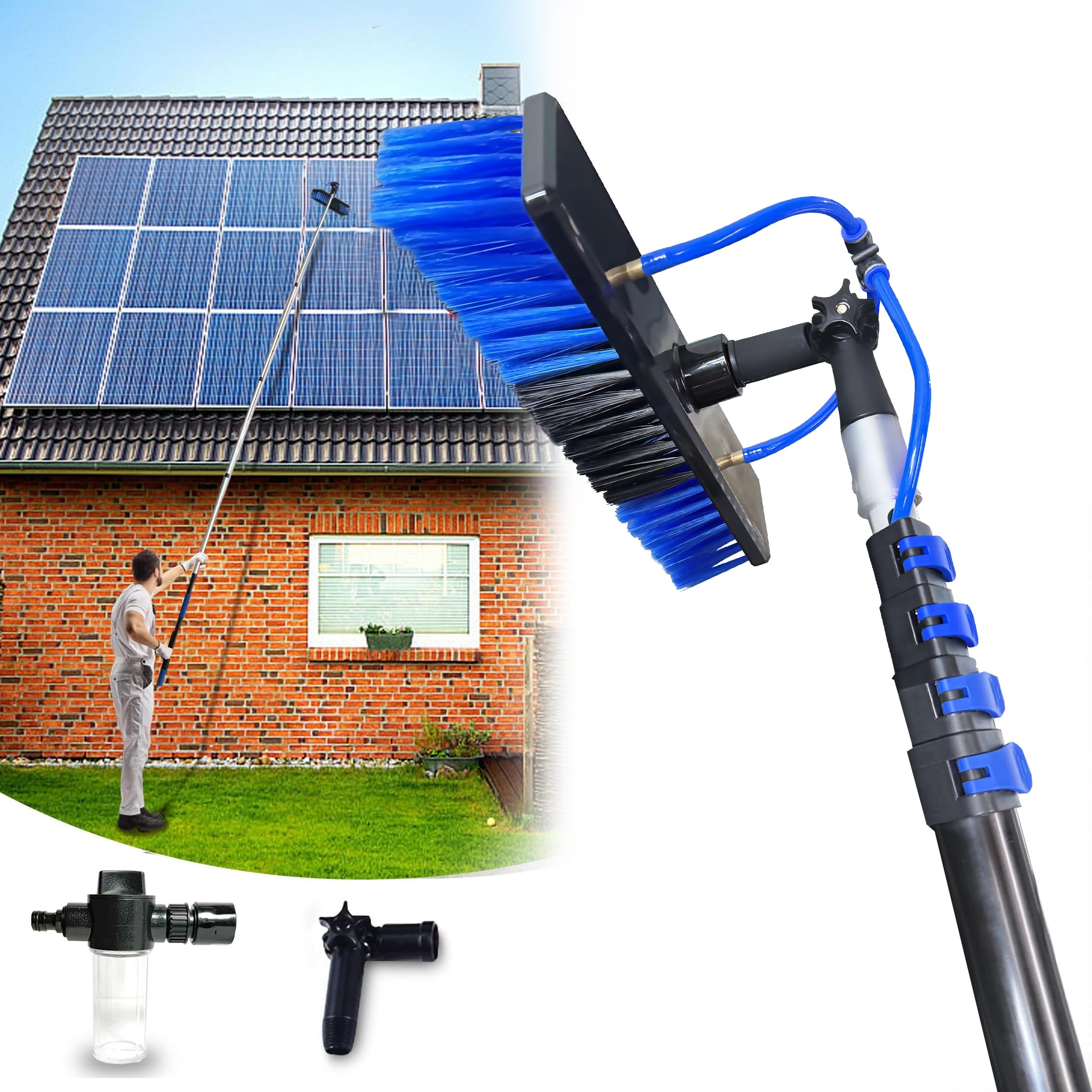
BSFRNF 16FT Solar Panel Cleaning Kit with Telescopic Pole & Soap Dispenser, Water Fed Solar Panel Brush for Home/Roof/Caravan, Extendable Window Cleaner Tool for RV, Boat, Deck & Outdoor Use (16FT) : Patio, Lawn & Garden
View on AmazonFlexibility to upgrade or exit
- Ownership: High flexibility—add panels or storage, change inverters, or decommission if desired. You can also refinance or use property-assessed financing in some areas.
- Lease/PPA: Upgrades may require provider approval; adding third-party equipment (like batteries) can be restricted.
Who owns the RECs?
- Ownership: You usually do, unless you sell them into an SREC market.
- Lease/PPA: The third-party owner typically keeps RECs. That means you may not be able to claim “renewable” use for reporting if RECs are sold elsewhere.
Which option fits your goals and constraints?
Match the structure to your situation and comfort with long-term commitments.
Maximize lifetime savings and control
- Best fit: Buy (cash if feasible; low-fee loan if not).
- Why: You capture the 30% ITC and any state/utility incentives, avoid escalators, and benefit from long post-payback savings.
- Good for: Long-term homeowners with stable roofs; those comfortable claiming tax credits.
Prioritize immediate bill relief with minimal upfront cost
- Best fit: Lease or PPA.
- Why: $0-down and instant savings versus your utility bill (in many markets). O&M is handled for you.
- Watch-outs: Escalators versus future utility rates; transfer rules if you sell.
Planning to move within 3–7 years
- Consider: Ownership can still work—homes with owned PV have documented resale premiums in many markets (LBNL). But ensure roof condition and keep good documentation. If uncertain, a shorter-term PPA/lease with clear transfer provisions may be acceptable, or consider offsite options.
- Alternative: If rooftop isn’t ideal or you’re renting, Community Solar Programs Available: How to Find, Compare, and Join (/renewable-energy/community-solar-programs-available-guide) can deliver savings without a roof commitment.
Limited tax liability this year
- Consider: Ownership still qualifies for the 30% ITC with carryforward under current IRS guidance. If multi-year tax liability is uncertain, a lease/PPA avoids relying on tax credits.
Credit considerations
- Ownership loans and TPO contracts both require credit checks. Many solar lenders and TPO providers look for FICO scores around the mid-600s or higher; cash purchases avoid credit entirely.
Roof age and condition
- If you’ll need a new roof within a few years, coordinate reroofing with solar installation to avoid future removal/reinstall costs. Some providers bundle reroofing; compare quotes carefully.
For a broader decision framework, see Are Solar Panels Worth It in 2026? Cost, Payback & Decision Guide (/renewable-energy/are-solar-panels-worth-it-2026) and Solar Panels Pros and Cons: A Data-Driven Guide to Decide If They’re Right for You (/renewable-energy/solar-panels-pros-and-cons-data-driven-guide).
Common misconceptions to clear up
“Leasing is always cheaper.”
- Not necessarily. Leases/PPAs can offer immediate savings with no cash outlay, but owners typically achieve higher lifetime savings because they capture tax credits and avoid escalators. The better deal depends on local rates, contract terms, and system cost.
“Owned systems don’t need maintenance.”
- PV is low-maintenance, not no-maintenance. Expect inverter replacement for string-inverter systems and occasional service. Microinverters and optimizers often carry longer warranties that can reduce out-of-pocket risk.
“Leased systems hurt resale value.”
- Evidence is mixed. Owned systems commonly increase value (LBNL, Zillow). Leased/PPAs can transfer smoothly in many sales, but some buyers resist long-term contracts—especially with escalators. Clear documentation and early communication with buyers and lenders help.
“You can’t get batteries with a lease or PPA.”
- Many TPO offerings now include storage, but terms vary and may change economics under net billing. Ownership also supports batteries, and the 30% ITC can apply to standalone storage that meets IRS rules.
“Net metering makes everything simple.”
- Net metering is evolving. In several states, export credits are lower than retail (net billing). This shifts value toward self-consumption and time-shifting with batteries. The impact is similar for owned and leased systems but interacts differently with loan or lease cash flows.
How to compare specific offers side by side
Create an apples-to-apples analysis using real quotes and your usage profile.

Emporia Gen 2 Smart Home Energy Monitor with 16 50A Circuit Level Sensors | Real Time Electricity Monitor/Meter | Solar/Net Metering - Amazon.com
View on Amazon- System size and production
- Get annual and monthly kWh production estimates (PVWatts or installer modeling). Check shading assumptions and panel orientation/tilt.
- Total installed price and $/W (ownership)
- Note dealer fees and adder costs. Compare to regional benchmarks. Our Solar Energy Comparison Charts: Key Metrics, Data Sources & How to Read Them (/renewable-energy/solar-energy-comparison-charts-metrics-methods) can help interpret metrics.
- Incentives
- Confirm eligibility for the 30% ITC, state rebates, SRECs, and tax exemptions. Identify who claims the benefits (you vs. third party).
- Financing details (loans)
- APR, term, dealer fee, and whether the loan assumes you’ll apply the ITC as a lump-sum principal payment. Model payments with and without that step.
- Lease/PPA details
- Starting rate/payment, escalator, production guarantee, O&M coverage, buyout schedule, transfer rules, and end-of-term options (renewal, removal, purchase at fair market value).
- Utility rate outlook
- Compare any escalator to your utility’s historic rate growth. If escalator > rate growth, savings may shrink.
- Cash flow timeline and NPV
- Build a simple spreadsheet with monthly cash flows: loan/lease payments, residual utility bills, and any incentive income. Discount future cash flows at your hurdle rate to compare net present value (NPV) for each option.
- Roof and home sale scenarios
- Include potential reroof costs during system life and the likelihood of selling the home before year 10. For leases/PPAs, test transfer or buyout costs.
What this means for households and policymakers
- For households: Ownership generally maximizes lifetime value if you can use tax credits and plan to stay put. Leases/PPAs democratize access with $0-down options and professional O&M but deserve close scrutiny on escalators, production guarantees, and transfer terms.
- For policymakers: Stable net billing frameworks, transparent interconnection timelines, and consumer-protection standards for TPO contracts can expand adoption while preserving consumer savings. Clear appraisal practices and REC accounting improve market function and promote accurate emissions claims.
The road ahead
Module prices fell dramatically over the past decade, and soft costs (permitting, customer acquisition, financing) now dominate residential pricing in many markets, according to NREL and LBNL. Expect further innovation in standardized permitting (e.g., SolarAPP+), automated design, and inverter/storage integration—all of which improve economics for both ownership and TPO models.
Regulatory shifts toward time-varying rates and net billing make self-consumption and batteries more valuable; both owners and TPO providers are adapting by bundling storage and smart controls. As financing costs and utility rates evolve, the better choice in the solar lease vs buy comparison will continue to hinge on local conditions and your personal goals. The best next step is a side-by-side, NPV-based comparison of real quotes using your tariff and usage data.
Recommended Products
Solar Electricity Handbook - 2023 Edition: A simple, practical guide to solar energy – designing and installing solar photovoltaic systems: Boxwell, Michael
Solar Electricity Handbook - 2023 Edition: <strong>A simple, practical guide to solar energy – designing and installing solar photovoltaic systems</strong> [Boxwell, Michael] on Amazon.com. *FREE* shi
Emporia Gen 2 Smart Home Energy Monitor with 16 50A Circuit Level Sensors | Real Time Electricity Monitor/Meter | Solar/Net Metering - Amazon.com
See how much electricity your home is using anywhere, anytime. ... <strong>Add individual 50A sensors to your Vue to monitor up to 16 individual circuits</strong> — providing accurate energy use for t
BSFRNF 16FT Solar Panel Cleaning Kit with Telescopic Pole & Soap Dispenser, Water Fed Solar Panel Brush for Home/Roof/Caravan, Extendable Window Cleaner Tool for RV, Boat, Deck & Outdoor Use (16FT) : Patio, Lawn & Garden
Electric Solar Panel Cleaning Kit, 20FT Solar Panel Cleaning Brush and Pole with Soap Dispenser, Telescopic Water Fed Pole, 100Mins Runtime, Solar Panel Cleaner Solution for Windows, Roof (Black) 35 F