
Solar Panel Financing Options: A Practical Guide to Choosing How to Pay for Solar
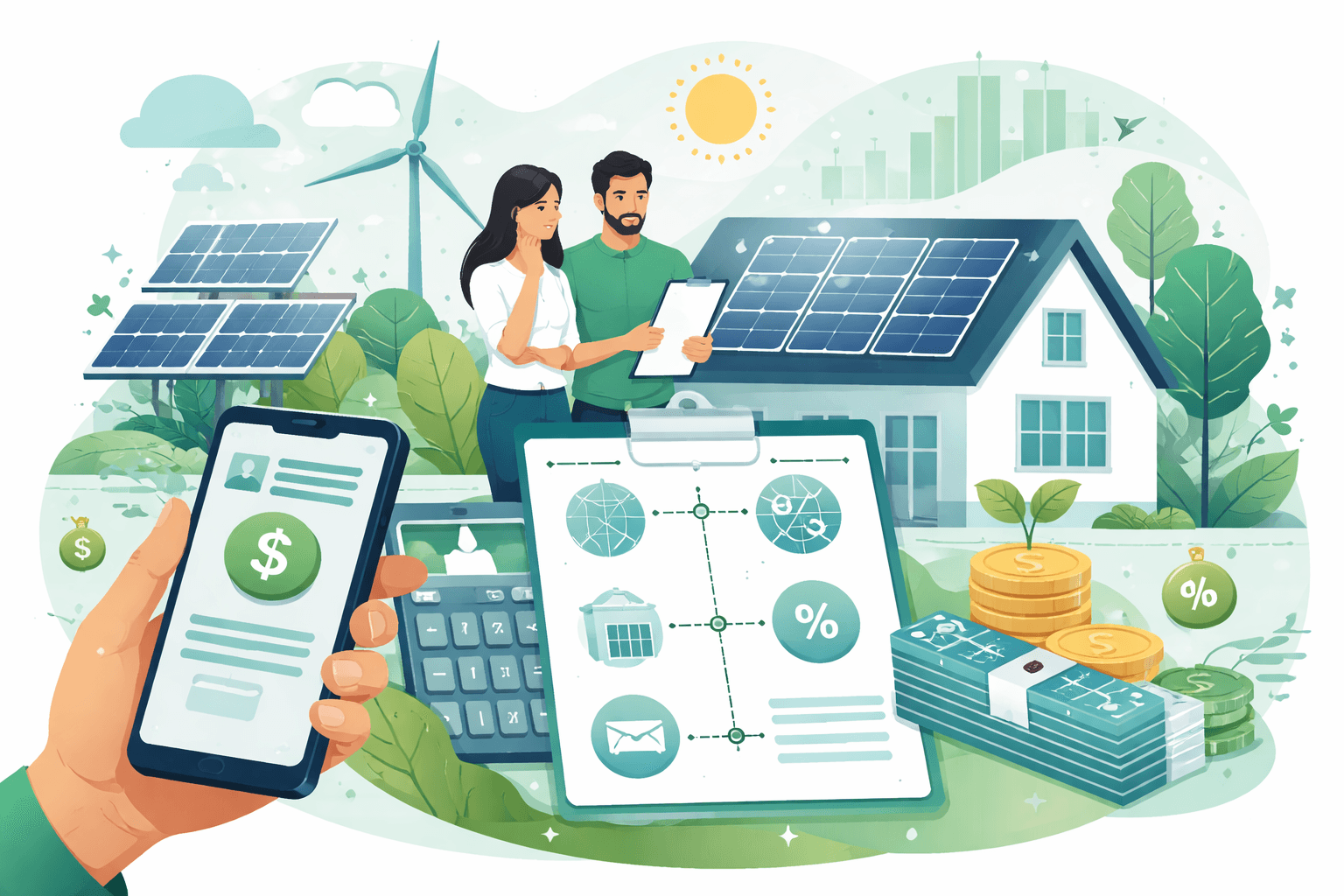
Solar panel financing options have expanded rapidly in the U.S. as residential solar capacity surpassed 30 GW by 2023, with installed prices for typical home systems clustering around $3–$4 per watt (Lawrence Berkeley National Laboratory’s Tracking the Sun 2023 places 2022 median at $3.8/Wdc for systems ≤10 kW). With the 30% federal Investment Tax Credit (ITC) extended through at least 2032, and many states offering additional incentives, how you pay for solar can matter as much as the panels you choose. This guide breaks down each financing path, what it costs, who owns the system, and how incentives apply—so you can pick the option that best fits your home or business.
What are the main solar panel financing options?
Below are the most common ways to pay for rooftop solar and small commercial systems, explained in plain terms.
Solar Electricity Handbook - 2023 Edition: A simple, practical guide to solar energy – designing and installing solar photovoltaic systems: Boxwell, Michael
Solar Electricity Handbook - 2023 Edition: <strong>A simple, practical guide to solar energy – designing and installing solar photovoltaic systems</strong> [Boxwell, Michael] on Amazon.com. *FREE* shi
Check Price on Amazon1) Cash purchase
- How it works: You pay the full installed price up front. You own the system immediately.
- Why choose it: Lowest total cost and maximum savings because there’s no interest or financing fees. You receive the full federal ITC and eligible state/utility incentives.
- Considerations: Highest upfront outlay. Payback is driven by local electricity rates, system output, and incentives.
2) Unsecured solar loan (personal/installer-arranged)
- How it works: Fixed-rate, no-collateral loans commonly offered through installers or fintech lenders. Terms typically 10–25 years. Often marketed as “no money down.”
- Why choose it: Spreads costs into predictable monthly payments while you still own the system and can claim incentives.
- Considerations: Interest rates and “dealer fees” (origination fees embedded in the project price) can significantly increase the total cost. Many loans are structured with an expectation you make a large prepayment equal to your tax credit within 12–18 months; if you don’t, payments can step up.
3) Secured solar loan
- How it works: The loan is secured by the solar equipment (via a UCC-1 filing) or your home. Rates can be lower than unsecured loans; terms 10–20+ years.
- Why choose it: Potentially lower APR than unsecured loans; borrower still owns the system and gets incentives.
- Considerations: A UCC-1 on the solar equipment can complicate a home sale or refinance unless released. If the loan is secured by the home, you assume mortgage-like obligations.
4) Home equity loan or HELOC
- How it works: You borrow against your home’s equity via a fixed-rate home equity loan or variable-rate home equity line of credit (HELOC).
- Why choose it: Often the lowest interest rate available to homeowners with equity and good credit. You own the system and get incentives.
- Considerations: Closing costs may apply. Your home is collateral. HELOC rates are variable. Interest may be tax-deductible in some cases when funds are used to “substantially improve” the home—consult a tax professional.
5) Solar lease
- How it works: A third party owns the system; you pay a fixed monthly lease payment (often with an annual escalator). Lease terms are typically 15–25 years.
- Why choose it: $0–low upfront cost with immediate utility bill reduction. The lessor handles maintenance.
- Considerations: You don’t own the system and generally cannot claim the ITC; the lessor claims it and bakes benefits into your payment. Lease transfer at home sale requires buyer approval; some buyers prefer owned systems.
6) Power Purchase Agreement (PPA)
- How it works: A third party owns the panels and sells you the electricity they produce at a set price per kWh, often starting below your utility’s rate. Terms 15–25 years, often with an annual price escalator.
- Why choose it: No upfront cost; you pay only for energy produced.
- Considerations: Similar to leases on ownership and incentives. Savings depend on the spread between PPA price and utility rates over time. Transferability at sale and escalator terms matter.
7) PACE and municipal property-tax financing
- How it works: Property Assessed Clean Energy (PACE) lets you finance solar with repayment as a line item on your property tax bill. The assessment is attached to the property, not the individual borrower.
- Why choose it: Long terms (10–25 years), non-recourse to the homeowner, and can be transferable to a new owner.
- Considerations: Availability varies by state and locality, and consumer protections differ. Because PACE assessments often have lien priority, they can complicate mortgage refinancing or sales for homes with conforming mortgages (the Federal Housing Finance Agency has issued guidance cautioning on residential PACE). Verify local rules and lender acceptance.
8) Utility on-bill financing or tariffed on-bill programs
- How it works: The utility or partner lender finances the system and you repay through your utility bill. In “tariffed on-bill” models (e.g., Pay As You Save), the obligation can stay with the meter rather than the customer.
- Why choose it: Simplicity, potentially lower credit barriers, and payments designed to be offset by energy savings.
- Considerations: Program availability is limited and terms vary. Ownership and incentive eligibility depend on program design.
9) Community solar subscriptions and shared-solar models
- How it works: You subscribe to a share of an offsite solar farm and receive bill credits for your share of generation.
- Why choose it: No roof required, minimal commitment, and subscriptions often promise 5–15% bill savings.
- Considerations: You don’t own a system, so the ITC doesn’t apply to subscribers. Contracts and portability vary. Ideal for renters or shaded roofs.
Cost and ownership: how choices change the math
Upfront cost vs. long-term savings
- Cash and low-interest home-equity financing typically deliver the lowest levelized cost of energy (LCOE) and highest lifetime savings because financing charges are modest or zero.
- Unsecured solar loans can make projects pencil out cash-flow positive in year one in high-rate markets, but dealer fees and higher APRs increase total cost.
- Leases/PPAs offer immediate bill reductions with no capital outlay but generally deliver lower lifetime savings than ownership because the third party captures tax benefits and a return on capital.
Who owns the system and why it matters
- Ownership (cash/loan/HELOC/PACE): You can claim the federal ITC and most state incentives, may increase home value, and control operations and maintenance.
- Third-party ownership (lease/PPA): The provider claims the ITC and incentives; benefits are reflected in your payment or PPA price. You’ll need to address transfer or buyout if selling the home.
Typical interest rates and terms (2024 market snapshot)
- Unsecured solar loans: Roughly 4.99–12.99% APR, 10–25 years, often with 0–25% dealer fees embedded in price (ranges vary by lender and FICO; Consumer Financial Protection Bureau has highlighted wide variability across providers).
- Secured solar loans: Often 4–9% APR, 10–20 years, sometimes with equipment liens (UCC-1).
- Home equity loans/HELOCs: Frequently the lowest rates available to qualified borrowers; 6–10% typical range in 2024, 5–20 years (HELOCs are usually variable-rate).
- Leases/PPAs: No “APR,” but effective cost shows up as monthly lease payments or cents/kWh PPA pricing, with common escalators of 0–3% annually.
- PACE: Terms 10–25 years; interest rates vary by program and municipal bond conditions.
Credit and income requirements
- Ownership loans: Many lenders look for FICO ≥650–680, with prime rates typically reserved for ≥700.
- Leases/PPAs: Credit thresholds often around 650–700.
- Utility on-bill and tariffed programs may consider utility payment history instead of traditional credit.
Incentive eligibility and home value impacts
- ITC eligibility: You must own the system (cash or any loan type, including PACE) to claim the residential ITC (Internal Revenue Code §25D). Leases/PPAs assign tax credits to the provider.
- State incentives: Some rebates reduce the basis used to calculate the ITC; performance-based incentives (e.g., SRECs) usually do not. Rules vary by state.
- Home value: Multiple LBNL studies have found owned PV systems are capitalized into home sale prices at roughly $3–4 per installed watt on average, all else equal. Leased systems generally do not confer the same premium and can require transfer approvals (LBNL, “Selling into the Sun” series). Market conditions and appraisal practices vary.
By the numbers: a quick reference
- Typical residential price: $3–$4/W before incentives; LBNL 2023 median = $3.8/Wdc for ≤10 kW (2022 installs).
- Typical system size: 6–10 kW for single-family homes; U.S. medians around 7–8 kW.
- 30% federal ITC: Available to homeowners for owned systems placed in service through at least 2032 (residential §25D); standalone batteries also qualify from 2023.
- Average U.S. residential electricity price: About 16¢/kWh in 2023 (U.S. Energy Information Administration).
- Capacity factor: Rooftop PV typically produces the equivalent of 14–20% of its nameplate capacity over a year, depending on location, tilt, and shading.
Example snapshot: A 7.5 kW system at $3.30/W costs $24,750 pre-ITC. The 30% ITC is $7,425, bringing the net cost to $17,325 (before any state incentives). If it generates 10,500 kWh/year and your retail electricity rate is 16¢/kWh, first-year bill savings are roughly $1,680. Simple payback (ignoring financing and price escalation) is about 10.3 years.
Incentives, rebates, and program eligibility
Federal Investment Tax Credit (ITC)
- Homeowners: A 30% nonrefundable credit on qualified expenditures for solar (and from 2023, standalone storage). Unused credit can typically carry forward to future tax years. You must have tax liability to benefit; consult a tax advisor for your situation (IRS Form 5695; IRC §25D).
- Businesses: A 30% credit under §48, with potential bonus credits for domestic content, energy community siting, and low-income projects (for qualifying community solar). The IRA allows tax-exempt entities to use “direct pay” and permits transferability of credits for businesses.
- Basis adjustments: State/utility rebates that are not taxable income generally reduce the federal ITC-eligible basis; performance payments usually do not.
State and local incentives
- Rebates, buy-downs, and sales/property tax exemptions exist in many states. Performance-based incentives and Solar Renewable Energy Credits (SRECs) in markets like New Jersey and the Mid-Atlantic can materially improve project economics.
- Policy lookup: The Database of State Incentives for Renewables & Efficiency (DSIRE) is a comprehensive resource maintained by the NC Clean Energy Technology Center.
Net metering and export rates
- Policies vary widely. Some states still credit exports at or near retail rates; others have moved to “net billing” with lower export compensation (e.g., California’s NEM 3.0 cut export values substantially, increasing the value of self-consumption and batteries; CPUC rulemaking 2023).
- Financing choices that depend on strong bill savings (e.g., high-APR loans) are more sensitive to net metering changes. Always model cash flows using your utility’s current and expected export tariffs.
Income-qualified and low-income programs
- Many states and utilities offer enhanced rebates or discounted community solar subscriptions for income-eligible households (e.g., Illinois Solar for All, NY-Sun Income-Eligible, California DAC programs). The EPA’s Solar for All program (awarded in 2024 under the Greenhouse Gas Reduction Fund) is deploying billions to scale no/low-upfront-cost solar for low-income communities through 2028.
- These programs can determine whether ownership, leasing, or community solar delivers the best near-term benefit.
Decision tools: how to compare offers and next steps
- Key numbers to compare
- APR vs. dealer fee: A 2.99% “promo APR” with a 20–25% dealer fee can cost more over time than a 7.99% loan with no fee. Ask for the cash price and the financed price side by side.
- Term length: Longer terms lower the monthly payment but increase total interest paid.
- Total of payments: The sum of all scheduled payments, including any balloon or step-up. Compare this to the cash price to see the financing premium.
- Monthly cash flow: Compare monthly loan or lease payments to modeled utility bill savings under your actual tariff.
- Payback period: Years until cumulative bill savings equal net cost after incentives. Useful but can obscure financing costs.
- Levelized Cost of Energy (LCOE): Total lifetime cost (install + O&M + financing) divided by lifetime energy (kWh). Compare your solar LCOE to your utility’s all-in cost per kWh. Example: If total 25-year cost is $28,000 and lifetime generation is 250,000 kWh, LCOE ≈ 11.2¢/kWh.
- Degradation and O&M: Panels typically degrade ~0.5%/year; plan modest inverter/battery replacement reserves.

Emporia Gen 2 Smart Home Energy Monitor with 16 50A Circuit Level Sensors | Real Time Electricity Monitor/Meter | Solar/Net Metering - Amazon.com
View on AmazonSample homeowner scenarios (illustrative)
- Cash purchase: $24,750 pre-ITC; $7,425 ITC; net $17,325 out-of-pocket by tax time. Annual savings ~$1,680. Simple payback ≈ 10.3 years; after payback, power is effectively “free” apart from maintenance.
- Unsecured solar loan with dealer fee: Financed amount $30,938 (assumes 25% dealer fee on $24,750). 2.99% APR, 25 years. Estimated payment ≈ $146/month ($1,756/year), near breakeven with savings. Total of payments ≈ $43,800 over 25 years—about $19,000 above cash.
- Unsecured loan, no dealer fee: $24,750 at 7.99% APR, 20 years. Payment ≈ $206/month ($2,477/year), exceeding modeled first-year savings. Total of payments ≈ $49,900.
- HELOC: Borrow $17,325 (assuming you apply the ITC as a lump-sum prepayment) at 8% APR, 10 years. Payment ≈ $210/month ($2,520/year). Shorter term reduces interest versus a 20–25 year loan.
- Lease/PPA: $0 down; either a fixed monthly lease or a PPA at, say, 14¢/kWh with a 2% escalator. Immediate bill savings if your retail rate is 16¢/kWh, but lifetime savings are capped by the contract and escalator.
Your local rates, solar resource, incentives, credit profile, and equipment selection will shift these outcomes—use them as a framework, not a quote.
Sample small-business considerations
- Businesses can stack the §48 ITC with accelerated depreciation (MACRS; bonus depreciation percentage is 60% in 2024 and stepping down thereafter under current law). This can drive net effective costs down dramatically in the first 5–6 years.
- Commercial PPAs are common where third-party ownership and tax appetite can be optimized; credit and site control (roof lease terms) are key underwriting factors.
Documentation and questions to ask
- Ask installers/lenders for: cash price, financed price, APR, term, dealer/origination fees, total of payments, prepayment policy, UCC-1 filings, and any balloon/step-up schedule.
- Request a production estimate (kWh/year) with location-specific assumptions, degradation rate, and weather file used (e.g., PVSyst, NREL PVWatts).
- Verify warranty terms: panel performance, inverter replacement, roof penetrations, and workmanship.
- Incentives: Who files for the ITC, SRECs, and utility rebates? How is the ITC assumed in the loan (e.g., required prepayment)?
- Home sale/refi: What happens to the loan, UCC-1, lease, or PPA if you sell? Are there transfer or buyout fees? Will your mortgage lender accept PACE or equipment liens?
Common red flags
- “Free solar” or “no-cost solar” claims. There’s always a cost—either a loan, a lease/PPA rate, or foregone incentives.
- High escalators (>2.9%/yr) in leases/PPAs can erase savings if utility rates don’t rise as fast.
- Mandatory arbitration clauses and large early-termination or removal fees buried in contracts.
- Aggressive step-up loans that assume you’ll make a large ITC prepayment—ask for a constant-payment version and compare totals.
- Incomplete site assessments leading to overestimated production (no shading or tilt analysis).
When to get professional advice
- Tax professional: To confirm ITC eligibility, basis adjustments, and any interest deductibility for home-equity financing.
- Real estate or mortgage professional: Before moving forward with PACE or equipment liens, or if you plan to sell/refi soon.
- Energy advisor: For an independent review of production models and savings assumptions.
How policy and markets shape the best choice
- In strong net metering markets with high retail rates, ownership (cash or low-cost loans) often delivers double-digit internal rates of return. Where export rates are reduced (net billing), pairing solar with load-shifting or batteries can protect savings; financing should reflect the updated savings profile.
- Rising interest rates in 2023–2024 shifted many consumers toward HELOCs or shorter-term loans to control total cost; dealer-fee-heavy “low APR” options often look cheaper monthly but can be more expensive overall.
- For households without tax liability or with limited credit, leases/PPAs and income-qualified community solar offer bill relief without upfront cost—especially where state programs add extra discounts.

EF ECOFLOW Smart Home Panel 2, the Center of the Whole
View on AmazonBottom line: matching solar panel financing options to your situation
- Prioritize total cost over headline APR. Compare the financed total of payments to the true cash price.
- Model savings under your actual tariff, including export compensation rules and likely rate changes.
- Choose ownership if you can capture the ITC and access reasonably priced capital; consider third-party options or community solar when upfront cost or tax appetite is a barrier.
- Keep future flexibility in mind—sale, refinance, roof replacement—and choose contract structures that won’t surprise you later.
Key sources: LBNL Tracking the Sun (2023) for installed price trends; U.S. EIA for electricity prices; NREL and DOE guides on residential solar financing; SEIA/Wood Mackenzie for market context; DSIRE for state incentives; CPUC for California NEM 3.0; CFPB/FHFA statements for PACE and consumer protections.
Recommended Products
Solar Electricity Handbook - 2023 Edition: A simple, practical guide to solar energy – designing and installing solar photovoltaic systems: Boxwell, Michael
Solar Electricity Handbook - 2023 Edition: <strong>A simple, practical guide to solar energy – designing and installing solar photovoltaic systems</strong> [Boxwell, Michael] on Amazon.com. *FREE* shi
Emporia Gen 2 Smart Home Energy Monitor with 16 50A Circuit Level Sensors | Real Time Electricity Monitor/Meter | Solar/Net Metering - Amazon.com
See how much electricity your home is using anywhere, anytime. ... <strong>Add individual 50A sensors to your Vue to monitor up to 16 individual circuits</strong> — providing accurate energy use for t
EF ECOFLOW Smart Home Panel 2, the Center of the Whole
Alternatively connect <strong>3 x EcoFlow DELTA Pro 3 units with 6 x Extra Batteries for energy storage up to 36kWh</strong>. It's not just for longer backup but lets you to control and run every