
Tesla Powerwall in Arizona: Cost, Availability & Is It Worth It?
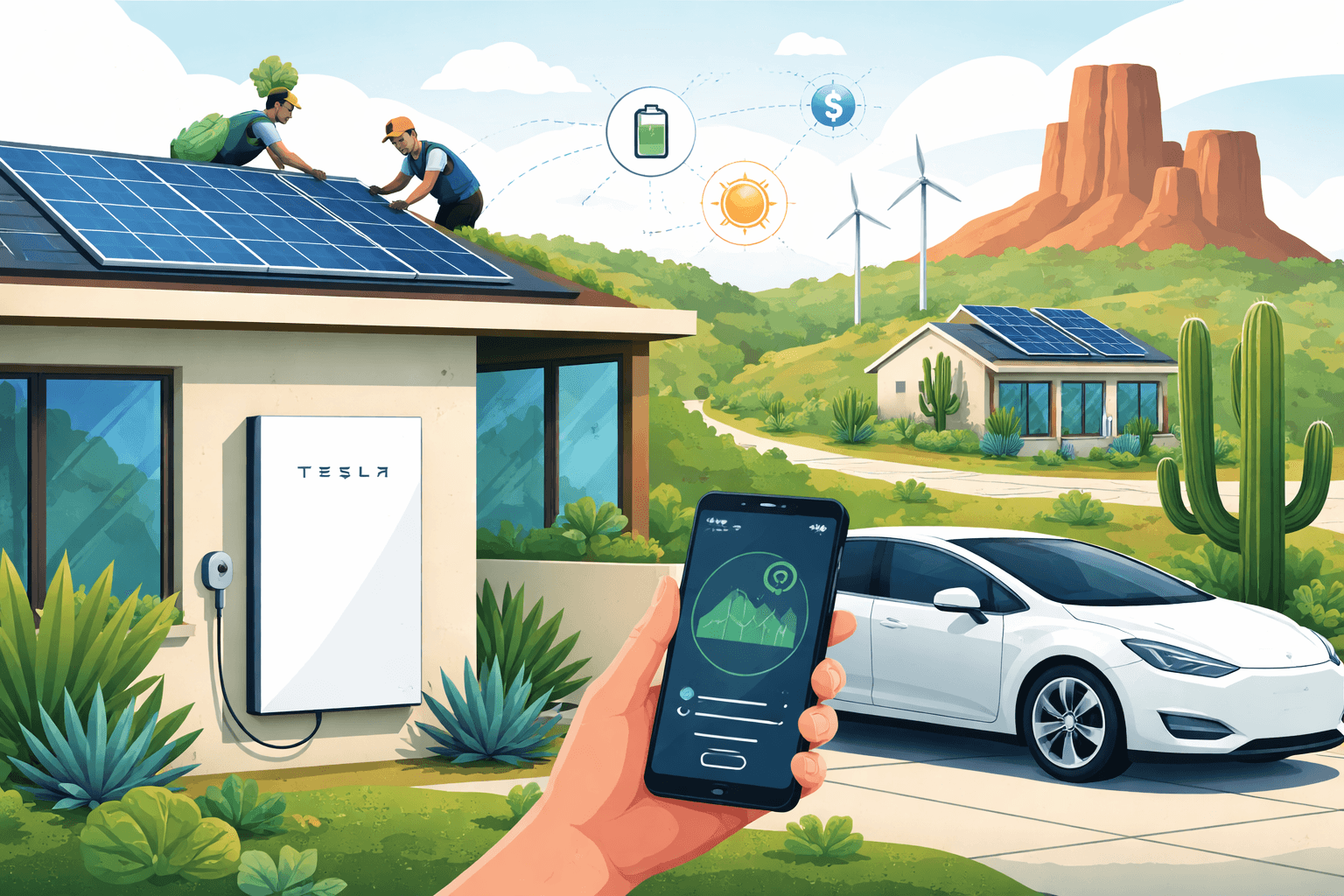
Arizona ranks among the sunniest states in the U.S., and that matters for the Tesla Powerwall in Arizona. With summer afternoon peaks that can exceed 25–35¢/kWh under time-of-use (TOU) plans from major utilities and export credit rates often just 7–10¢/kWh, batteries are increasingly the lever that makes rooftop solar deliver bigger bill savings and reliable backup. The 30% federal tax credit for standalone storage (IRA, through 2032) further improves the economics (U.S. DOE/IRS).
This guide breaks down specs, pricing, incentives, rate structures, installer options, and alternatives—so Arizona homeowners can decide if a Powerwall pencils out.
Tesla Powerwall overview: specs, capacity, and how it works
Tesla’s Powerwall family is a lithium-ion home battery that stores energy from solar or the grid and discharges it later for bill savings or backup. Two models are commonly seen in Arizona:

The Homeowner's Guide to Renewable Energy - Revised & Updated Edition: Achieving Energy Independence through Solar, Wind, Biomass and Hydropower: Chiras, Dan
After beginning with the all important discussion about energy efficiency and conservation, <strong>Dan guides you through everything you need to choose which renewable options to integrate into your
Check Price on AmazonPowerwall 2 (AC-coupled)
- Usable capacity: 13.5 kWh
- Continuous power: ~5 kW (higher for short peaks)
- Round-trip efficiency: ~90%
- Warranty: 10 years, typically to 70% of original capacity (Tesla)
Powerwall 3 (hybrid, with integrated inverter)
- Usable capacity: 13.5 kWh
- Continuous power: up to ~11.5 kW with higher surge capacity (suitable for large HVAC startup)
- Higher PV input handling for DC-coupled designs and improved round-trip efficiency vs. AC-coupled setups (Tesla)
- Warranty: 10 years
How it works
- Charge: During sunny hours, your solar array fills household loads first, then charges the Powerwall. If solar is insufficient (clouds, winter), the battery can also charge from the grid during off-peak hours on TOU plans.
- Discharge: In the evening peak window—when Arizona rates are highest—the Powerwall powers the home to reduce expensive grid purchases. It also keeps critical loads on during outages via a backup gateway that isolates the home from the grid (islanding) for safety.
Right-sizing
- A single 13.5 kWh Powerwall can cover an average evening peak of 1–3 kW for 4–10 hours. High-load appliances (electric ovens, 3–5 ton air conditioners) can be supported, but runtime shortens as load rises. For example, a 4 kW AC compressor could draw down one battery in ~3 hours (13.5 kWh ÷ 4 kW), not counting efficiency losses.
- Homes with multiple HVAC units or well pumps often install 2–3 Powerwalls for higher power and longer backup.
Further reading on specs and configurations: Tesla Powerwall: Complete Buyer’s Guide — Cost, Installation & Alternatives.
Powerwall pricing in Arizona including installation costs
Installed costs in Arizona vary by site conditions, panel space, and whether you’re pairing with new solar or retrofitting. Based on recent quotes reported by installers and market trackers (NREL, 2024 residential storage cost benchmark), typical ranges are:
- First Powerwall installed: $12,000–$15,000
- Each additional Powerwall (same project): $9,000–$11,000
- Electrical service upgrades, trenching, or long conduit runs: +$1,000–$4,000
What affects price
- New solar vs. retrofit: Powerwall 3 can share balance-of-system components with a new PV install, trimming costs vs. an AC-coupled retrofit.
- Main panel upgrade: Many older Arizona homes have 100–150A service. Battery + EV charger + heat pump water heater can push you toward a 200A upgrade.
- Permitting and plan review: Municipal requirements differ across Phoenix metro, Tucson, and Flagstaff.
After incentives
- Federal tax credit (ITC): 30% off eligible project costs through 2032 (standalone or solar-paired). Example: $13,500 gross → $9,450 after ITC.
- Arizona’s state residential solar tax credit: up to $1,000. Applicability to batteries depends on project scope and Arizona Department of Revenue guidance; many installers secure it when the battery is paired with solar as a “solar energy device.” Consult a tax professional (DSIRE; AZDOR).
For a full system cost picture if you’re still pricing PV, see our state guide: Solar in Arizona: Costs, Incentives & Top Installers (2026).
Arizona battery storage incentives: state rebates, SGIP, utility programs
- Statewide rebates: Arizona does not offer a statewide battery rebate (unlike California’s SGIP). SGIP is California-only.
- Federal: 30% ITC as noted above.
- Utility programs (availability and terms change; confirm current details):
- Salt River Project (SRP): Historically offered a Battery Storage Incentive with capped, limited-enrollment rebates for residential customers. Prior cycles provided up to several thousand dollars per home. SRP also has TOU and demand-based plans where batteries can reduce bills by shaving evening peaks. Check SRP’s current battery program page for the latest enrollment status and amounts.
- Arizona Public Service (APS): Has run residential battery pilots that paid enrollment incentives and bill credits for allowing limited, scheduled battery dispatch during peak events (demand response). Offers TOU and demand-based rates (more below) where storage can materially reduce costs.
- Tucson Electric Power (TEP): Offers TOU rates and has tested customer battery programs. Batteries can be configured for self-consumption and peak shaving under those tariffs.
Because these utility offerings frequently open and close with limited budgets, ask installers to verify current incentives in your service territory and include enrollment support in their bids.
How the Powerwall pairs with solar in Arizona: backup vs. self-consumption
Arizona’s policy environment has shifted from classic net metering to “net billing” or export credit rates that are typically below retail energy charges. APS’s resource comparison proxy (RCP) and similar export structures elsewhere in the state have recently paid around 7–10¢/kWh for excess solar sent to the grid, while on-peak retail energy can be 2–3 times higher (utility tariffs and commission filings).
What that means in practice
- Without a battery, a large share of midday solar production is exported for a modest credit—especially in summer when AC loads peak later in the day.
- With a Powerwall, you store those midday kWh and run your home in the 4–9 p.m. window (typical APS/TEP peak periods) when rates jump. This lifts self-consumption and arbitrages the difference between low export credits and high retail energy charges.
Backup vs. bill optimization
- Backup mode: Reserve capacity so the battery is ready for outages from monsoon storms and extreme heat events. NOAA data show Arizona’s summer storms increasingly cause localized outages; EIA tracks average outage durations rising during severe weather years. Keeping a 20–40% reserve ensures critical loads stay on.
- Time-based control: Tesla’s app uses rate schedules to charge off-peak (or from solar) and discharge on-peak. NREL modeling shows batteries can increase rooftop PV self-consumption by 20–35 percentage points in TOU/net-billing markets, significantly improving payback times compared to solar-only systems.
Realistic expectations
- A single Powerwall can typically cover evening lighting, refrigeration, entertainment, and a portion of HVAC. To fully ride through a hot summer night with central AC, many households opt for 2 units and program a higher thermostat setpoint during peaks.
Arizona utility rate structures and how Powerwall saves with time-of-use
Arizona’s three major territories—APS, SRP, and TEP—offer multiple plans that matter for batteries:

Emporia Gen 2 Smart Home Energy Monitor with 16 50A Circuit Level Sensors | Real Time Electricity Monitor/Meter | Solar/Net Metering - Amazon.com
View on Amazon- Time-of-use (TOU): Higher prices during late afternoon/evening, lower overnight/midday. Summer on-peak can exceed 25–35¢/kWh; off-peak can be 8–12¢/kWh. Batteries shift kWh from low to high periods.
- Demand charges (certain plans): A monthly fee based on your highest 60-minute (or 30-minute) average demand during the billing cycle, often in the $8–$17 per kW range. Batteries can “shave” short peaks—e.g., when the oven, dryer, and AC overlap—lowering that billed kW.
- Net billing/export credits: Solar exports are credited at a fixed or seasonally adjusted rate, typically below retail energy. Batteries help avoid exporting low-value kWh.
Example savings math (illustrative)
- Evening peak energy price: 30¢/kWh; off-peak or export value: 10¢/kWh. Arbitrage spread: 20¢/kWh.
- Discharging 10 kWh per day during peak could save ~$2/day, or ~$60/month (assuming 90% round-trip efficiency, the net may be ~9 kWh delivered). Summer savings can be higher with longer/steeper peaks; winter lower.
- Demand shave: If your monthly peak demand drops from 7 kW to 4 kW on a $12/kW plan, you save $36 that month.
Combined, many Arizona homes see $60–$120/month in avoided costs from a single battery under aggressive TOU and demand tariffs, with higher savings for two batteries or larger homes. Precise outcomes depend on appliance mix, thermostat settings, and app tuning.
Tip: Use the Tesla app’s advanced time-based settings and consider a smart load controller or smart panel to automate noncritical loads off during peaks. Products like a reliable smart panel or load-shedding device Smart Load Controller can ensure the battery prioritizes essential circuits when it matters.
Powerwall availability and certified installers in Arizona
Availability
- Tesla sells and installs Powerwalls directly in much of Arizona and also authorizes third-party Certified Installers across Phoenix, Tucson, and many rural communities. Lead times are typically 2–8 weeks, longer in mid-summer.
How to vet an installer
- Experience: Ask for at least 10–20 recent battery projects in your utility territory.
- Rate modeling: Insist on a utility-specific model showing TOU and demand impacts, export credits, and seasonal behavior.
- Electrical scope: Confirm main panel upgrade needs, critical loads subpanel vs. whole-home backup, and HVAC inrush handling.
- Program support: Enrollment help for any SRP/APS/TEP pilots and precise PTO (permission to operate) timelines.
If you’re still comparing brands and configurations, bookmark our Tesla Powerwall: Complete Buyer’s Guide — Cost, Installation & Alternatives for spec sheets and checklists.
Alternatives to Powerwall available in Arizona: Enphase, LG, Generac
Arizona homeowners commonly compare Powerwall to three families of storage systems. All provide 10-year warranties and UL 9540 safety certification.
Enphase IQ Battery 5P/10/15 (AC-coupled)
- Modular 5 kWh units; common configurations are 10 or 15 kWh.
- High power output per module (IQ 5P ~3.84 kW continuous), excellent for TOU peak shaving.
- Tight integration with Enphase microinverters and robust app. Strong choice for existing Enphase PV arrays.
- If you run Enphase microinverters today, the Enphase IQ Battery 10 typically offers clean integration and competitive whole-home performance.
LG Energy Solution RESU Prime 10H/16H (DC-coupled)
- 9.6–16 kWh usable per cabinet; pairs with hybrid inverters like SolarEdge.
- Good energy density and strong service track record.
- Often cost-competitive in new PV builds where a hybrid inverter is planned.
Generac PWRcell (DC-coupled, modular)
- Scales roughly 9–18 kWh usable per cabinet with high power capabilities.
- Suited to homes with large HVAC or well pumps due to robust surge handling.
- Pairs well with new SolarEdge/Generac hybrid inverter designs.
How they stack up in Arizona
- AC retrofits: Enphase and Powerwall 2 are easiest. If you already have Enphase microinverters, Enphase IQ Batteries reduce balance-of-system complexity.
- New PV + storage: Powerwall 3 or a DC-coupled system (LG/Generac) can maximize round-trip efficiency and cut equipment count.
- High-power loads: Powerwall 3’s higher continuous output and whole-home backup capabilities are attractive for 3–5 ton AC units common in Arizona. Generac PWRcell also shines for surge-heavy sites.
For value seekers, all-in package pricing matters as much as specs. A dependable hybrid inverter plus a 10–15 kWh battery like the RESU Prime 16H can be a strong deal in bundled quotes.
By the numbers: Arizona + batteries
- 30%: Federal Investment Tax Credit for standalone storage, available through 2032 (U.S. DOE/IRS).
- 13.5 kWh: Usable capacity per Tesla Powerwall unit (Tesla).
- 25–35¢/kWh: Typical summer on-peak retail rates under TOU; 8–12¢ off-peak (utility tariffs).
- 7–10¢/kWh: Common export credit range for excess solar (APS/TEP export schedules).
- 8–17 $/kW: Typical range of residential demand charges on certain AZ plans (utility tariffs).
- 1,100–1,200 kWh: Typical monthly household electricity use in Arizona (EIA), with significant seasonal increases from AC.
Practical implications: what this means for Arizona homeowners
- Best-fit households: Solar owners on TOU/demand rates, especially with evening-heavy usage and AC. The bigger the spread between on-peak prices and export credits, the faster the payback.
- Budgeting: Expect $9–11k net cost for one battery after ITC (more if service upgrades are required). Two batteries will cost more but can materially expand HVAC coverage and shave deeper peaks.
- App tuning: Set up “Time-Based Control” with accurate rate schedules; adjust backup reserve seasonally. Consider pre-cooling the home in late afternoon using solar and off-peak energy, then ride peaks on battery.
- Resilience: A single battery can back up essential loads for many hours. Two or more enable overnight AC in many homes if thermostats are moderated.

ecobee Smart Thermostat Premium with Smart Sensor and Air Quality Monitor - Programmable Wifi Thermostat - Works with Siri, Alexa, Google Assistant - Amazon.com
View on AmazonIs the Tesla Powerwall worth it in Arizona?
Financially compelling cases
- You have or plan rooftop solar and are on APS/SRP/TEP TOU or demand rates with steep summer peaks.
- Your utility export credits are materially below retail energy prices, making self-consumption valuable.
- You experience summer outages or want resilience during monsoon season.
Marginal cases
- Low on-peak/off-peak spreads and no demand charges; small homes with modest evening loads.
- All-gas homes with minimal electric use outside of lighting and electronics.
Non-financial value
- Comfort and safety during outages (medical devices, refrigeration, communications).
- Quiet, automatic backup vs. fuel generators; zero onsite emissions.
If you’re early in the journey, our Arizona solar guide can help you size PV to complement storage: Solar in Arizona: Costs, Incentives & Top Installers (2026).
FAQ: common questions about Tesla Powerwall in Arizona
How many Powerwalls do I need to run air conditioning?
- A single 13.5 kWh battery can start and run many 3–4 ton systems for short windows, but sustained overnight cooling typically requires 2–3 units, smart thermostat settings (e.g., pre-cooling), and efficient SEER2-rated HVAC. Consider a high-efficiency heat pump and smart load control to extend runtime.
Does Arizona have a statewide battery rebate like California’s SGIP?
- No. Arizona relies on the 30% federal tax credit and occasional utility-run pilots or incentives. Check APS, SRP, and TEP program pages.
Will I get the Arizona state solar tax credit for a battery?
- Many homeowners pairing storage with solar claim the state’s up-to-$1,000 credit for “solar energy devices.” Eligibility for standalone batteries is less clear; consult your installer and a tax professional.
What’s the typical payback period?
- With solar, TOU/demand savings plus export avoidance can drive simple paybacks in the 7–12 year range for well-optimized systems. Standalone batteries rely mostly on TOU arbitrage and demand shaving—payback varies widely by rate plan and usage.
Can a Powerwall back up my whole home?
- Yes, especially with Powerwall 3’s higher continuous power and if you install multiple units. Many homeowners still opt for a critical loads subpanel to maximize backup endurance.
How long is the warranty?
- 10 years. Capacity typically warranted to ~70% at year 10 (Tesla). Actual life depends on cycling frequency and temperature. Arizona’s heat argues for shaded, ventilated mounting locations.
What maintenance is required?
- No scheduled maintenance. Keep the unit shaded from direct sun, ensure clear airflow, and update the Tesla app for optimal performance.
How does the battery perform in extreme heat?
- The Powerwall operates in a broad temperature range and includes thermal management, but efficiency and power output can derate at high ambient temperatures. A shaded, north-facing exterior wall or garage location is typical in Arizona.
Can I charge from the grid at night and use it during the day?
- Yes. Time-based control allows off-peak charging and on-peak discharging where permitted by your utility tariff.
Are there alternatives that might be better for my home?
- If you already have Enphase microinverters, an Enphase IQ Battery can be a simpler retrofit. For large surge loads, Generac PWRcell or multiple Powerwalls may be preferable. Your installer should model each option.
Where this is heading
Arizona’s grid is adding record solar, and afternoon peaks are getting steeper as loads shift toward evening. IEA and NREL both project rapidly growing roles for distributed storage to smooth these ramps. As utilities continue to refine TOU and export rates, batteries will be the tool that turns daytime desert sun into evening comfort and lower bills. For homeowners, the combination of a 30% federal credit, maturing hardware (like Powerwall 3), and smarter rate designs is making storage less of a luxury and more of a standard complement to solar.
Recommended Products
The Homeowner's Guide to Renewable Energy - Revised & Updated Edition: Achieving Energy Independence through Solar, Wind, Biomass and Hydropower: Chiras, Dan
After beginning with the all important discussion about energy efficiency and conservation, <strong>Dan guides you through everything you need to choose which renewable options to integrate into your
Emporia Gen 2 Smart Home Energy Monitor with 16 50A Circuit Level Sensors | Real Time Electricity Monitor/Meter | Solar/Net Metering - Amazon.com
See how much electricity your home is using anywhere, anytime. ... <strong>Add individual 50A sensors to your Vue to monitor up to 16 individual circuits</strong> — providing accurate energy use for t
ecobee Smart Thermostat Premium with Smart Sensor and Air Quality Monitor - Programmable Wifi Thermostat - Works with Siri, Alexa, Google Assistant - Amazon.com
ecobee Smart Thermostat Premium with Smart Sensor and Air Quality Monitor - Programmable Wifi Thermostat - <strong>Works with Siri, Alexa, Google Assistant</strong> - Amazon.com