
Tesla Powerwall in New Mexico: Cost, Availability & Is It Worth It?
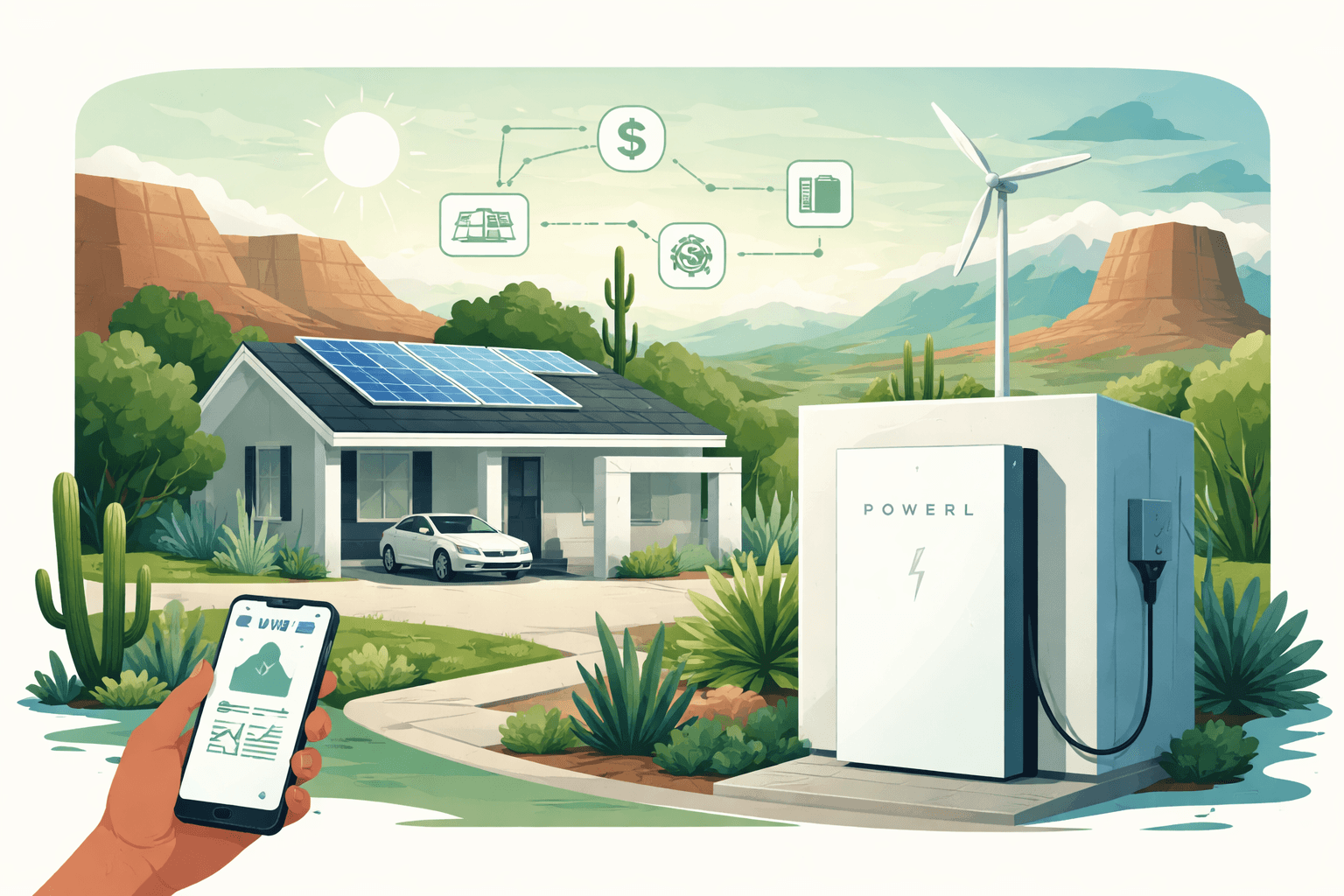
New Mexico homeowners are increasingly asking whether a Tesla Powerwall in New Mexico makes financial and practical sense. With the 30% federal clean energy tax credit now applying to standalone batteries and utilities expanding time-of-use (TOU) rates, the case for home storage has shifted. Below, we break down specs, real-world pricing, state incentives, how Powerwall pairs with rooftop solar, and where it delivers the most value in the Land of Enchantment.
Tesla Powerwall overview: specs, capacity, and how it works
Tesla’s Powerwall is a lithium-ion home battery that stores electricity for later use—either from rooftop solar or the grid. It can provide backup power during outages and shift energy from off-peak to on-peak hours to lower bills.

Electrify: An Optimist's Playbook for Our Clean Energy Future
In Electrify, <strong>Griffith lays out a detailed blueprint—optimistic but feasible—for fighting climate change while creating millions of new jobs and a healthier environment</strong>. Griffith’s pl
Check Price on AmazonKey technical points (Tesla product sheets and installer documentation, 2024–2025):
- Usable energy capacity: 13.5 kWh per unit
- Power output: Powerwall 2 is 5 kW continuous (7 kW peak); Powerwall 3 increases on-grid continuous power capability (commonly cited around 11 kW) with an integrated solar inverter
- Round-trip efficiency: roughly up to ~90% AC-to-AC
- Operating temperature: about -4°F to 122°F (-20°C to 50°C), suitable for New Mexico’s high-desert climate when installed per code
- Expandability: up to 10 units in parallel
- Warranty: 10 years; Tesla warrants at least 70% of nameplate capacity at year 10 under normal residential use
How it works
- Self-consumption: Store midday solar you’d otherwise export and use it in the evening.
- Time-based control: Charge when energy is cheap; discharge when it’s expensive on TOU schedules.
- Backup: Automatically provides power when the grid fails, switching in a fraction of a second via the Tesla Backup Gateway.
By the numbers
- 13.5 kWh: energy per Powerwall. One unit can run a 1,000 W essential load panel for roughly 10–12 hours, longer if loads are lighter, shorter if HVAC is included. Real runtime depends on what you power.
- 30%: federal tax credit for residential energy storage through 2032 under the Inflation Reduction Act (IRS/DOE guidance, 2023–2025).
- Up to 10: maximum number of Powerwalls per home for larger whole-home backup.
- ~90%: typical AC round-trip efficiency, meaning ~10% losses converting in and out of the battery.
Powerwall pricing in New Mexico including installation costs
Installed prices in New Mexico reflect local labor rates, permitting, and whether the system is added to an existing PV array or installed with new solar.
Current market ranges we see in New Mexico (quotes from 2024–2026, aggregator and installer reports):
- Single Tesla Powerwall installed with existing solar: about $12,000–$15,000 before incentives
- Single Tesla Powerwall installed as a standalone (no solar): about $12,500–$16,000 before incentives
- Additional units: typically $8,500–$11,500 each before incentives, depending on balance-of-system upgrades
What moves your price up or down
- Main panel upgrades and rewiring: $1,500–$3,500 if needed
- Trenching/conduit for detached garages: $500–$2,000
- Permitting/engineering: $300–$1,200 depending on jurisdiction
- Whole-home backup vs. essential loads: whole-home often needs more units or load management
Remember the 30% federal tax credit applies to the full installed cost—hardware, labor, and necessary electrical work—substantially lowering net price.
New Mexico battery storage incentives: state rebates, SGIP, utility programs
- Federal Investment Tax Credit (ITC): 30% through 2032 for residential energy storage, including standalone batteries. There’s no longer a requirement that batteries charge primarily from solar (IRS/DOE 2023 guidance under the Inflation Reduction Act). Most homeowners in New Mexico can claim this, subject to tax liability.
- New Mexico Solar Market Development Tax Credit: The state program offers a 10% income tax credit (capped per project) for qualifying solar PV and solar thermal systems (New Mexico Taxation & Revenue Department guidance). Batteries are not explicitly listed; some installers may include storage when paired with new PV, but eligibility is not guaranteed—confirm with your tax professional and the state before assuming credit on storage costs.
- Property and sales tax: New Mexico has historically exempted certain solar equipment from gross receipts tax in specific contexts; batteries may not be included in all cases—ask your installer and accountant how your project will be invoiced and taxed locally.
- Utility/Co-op programs: As of 2026, there is no statewide battery rebate akin to California’s SGIP. Individual investor-owned utilities and electric co-ops occasionally run pilot demand response or virtual power plant (VPP) programs that may offer enrollment incentives. Check with your provider (PNM, El Paso Electric, Southwestern Public Service/Xcel, or your co-op) for current offerings.
- SGIP clarification: Self-Generation Incentive Program rebates are a California-only program. If you’re researching that framework, our California overview explains how SGIP stacks with the ITC for that market context. See Tesla Powerwall in California: Cost, Availability & Is It Worth It? (/renewable-energy/tesla-powerwall-in-california-cost-availability-worth-it)
How the Powerwall pairs with solar in New Mexico: backup vs. self-consumption
New Mexico is a strong solar state—high insolation, dry climate, and abundant roof space. Battery value depends on how you use it:
- Backup-first: If your priority is resilience for monsoon-season storms, wildfire-related outages, or rural reliability issues, a Powerwall provides automatic backup for critical loads. One unit typically covers lighting, refrigeration, internet, a gas furnace blower, and small appliances. Whole-home backup (including central AC or heat pumps) usually requires 2–3 units and careful load management.
- Self-consumption: With favorable net metering in much of New Mexico, pure self-consumption may yield modest bill savings compared to states with lower export credits. Still, a Powerwall can eliminate evening imports and improve energy independence.
- Time-of-use (TOU) shifting: Where TOU exists, batteries shine by charging from midday solar or off-peak grid power and discharging on-peak. This is increasingly relevant as utilities align pricing with late-afternoon/evening peaks.
Technical fit with New Mexico’s climate
- Heat tolerance: Liquid cooling and shaded/indoor installation keeps batteries in their optimal temperature band through hot summers.
- Altitude: No special derating is typically required for common New Mexico elevations; your installer will follow manufacturer guidance on ventilation and placement.
New Mexico utility rate structures and how Powerwall saves with time-of-use
Rate design varies by service territory. Three large providers serve much of the state, alongside municipal utilities and rural electric co-ops:
- PNM (Public Service Company of New Mexico): Offers time-of-use options for many residential customers. Peak periods typically align with late afternoon and evening when solar production falls. Some EV-focused rates further widen the off-peak window overnight.
- El Paso Electric (EPE, southern NM): Offers optional TOU schedules. Peak windows emphasize late afternoon/evening hours in summer when cooling demand is highest.
- Southwestern Public Service (SPS/Xcel, eastern NM): Rate pilots and TOU options are growing; check the latest tariffs or an installer’s rate analysis for your address.
Where batteries deliver value
- TOU arbitrage: If the on-peak price is meaningfully higher than off-peak, a Powerwall can charge from solar/off-peak and discharge on-peak. Even a 10–15 cent/kWh differential can add up over a year. Ask your installer to model your exact tariff.
- Demand charge mitigation: While residential demand charges are uncommon for most New Mexico homes, some optional or pilot rates or certain co-ops may include a demand component. A battery can reduce short, high-power spikes that set your monthly demand charge. Confirm applicability on your specific rate.
- Outage mitigation value: EIA reliability data show weather-related outages remain a top cause across the Southwest. For households with medical devices, well pumps, or home offices, avoided downtime carries tangible value beyond kilowatt-hour savings.
Pro tip: Request a rate-specific savings model. Reputable installers will import 12 months of your interval data (if available), simulate solar + storage dispatch against your actual tariff and household load profile, and provide a bill comparison with and without a Powerwall.
Powerwall availability and certified installers in New Mexico
Tesla sells Powerwall through its own channels and a network of Certified Installers. In New Mexico, most projects are completed by local certified contractors in Albuquerque, Santa Fe, Las Cruces, and across rural counties.
What to expect
- Site assessment: Installers will review your main service panel, backup loads, and roof or ground-mount solar (if present). A main panel upgrade is common in older homes.
- Permitting and interconnection: New Mexico jurisdictions typically process storage permits within a few weeks. Interconnection approval with your utility often adds 2–8 weeks depending on workload and whether the battery is paired with new or existing PV.
- Timeline: From contract to permission to operate (PTO), plan on 4–12 weeks in most cases, longer in peak season or when supply chains are tight.
If you’re comparing regional pricing, our neighboring state guides can provide context on labor and incentive differences:
- Tesla Powerwall in Arizona: Cost, Availability & Is It Worth It? (/renewable-energy/tesla-powerwall-in-arizona-cost-availability-worth-it)
- Tesla Powerwall in Colorado: Cost, Availability & Is It Worth It? (/renewable-energy/tesla-powerwall-in-colorado-cost-availability-worth-it)
Alternatives to Powerwall available in New Mexico: Enphase, LG, Generac
Several strong competitors are widely available in the state. Always compare usable capacity, continuous/peak power, inverter compatibility, warranty terms, and local installer expertise.

EF ECOFLOW Portable Power Station DELTA 2, 1024Wh LiFePO4 (LFP) Battery, 1800W AC/100W USB-C Output, Solar Generator(Solar Panel Optional) for Home Backup Power, Camping & RVs : Patio, Lawn & Garden
View on Amazon
Emporia Gen 2 Smart Home Energy Monitor with 16 50A Circuit Level Sensors | Real Time Electricity Monitor/Meter | Solar/Net Metering - Amazon.com
View on AmazonEnphase IQ Battery 5P/10/3T series
- Modular AC-coupled units; IQ 5P provides ~5 kWh usable, 3.84 kW continuous per unit (stackable)
- Works natively with Enphase IQ8 microinverters and the Enphase App
- Strengths: Fine-grained modularity, fast outage switchover, strong monitoring
- Consider if: You already have Enphase microinverters or want small, incremental capacity
LG Energy Solution RESU Prime (10H/16H)
- 9.6–16 kWh usable, 10-year warranty; pairs with compatible hybrid inverters (SolarEdge, SMA, etc.)
- Strengths: High energy density, reputable cell manufacturing heritage
- Consider if: You prefer a DC-coupled architecture with a hybrid inverter and want 16 kWh blocks
Generac PWRcell
- Modular DC-coupled packs from ~9 to 18 kWh; 4.5–9 kW continuous depending on configuration
- Strengths: High power for whole-home backup with right module count; good with managed loads
- Consider if: You need strong surge capability for well pumps or larger HVAC and want tighter inverter-battery integration
Practical accessory picks
- Smart load management: A load control panel helps stretch one or two batteries further during outages. Based on field performance and app quality, a smart panel like Span Smart Panel can optimize which circuits stay powered.
- Energy monitoring: Before sizing a battery, track your loads. An affordable whole-home monitor such as the Emporia Vue Energy Monitor provides circuit-level data to right-size storage and avoid overbuying.
- Portable backup: If you only need a few essential devices during brief outages, a portable power station like the EcoFlow DELTA 2 can be a low-cost resilience step while you plan a whole-home solution.
Is a Tesla Powerwall in New Mexico worth it?
It depends on your utility rate, outage profile, and goals:
Strong use cases
- You experience frequent or prolonged outages or live in a rural area with longer restoration times.
- Your utility offers TOU with a meaningful on-peak premium, or you anticipate evolving rates that reward evening capacity.
- You plan to electrify (EV, heat pump) and want to cap evening grid imports.
More marginal use cases
- You have full-retail net metering, minimal outages, and no TOU. In this case, a Powerwall is often about resilience and energy independence rather than pure payback.
Back-of-envelope savings check
- Ask your installer to model: annual on-peak kWh offset times the on-peak premium, minus round-trip losses, plus any demand charge reduction. Subtract annualized cost of the battery (net of incentives) over 10 years to estimate payback.
FAQ: common questions about Tesla Powerwall in New Mexico
How many Powerwalls do I need for whole-home backup?
- Many 2,000–2,500 sq. ft. homes in New Mexico opt for 2–3 units to cover central AC/heat pumps and cooking loads. One unit is often sufficient for an essentials panel. Your actual need depends on HVAC type, well pumps, and EV charging.
Can a Powerwall run a swamp cooler or mini-split?
- Yes, but check starting surges and continuous wattage. Evaporative coolers and mini-splits are generally battery-friendly compared to older central AC compressors, but a professional load calculation is essential.
Does the New Mexico Solar Market Development Tax Credit apply to batteries?
- The program explicitly covers solar PV and solar thermal. Batteries are not clearly enumerated. Some projects paired with new PV have attempted to include storage—coordinate with your installer and a tax advisor to confirm current interpretation by New Mexico Taxation & Revenue.
Do I need solar to claim the 30% federal credit on a Powerwall?
- No. Since 2023, standalone residential batteries qualify for the 30% ITC as part of the Inflation Reduction Act, regardless of how they’re charged.
What maintenance does a Powerwall require in New Mexico’s climate?
- Minimal. Keep the unit shaded/indoors if possible, maintain clear airflow, and ensure firmware updates via internet connectivity. Dust is common in high desert—inspect periodically and keep the area clean.
How long will a Powerwall last?
- The warranty is 10 years to 70% of original capacity. Many systems will continue operating beyond the warranty period, with gradual capacity fade typical of lithium-ion batteries.
How does a Powerwall compare to a generator for outages?
- Batteries are silent, instant, and emissions-free. They can be recharged daily by solar. Generators typically cost less upfront per kW and can run indefinitely with fuel but require maintenance and produce noise and emissions. Some households pair a smaller generator with a battery for extended outages.
What about California’s SGIP rebate—can I get it in New Mexico?
- No. SGIP is California-specific. New Mexico currently relies on the federal ITC and any utility/co-op pilots available at the time of installation. For context on SGIP, see our California market guide: Tesla Powerwall in California: Cost, Availability & Is It Worth It? (/renewable-energy/tesla-powerwall-in-california-cost-availability-worth-it)
Where is this headed?
- NREL and IEA analyses project rapid growth in distributed storage through 2030 as TOU rates proliferate and solar penetration rises. Expect more utility VPP programs in New Mexico that compensate homeowners for providing evening capacity—improving the economics of batteries while supporting grid reliability.
Bottom line for New Mexico
- If you value resilience, expect TOU-driven bills, or plan deeper electrification, a Tesla Powerwall can be a strong addition—especially when combined with the 30% federal credit. If your primary goal is bill savings under full-retail net metering with few outages, storage is more of a lifestyle and resilience choice than a strict ROI play. If you’re comparing regional dynamics, you can also review our neighboring market guides for context in the Southwest and Rockies: Arizona (/renewable-energy/tesla-powerwall-in-arizona-cost-availability-worth-it) and Colorado (/renewable-energy/tesla-powerwall-in-colorado-cost-availability-worth-it).
Recommended Products
Electrify: An Optimist's Playbook for Our Clean Energy Future
In Electrify, <strong>Griffith lays out a detailed blueprint—optimistic but feasible—for fighting climate change while creating millions of new jobs and a healthier environment</strong>. Griffith’s pl
Emporia Gen 2 Smart Home Energy Monitor with 16 50A Circuit Level Sensors | Real Time Electricity Monitor/Meter | Solar/Net Metering - Amazon.com
See how much electricity your home is using anywhere, anytime. ... <strong>Add individual 50A sensors to your Vue to monitor up to 16 individual circuits</strong> — providing accurate energy use for t
EF ECOFLOW Portable Power Station DELTA 2, 1024Wh LiFePO4 (LFP) Battery, 1800W AC/100W USB-C Output, Solar Generator(Solar Panel Optional) for Home Backup Power, Camping & RVs : Patio, Lawn & Garden
Amazon.com : EF ECOFLOW Portable Power Station DELTA 2, <strong>1024Wh LiFePO4 (LFP) Battery, 1800W AC/100W USB-C Output, Solar Generator(Solar Panel Optional) for Home Backup Power, Camping & RVs