
Tesla Solar in Vermont: Panels, Roof & Pricing Guide (2026)
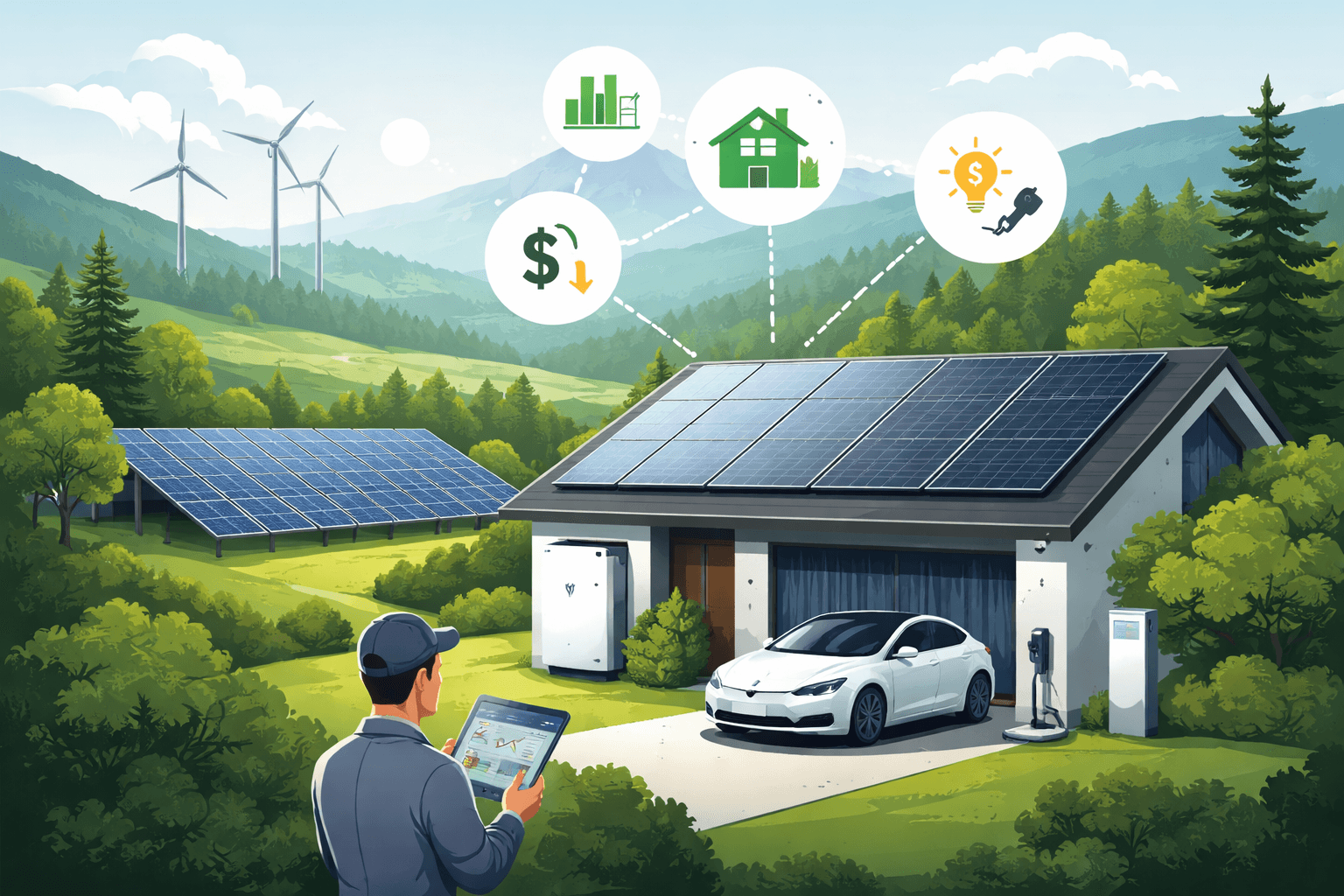
Vermont homeowners are leaning into clean energy: residential solar capacity in the state has topped 150 MW, and the average home uses roughly 6,700 kWh per year (U.S. EIA 2022). If you’re evaluating Tesla Solar in Vermont—panels, Solar Roof, and Powerwall—this 2026 guide compiles current pricing ranges, incentives, timelines, and what real owners report in cold-climate conditions.
Note: This guide references data and rules from sources including the U.S. Energy Information Administration (EIA), the National Renewable Energy Laboratory (NREL PVWatts), the Lawrence Berkeley National Laboratory (LBNL Tracking the Sun), the Vermont Public Utility Commission (Rule 5.100), DSIRE, and Vermont utilities such as Green Mountain Power (GMP) and Vermont Electric Cooperative (VEC). Program specifics can change; always confirm with your installer and utility.
Tesla Solar products available in Vermont: panels, Solar Roof, and Powerwall bundles
Tesla sells three primary offerings in Vermont:
Solar Electricity Handbook - 2023 Edition: A simple, practical guide to solar energy – designing and installing solar photovoltaic systems: Boxwell, Michael
Solar Electricity Handbook - 2023 Edition: <strong>A simple, practical guide to solar energy – designing and installing solar photovoltaic systems</strong> [Boxwell, Michael] on Amazon.com. *FREE* shi
Check Price on Amazon- Tesla Solar Panels: Tesla’s all-black, high-efficiency modules paired with a Tesla Inverter (12-year warranty) and low-profile mounting. Recent module power classes typically range from 400–440 W with panel efficiencies around 20–21.7%, depending on batch and supplier. Expect a 25-year performance warranty (production typically warranted at ~80–85% of nameplate at year 25) and 10–12 years on product, with workmanship covered by Tesla’s limited warranty terms.
- Tesla Solar Roof: Building-integrated photovoltaic (BIPV) tiles that replace your roofing material while generating power. Best suited when you already need a roof replacement or want a unified aesthetic. System includes photovoltaic tiles plus non-PV tiles for all roof areas and a Tesla Inverter.
- Powerwall (Powerwall 2 and Powerwall 3): 13.5 kWh-class home batteries designed for backup and solar self-consumption. Warranty is 10 years with at least 70% retained capacity under typical residential use. Powerwall 3 integrates a solar inverter, which can simplify system design on new installs.
In Vermont, Tesla typically installs rooftop systems (asphalt shingle, many standing-seam metal roofs with clamp mounts, and some other common profiles). Ground mounts and complex roof geometries may be limited or referred to partner installers—ask during your site assessment.
If you’re considering backup power or participating in utility battery programs, reading our Vermont-specific battery overview can help you size storage and understand bill credit structures: see Tesla Powerwall in Vermont: Cost, Availability & Is It Worth It? (/renewable-energy/tesla-powerwall-in-vermont-cost-availability-worth-it).
Tesla Solar pricing in Vermont: panels vs. Solar Roof cost comparison
Installed costs vary by roof type, snow load hardware, permitting, and wiring distance to your main panel. Using 2024–2025 benchmarks as a guide and accounting for Vermont labor/materials, here’s what homeowners commonly see quoted before incentives:

Enphase IQ8M Microinverter for 260-460 Watt Solar Panels - Works with Grid Tied and Off Grid Solar PV Systems - Compatible with Batteries - IQ8M-72-2-US 240V - UL Listed for Safety : Patio, Lawn & Garden
View on Amazon- Tesla Solar Panels: Approximately $2.40–$3.00 per watt (DC) in much of the Northeast for standard rooftop systems. A typical 8 kW array might price at $19,000–$24,000 before incentives. Tesla’s online configurator often undercuts local averages by leveraging standardized designs and in-house inverter hardware. LBNL’s Tracking the Sun (2023) reported U.S. residential median prices near $3.3/W; Vermont tends to land in the $3.0–$3.6/W range from local installers, making Tesla’s direct pricing competitive where offered.
- Tesla Solar Roof: Total project pricing frequently lands higher than conventional panels because you’re replacing the roof and adding PV. Vermont homeowners commonly see $6.00–$9.00 per watt of solar capacity once the full roof scope is included, with total project costs often $45,000–$90,000+ for average homes. Where the Solar Roof makes the most sense: when your existing roof needs replacement within the next 5–10 years or you strongly prioritize aesthetics.
- Powerwall: Installed costs typically fall between $9,000 and $13,000 per unit in the Northeast, varying with electrical work, wall reinforcement, and permitting. Bundling with solar may save a few hundred dollars per battery in soft costs.
After incentives, net costs can drop substantially (see “Vermont solar incentives” below). If you’re price-comparing a Tesla rooftop PV quote against non-Tesla equipment, consider high-efficiency REC, Qcells, or Canadian Solar modules with microinverters or a hybrid inverter. Based on current efficiency and reliability data, alternatives like REC Alpha Pure-R panels and Enphase IQ8 microinverters represent strong value for cold-climate rooftops with complex shading.
For a broader view of local market pricing and installer options beyond Tesla, see Solar in Vermont: Costs, Incentives & Top Installers (2026) (/renewable-energy/solar-in-vermont-costs-incentives-top-installers-2026).
How to order Tesla Solar in Vermont: timeline, site assessment, and installation
Tesla’s process is designed to be online-first and standardized, which helps keep costs down:

Sense Energy Monitor with Solar – Track Electricity Usage and Solar Production in Real Time
View on Amazon- Online design and estimate
- Enter your address, average bill, and roof details on Tesla’s website. You’ll see a recommended system size, modeled annual production (often via NREL PVWatts assumptions), and an estimated price. You can add Powerwall(s) and see updated totals.
- Virtual/onsite assessment
- Tesla or a partner technician reviews roof structure, electrical panel capacity, and potential obstructions. They may request photos or schedule an onsite visit, especially for older homes or complex roofs.
- Final design and contract
- You’ll receive a design packet with module layout, inverter placement, and expected production. Review interconnection type (net metering in Vermont), equipment, and warranties.
- Permitting and utility interconnection application
- Tesla submits for local building/electrical permits and applies to your utility under Vermont’s net metering Rule 5.100. Simple rooftop net-metered projects can move quickly, but interconnection timelines vary by utility and grid constraints.
- Installation day(s)
- A standard rooftop PV system often installs in 1–2 days; Solar Roofs typically take longer (several days to weeks depending on complexity). Winter weather can extend timelines.
- Inspection and Permission to Operate (PTO)
- Local inspectors and your utility must sign off before you can energize. Plan on a total timeline of 6–12+ weeks from contract to PTO, though some projects complete faster and others take longer due to supply chains or utility queues.
Practical tip: If your main service panel is undersized (100 A is common in older Vermont homes), discuss a panel upgrade or load management options early. Smart load controllers such as a Span smart panel can sometimes avoid a full service upgrade when adding solar, batteries, and EV charging.
Vermont solar incentives that apply to Tesla installations
Vermont’s incentive stack for Tesla Solar typically includes:
- Federal Investment Tax Credit (ITC): 30% of eligible project costs through at least 2032 (Inflation Reduction Act). Applies to Tesla solar panels, Solar Roof (PV portion and required roofing for solar tiles), and Powerwall when charged primarily by solar.
- State sales tax exemption: Vermont exempts renewable energy systems, including residential solar PV equipment, from state sales tax (see DSIRE and Vermont statutes). This reduces upfront costs by 6% compared to taxable purchases.
- Property tax treatment: Vermont provides favorable property tax treatment for small PV systems (≤50 kW) via an exemption or reduced capacity tax. Local assessment practices vary; verify with your town lister and Vermont Department of Taxes guidance.
- Net metering credits (Rule 5.100): Vermont’s net metering credits your exported solar generation at a blended rate established by your utility, adjusted by siting and REC (renewable energy credit) factors. Credits vary by utility (e.g., Green Mountain Power, VEC, Burlington Electric Department) and project category (rooftop vs. ground mount). As of recent rules, typical rooftop residential projects receive credits close to the retail rate with modest adjustors—confirm your utility’s current tariff.
- Battery programs (utility-specific):
- Green Mountain Power (GMP) has historically offered battery lease programs and “Bring Your Own Device” (BYOD) incentives that provide upfront payments or bill credits in exchange for allowing the utility to discharge your Powerwall during peak events. Past incentives have ranged roughly $850–$1,000 per kW of battery power with caps. These programs update periodically—check current GMP BYOD terms.
- Vermont Electric Coop (VEC) and some municipal utilities may offer participation credits or seasonal peak-reduction payments for home batteries.
Modeling your savings: An 8 kW Tesla array in central Vermont with good orientation can produce roughly 8,000–9,600 kWh/year (1,000–1,200 kWh/kW-year per NREL PVWatts for Vermont). With net metering, credits offset most or all of an average home’s 6,700 kWh annual usage (EIA). If your utility offers a battery incentive, adding a Powerwall can further reduce bills and improve resilience during winter outages. For battery specifics and current Vermont utility programs, see Tesla Powerwall in Vermont: Cost, Availability & Is It Worth It? (/renewable-energy/tesla-powerwall-in-vermont-cost-availability-worth-it).
Tesla Solar reviews from Vermont customers: what owners actually report
Owner feedback in cold climates like Vermont tends to cluster around a few themes (based on SolarReviews trends, utility case studies, and regional customer reports through 2024):
- Aesthetics and noise: Tesla’s low-profile racks, skirted edges, and all-black modules are a frequent positive. Inverters and Powerwalls are quiet; many report a subtle transformer hum only at close range during high output.
- Production vs. estimates: Annual production generally aligns with PVWatts-modeled ranges over a full year, but winter months are lower than new owners expect due to short days, low sun angle, and snow cover. Spring often overperforms, balancing the year.
- Snow and ice: Panels shed snow faster than asphalt shingles on sunny days. Some owners add snow guards on lower roof edges to manage sliding off metal roofs. Tesla’s crews may or may not install third-party snow retention—ask before contracting.
- Scheduling and communication: Tesla’s scale enables competitive pricing, but several Vermont and New England customers note longer scheduling windows or subcontractor variability. Local installers sometimes earn higher marks for responsiveness even at higher prices.
- Service and warranty: Warranty claims are typically handled through the Tesla app. Response times vary; some owners report quick inverter replacements, others cite delays during peak seasons.
When reading reviews, prioritize long-term production and service experiences over installation-day impressions; Vermont’s first full winter and a spring melt are the real tests.
Tesla vs. local Vermont installers: pros, cons, and price comparison
Pros of choosing Tesla in Vermont
- Competitive pricing: Standardized designs and direct sourcing often yield $2.40–$3.00/W quotes, below the Vermont residential average reported in LBNL data.
- Integrated ecosystem: Tight app integration among solar, Powerwall, and EV charging. Powerwall 3’s built-in solar inverter can simplify design.
- Aesthetic package: Sleek panels and the Solar Roof option for high-visibility homes in historic towns.
Cons and where local installers may win
- Roof and site flexibility: Local firms may handle complex roofs (slate, clay, very steep pitches), ground mounts, or barns/outbuildings more readily.
- Subcontractor variance: Tesla often uses partners; work quality generally good, but experiences vary. Local firms can offer a single accountable team.
- Service proximity: For nuanced snow-management hardware (snow guards, heat cables), local installers may be more familiar with what works on your exact roof profile.
Price comparison snapshot (typical Vermont ranges)
- Tesla Solar Panels: ~$2.40–$3.00/W before incentives for straightforward rooftops.
- Local installers: ~$3.00–$3.80/W, with premium modules/microinverters or complex roofs pushing higher.
- Solar Roof vs. new premium roof + panels: If you need a new roof soon, price the Solar Roof against “premium standing-seam metal + high-efficiency panels.” For many homes, premium roof + panels still costs less than Solar Roof while delivering equal or better kW capacity.
If you’re near the Upper Valley or cross-shopping across the Connecticut River, some regional pricing context is available here: Tesla Solar in New Hampshire: Panels, Roof & Pricing Guide (2026) (/renewable-energy/tesla-solar-in-new-hampshire-panels-roof-pricing-guide-2026).
Tesla Solar warranty and what it covers in Vermont
- Panels: 25-year power output warranty (degradation curve specified by Tesla), 10–12-year product warranty, and limited workmanship coverage.
- Inverter: 12-year manufacturer warranty (Tesla Inverter). If you receive a Powerwall 3 as the solar inverter, see battery warranty details for the inverter section.
- Solar Roof: 25-year weatherization and tile power warranty on PV tiles; workmanship terms apply to installation.
- Powerwall: 10-year warranty with at least 70% capacity retention when used for solar self-consumption/backup under normal conditions. Tesla specifies energy throughput and operational terms in the warranty document.
Vermont-specific note: Severe weather, snow and ice, and roof snow-management accessories should be discussed before install. Modifying mounts, adding third-party snow guards post-install, or using de-icing chemicals on PV surfaces can affect coverage; get any add-ons approved in writing.
By the Numbers: Tesla Solar in Vermont
- 6,700 kWh: Average annual electricity use for a Vermont home (EIA 2022). An 8 kW Tesla array can offset most or all usage with net metering.
- 1,000–1,200 kWh/kW-year: Typical Vermont solar yield from NREL PVWatts for south-facing roofs with modest shading.
- $2.40–$3.00/W: Common Tesla panel pricing in the Northeast; Vermont local installers often quote $3.00–$3.80/W (LBNL 2023 trends + regional quotes).
- 30%: Federal ITC available for Tesla solar, Solar Roof (PV portion), and Powerwall when paired with solar.
- 10 years: Tesla Powerwall and inverter warranty; 25 years: PV panel/Solar Roof power warranties.
Practical implications for Vermont homeowners
- Snow strategy matters: Plan for winter. Discuss snow guards on metal roofs, eave protection, and access paths for heavy snow years.
- Panel upgrades: Older 100 A services are common in Vermont farmhouses and village homes. Consider smart panels or partial electrification staging to avoid full service upgrades when adding EVs and heat pumps.
- Battery economics: With BYOD-style incentives and frequent rural outages, a single Powerwall can pay back faster in Vermont than in states without peak programs—especially if your utility offers meaningful bill credits.
- Roof condition first: For 20+ year performance, start with structure and roofing. If your shingles have <10 years left, cost-compare a new roof + panels versus Solar Roof. Panels generally deliver the lowest $/W.
FAQ: common questions about Tesla Solar in Vermont
How well does Tesla Solar work in Vermont winters?
- Very well over a full year, but winter output is lower. Panels often shed snow quickly after storms on sunny days. Expect annual production to align with PVWatts estimates, with spring/summer making up winter deficits.
Do Tesla panels need special mounts for heavy snow?
- Mounting systems are engineered for local snow and wind loads. Tesla’s design accounts for Vermont code requirements. On metal roofs, clamp-on racking is typical; confirm that snow guards and eave details are compatible.
How many Powerwalls do I need in Vermont?
- For essential loads (fridge, well pump, boiler controls, lights, internet), 1 Powerwall often suffices. For whole-home backup with electric heat pumps or resistance heat, 2–3 units are common. Sizing depends on your peak kW and desired backup duration; ask for a load audit.
Can I stack incentives—federal ITC, net metering, and utility battery programs?
- Yes. The 30% ITC applies to eligible costs. Net metering credits apply to solar exports. Utility BYOD/peak programs for batteries are separate and can be stacked, but they may require minimum availability windows.
How long is the Tesla Solar install timeline in Vermont?
- Many projects complete in 6–12+ weeks from contract to PTO, depending on utility interconnection queues, permitting, weather, and equipment availability.
Is the Tesla Solar Roof practical in Vermont?
- It’s viable and designed for weather extremes, but it’s typically more expensive than panels on an existing roof. It’s most compelling when you already need a roof replacement and prize aesthetics.
Will Tesla install on my standing-seam metal roof?
- Often yes, using seam clamps without roof penetrations. Share your panel profile with Tesla early. For copper, slate, clay, or very old roofs, a local specialist may be preferable.
Do I need to shovel panels?
- Usually no. Shoveling risks damage. Let snow slide naturally; energy lost to a few cloudy, snowy days in January is small compared to spring and summer gains.
How does Tesla Solar compare with microinverter systems in Vermont?
- Tesla pairs panels with a string/hybrid inverter. Microinverters (e.g., Enphase IQ8) can outperform on complex roofs with multiple orientations or shading but add cost. For straight south-facing roofs, Tesla’s standard design is typically cost-effective.
Where the market is heading in 2026
- Standardized, lower-cost installs: Expect Tesla to continue pushing integrated hardware (Powerwall 3 + inverter) and digital permitting, shrinking soft costs that keep Vermont pricing high.
- More battery-grid coordination: GMP and other Vermont utilities are national leaders in using behind-the-meter batteries for peak shaving. As winter peaks intensify with electrification, BYOD-style incentives should remain attractive.
- Smarter load management: As homes add heat pumps and EVs, Vermont customers will benefit from dynamic controls—battery discharge during peaks, EV smart charging, and automated load shedding—improving paybacks even under conservative net metering.
For local pricing context and installer comparisons beyond Tesla, see Solar in Vermont: Costs, Incentives & Top Installers (2026) (/renewable-energy/solar-in-vermont-costs-incentives-top-installers-2026). If you’re evaluating a home across the river or on a second property, regional insights are here: Tesla Solar in New Hampshire: Panels, Roof & Pricing Guide (2026) (/renewable-energy/tesla-solar-in-new-hampshire-panels-roof-pricing-guide-2026).
Affiliate disclosure: We may earn a commission if you purchase products through links in this article. We only recommend options that align with the performance, reliability, and value data discussed above. Consider REC Alpha Pure-R panels, Enphase IQ8 microinverters, and a Span smart panel when comparing non-Tesla equipment or planning electrification.
Recommended Products
Solar Electricity Handbook - 2023 Edition: A simple, practical guide to solar energy – designing and installing solar photovoltaic systems: Boxwell, Michael
Solar Electricity Handbook - 2023 Edition: <strong>A simple, practical guide to solar energy – designing and installing solar photovoltaic systems</strong> [Boxwell, Michael] on Amazon.com. *FREE* shi
Enphase IQ8M Microinverter for 260-460 Watt Solar Panels - Works with Grid Tied and Off Grid Solar PV Systems - Compatible with Batteries - IQ8M-72-2-US 240V - UL Listed for Safety : Patio, Lawn & Garden
Amazon.com: Enphase IQ8M Microinverter for 260-460 Watt Solar Panels - Works with Grid Tied and Off Grid Solar PV Systems - Compatible with Batteries - IQ8M-72-2-US 240V - UL Listed for Safety : Patio
Sense Energy Monitor with Solar – Track Electricity Usage and Solar Production in Real Time
KNOW WHAT’S ON: Track how much electricity you’re using, what time your kids got home, or when someone leaves the basement light on. Sense <strong>identifies patterns in your energy use to help your f