
Tesla Solar in Washington: Panels, Roof & Pricing Guide (2026)
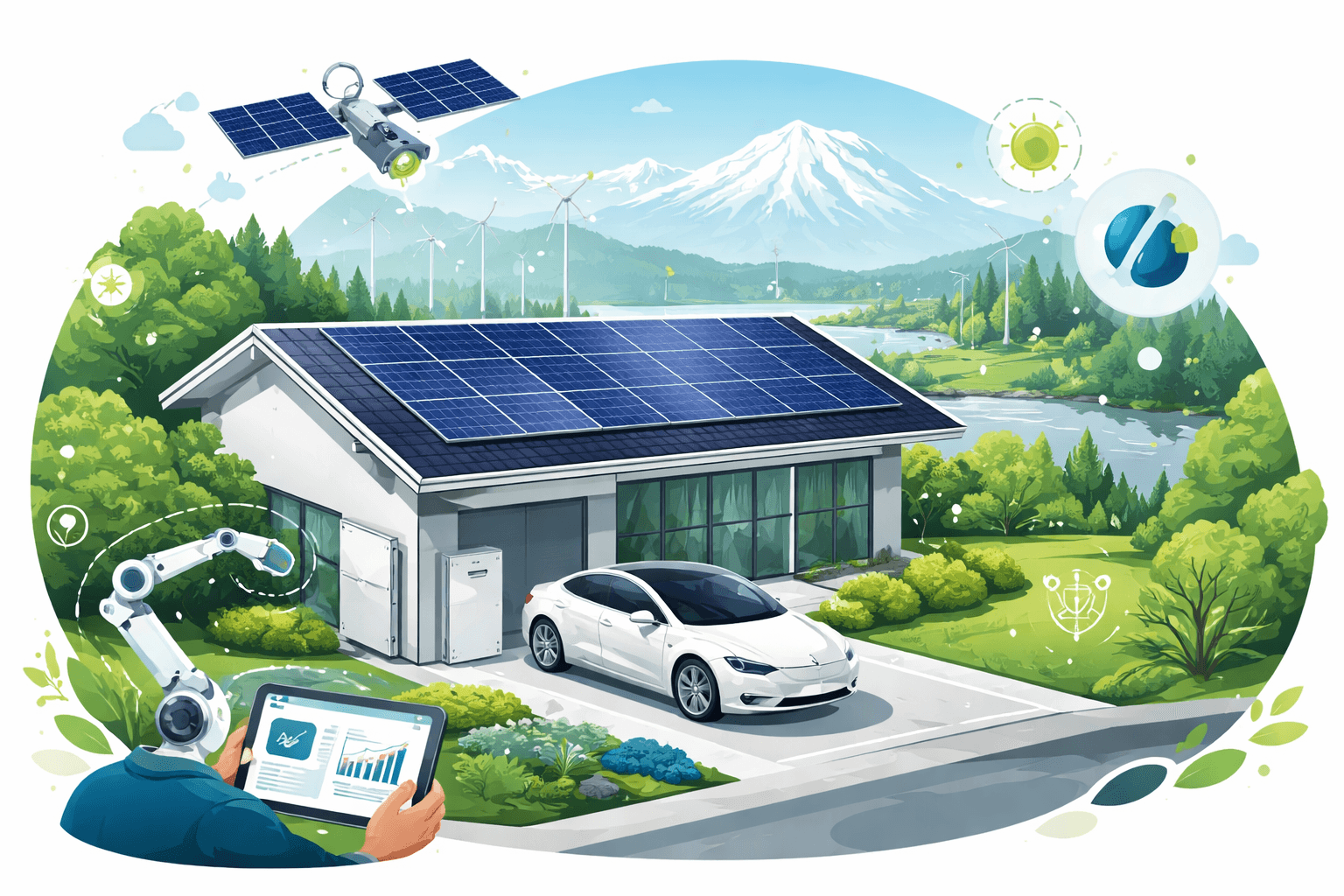
Washington may be famous for clouds, but solar pencils out here thanks to retail-rate net metering, a 100% state sales-tax exemption on residential PV up to 100 kW, and the 30% federal Clean Energy Credit. For homeowners comparing Tesla Solar in Washington, the headline is simple: Tesla’s bundled pricing (often near $2.30–$2.60/W before incentives) undercuts many local quotes, while the Solar Roof appeals when you already need a full roof replacement. NREL’s PVWatts indicates typical production of about 1,050–1,250 kWh per kW-year west of the Cascades and 1,250–1,450 kWh per kW-year in sunnier Central and Eastern Washington—enough to offset most of an average household’s annual load at modest system sizes.
Below, we detail Tesla’s available products, Washington-specific pricing and incentives, installation timelines, real owner feedback, and how Tesla stacks up against local installers in 2026.
Tesla Solar products available in Washington: panels, Solar Roof, and Powerwall bundles
Tesla sells two core solar options in Washington:
Solar Electricity Handbook - 2023 Edition: A simple, practical guide to solar energy – designing and installing solar photovoltaic systems: Boxwell, Michael
Solar Electricity Handbook - 2023 Edition: <strong>A simple, practical guide to solar energy – designing and installing solar photovoltaic systems</strong> [Boxwell, Michael] on Amazon.com. *FREE* shi
Check Price on Amazon- Tesla solar panels (flush-mount, all-black) with a Tesla string inverter or the integrated inverter in the Powerwall 3 when paired with storage.
- Tesla Solar Roof (glass solar tiles plus non-solar tiles), typically bundled with at least one Powerwall for backup and load management.
Powerwall storage
- Capacity and power: Each Powerwall provides 13.5 kWh of usable energy storage. Power output varies by model and configuration, with whole-home backup typically requiring multiple units for larger homes or 200A services.
- Integration: The Powerwall 3 integrates a solar inverter, simplifying hardware and often reducing total installed cost compared to separate inverters. Stacking units increases both storage capacity and backup power.
- Use cases in Washington: Backup for winter storms and wildfire-related outages, time-based control where available, and self-consumption to smooth cloudy-day variability. For deeper specs and pricing details specific to the state, see our Washington-focused storage guidance: Tesla Powerwall in Washington: Cost, Availability & Is It Worth It?.
Panel performance in Washington’s climate
- Output: Modern monocrystalline modules still perform well in cool temperatures; PV efficiency actually improves on cold, clear days. Expect capacity factors in the 12–17% range across the state, per NREL modeling, with higher performance east of the Cascades.
- Snow and rain: Washington’s coastal rain keeps modules relatively clean; light snow typically sheds quickly from modern, low-friction glass. Steeper roof pitches and all-black modules can aid snowmelt but plan for occasional winter production dips.
Tesla Solar pricing in Washington: panels vs. Solar Roof cost comparison
What homeowners pay depends on roof complexity, service upgrades, and whether you add storage. Price references below are 2026 typicals and may vary by utility and jurisdictional permitting.
Panels (Tesla solar panels)
- Typical price: $2.30–$2.60 per watt (W) before incentives for straightforward roofs (single-plane, asphalt shingle, minimal obstructions). Complex roofs can run higher.
- Example systems: A 7 kW system might price at $16,100–$18,200 before incentives; a 10 kW system might land around $23,000–$26,000.
- After incentives: Applying the 30% federal credit reduces those examples to roughly $11,300–$12,700 (7 kW) and $16,100–$18,200 (10 kW). Washington’s sales tax exemption for systems up to 100 kW keeps state sales tax off the invoice, improving net cost versus many other states.
Solar Roof (Tesla Solar Roof)
- Typical price range: Heavily dependent on roof size, pitch, and complexity. All-in installed costs (solar + non-solar tiles + tear-off + underlayment + flashings) often run $30–$50 per square foot of roof surface, though complex roofs can exceed this.
- Example: A 2,000-square-foot roof with a 7–9 kW solar capacity commonly quotes between $60,000 and $100,000+ before incentives. Many Solar Roof projects include at least one Powerwall for backup.
- When it makes sense: If your existing roof is near end-of-life, the Solar Roof can be cost-competitive versus buying premium roofing plus a conventional PV array. If the roof is new and you mainly want solar generation at the best price, panels usually beat Solar Roof on $/W.
Context for these numbers
- Benchmarking: Lawrence Berkeley National Laboratory’s Tracking the Sun (2024) reported a 2023 median U.S. residential PV price near $3.28/W (pre-incentive), while marketplace data often show $2.80–$3.30/W in 2025–26 for full-service installers. Tesla’s online pricing strategy aims lower via standardization and volume procurement.
- Electricity value: EIA data peg Washington’s average residential rate roughly around $0.12/kWh, but utility rates vary (e.g., Seattle City Light vs. PSE vs. PUDs). With retail-rate net metering, each kWh your system produces offsets that retail price.
How to order Tesla Solar in Washington: timeline, site assessment, and installation
Tesla’s process is designed to be mostly online, with steps that look like this for a panels-only project:
- Instant quote and design
- Enter your address, average monthly bill, and select a system size; Tesla proposes a layout and estimated production using satellite imagery and typical tilt/azimuth assumptions.
- Virtual/onsite assessment
- A remote assessment is common for simple roofs. For complex roofs, unusual setbacks, or service upgrades, Tesla or a subcontractor may do a site visit to confirm measurements and electrical capacity.
- Permitting and interconnection
- Tesla prepares engineering drawings, submits city/county permits, and files interconnection with your utility. Washington permitting can take 2–8 weeks depending on jurisdiction. Utilities usually process interconnection in parallel or shortly after installation.
- Installation
- Panels: 1–2 days on site for most residential arrays; add 0.5–1 day if trenching or service work is needed.
- Powerwall: Often installed the same day or next day; whole-home backup projects may take 2–3 days.
- Solar Roof: Typically 1–2 weeks depending on complexity, weather, and crew availability.
- Inspection and Permission to Operate (PTO)
- Local inspectors sign off first; the utility then issues PTO to enable export and net metering. In Washington, PTO often arrives 1–4 weeks after final inspection.
Total timeline
- Straightforward panels + optional Powerwall: 6–12 weeks from deposit to PTO is common, though supply chain, weather, or utility queues can stretch schedules.
- Solar Roof: 8–16+ weeks, depending on roof complexity and local approvals.
Washington solar incentives that apply to Tesla installations
- Federal Clean Energy Credit (Investment Tax Credit): 30% of total installed cost for solar and storage (standalone storage also qualifies) through at least 2032, per the Inflation Reduction Act. Consult a tax professional to confirm eligibility for your situation.
- State sales tax exemption: Washington provides a 100% sales and use tax exemption for solar energy systems up to 100 kW. This is a major savings compared with states that apply 6–10% sales tax.
- Net metering: Washington law (RCW 80.60) provides retail-rate net metering for systems up to 100 kW. Excess credits typically roll month to month and reconcile annually on April 30; any remaining credit resets to zero at that time. Check your utility’s current program rules and enrollment status, as caps can vary by utility.
- Local/PUD programs: Some municipal utilities and PUDs offer occasional bonuses or expedited interconnection; these vary and can be time-limited. Always confirm current terms with your utility.
For a broader view of statewide economics and policy, see our overview: Solar in Washington: Costs, Incentives & Top Installers (2026).
Tesla Solar reviews from Washington customers: what owners actually report
Common positives
- Price transparency: The online quote and standardized equipment keep pricing straightforward and often below many full-service local quotes.
- Aesthetics: All-black modules, low-profile mounting, and tidy conduit runs (especially when paired with Powerwall 3’s integrated inverter) rank high in homeowner satisfaction.
- App experience: The Tesla app unifies solar production, home consumption, and storage control with intuitive modes (self-consumption, backup reserve, time-based control where available).
Common pain points
- Scheduling variance: Weather, subcontractor availability, and utility queues can stretch the timeline. Owners recommend planning for a realistic 2–4 months.
- Customization limits: Tesla favors standardized designs. Complex roof planes, shaded sites requiring extensive module-level optimization, or specialty equipment requests may be a better fit with a custom local installer.
- Communication gaps: Some reviewers cite uneven communication during permitting and interconnection; others report smooth, predictable updates. This often depends on local crews and jurisdictions.
Performance in Washington’s climate
- Production meets or exceeds estimates for many Eastside and Central Washington homes; Westside owners report steady annual performance with softer winters and stronger late-spring/summer production. NREL-modeled expectations typically line up within ±10% when shading and roof orientation are accurately captured.
Tesla vs. local Washington installers: pros, cons, and price comparison
Where Tesla shines
- Cost: Tesla’s per-watt pricing often comes in 10–25% below traditional full-service quotes due to standardized designs and procurement scale.
- Simplicity: One brand ecosystem for panels, inverter (or integrated inverter when paired with Powerwall 3), monitoring, and storage. Fewer vendors can mean fewer integration headaches.
Where local installers shine
- Custom engineering: Highly shaded sites, complex roofs, service upgrades, or specialty equipment (e.g., premium high-efficiency modules, microinverters, hybrid inverters optimized for generator integration) can benefit from bespoke design.
- Service model: Some homeowners prefer a local point of contact for post-install support and maintenance.
Price landscape in 2026
- Tesla panels: Commonly $2.30–$2.60/W before incentives in Washington for standard roofs.
- Local installers: Often $2.70–$3.40/W for similar scopes (varies by hardware—e.g., microinverters, premium modules—and service package). Marketplace and LBNL data suggest Washington aligns broadly with national medians once the state sales tax exemption is factored in.
Cross-border note: If you live near Vancouver, WA or work across the river, pricing and utility programs differ in Oregon. For regional context on Tesla’s offerings next door, see: Tesla Solar in Oregon: Panels, Roof & Pricing Guide (2026).
Tesla Solar warranty and what it covers in Washington
- Panels: 25-year performance warranty (typical end-of-term output in the mid-80% range of nameplate, per Tesla’s current datasheets) and long-duration product warranty. Exact degradation rates vary by module generation; check your specific spec sheet.
- Inverter: Tesla’s string inverter carries a limited warranty (commonly 12.5 years). When Powerwall 3 serves as the solar inverter, its warranty terms govern inverter functions.
- Powerwall: 10-year warranty with throughput limits consistent with residential cycling. Backup-only use typically stays well within warranted energy throughput.
- Workmanship/roof penetrations: Tesla provides workmanship coverage; roof-penetration leak coverage applies for a defined term. Review Tesla’s current warranty booklet provided with your contract for Washington-specific terms.
By the numbers: Tesla Solar in Washington
- Typical Tesla panel pricing: $2.30–$2.60/W before incentives
- Sample 7 kW system net cost after 30% federal credit: ~$11,300–$12,700 (no state sales tax due to exemption)
- Solar Roof all-in range (2,000 sq ft): ~$60,000–$100,000+ before incentives
- Powerwall storage: 13.5 kWh per unit; whole-home backup commonly 2–3 units
- Modeled annual production (NREL PVWatts): ~1,050–1,250 kWh/kW-year westside; ~1,250–1,450 kWh/kW-year eastside
- Washington residential electricity: ~12¢/kWh average (EIA), varies by utility
- Net metering: Retail-rate credit up to 100 kW; annual reset typically April 30 (RCW 80.60)
- Payback: Often 7–12 years panels-only; faster in sunnier locations or higher-rate service territories
Practical tips to improve ROI in Washington
- Size to your load: Right-size the array to your annual kWh, not just roof space. Overproduction beyond annual needs resets at the utility true-up.
- Aim for midday loads: Run dishwashers, laundry, and EV charging during sunny hours to self-consume. A smart EVSE or home energy monitor can automate this.
- Consider storage strategically: If outages are frequent or your utility has time-based rates, Powerwall can improve resilience and economics. If outages are rare and rates are flat, storage is more of a resilience investment than a strict ROI driver.

EMPORIA Level 2 EV Charger w/ J1772 Charger, 48 amp ...
View on Amazon
Sense Energy Monitor with Solar – Track Electricity Usage and Solar Production in Real Time
View on AmazonHelpful add-ons
- Based on efficiency and control features, the Sense Home Energy Monitor offers strong value for tracking loads and increasing solar self-consumption.
- For panel-level optimization and rapid-shutdown compliance when not using Powerwall 3’s integrated approach, Enphase IQ8 Microinverters are a proven option with sunlight backup capability when designed appropriately.
- To soak up mid-day solar for EV owners, a Level 2 Smart EV Charger can schedule charging to align with peak PV output.
FAQ: common questions about Tesla Solar in Washington
Is Tesla currently installing solar in my part of Washington?
- Tesla covers most metro areas and many rural communities via traveling crews and partner subcontractors. Enter your address in Tesla’s online estimator to confirm service availability.
Do cloudy winters make solar a bad investment in Western Washington?
- Winter output is lower, but long summer days balance the annual picture. NREL modeling and real-world data show healthy annual production, typically achieving 1,050–1,250 kWh/kW-year west of the Cascades. Payback periods are often in the single digits to low teens in years, depending on system size and utility rate.
How does Washington’s net metering work for Tesla Solar?
- Most residential systems up to 100 kW earn retail-rate credits for excess generation, offsetting imports later. Credits reset annually—often April 30—so it’s best not to oversize far beyond your annual usage.
Can I get the 30% federal credit if I only install a Powerwall?
- Yes. The Inflation Reduction Act made standalone residential storage eligible for the 30% credit. See our state-specific page for details: Tesla Powerwall in Washington: Cost, Availability & Is It Worth It?.
Will the Solar Roof survive wind, rain, and occasional snow loads?
- Tesla designs for stringent wind and snow ratings and backs tiles with robust material warranties. In high-snow microclimates, be sure the design team verifies snow loading and clearances.
What about HOA rules and permitting?
- Washington’s “solar rights” protections limit unreasonable HOA restrictions. Permitting times vary by city/county; most single-family PV projects follow a streamlined process.
Can I expand later or add Powerwall after installing panels?
- Yes. Many owners start with panels and add storage later. If you expect to add Powerwall(s), let your installer plan for breaker space and service capacity upfront.
How do Tesla’s prices compare with local quotes?
- In 2026, many Washington homeowners report Tesla panel quotes around $2.30–$2.60/W pre-incentive, while local full-service quotes often range $2.70–$3.40/W depending on hardware and services. Always compare a few bids.
Where can I learn more about overall solar economics in the state?
- See our statewide briefing: Solar in Washington: Costs, Incentives & Top Installers (2026).
What this means for Washington homeowners
- If your priority is the lowest $/W with clean aesthetics and a single-vendor ecosystem, Tesla Solar in Washington is often compelling.
- If your roof is complex, shaded, or you want highly customized hardware (specialty modules, microinverters everywhere, generator integration), local installers may deliver a better-tailored design—albeit often at a higher price.
- With a 30% federal credit and Washington’s sales tax exemption, panels commonly reach payback in 7–12 years. Matching system size to your actual annual kWh and aligning daytime loads will tighten that range.
The bottom line: Between robust net metering, no state sales tax on qualifying systems, and year-round but seasonally variable production, Washington remains a strong market for residential solar. Tesla’s aggressive pricing and integrated hardware make it a top contender—especially when your goals include aesthetics, app-driven controls, and backup power options.
Recommended Products
Solar Electricity Handbook - 2023 Edition: A simple, practical guide to solar energy – designing and installing solar photovoltaic systems: Boxwell, Michael
Solar Electricity Handbook - 2023 Edition: <strong>A simple, practical guide to solar energy – designing and installing solar photovoltaic systems</strong> [Boxwell, Michael] on Amazon.com. *FREE* shi
Sense Energy Monitor with Solar – Track Electricity Usage and Solar Production in Real Time
KNOW WHAT’S ON: Track how much electricity you’re using, what time your kids got home, or when someone leaves the basement light on. Sense <strong>identifies patterns in your energy use to help your f
EMPORIA Level 2 EV Charger w/ J1772 Charger, 48 amp ...
Explore a wide selection of hardwired Level 2 EV charging stations. Features include 25-foot cables, app control, and weather-resistant construction.