
Tesla Solar in Wyoming: Panels, Roof & Pricing Guide (2026)
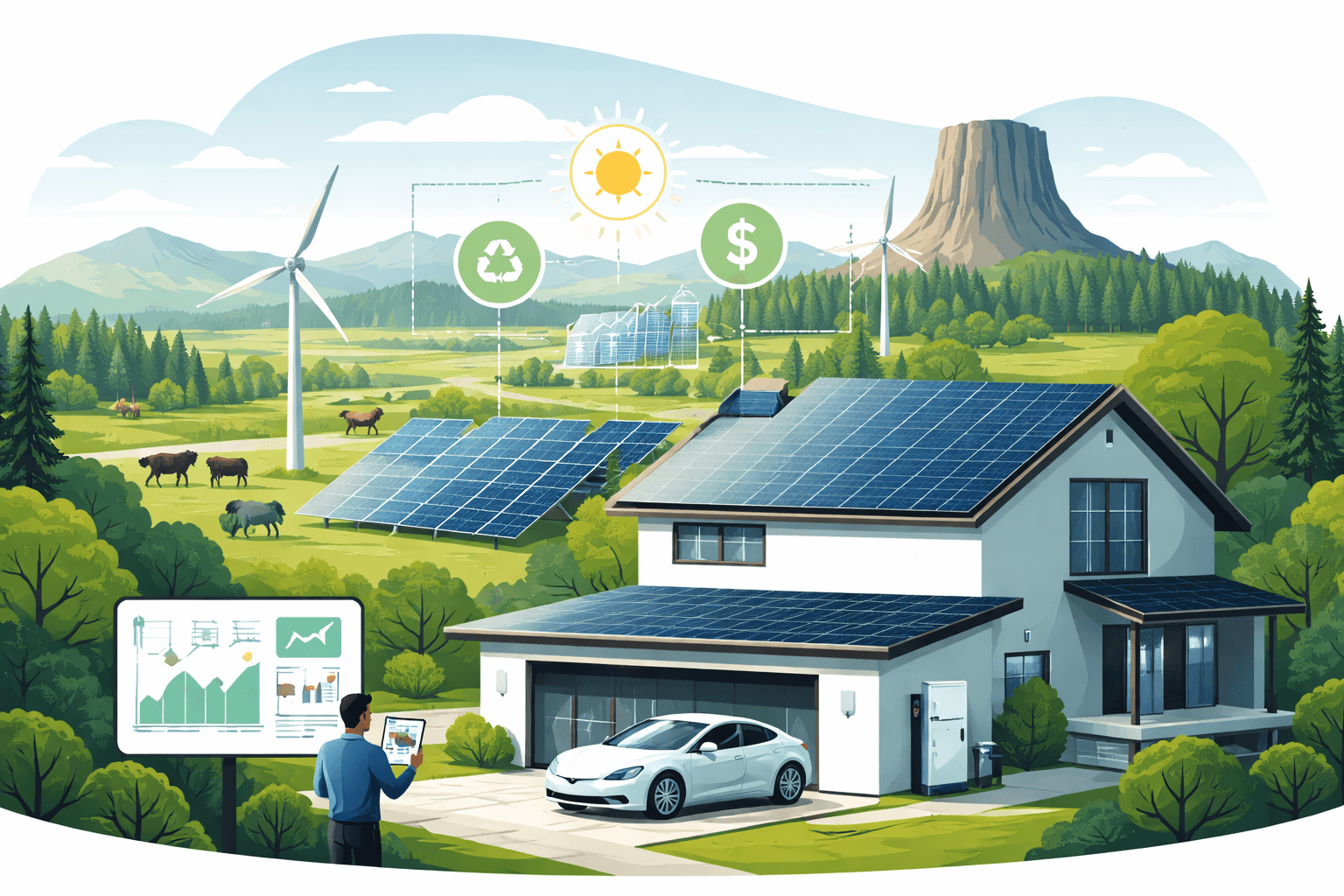
Wyoming has some of the best solar resource in the Mountain West — high elevation, cold ambient temperatures that help panel efficiency, and 4.8–5.6 average peak sun hours depending on location (NREL). Yet the state remains a small market for residential solar. The Solar Energy Industries Association (SEIA) estimates roughly a few hundred megawatts of cumulative solar capacity in Wyoming as of 2024, placing it in the lower tier nationally. For homeowners evaluating Tesla Solar in Wyoming, the combination of strong sun, modest electricity rates, and limited state incentives means system sizing, pricing, and net metering details matter more than in many other states.
This guide explains Tesla’s solar panels, Solar Roof, and Powerwall bundles available in Wyoming; what they cost; how installation works; which Wyoming incentives apply; and how Tesla compares to local installers.
By the end, you should know whether Tesla Solar in Wyoming pencils out for your home and how to move from quote to interconnection with fewer surprises.
By the numbers: Tesla Solar in Wyoming
- Solar resource: 4.8–5.6 average peak sun hours (NREL PV resource)
- Typical 10 kW system production: ~13,000–15,000 kWh/year in Cheyenne–Casper–Jackson range (NREL PVWatts estimate, fixed-tilt, south-facing)
- Average residential rate: roughly 10–12¢/kWh (EIA 2024 range), below the U.S. average
- Federal incentive: 30% Residential Clean Energy Credit (IRS, effective through 2032)
- Net metering cap: Up to 25 kW residential system capacity for eligible utilities; credits roll month-to-month (Wyoming statute; see utility tariff)
Solar Electricity Handbook - 2023 Edition: A simple, practical guide to solar energy – designing and installing solar photovoltaic systems: Boxwell, Michael
Solar Electricity Handbook - 2023 Edition: <strong>A simple, practical guide to solar energy – designing and installing solar photovoltaic systems</strong> [Boxwell, Michael] on Amazon.com. *FREE* shi
Check Price on AmazonTesla Solar in Wyoming: products available now
Tesla offers three core components for Wyoming homes:

Sense Energy Monitor with Solar – Track Electricity Usage and Solar Production in Real Time
View on AmazonTesla solar panels (traditional rack-mounted modules): Black, high-efficiency monocrystalline modules typically in the ~400–430 W range. Tesla provides a unified system with an integrated string inverter (or Powerwall 3’s hybrid inverter), monitoring in the Tesla app, and low-profile racking. Expect module efficiencies around 20–22%, typical of premium Tier-1 modules cited by NREL’s module benchmarks.
Tesla Solar Roof (building-integrated PV): Glass roof tiles with integrated photovoltaics on active sections. Unlike panels mounted atop existing shingles, Solar Roof replaces your roofing material. It is best considered when your roof already needs replacement or you strongly prefer the all-in-one aesthetic.
Tesla Powerwall (battery storage): Powerwall 2 and Powerwall 3 provide 13.5 kWh of usable energy per unit. Powerwall 2 is paired with a separate solar inverter; Powerwall 3 includes an integrated hybrid inverter and higher backup power output. Batteries enable backup during outages, solar self-consumption, and limited time-of-use shifting (where available). For Wyoming-specific pricing and availability details, see our dedicated page: Tesla Powerwall in Wyoming: Cost, Availability & Is It Worth It?.
Practical note on climate: Wyoming’s snow and wind loads demand sturdy mounting. Most Tier-1 panels and racking are rated for 5,400 Pa front load (~113 psf) and 2,400 Pa back load (~50 psf) and undergo IEC hail impact testing. Installers will specify rail spans and attachment patterns to local code (snow load 30–70+ psf in some jurisdictions). If your home faces frequent drifting snow or 100+ mph design wind speeds, ask Tesla to show stamped racking calculations for your address.
Affiliate tip: Given Wyoming’s long winters, pairing solar with a whole-home energy monitor helps you time heavy loads to sunny windows. Based on cost and ease of install, the Sense Energy Monitor is a strong value for tracking appliance-level usage right in your phone.
Tesla Solar pricing in Wyoming: panels vs. Solar Roof
Costs vary by roof complexity, distance to the nearest Tesla crew/subcontractor, service panel upgrades, and whether you add Powerwall. That said, recent quotes and national tracker data provide a reasonable range.

ChargePoint HomeFlex Level 2 EV Charger J1772 - Fast Smart Battery Power Charging at Home for Electric Automobile Vehicles - NEMA 14-50 Plug for Electric Car : Automotive
View on AmazonPanels (rack-mounted)
- Before incentives: Roughly $2.80–$3.50 per watt (W) in Wyoming for typical Tesla panel installations, consistent with national averages reported by Wood Mackenzie/SEIA and NREL’s cost benchmarks for 2024.
- After the 30% federal tax credit: Effective net cost ~$1.96–$2.45/W.
Example budgets
- 6 kW system: $16,800–$21,000 before ITC; $11,760–$14,700 after ITC
- 10 kW system: $28,000–$35,000 before ITC; $19,600–$24,500 after ITC
What you’ll save: With Wyoming residential electricity near 10–12¢/kWh (EIA 2024), a 10 kW array producing ~14,000 kWh/year could offset ~$1,400–$1,680 annually at today’s rates. Simple paybacks commonly fall in the 11–15 year range depending on roof orientation, shade, net metering details, and any batteries added.
Solar Roof
- Pricing is more variable because it replaces roofing. Nationally, homeowners report total project costs in the ~$60,000–$100,000+ range before ITC for average roofs, often landing $30–$50 per square foot of roof for systems with adequate PV coverage.
- After the 30% tax credit, net costs may fall into the ~$42,000–$70,000+ range for typical Wyoming homes, depending on roof size, pitch, complexity (hips/valleys, dormers), and power needs.
- Solar Roof often pencils out best if your shingles are due for replacement within ~5 years and you value roof aesthetics and bundled warranties.
Batteries (Powerwall)
- Hardware price for a single Powerwall unit is commonly quoted around the high-$8,000s to low-$9,000s, with installed costs typically $11,000–$15,000 per unit depending on main panel upgrades, trenching, and distance to service equipment. Multi-unit installs enjoy economies of scale.
- The 30% tax credit applies to standalone residential batteries beginning in 2023 if they have capacity ≥3 kWh — Powerwall qualifies. See our Wyoming-focused storage guide: Tesla Powerwall in Wyoming: Cost, Availability & Is It Worth It?.
LCOE lens: A 10 kW Tesla array at $22,000 net (post-ITC) producing ~14,000 kWh/year with 0.5%/year degradation may deliver a levelized cost of energy (LCOE) around 6–9¢/kWh over 25 years before minor O&M — generally competitive with Wyoming retail rates today and more so as rates rise.
Affiliate tip: If you plan EV charging from solar, a flexible Level 2 charger like the ChargePoint Home Flex can align charging with midday production, improving self-consumption and reducing grid draw.
How to order Tesla Solar in Wyoming: timeline and installation steps
Tesla focuses on a streamlined, app-driven process. In Wyoming’s dispersed population centers, add buffer time for utility and permitting queues.
- Online design and deposit
- Use Tesla’s online configurator to enter your address and average monthly kWh. Tesla generates a preliminary system size from satellite imagery.
- You may be asked for a small order fee (historically around $250). Confirm current terms and refund policy at checkout.
- Remote and/or on-site assessment
- Tesla reviews roof complexity, shading, main service panel size, and potential structural flags (e.g., truss spacing). For older roofs or steep pitches, expect an on-site visit.
- If you’re considering Solar Roof, Tesla will evaluate decking condition and underlayment requirements.
- Final design, paperwork, and permits
- You’ll receive a final design set including module layout, single-line diagram, and racking details. Verify interconnection details with your utility (most Wyoming customers fall under net metering for systems ≤25 kW if served by eligible utilities).
- Tesla submits building and electrical permits to your local authority having jurisdiction (AHJ) and files the interconnection application with your utility/co-op. Application fees and meter-change fees vary by utility.
- Installation day(s)
- Rack-mounted panels: 1–2 days for most homes; add time for service panel upgrades or trenching.
- Solar Roof: 5–7+ days depending on size and weather windows.
- Powerwall: Often installed with solar; commissioning may add several hours.
- Inspection, PTO, and app activation
- City/county inspection typically occurs within 1–3 weeks of install.
- Utility permission to operate (PTO) can add 1–6 weeks depending on the utility’s queue.
- Average end-to-end timeline in Wyoming: 6–12+ weeks from contract to PTO, with rural sites trending longer. Winter weather can push roof work into spring.
Pro tip: Ask Tesla to model snow shed and access pathways. In heavy-snow regions, installers sometimes gap lower rows to reduce ice dams, and homeowners may add snow guards on metal roofs.
Wyoming solar incentives that apply to Tesla installations
Federal Residential Clean Energy Credit (30%): Applies to Tesla panels, Solar Roof’s photovoltaic portion, inverters, balance-of-system, and Powerwall when paired with solar or as a standalone battery (≥3 kWh). Consult a tax professional for eligibility.
Net metering (up to 25 kW residential): Wyoming statute enables net metering for investor-owned and certain cooperative utilities with ≥500 customers. Credits are typically at the retail rate and roll over month to month. Annual true-up policies vary by utility; some co-ops may offer avoided-cost rates for annual excess. Always check your utility’s current tariff and application forms.
USDA REAP (for rural small businesses and ag producers): Federal grants can cover up to 50% of eligible costs for qualifying projects in rural areas — highly relevant in Wyoming. Businesses must apply competitively; awards depend on scoring and funding availability.
State and local incentives: As of 2024, DSIRE lists no statewide personal tax credit or sales tax exemption specific to residential solar in Wyoming. Some municipal utilities or co-ops occasionally offer small rebates or on-bill financing; check your provider. For broader cost context and a list of active Wyoming installers, see our guide: Solar in Wyoming: Costs, Incentives & Top Installers (2026).
Property tax considerations: Wyoming does not have a uniform statewide solar property tax exemption. In many cases, added home value from solar may factor into assessments over time. Verify with your county assessor.
Tesla Solar reviews from Wyoming customers: reported pros and cons
While formal, Wyoming-specific datasets are limited, themes from owner reports in similar Mountain West markets and Tesla’s broader customer base are instructive:
What owners like
- Price transparency and competitive per-watt pricing versus many national installers
- Clean black-on-black aesthetic and low-profile racking that handles wind well
- Seamless monitoring in the Tesla app; simple outage transition with Powerwall
- Strong bundled proposition if you own a Tesla EV and want unified energy controls
What owners flag
- Scheduling and communication: Rural installs sometimes face longer lead times; communication may lag during permit/PTO waiting periods
- Subcontractor variability: In areas without a dedicated Tesla crew, workmanship can vary depending on the partner; escalate issues within the Tesla app for warranty support
- Snow management: Panels shed snow quickly on sunny days, but roof access planning and conduit routing matter for winter serviceability
- Solar Roof complexity: More moving parts than a panel-only system; price and schedule risk are higher on complex roofs or during cold seasons
Performance notes: In high-altitude, cold climates, panels often perform a bit above nameplate on clear winter days due to better module efficiency at low temperatures (NREL cell temperature coefficients). Expect annual performance ratio to benefit accordingly, even with some snow losses.
Tesla vs. local Wyoming installers: pros, cons, and price comparison
Price
- Tesla panels: Frequently $2.80–$3.50/W before ITC in Wyoming-sized markets
- Local installers: Commonly $3.20–$4.20/W before ITC, with variation based on travel distances, crew size, and component brands
Service trade-offs
- Tesla advantages: National buying power, standardized designs, integrated app, strong pricing, easy online quoting
- Local advantages: Hands-on site walks, tailored mounting to unique snow/wind loads, quicker service calls, broader equipment choices (microinverters, optimizers, premium racking) when requested
Consider asking local bids to match Tesla’s bill of materials (wattage, inverter type, racking spec) to enable an apples-to-apples comparison. If you live far from population centers (e.g., outside Cheyenne, Casper, Laramie, Jackson), a local installer’s travel radius and winter scheduling flexibility may be decisive.
For a landscape of active Wyoming installers and tips on vetting bids, see: Solar in Wyoming: Costs, Incentives & Top Installers (2026).
Affiliate tip: If you opt for a local installer and prefer microinverters, the high-efficiency Enphase IQ8 Microinverters are widely available and perform well under partial shading common near tall conifers.
Tesla Solar warranty: what it covers in Wyoming
Tesla’s warranty terms are nationwide and apply in Wyoming installations, with workmanship coverage for the parts Tesla or its subcontractors install.
Panels: 25-year performance warranty (typical minimum output ~80–85% of original at year 25, per module datasheet) and a product warranty commonly 12 years on modules and 10–12 years on the inverter. Check your final agreement for exact module OEM terms.
Solar Roof: 25-year power output warranty on active tiles and 25-year weatherization warranty for the roof system per Tesla’s published terms. Inverter coverage is commonly 10–12 years. Roof leak workmanship coverage is typically included.
Powerwall: 10-year warranty with throughput/capacity terms designed to retain most of its 13.5 kWh capacity at year 10. Backup and self-consumption use cases are covered; off-grid duty cycles may have specific terms.
Workmanship: Tesla’s workmanship warranty generally runs 10 years for mounting and penetrations. Ask for documentation specific to roof attachment and conduit runs.
Always review the final contract; Tesla updates terms periodically.
FAQ: common questions about Tesla Solar in Wyoming
How many Powerwalls does a Wyoming home need?
- Many 2,000–2,500 sq ft homes with gas heat choose 1–2 Powerwalls for critical loads (refrigeration, well pump, furnace fan, networking, lighting). All-electric homes or properties with deep wells and large HVAC loads often require 2–3. Each Powerwall provides 13.5 kWh; Powerwall 3 can deliver higher instantaneous backup power than Powerwall 2.
Will snow kill my production?
- Snow temporarily blocks generation, but Wyoming’s sun and steep roof pitches help clear panels quickly. Over a full year, many systems only lose a single-digit percentage of output to snow. Design choices (row spacing, placement away from valleys) can reduce accumulation.
Does Wyoming have time-of-use (TOU) rates that make batteries pay off faster?
- Most Wyoming residential customers are on flat rates. Batteries in Wyoming are primarily for resilience rather than TOU arbitrage. That said, Powerwall can still store midday solar to run evening loads and cover outages.
Can I go off-grid with Tesla?
- Tesla primarily designs grid-tied systems. Partial or full off-grid is technically possible with adequate solar, storage, and load management, but expect significant sizing and cost increases. Discuss cold-start, well pump, and winter load profiles carefully with your designer.
How long is the installation timeline in winter?
- Roof work slows below freezing and during storms. Many Wyoming projects contract in winter, permit/interconnect over 4–10 weeks, and install in the first stable spring weather window.
Is the Solar Roof practical in hail country?
- Solar Roof tiles are impact rated and carry a 25-year weatherization warranty. Traditional premium shingles or metal plus rack-mounted panels can also be excellent in hail regions. Ask for UL/ASTM impact classifications for any roof product you consider.
What about HOA restrictions?
- Wyoming lacks a universal, explicit solar access law for HOAs; rules can vary. Many HOAs allow solar with aesthetic guidelines. Consult your covenants early in design.
What production should I expect in Cheyenne vs. Jackson?
- Expect similar annual totals (often 13,000–15,000 kWh/year for 10 kW), with microclimate and shading driving most differences. South-facing roofs at 25–35° tilt generally perform best.
Can I add solar now and Powerwall later?
- Yes. Many Tesla panel systems can add Powerwall later. If you think you’ll add storage, ask Tesla to plan conduit and breaker space now to reduce future labor.
Is Tesla the cheapest option in Wyoming?
- Often, but not always. In remote areas, travel and subcontractor premiums can narrow or reverse Tesla’s price advantage. Solicit at least two local bids for comparison.
What this means for Wyoming homeowners
- If your roof is in good condition and you prioritize ROI, Tesla’s rack-mounted panels often deliver the best cost per kWh.
- If aesthetics and a new roof are top priorities, Solar Roof can combine projects — at a premium.
- With modest electricity prices, right-sizing matters. Oversizing beyond your annual usage plus a reasonable buffer extends payback and may not be allowed under utility net metering rules.
- For ranches and rural businesses, federal REAP grants can be transformative — solar plus batteries can stabilize operations where outages are costly.
For a broader market view, local installer contacts, and incentive updates, bookmark: Solar in Wyoming: Costs, Incentives & Top Installers (2026). And if resilience is a priority, dive deeper into Powerwall specifics here: Tesla Powerwall in Wyoming: Cost, Availability & Is It Worth It?.
Where the market is heading: Equipment prices have trended down across 2023–2024 per NREL and Wood Mackenzie, while batteries continue to gain functionality (higher backup power, better cold-weather performance). If Wyoming maintains retail-rate net metering and federal incentives hold through 2032, Tesla Solar in Wyoming should increasingly compete on long-term cost per kWh — especially for sun-rich, south-facing roofs with minimal snow shading.
Recommended Products
Solar Electricity Handbook - 2023 Edition: A simple, practical guide to solar energy – designing and installing solar photovoltaic systems: Boxwell, Michael
Solar Electricity Handbook - 2023 Edition: <strong>A simple, practical guide to solar energy – designing and installing solar photovoltaic systems</strong> [Boxwell, Michael] on Amazon.com. *FREE* shi
Sense Energy Monitor with Solar – Track Electricity Usage and Solar Production in Real Time
KNOW WHAT’S ON: Track how much electricity you’re using, what time your kids got home, or when someone leaves the basement light on. Sense <strong>identifies patterns in your energy use to help your f
ChargePoint HomeFlex Level 2 EV Charger J1772 - Fast Smart Battery Power Charging at Home for Electric Automobile Vehicles - NEMA 14-50 Plug for Electric Car : Automotive
Home Flex Hardwired offers the fastest charge at up to 50A. NEMA 6-50 and 14-50 versions <strong>provide up to 40A and work with existing 240V wall outlets</strong>. Yes! Choose from our list of prefe