
AI in Renewable Energy: Use Cases, Measurable Impacts, and How to Deploy
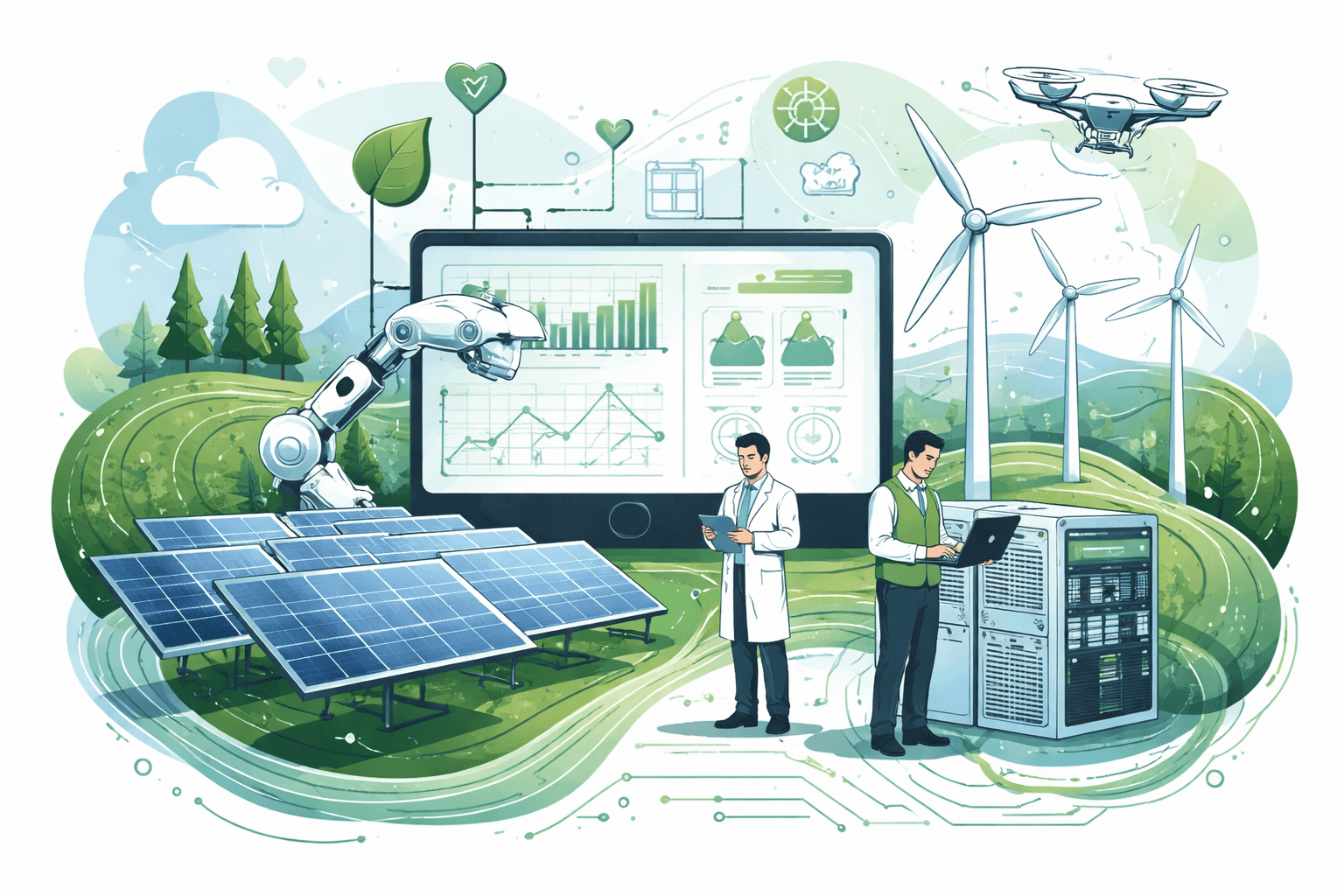
Artificial intelligence (AI) is quickly moving from pilots to plant-critical operations in clean power. In 2023, the world added a record ~507 GW of new renewable capacity, up 50% year-over-year, according to the IEA. As variable wind and solar become the backbone of power systems, AI applications in renewable energy—particularly forecasting, grid optimization, storage management, and predictive maintenance—are delivering measurable gains in energy yield, cost, and reliability.
Below is a practical, data-rich guide to the most valuable use cases, the techniques that work, the real-world impact so far, and how to deploy responsibly at scale.
AI applications in renewable energy across the value chain
AI is not a single tool. Machine learning (ML), deep learning (DL), reinforcement learning (RL), and computer vision each map to specific challenges in renewables. Here’s where they fit best.
1) Solar and wind forecasting
- Problem: Variable generation challenges scheduling, reserves, and market bidding.
- AI fit: ML/DL models (gradient boosting, random forests, LSTMs, transformers) to post-process numerical weather prediction (NWP) and convert meteorological features into site- or fleet-level power forecasts. Probabilistic models (quantile regression, conformal prediction) quantify uncertainty for operators and traders.
- What it delivers: Lower forecast error, better unit commitment and dispatch, reduced curtailment and reserve costs, improved market value of renewables.
- Evidence:
- NREL’s multi-year studies find improved solar forecasting can reduce integration costs by roughly $0.5–$1.6 per MWh, depending on system conditions and reserve procurement (NREL, “Value of Improved Solar Forecasting”).
- Google reported that applying ML to wind forecasts 24–36 hours ahead increased the value of their wind power by ~20% by enabling better day-ahead bids relative to a simple persistence baseline (Google/DeepMind blog, 2019).
- Techniques to know: Feature engineering on ensemble NWPs; DL architectures for spatiotemporal learning; physics-informed ML to respect power curve constraints; probabilistic scoring with CRPS and reliability diagrams.

Renewable Energy Forecasting: From Models to Applications (Woodhead Publishing Series in Energy): Kariniotakis, Georges
<strong>This timely book covers the state-of-the-art in renewable energy forecasting technology and applications in power system management and energy markets</strong> · George Kariniotakis received h
Check Price on AmazonFor readers seeking a refresher on resource types and characteristics, see Renewable Energy Sources: A Clear Guide to Solar, Wind & More (/renewable-energy/renewable-energy-sources-guide).
2) Grid integration and demand response
- Problem: As inverter-based resources scale, system operators need fast, accurate forecasts of load and renewables, and flexible demand to balance supply in real time.
- AI fit: Short-term load forecasting (minutes to days) with ML/DL; RL and model predictive control (MPC) for automated demand response (ADR); anomaly detection for grid events; portfolio optimization for DER aggregations.
- What it delivers: Lower balancing costs, reduced renewable curtailment, higher hosting capacity on distribution feeders, and more precise dispatch of flexible loads.
- Evidence:
- The IEA estimates that demand-side flexibility needs to grow by a factor of 4 by 2030 to integrate rising renewables cost-effectively; AI-enhanced forecasting and control are central enablers (IEA, “Electricity 2024”).
- Probabilistic renewables and load forecasting can reduce reserve procurement and re-dispatch costs; multiple ISO/RTO and NREL studies show meaningful savings when forecast error distributions (not just point estimates) drive operations.
- Techniques to know: Gradient boosting/transformers for load; RL/MPC for control policies with safety constraints; OpenADR for signaling; scenario-based stochastic optimization for aggregator bidding.
For a data-grounded look at wind integration trade-offs and myths, see Wind Energy Facts vs. Myths: Evidence, Trade-offs, and What Really Matters (/sustainability-policy/wind-energy-facts-vs-myths-evidence-trade-offs).
3) Energy storage optimization
- Problem: Batteries and other storage must continuously choose among energy arbitrage, frequency regulation, and reserve products while managing state of charge, degradation, and interconnection limits.
- AI fit: RL and stochastic optimization to co-optimize multi-market participation; ML-based battery health estimation; fast edge inference for sub-second frequency services.
- What it delivers: Higher revenue capture, extended asset life, improved grid stability.
- Evidence:
- The Hornsdale Power Reserve in South Australia—optimized by fast automated trading and control—cut frequency control ancillary services (FCAS) costs for the region by an estimated AUD $150 million in its first two years, per analyses by AEMO and Aurecon. While not all of this is “AI,” similar ML/RL dispatch logic now underpins leading storage platforms.
- Techniques to know: Policy-gradient RL, distributional RL for risk-sensitive bidding, physics-informed battery state estimation, and constraint-handling MPC at the edge for millisecond response.
4) Predictive maintenance and asset performance management (APM)
- Problem: Unplanned failures drive expensive crane mobilizations for wind, inverter replacements for solar, and safety risks across fleets.
- AI fit: Supervised learning on SCADA and condition-monitoring data (vibration, oil particulates, temperatures) to predict failures; unsupervised anomaly detection (autoencoders, isolation forests) for early warning; computer vision from drones/ground cameras for blade cracks, leading-edge erosion, and hot spots.
- What it delivers: Fewer catastrophic failures, higher availability, lower O&M costs, and targeted maintenance campaigns.
- Evidence:
- NREL and industry partners report that condition-based maintenance in wind can increase availability by 1–3% and reduce major component failure costs via earlier interventions; exact gains vary by turbine model, site conditions, and baseline practices (NREL wind O&M analyses).
- Raptor Maps’ 2023 global solar performance report found a median 3%+ energy loss across portfolios from anomalies and soiling detectable via aerial thermography and computer vision—losses AI-driven inspection prioritization can help recover.
- Techniques to know: Time-series classification with engineered features (e.g., SCADA-based power deviation methods), multimodal fusion of CMS/SCADA/weather, transfer learning for new sites, defect segmentation with CNNs.

FLIR E8-XT - Commercial Thermal Imaging Camera with ...
One - Thermal Imaging Camera for iOS Smartphones (iPhone 15 and Newer w/USB-C), 240x180 Super Resolution (80x60 Native IR) · One Pro - Thermal Imaging Camera for iOS Smartphones (iPhone 15 and Newer w
Check Price on Amazon5) Site selection and resource assessment
- Problem: Identifying high-yield, low-impact sites is a geospatial optimization challenge spanning resource, grid proximity, land use, and biodiversity constraints.
- AI fit: ML on reanalysis data (ERA5, MERRA‑2), satellite imagery, and terrain features to predict capacity factors; computer vision to map rooftops and obstructions for distributed solar; optimization models to minimize curtailment and interconnection delays.
- What it delivers: Faster prospecting, better interconnection success rates, higher long-term yields, and improved environmental siting.
- Techniques to know: Gradient boosting and DL for geospatial regression; geospatial constraint screening; multi-objective optimization that includes biodiversity and cultural sensitivities alongside LCOE.
By the numbers
- 507 GW: Global renewable capacity additions in 2023 (+50% year-over-year), led by solar PV (IEA, Renewables 2023).
- $0.5–$1.6/MWh: Estimated reduction in solar integration costs from improved forecasts (NREL).
- ~20%: Increase in economic value of wind power reported by Google using ML-informed day-ahead bidding (Google/DeepMind).
- AUD ~$150 million: FCAS savings to South Australia in Hornsdale’s first two years of operation, enabled by fast automated control (AEMO/Aurecon).
- ~3%+: Median energy loss across solar portfolios from detectable anomalies and soiling (Raptor Maps 2023), recoverable through targeted maintenance.
Case studies: What real deployments delivered
ML-enhanced wind bidding boosts revenue certainty
- Context: Google applied ML to forecast the next-day production profile of its wind farms.
- Result: ~20% improvement in the realized value of wind energy versus a persistence baseline by enabling more accurate day-ahead bids.
- Takeaway: Better probabilistic forecasts translate directly to market revenues and lower imbalance penalties.
AI-guided drone inspections lift solar yield
- Context: Utility-scale solar portfolios used aerial thermography with computer vision to classify module and string anomalies.
- Result: Portfolio-level recoverable losses of 1–5% identified, with remediation prioritized to highest-energy-impact faults (industry reports; Raptor Maps).
- Takeaway: Pairing CV-based defect detection with energy impact models turns inspections into immediate yield recovery.
Storage control algorithms deliver system value
- Context: The Hornsdale battery participated in fast frequency markets with automated dispatch and tight state-of-charge control.
- Result: Region-wide FCAS cost reductions of ~AUD $150 million in two years and measurable reductions in grid frequency excursions (AEMO/Aurecon analyses).
- Takeaway: Algorithmic dispatch is a core enabler for storage to monetize multiple services while supporting system stability.
Condition-based maintenance reduces wind downtime
- Context: Turbines equipped with vibration and oil-particle sensors plus SCADA-based anomaly detection triggered early inspections.
- Result: Higher availability (1–3%) and fewer catastrophic gearbox and bearing failures in fleets adopting CBM versus time-based maintenance (NREL and IEA Wind TCP O&M literature).
- Takeaway: Even modest availability gains compound into significant annual energy production (AEP) and O&M savings across large fleets.
Implementation: data, models, deployment, and integration
AI success in renewables depends less on exotic algorithms and more on disciplined engineering.
Data requirements and quality
- Sources: SCADA (1-second to 10-minute intervals), CMS (vibration, oil debris), meteorological masts/LiDAR/SoDAR, reanalysis/NWP, AMI smart meters, price and congestion data.
- Quality pitfalls: Missingness, sensor drift, timestamp misalignment, unit inconsistencies, curtailment flags, planned outages not labeled, and data siloed by vendor.
- Practices:
- Establish a unified data model with clear tags (CIM, IEC 61850, OPC UA) and robust time synchronization.
- Implement rigorous data validation: range checks, inter-sensor consistency, and automated anomaly flags on ingest.
- Preserve raw data; engineer features in reproducible pipelines with versioning.
Model selection and validation
- Forecasting: Start with strong baselines (persistence, simple regressors) and graduate to gradient boosting or DL where spatiotemporal complexity justifies it. Always produce probabilistic outputs for operations.
- Maintenance: Combine physics-aware features (e.g., power deviation curves in wind) with ML classifiers; for rare failure events, use anomaly detection plus human-in-the-loop labeling.
- Validation:
- Use time-series cross-validation and rolling-origin backtests; avoid data leakage across time.
- Evaluate with operationally relevant metrics: MAPE/RMSE for point forecasts; CRPS and calibration for probabilistic; availability uplift and avoided downtime hours for APM.
- Compare against production baselines in “shadow mode” before taking control actions.
Edge vs. cloud deployment
- Edge: Latency-critical control (e.g., primary frequency response, inverter ride-through) belongs on embedded controllers or site gateways with deterministic timing and fail-safe modes.
- Cloud: Day-ahead forecasts, portfolio optimization, fleet-wide model training, and what-if scenario analysis fit well in the cloud.
- Hybrid: Train in the cloud; deploy compact inference models at the edge. Implement over-the-air updates with cryptographic signing and rollback paths.

NVIDIA Jetson Orin Nano Super Developer Kit : Electronics
The NVIDIA Jetson Orin Nano Developer Kit <strong>sets a new standard for creating entry-level AI-powered robots, smart drones, and intelligent cameras</strong>,and simplifies getting started with the
Check Price on AmazonIntegration with SCADA/EMS and market systems
- Interfaces: IEC 61850, DNP3, Modbus, OPC UA to plant SCADA; ICCP/TASE.2 to control centers; CIM for EMS; OpenADR 2.0b and IEEE 2030.5 for DER/DR.
- Architectural principle: AI should be a decision-support or supervisory layer feeding setpoints to existing control loops, not a bolt-on that bypasses safety interlocks.
- Operationalization: Clear handoffs between AI recommendations and human/operator approval; auditable logs of model inputs/outputs and setpoints.
Cybersecurity and reliability-by-design
- Standards: NERC CIP (North America), IEC 62443 (industrial cybersecurity), and NIS2 (EU) for critical infrastructure.
- Practices: Network segmentation, least-privilege access, signed models and data pipelines, adversarial robustness checks, continuous monitoring, and incident response playbooks.
- Resilience: Graceful degradation to safe modes if models fail; periodic chaos testing; redundant sensing and communications.
Common pitfalls and how to avoid them
- Concept drift: Weather regimes, equipment aging, and control changes shift data distributions. Mitigation: Drift detection, frequent re-training, and continual calibration.
- Mis-specified objectives: Optimizing for MAPE can worsen operational risk. Mitigation: Align loss functions to cost-of-error asymmetries and market penalties.
- Data silos and vendor lock-in: Proprietary data schemas hinder cross-fleet learning. Mitigation: Contract for data portability and open standards up front.
- Over-automation: Removing humans can degrade safety. Mitigation: Human-in-the-loop, clear escalation paths, and model explainability where decisions affect safety or markets.
For a policy and governance-focused roadmap to adoption, see AI in Renewable Energy: Applications, Risks, and a Roadmap for Adoption (/sustainability-policy/ai-in-renewable-energy-applications-risks-roadmap).
Beyond technology: business models, policy, workforce, and ethics
Business models and procurement paths
- Build vs. buy vs. hybrid: Most owners/operators start with vendor platforms for forecasting, APM, and storage optimization, then layer custom models for site-specific nuances.
- Commercial terms: Look for performance-linked pricing (e.g., share of recovered energy or revenue uplift), robust SLAs on data latency/availability, and clear IP ownership of derived models.
- ROI tracking: Define baselines before deployment; use counterfactual evaluation for market outcomes and maintenance events.
Regulatory and policy constraints
- Market participation: Rules for DER aggregation (e.g., FERC Order 2222 in the U.S.) and fast frequency products shape what AI-optimized fleets can monetize.
- Interconnection and inverter standards: IEEE 1547-2018 and grid codes govern autonomous behaviors (e.g., ride-through, volt/VAR); AI supervisory control must respect these constraints.
- Data governance: Consumer data for DR/DER is subject to GDPR/CCPA; ensure consent, minimization, and transparent use.
- Safety and trust: The EU AI Act and sector-specific guidance increasingly require risk management, logging, and transparency for high-impact systems in critical infrastructure.
Workforce and skills
- Roles in demand: Energy data scientists, power systems engineers fluent in ML, DevOps/MLOps for OT, drone/CV technicians for inspections, and cybersecurity specialists for industrial networks.
- Upskilling: Cross-train operations teams on data literacy and model interpretation. Partnerships with universities and training providers can accelerate capability-building.
- Hiring resources: Explore sector pathways and required skills in Renewable Energy Job Opportunities: Sectors, Skills, Market Outlook and How to Break In (/sustainability-policy/renewable-energy-job-opportunities-sectors-skills-market-outlook-how-to-break-in).
Ethics: fairness, transparency, and environmental integrity
- Fair demand response: Avoid bias that disproportionately curtails or burdens low-income customers; include opt-out and comfort constraints.
- Market integrity: Ensure AI bidding is compliant and auditable; maintain explainability for dispatch and curtailment decisions affecting third parties.
- Conservation-aware siting: Integrate biodiversity layers into ML siting tools to minimize habitat fragmentation and species impacts.
- Model carbon footprint: Prefer efficient architectures and renewable-powered training/inference where feasible.
How to evaluate and adopt AI solutions: a practical checklist
- Define the problem in operational and financial terms
- Example goals: Reduce day-ahead forecast error by 20%; lift availability by 1%; increase storage revenue by 10% without exceeding cycle-life targets.
- Inventory and prepare data
- Map sources, permissions, and quality; establish a unified time-series data store with metadata and lineage.
- Establish baselines and KPIs
- For forecasting: current MAE/MAPE and reserve costs. For APM: current availability, failure rates, and O&M costs. For storage: current market revenues by product.
- Run a time-bound pilot in shadow mode
- 3–6 months parallel run with no control authority; measure against baselines; stress-test during events (storms, price spikes).
- Integrate with controls and operations
- Start with decision-support; expand to supervised automation with clear safety gates and rollback plans.
- Govern and secure
- Document models, data lineage, and change controls; align with NERC CIP/IEC 62443; establish red-team exercises for cyber and adversarial ML risks.
- Scale with continuous improvement
- Implement MLOps for retraining, drift monitoring, and A/B tests across sites. Share learnings fleet-wide via reusable feature stores and templates.
Where this is heading: Grid-forming inverters will expose richer telemetry for AI to stabilize low-inertia systems; DL models will fuse radar/satellite nowcasts with on-site sensors for sub-hour forecasts; RL will coordinate multi-asset portfolios across wholesale, retail, and distribution-level services. With careful engineering, policy alignment, and a skilled workforce, AI can help renewables deliver reliability at scale while lowering system costs and environmental impacts.
Recommended Products
Renewable Energy Forecasting: From Models to Applications (Woodhead Publishing Series in Energy): Kariniotakis, Georges
<strong>This timely book covers the state-of-the-art in renewable energy forecasting technology and applications in power system management and energy markets</strong> · George Kariniotakis received h
FLIR E8-XT - Commercial Thermal Imaging Camera with ...
One - Thermal Imaging Camera for iOS Smartphones (iPhone 15 and Newer w/USB-C), 240x180 Super Resolution (80x60 Native IR) · One Pro - Thermal Imaging Camera for iOS Smartphones (iPhone 15 and Newer w
NVIDIA Jetson Orin Nano Super Developer Kit : Electronics
The NVIDIA Jetson Orin Nano Developer Kit <strong>sets a new standard for creating entry-level AI-powered robots, smart drones, and intelligent cameras</strong>,and simplifies getting started with the
More in Sustainability Policy
- AI in Renewable Energy: Applications, Risks, and a Roadmap for Adoption
- Using AI for Energy Efficiency: Use Cases, Benefits, Risks, and How to Start
- AI Tools for Energy Efficiency: Practical Guide to Technologies, Benefits, and Real-World Implementation
- AI for Environmental Monitoring: Methods, Use Cases & Tools