
AI Tools for Energy Efficiency: Practical Guide to Technologies, Benefits, and Real-World Implementation
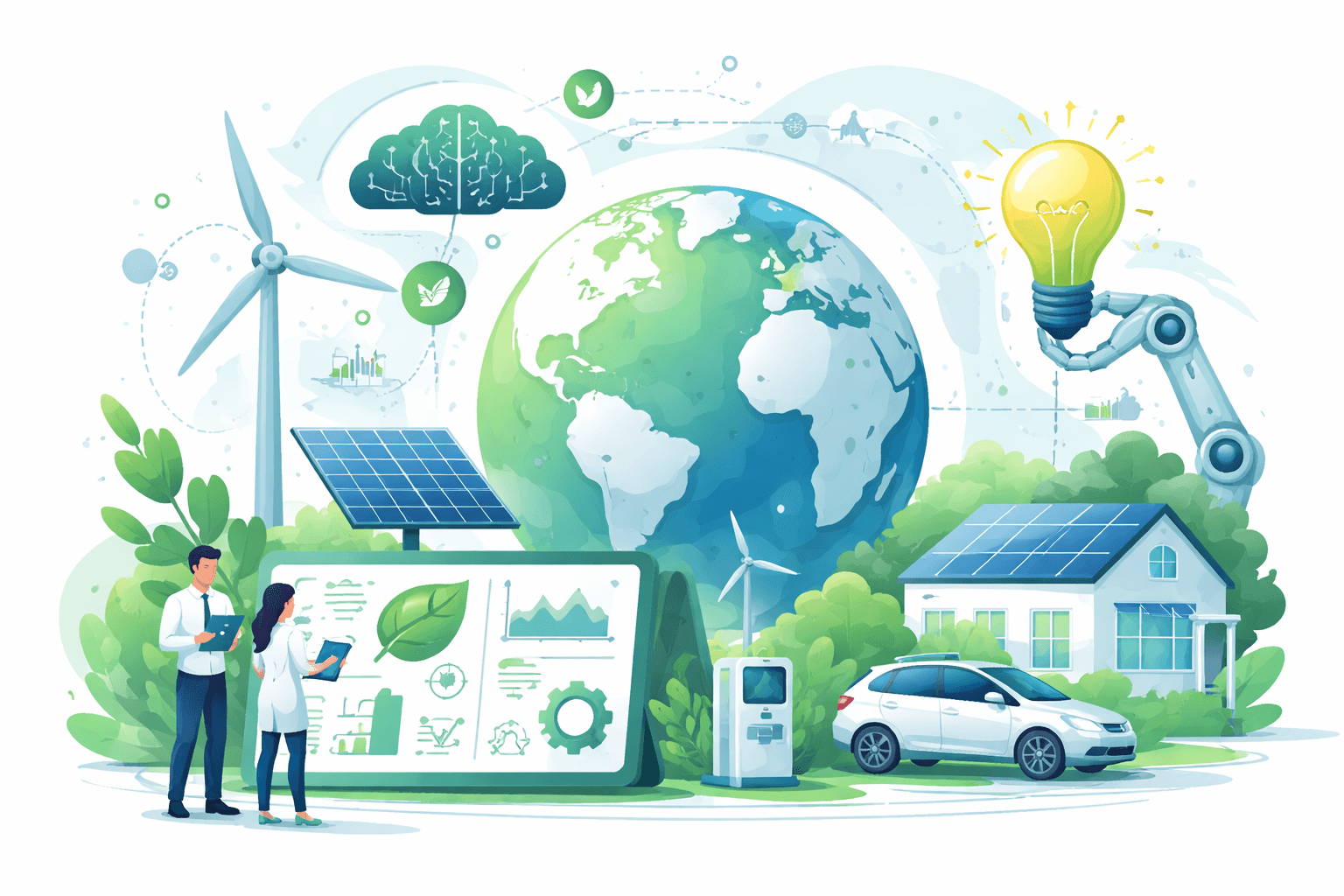
Artificial intelligence is quietly becoming one of the highest‑ROI efficiency upgrades across buildings, industry, and the grid. The International Energy Agency (IEA) estimates that doubling the global rate of energy intensity improvement by 2030 can deliver roughly one‑third of the emissions cuts needed this decade; digitalization and AI are central enablers of that acceleration (IEA Energy Efficiency 2023). In buildings and industry alone, AI‑enabled controls and analytics can typically reduce energy use 10–20% without major hardware retrofits (IEA Digitalization & Energy, 2017). This guide explains AI tools for energy efficiency—what they do, where they work, measurable outcomes, and how to deploy them with rigor.
AI tools for energy efficiency: core capabilities
AI is not a single product; it’s a toolkit that learns patterns from data and acts in real time. The capabilities below are the building blocks used across sectors.
Data-Driven Science and Engineering: Machine Learning, Dynamical Systems, and Control: Brunton, Steven L., Kutz, J. Nathan
Data-Driven Science and Engineering: Machine Learning, Dynamical Systems, and Control [Brunton, Steven L., Kutz, J. Nathan] on Amazon.com. *FREE* shipping on qualifying offers. Data-Driven Science and
Check Price on AmazonPredictive maintenance (PdM)
- What it is: Machine‑learning (ML) models that detect early signs of equipment degradation—motors, chillers, compressors—using vibration, temperature, current, pressure, or acoustic data.
- Why it saves energy: Degraded assets draw more power and operate off‑setpoints (e.g., fouled heat exchangers force higher pumping and fan loads). The U.S. DOE reports predictive maintenance can cut maintenance costs 25–30% and reduce breakdowns 70–75%; energy savings of 5–10% are common side benefits when assets run at optimal efficiency (DOE O&M Best Practices, 2010; Better Plants).
- Where used: Industrial motors, HVAC plants, refrigeration, wind turbine drivetrains.
Demand forecasting
- What it is: Short‑ to medium‑term forecasts of load, solar, wind, or EV charging using ML models (gradient boosting, LSTMs) enriched with weather, calendar, and operational data.
- Why it saves energy/costs: Better forecasts reduce over‑generation and spinning reserves, improve unit commitment, and inform pre‑cooling/pre‑heating to shift loads into off‑peak windows.
- Impact: Improved variable‑renewable forecasting can trim balancing costs 10–20% (EPRI; NREL integration studies). At site level, accurate kW forecasts reduce demand charges, often 20–50% of C&I electricity bills in North America.
Real‑time optimization and supervisory control
- What it is: Algorithms that continuously adjust setpoints (supply air temperature, static pressure, chilled water temperature, boiler staging) to meet comfort/process constraints at minimum energy.
- Why it works: Systems rarely operate at design conditions; AI identifies efficient operating points hour‑by‑hour.
- Impact: Supervisory optimization typically yields 5–15% HVAC savings in commercial buildings (LBNL field studies) and 3–10% in industrial utilities (compressed air, steam).
Model‑Predictive Control (MPC)
- What it is: A control strategy that uses a model of the building or process plus future weather/price forecasts to choose control actions optimizing a cost function (e.g., kWh, kW, comfort) over a time horizon.
- Why it saves: MPC can safely pre‑charge thermal mass, avoid coincident peaks, and respect constraints (comfort bands, process SLAs).
- Impact: NREL/PNNL research shows MPC can reduce HVAC energy 10–20% and peak demand 10–30% in large buildings, with higher savings in demand‑charge regions.
Digital twins
- What it is: Virtual replicas of assets or facilities calibrated with real data; used for scenario testing, commissioning, and training controls.
- Why it saves: Twins expose inefficiencies (e.g., valve leakage, sensor bias) and let operators test control strategies risk‑free before applying them.
- Impact: Commissioning with physics‑based twins can unlock 5–15% savings by correcting sequences of operation (ASHRAE commissioning guidelines; LBNL).
IoT analytics and contextual data fusion
- What it is: Stream processing of high‑frequency sensor data (1‑second to 15‑minute intervals) combined with metadata (equipment type, zones, schedules) to derive features like runtime, part‑load ratio, and occupancy.
- Why it saves: Unlocks fault detection, granular baselining, and targeted control changes rather than blanket schedules.
Anomaly and fault detection/diagnostics (FDD)
- What it is: Rule‑based and ML models that flag abnormal behavior (economizer stuck, simultaneous heating/cooling, sensor drift) and estimate savings from fixes.
- Why it saves: Persistent minor faults can add 10–30% to HVAC energy use. LBNL meta‑analysis shows building FDD consistently delivers 5–30% savings, median around 9%, with paybacks under 2 years in many facilities.
Sector applications and measurable outcomes
Commercial and residential buildings
- What works
- Advanced scheduling and occupancy‑aware control: ML infers true occupancy to avoid conditioning empty spaces; 5–15% HVAC reduction in offices and schools.
- VAV/air‑side optimization: Static pressure reset, supply air temperature optimization, and economizer control save 5–20%.
- Chiller/boiler plant optimization: Plant sequencing and variable setpoints yield 5–15% savings, with demand‑charge reductions of 10–30% via peak shaving.
- FDD and automated commissioning: Eliminates simultaneous heat/cool, sensor bias, and valve leakage; 5–15% typical.
- KPIs
- Energy Use Intensity (EUI, kBtu/ft²·yr or kWh/m²·yr)
- Peak demand (kW) and demand charges ($/kW)
- HVAC kWh per cooling/heating degree day
- Comfort compliance (% of hours within setpoint bands)
- ROI drivers
- Utility incentives for retro‑commissioning and demand response
- Avoided maintenance truck rolls via predictive alerts
- Demand charge reductions and time‑of‑use arbitrage
- Notable datapoint: Google reported a 40% reduction in data‑center cooling energy using DeepMind’s control optimization, improving overall PUE by ~15% (Google/DeepMind, 2016)—a benchmark for supervisory AI.
- For homeowners: Smart thermostats with occupancy/learning features consistently save 8–15% on heating and cooling (multiple utility evaluations). Pair AI controls with envelope upgrades and heat pumps for compounding gains; see our guidance on Smart Home Technology for Sustainability: High‑Impact Upgrades, Integration, and Real‑World Guidance and How to Make Your Home More Energy Efficient: Practical Steps & Savings.

ecobee Smart Thermostat Premium with Smart Sensor and Air Quality Monitor - Programmable Wifi Thermostat - Works with Siri, Alexa, Google Assistant - Amazon.com
View on AmazonIndustrial processes and facilities
- What works
- Predictive maintenance and quality prediction: Sensor fusion on motors, pumps, and compressors detects inefficiencies; 5–10% energy savings typical, with 25–30% lower maintenance costs (DOE AMO).
- Process setpoint optimization: Reinforcement learning or Bayesian optimization tunes multivariable processes (kilns, dryers, fermentation) for yield and energy; 3–15% energy cuts without throughput loss.
- Industrial utilities: Compressed air leakage analytics and pressure optimization reduce energy 10–20%; steam trap analytics 5–15%.
- KPIs
- kWh/ton (or per unit output), specific energy consumption (SEC)
- Asset efficiency (kWh per runtime hour), OEE interactions
- Avoided scrap/rework (quality improvements often save more energy than controls)
- ROI drivers
- Avoided downtime (largest cash driver)
- Lower scrap and rework, fewer off‑spec batches
- Utility incentives for motor/VFD optimization and process efficiency
Utilities and grids
- What works
- AI‑enhanced load and renewable forecasting improves dispatch and reduces reserves; integration studies show 10–20% balancing cost reductions (EPRI/NREL).
- DER orchestration and demand response: Model‑predictive load control across buildings/EVs shifts demand off peak, reducing system peaks and emissions.
- Grid asset health: Transformer and cable PdM averts failures and optimizes replacement cycles.
- KPIs
- Forecast MAE/MAPE; reserve requirements; curtailment hours
- Peak load reduction (MW) and avoided CO2 (t/MWh based on marginal emissions)
- Reliability (SAIDI/SAIFI) and hosting capacity for DERs
- ROI drivers
- Deferred capacity investments and avoided peaker dispatch
- Fewer truck rolls and outage penalties
- Learn more about AI on the supply side in AI in Renewable Energy: Use Cases, Measurable Impacts, and How to Deploy.
Transport and fleets
- What works
- Route and load optimization: ML‑based routing and consolidation cut fuel use 5–15% and miles 10–20% (U.S. DOT/FHWA case studies).
- Eco‑driving and adaptive cruise: AI driver coaching reduces fuel 5–10% (IEA).
- Managed EV charging: AI schedules charging to off‑peak windows, flattening load; pilots report 30–60% reduction in demand charges and major deferral of distribution upgrades (DOE/NREL managed charging studies).
- KPIs
- Fuel/energy intensity (kWh or L/100km per payload‑km)
- Demand charges per vehicle and depot peak kW
- On‑time performance and asset utilization
By the Numbers
- 10–20% typical energy savings from AI‑enabled controls and analytics in buildings and industry (IEA Digitalization & Energy, 2017; LBNL; NREL/PNNL MPC studies).
- 5–30% HVAC savings identified and often realized via building FDD, median ~9% (LBNL meta‑analysis).
- 25–30% lower maintenance costs and 35–45% less downtime with predictive maintenance; 5–10% energy reduction as assets run efficiently (DOE O&M Best Practices).
- 10–20% reduction in balancing costs via improved VRE forecasting (EPRI/NREL), improving grid emissions by avoiding peaker plants.
- 40% reduction in data‑center cooling energy and ~15% PUE improvement with AI supervisory control (Google/DeepMind, 2016).
Implementation prerequisites and practical guidance
Getting value from AI tools for energy efficiency hinges on data readiness, integration, and disciplined measurement and verification (M&V).
Data needs and quality
- Minimum viable data
- Interval energy data (15‑min or finer) for whole‑building baseline and peak analysis
- Key equipment points via BMS/SCADA: temperatures, flows, valve/ damper positions, setpoints, runtimes
- Weather, schedules, and occupancy proxies (badge, Wi‑Fi, CO2) where privacy‑appropriate
- Quality checks
- Sensor calibration and unit consistency; address missing data and clock drift
- Metadata tagging (e.g., Project Haystack, Brick Schema) to map points to equipment and zones
- Sampling rates
- Controls optimization and FDD: 1–5 minutes often sufficient
- Vibration/acoustic PdM: sub‑second to 1 Hz with edge preprocessing

Emporia Gen 2 Smart Home Energy Monitor with 16 50A Circuit Level Sensors | Real Time Electricity Monitor/Meter | Solar/Net Metering - Amazon.com
View on AmazonIntegration with BMS/SCADA/IoT
- Protocols and gateways: BACnet, Modbus, OPC UA for legacy systems; MQTT/REST for IoT. Ensure read/write permissions are clear and auditable.
- Control loop design: Start in advisory mode, progress to closed‑loop with guardrails (setpoint bounds, rate limits, automated fallback to default sequences).
- SCADA and DCS in industry: Use historian data (PI, etc.) and create a change‑management window for deploying new control strategies.
Edge vs. cloud trade‑offs
- Edge advantages: Low latency, resilience if WAN drops, data sovereignty; ideal for MPC, PdM feature extraction, and safety‑critical controls.
- Cloud advantages: Heavy training workloads, fleet benchmarking, global model updates, and cross‑site learning.
- Hybrid approach: Feature extraction and control at edge; periodic cloud retraining. Compress/aggregate high‑rate data (e.g., FFT features for vibration) before upload.
Cybersecurity and data governance
- Frameworks: Align with NIST Cybersecurity Framework and, for industrial systems, IEC 62443; require vendor ISO 27001 alignment for data management.
- Network segmentation: Separate OT from IT; use firewalls and least‑privilege access. Avoid outbound‑only assumptions—validate secure broker patterns.
- Privacy: Occupancy and HVAC data can infer presence; comply with GDPR/CCPA where applicable. Anonymize and minimize data; document retention and access policies.
Workforce, training, and change management
- Involve operators early. Co‑design alerts and dashboards; ensure explainability (what changed, why, expected impact).
- Train staff on AI‑augmented workflows (fault triage, setpoint acceptance). Establish a “human‑in‑the‑loop” stage before full autonomy.
- Align incentives: Tie energy KPIs to site leadership goals; recognize savings and avoided downtime.
Project sizing: pilot to scale
- Scoping: Choose a representative site or line with accessible data and clear KPIs (e.g., 10% HVAC kWh reduction, 15% peak kW reduction).
- Baseline and M&V: Use IPMVP Option C (whole‑facility) for building projects and Option B (isolated measure) for equipment. Normalize for weather and occupancy.
- 90‑day pilot rhythm: Weeks 1–3 data health; weeks 4–8 model training/advisory mode; weeks 9–12 controlled A/B test in limited zones/shifts.
- Scale plan: Define gating criteria (savings, comfort, false‑positive rates), deployment templates, and operator playbooks. Budget for ongoing model maintenance and data onboarding per site.
- For a broader roadmap with pitfalls to avoid, see Using AI for Energy Efficiency: Use Cases, Benefits, Risks, and How to Start.
Limitations, risks, vendor selection, and deployment best practices
Model accuracy, drift, and bias
- Seasonal drift: Models trained in mild seasons may mispredict extremes. Mitigation: continuous learning with guardrails and seasonal retraining.
- Sensor bias: A single miscalibrated temperature or flow meter can collapse savings. Mitigation: periodic metrology checks and cross‑sensor validation.
- Data leakage and overfitting: Especially in demand forecasting. Mitigation: proper train/test splits by time and rolling cross‑validation; holdout during extreme events.
Privacy and regulatory concerns
- Occupancy inference and indoor analytics may be subject to local privacy laws. Use aggregated, anonymized features; explicit signage and opt‑outs in public spaces; DPIAs under GDPR when applicable.
Common failure modes and remediation
- Failure mode: “Advisor paralysis”—recommendations never acted upon. Fix: Escalation routes, auto‑ticketing in CMMS, and budgeted minor fixes.
- Failure mode: Comfort or process excursions after control changes. Fix: Tight constraints, staged rollouts, watchdog timers, and automated reversion.
- Failure mode: No baseline, no proof. Fix: IPMVP‑compliant M&V plan from day one; weather and occupancy normalization; publish savings reports monthly.
- Failure mode: One‑off pilot that never scales. Fix: Define multi‑site template, data onboarding playbook, and TCO model including integration and ops.
Vendor selection checklist (category‑based)
Evaluate categories rather than chasing features in isolation:
- Building analytics and FDD platforms: Focus on BACnet/Modbus interoperability, rule libraries plus ML, closed‑loop capability, comfort safeguards, and IPMVP reporting.
- Plant and process optimization (industry): Ability to integrate with DCS/SCADA, support for constrained optimization/MPC, and explainable setpoint recommendations.
- Predictive maintenance suites: Edge analytics support for vibration/acoustic data, model transparency, and CMMS integration.
- DERMS/demand response and managed EV charging: Forecasting accuracy, control across heterogeneous devices, and price‑/carbon‑aware optimization.
- Cross‑site fleet analytics: Benchmarking, anomaly detection, and templated deployment. Key questions to ask any vendor:
- Data model and interoperability: Which protocols? How is metadata mapped (Haystack/Brick)?
- Security posture: SOC 2/ISO 27001 evidence; pen‑test results; OT network architecture.
- M&V methodology: How are savings calculated? Weather/occupancy normalization? Can we audit?
- Control philosophy: Advisory vs. autonomous; guardrails; rollback procedures.
- Lifecycle costs: Integration hours/site, licensing by point/device/site, ongoing model maintenance.
- References and evidence: Peer‑reviewed pilots, third‑party verifications, or utility‑approved results.
Short case examples (patterns to look for)
- Large hospital, 500,000 ft²: FDD finds simultaneous heat/cool and leaky valves; 12% HVAC kWh reduction in 6 months; comfort complaints down 30% (pattern consistent with LBNL studies).
- Food & bev plant: Compressed air analytics and leak tagging cut compressor energy 18% with <1‑year payback; downtime decreases due to PdM on critical motors (DOE Better Plants analogs).
- University microgrid: AI load/solar forecasting and MPC pre‑cools buildings before afternoon peaks; campus peak drops 15%, saving six figures annually in demand charges (NREL campus integration style outcomes).
- Fleet depot: Managed EV charging flattens overnight peaks; demand charges fall 40% and interconnection upgrade deferred (NREL/utility pilots align).
Practical implications for operators and policymakers
- Facilities teams: Prioritize measures with closed‑loop control and clear M&V; start where BMS data is richest. Pair AI with low‑cost fixes (schedules, sequences) for fastest payback. For additional no‑regret actions, see Energy Conservation Techniques: Practical Steps to Save Energy, Money & Cut Emissions.
- Industrial leaders: Tie AI projects to throughput/quality KPIs as well as kWh; PdM plus process optimization often outperforms standalone energy projects on ROI.
- Utilities/regulators: Encourage performance‑based incentives and standardized M&V for AI controls; support open protocols and data access to spur competition.
Where this is heading
- Converged optimization: Expect unified platforms optimizing cost, carbon, and comfort/process simultaneously as marginal emissions signals become more available in day‑ahead markets.
- Foundation models for buildings and industry: Pretrained models on large operational datasets will shrink deployment time from months to days, especially for FDD and forecasting.
- Edge autonomy with safety: More closed‑loop control at the edge, with formal verification to guarantee safety and comfort constraints.
- Grid‑interactive efficient buildings (GEBs): AI will make buildings flexible grid assets—earning revenue via automated demand response—while lowering EUI.
- Standards and transparency: Wider adoption of schemas (Haystack/Brick), open APIs, and IPMVP‑aligned reporting will raise confidence and unlock financing.
Organizations that approach AI tools for energy efficiency as a disciplined engineering and change‑management effort—data‑ready, interoperable, cyber‑secure, and measured—are consistently finding double‑digit energy cuts, lower peaks, and faster paybacks than traditional retrofits alone.
Recommended Products
Data-Driven Science and Engineering: Machine Learning, Dynamical Systems, and Control: Brunton, Steven L., Kutz, J. Nathan
Data-Driven Science and Engineering: Machine Learning, Dynamical Systems, and Control [Brunton, Steven L., Kutz, J. Nathan] on Amazon.com. *FREE* shipping on qualifying offers. Data-Driven Science and
ecobee Smart Thermostat Premium with Smart Sensor and Air Quality Monitor - Programmable Wifi Thermostat - Works with Siri, Alexa, Google Assistant - Amazon.com
ecobee Smart Thermostat Premium with Smart Sensor and Air Quality Monitor - Programmable Wifi Thermostat - <strong>Works with Siri, Alexa, Google Assistant</strong> - Amazon.com
Emporia Gen 2 Smart Home Energy Monitor with 16 50A Circuit Level Sensors | Real Time Electricity Monitor/Meter | Solar/Net Metering - Amazon.com
See how much electricity your home is using anywhere, anytime. ... <strong>Add individual 50A sensors to your Vue to monitor up to 16 individual circuits</strong> — providing accurate energy use for t