
Climate Change Adaptation Strategies: Practical, Equitable Solutions for Communities, Infrastructure, and Nature
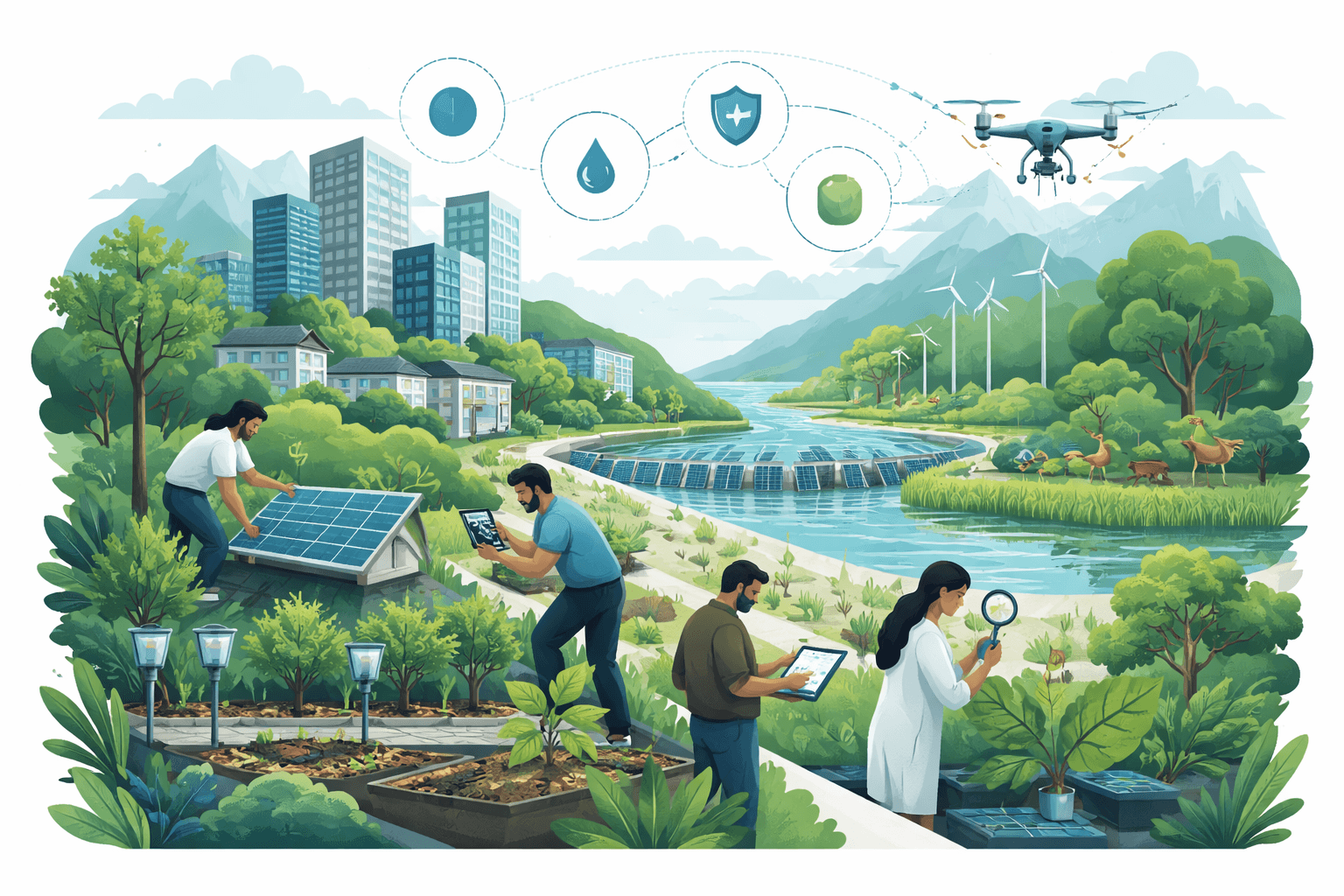
Adaptation to climate change is no longer optional. The IPCC’s 2022 assessment warns that 3.3–3.6 billion people already live in contexts highly vulnerable to climate impacts, with risks accelerating as warming increases. UNEP’s 2023 Adaptation Gap Report estimates developing-country needs at $215–387 billion per year this decade—10–18 times current international public flows. Climate change adaptation strategies must therefore move from plans to procurement, from pilots to portfolios.
This guide defines climate adaptation, maps the highest-impact, science-backed options across sectors, and offers tools to fund, implement, and evaluate measures in a way that is practical and fair.
What adaptation is—and why it matters now
Adaptation means adjusting systems—human and natural—to current or expected climate effects to reduce harm or seize beneficial opportunities. It differs from mitigation, which cuts the greenhouse gas emissions driving climate change. The core objectives of adaptation are to:
Climate Change 2022 – Impacts, Adaptation and Vulnerability 3 Volume Paperback Set: Working Group II Contribution to the Sixth Assessment Report of ... Panel on Climate Change, 1-3): Intergovernmental Panel on Climate Change (IPCC)
IPCC reports are produced in comprehensive, objective and transparent ways, ensuring they reflect the full range of views in the scientific literature. Novel elements include focused topical assessmen
Check Price on Amazon- Reduce vulnerability to hazards (floods, heat, drought, wildfire, storms)
- Enhance resilience (the capacity to anticipate, absorb, recover, and evolve)
- Protect and restore ecosystems that buffer risk and sustain livelihoods
The risks are rising and unevenly distributed:
- Heat: The Lancet Countdown (2023) reports a 68% increase in heat-related mortality among people over 65 between 2000–2004 and 2017–2021.
- Coasts: About 680 million people live in low-lying coastal zones today, projected to exceed 1 billion by 2050 (IPCC Special Report on the Ocean and Cryosphere).
- Water: The World Bank warns that water scarcity could shave up to 6% off GDP in some regions by 2050 without strong adaptation.
- Food: Each 1°C of warming can reduce global yields of major staples: maize (−7.4%), wheat (−6.0%), rice (−3.2%), and soybean (−3.1%) absent adaptation (Zhao et al., PNAS).
By the numbers
- $215–387 billion/year: Estimated adaptation finance needed in developing countries by 2030 (UNEP 2023)
- 10–18x: Size of the international public finance gap relative to needs (UNEP 2023)
- 97%: Wave energy reduction across reef crests provided by healthy coral reefs (Ferrario et al., 2014)
- $625 million: Flood damages avoided by U.S. coastal wetlands during Hurricane Sandy (Narayan et al., Scientific Reports, 2017)
- ~50%: Reduction in Cape Town’s municipal water use at the height of its 2018 crisis, helping avert “Day Zero” (World Bank)
- 2°C: Neighborhood-scale temperature reduction from Medellín’s Green Corridors (City of Medellín)
2 million: People evacuated ahead of Cyclone Amphan (2020) in Bangladesh; mortality was orders of magnitude lower than 1970’s Bhola cyclone due to early warnings and shelters (Bangladesh authorities/UN OCHA)
Climate change adaptation strategies by sector
Resilient infrastructure and building design
- Design for non-stationarity: Use future weather files and updated intensity–duration–frequency (IDF) curves that reflect shifting storm patterns rather than relying on historical averages (ASCE/ISO 14090 guidance).
- Flood resilience: Elevate critical equipment; employ dry or wet floodproofing; install backflow preventers; convert floodplains to multifunctional parks. The Netherlands’ Room for the River program reduced peak Rhine flood levels by up to 30 cm while adding public space.
- Urban drainage and cloudburst management: Combine green and gray measures—permeable pavements, bioswales, detention basins, and upsized conveyance—to handle 100-year storms. Copenhagen’s Cloudburst Plan uses 300+ blue–green projects to route excess water to streets and parks designed as safe overflows.
- Heat-resilient buildings: High-reflectance “cool” roofs and walls can lower indoor temps by 1–2°C and cut cooling demand 10–20% in hot climates (LBNL Heat Island Group). External shading, high-performance glazing, and passive ventilation improve thermal safety during outages. For broader design strategies, see Buildings That Incorporate Sustainability (/sustainability-policy/buildings-that-incorporate-sustainability).
- Grid resilience and critical services: Microgrids and on-site storage keep hospitals, water treatment plants, and shelters online during extreme events. Utility substations can be raised above flood elevations; wildfire-prone areas can adopt covered conductors and sectionalizing switches.
Climate-smart agriculture and resilient food systems
- Crop and variety shifts: Diversify crops and deploy heat- and drought-tolerant varieties; conservation tillage and cover crops increase soil organic matter and water retention, raising yields and reducing erosion.
- Efficient irrigation: Drip and sprinkler systems paired with soil-moisture sensors can reduce water use 30–60% while maintaining yields (FAO). Scheduling irrigation to cooler hours reduces evaporative losses.
- Agroforestry and shade systems: Trees buffer temperature extremes, reduce wind stress, and improve infiltration; they also diversify farm income.
- Risk transfer and finance: Index-based insurance and forecast-based financing (e.g., Ethiopia’s R4 initiative) help smallholders invest in improved practices and recover faster after shocks.
- Cold chains and storage: Solar-powered cold rooms and improved post-harvest handling reduce food loss—a critical adaptation for hotter climates.
Water management, coastal protection, and managed retreat
- Demand management and leakage control: Many cities lose 20–40% of water to non-revenue losses. District metering and smart leak detection free up supply faster and cheaper than new sources.
- Augmentation and reuse: Aquifer recharge (MAR/ASR), potable and non-potable reuse, and rainwater harvesting expand supply portfolios. Desalination is an option where energy and brine impacts are managed.
- Nature-based coastal defenses: Mangroves, salt marshes, dunes, and oyster reefs attenuate waves and reduce storm surge. Global analyses estimate mangroves provide $65+ billion/year in flood protection benefits and reduce risk for 15–20 million people (Menéndez et al.; The Nature Conservancy).
- Living shorelines and hybrid systems: Pair green buffers with strategic seawalls or surge barriers to manage residual risk and sea-level rise over time.
- Managed retreat where risk is unsustainable: Buyouts and relocation can be more cost-effective than rebuilding. New York’s post–Hurricane Sandy voluntary buyouts in Staten Island moved residents from repeatedly flooded zones, converting land to open space. Transparent, community-led processes and fair compensation are essential.
Public health preparedness and heat action
- Heat action plans: Early warning, public alerts, cooling centers, work/rest guidelines, and targeted outreach reduce mortality. Ahmedabad’s Heat Action Plan (India), launched in 2013, is associated with substantial reductions in heat-related deaths on extreme days (NRDC/IIPH studies).
- Built environment cooling: Trees, cool roofs, and reflective pavements lower neighborhood heat. Urban shade standards for streets and bus stops protect vulnerable workers and commuters.
- Surveillance and services: Strengthen disease-vector monitoring as ranges shift; climate-proof clinics and stockpiles; ensure backup power for cold chains and critical care. Demand-side energy efficiency reduces blackout risk during heatwaves; for practical steps, see Energy Conservation Techniques (/conservation/energy-conservation-techniques-practical-steps-save-energy-money-cut-emissions).
Ecosystem-based adaptation (EbA)
- Wetland and peatland restoration: Rewetted peatlands store carbon and reduce wildfire risk; floodplain reconnection stores peak flows. During Hurricane Sandy, U.S. coastal wetlands avoided $625 million in damages (Narayan et al.).
- Coral and oyster reefs: Healthy reefs can reduce wave energy by up to 97% at the reef crest (Ferrario et al.). Reef insurance pilots in Mexico fund rapid post-storm repairs to restore protection.
- Urban green infrastructure: Parks, street trees, and green roofs mitigate heat and manage stormwater. Medellín’s Green Corridors cut local temperatures by up to 2°C while improving air quality.
- Biodiversity co-benefits and stewardship: EbA succeeds when local communities co-design, monitor, and benefit from projects. For practice-proven conservation approaches and monitoring, see Effective Wildlife Conservation Practices (/sustainability-policy/effective-wildlife-conservation-practices-guide).
- Nature in the garden and neighborhood: Native plantings, rain gardens, and soil-building enhance infiltration and cooling. For how-to guidance at property scale, see How to Create Sustainable Gardens (/sustainability-policy/how-to-create-sustainable-gardens).
Planning tools and methods practitioners should use
- Vulnerability and risk assessment: Map exposure (who and what is in harm’s way), sensitivity (how severely they are affected), and adaptive capacity (ability to cope). ISO 14091 provides a structured approach; many cities use the UNFCCC National Adaptation Plan (NAP) Technical Guidelines framework.
- Scenario planning: Stress-test strategies under multiple climate and socioeconomic futures using IPCC-aligned scenarios—Representative Concentration Pathways (RCPs) for emissions and Shared Socioeconomic Pathways (SSPs) for development. Robust Decision Making (RDM) and Dynamic Adaptive Policy Pathways (DAPP) help design options that perform well across uncertainty and include triggers to change course.
- Appraising nature-based solutions: Use benefit–cost analysis that captures avoided damages, ecosystem services, and co-benefits (cooling, recreation, habitat). Tools such as InVEST, FEMA BCA Toolkit (with ecosystem service modules), and TNC’s guidelines help quantify EbA.
- No-regret and low-regret measures: Prioritize options that yield net benefits under a wide range of futures—e.g., leak reduction, early-warning modernization, building shading, urban trees, and wetland protection.
- Early warning systems (EWS): Invest in hazard monitoring, forecasting, risk communication, and last-mile response. As of 2023, roughly half of countries lack adequate multi-hazard EWS; the WMO’s “Early Warnings for All” initiative aims for universal coverage by 2027.
- Remote sensing and monitoring: Use Copernicus Sentinel-1/2 for flood extent and land cover, NASA SMAP for soil moisture, ECOSTRESS for surface temperature, and Planet/drone imagery for high-resolution change detection. Pair with IoT sensors for rainfall, river levels, and air temperature to evaluate performance in near-real time.
- Open data and decision platforms: NOAA Sea Level Rise Viewer, WRI Aqueduct (water risk), the World Bank Climate Change Knowledge Portal and Country Climate and Development Reports, and the Copernicus Climate Data Store provide ready-to-use inputs for planning.
Governance, finance, and equity considerations
- Mainstream adaptation into policy and regulation: Embed climate risk into land-use plans, building and infrastructure codes, and environmental impact assessments. Development control in floodplains, wildfire setbacks, and heat-resilient urban design standards prevent lock-in to high-risk patterns. For building features that deliver both mitigation and resilience co-benefits, see Buildings That Incorporate Sustainability (/sustainability-policy/buildings-that-incorporate-sustainability).
- Funding mechanisms: Combine public budgets, multilateral finance, and private capital.
- International funds: The Green Climate Fund has approved more than $12 billion across 200+ projects, with a large share for adaptation; the Adaptation Fund has committed roughly $1 billion to date (agency reports through 2024).
- Multilateral development banks: MDBs provided about $25 billion in adaptation finance in 2022 (Joint MDB Report).
- Domestic instruments: Resilience bonds and stormwater utilities finance gray–green upgrades; revolving funds support household retrofits.
- Insurance and risk pools: Parametric products like the Caribbean Catastrophe Risk Insurance Facility (CCRIF) and African Risk Capacity (ARC) provide rapid liquidity after disasters. Innovative policies insure natural assets (e.g., Mexico’s reef insurance).
- Private sector disclosure and governance: Frameworks such as TCFD and ISSB require assessment of physical climate risks, pushing companies to invest in resilience across assets and supply chains.
- Stakeholder engagement and capacity building: Co-design with residents, especially those at highest risk. Build local maintenance capacity and fund operations, not just capital works.
- Equity and justice: Prioritize vulnerable and marginalized communities by targeting heat islands, floodplains, and service gaps; ensure Free, Prior, and Informed Consent (FPIC) for Indigenous Peoples; and offer relocation assistance that maintains community ties and livelihoods. Avoid maladaptation—like hard seawalls that worsen erosion for neighbors or cooling strategies that raise energy bills for low-income households.
- Policy coherence: Align national adaptation plans with sector strategies and municipal investments; track progress via transparent dashboards. For the global policy context and where current efforts fall short, see Global Climate Change Initiatives: Progress, Gaps, and Scalable Solutions (/sustainability-policy/global-climate-change-initiatives-progress-gaps).
Practical implementation and evaluation
- Start with portfolios, not single projects: Combine quick wins (e.g., leak reduction, shade structures) with longer-lead items (e.g., floodplain restoration, major drainage) to deliver near-term benefits while building toward system-scale resilience.
- Phased and scalable delivery: Pilot in high-risk districts, evaluate, then scale. Use adaptive pathways with signposts and triggers—e.g., if sea level exceeds a threshold or storm frequency crosses a benchmark, shift from beach nourishment to hybrid defenses, and then to managed retreat.
- Procurement for performance: Specify measurable outcomes—peak flow reduced, indoor maximum temps capped, hours of critical service maintained—rather than only inputs.
- Maintenance matters: Budget 2–5% of capital cost annually for operations and maintenance of green and gray assets. Train community stewards for urban trees and rain gardens to ensure survival.
- Monitoring indicators and metrics:
- Risk reduction: people protected; avoided economic losses ($); downtime avoided (hours) for power, water, transport; habitat/area restored (hectares).
- Climate services: forecast accuracy; warning lead time; percentage of population reached by alerts; evacuation uptake rates.
- Heat resilience: reduction in wet-bulb globe temperature at street level; indoor maximum temperature during outages; emergency room visits on heat-alert days.
- Water: liters per capita per day; non-revenue water (%); aquifer levels; storage buffer (days).
- Equity: share of investment in high-vulnerability neighborhoods; participation rates of underrepresented groups; affordability metrics (bill burden as % of income).
- Co-benefits: air quality improvements; urban biodiversity indices; recreational access.
- Real-world lessons
- Bangladesh cyclones: Investments in early warning, 14,000+ cyclone shelters, and community mobilization have reduced mortality by orders of magnitude compared to the 1970s for storms of similar intensity.
- Cape Town water crisis: A mix of aggressive demand management, pressure reduction, leak control, and new supplies cut usage by ~50%, buying critical time during extreme drought.
- Netherlands Room for the River: Shifting from ever-higher dikes to giving rivers space reduced peak flood levels and delivered recreation and habitat.
- Medellín Green Corridors: Targeted urban greening reduced local temperatures by up to 2°C and improved walkability and air quality.
- U.S. wetlands and Hurricane Sandy: Natural infrastructure delivered quantifiable avoided losses, supporting the business case for EbA in dense coastal regions.
Recommended toolkits and resources
- Standards and frameworks: ISO 14090 (adaptation management), ISO 14091 (vulnerability), UNFCCC NAP Technical Guidelines, WHO Heat-Health Action Planning guidance.
- Data and analytics: Copernicus Climate Data Store; NOAA Sea Level Rise Viewer; NASA POWER for building-scale weather data; WRI Aqueduct for water risk; World Bank Climate Change Knowledge Portal; SERVIR for geospatial support in Africa, Asia, and Latin America.
- Appraisal and design: FEMA Benefit–Cost Analysis Toolkit; The Nature Conservancy’s guidelines for valuing nature-based solutions; InVEST for ecosystem services; Deltares’ tools (e.g., Delft-FEWS) for flood forecasting.
- Implementation support: C40/100RC playbooks for city adaptation; FAO climate-smart agriculture briefs; WMO Early Warnings for All roadmap.
Where adaptation is heading
- From pilots to pipelines: Expect larger, programmatic investments bundling hundreds of neighborhood-scale projects under standardized designs and contracts.
- Blended finance and resilience credits: More projects will combine grants, concessional loans, and pay-for-performance structures to monetize avoided losses and co-benefits.
- Nature-positive by default: EbA will be mainstreamed as first-line defense where feasible, with hybrid systems managing residual risk and sea-level rise over time.
- Data to decisions: Near-real-time monitoring and digital twins will enable adaptive operations—e.g., dynamic cooling and flood routing based on forecasts.
- Equity as a requirement: Donor and domestic funding will condition support on demonstrable benefits for vulnerable groups and on robust community engagement.
Adaptation must proceed alongside rapid emissions cuts. But the science is clear: well-designed climate change adaptation strategies save lives, protect ecosystems, and can pay for themselves many times over through avoided damages and healthier, more livable communities.

Davis Instruments Wireless Vantage Pro2 Weather Station with WeatherLink Console - Metric : Patio, Lawn & Garden
Mount anemometer up to 12 m from the rest of sensor suite for flexible siting. Rugged, weather-proof housing gives you years of reliable data. Sensor suite is solar-powered with battery back-up; conso
Check Price on Amazon
EF ECOFLOW Portable Power Station 3600Wh DELTA Pro, 120V AC Outlets x 5, 3600W, 2.7H Fast Charge, Lifepo4 Power Station, Solar Generator for Home Use, Power Outage, Camping, RV, Emergencies : Patio, Lawn & Garden
View on AmazonRecommended Products
Climate Change 2022 – Impacts, Adaptation and Vulnerability 3 Volume Paperback Set: Working Group II Contribution to the Sixth Assessment Report of ... Panel on Climate Change, 1-3): Intergovernmental Panel on Climate Change (IPCC)
IPCC reports are produced in comprehensive, objective and transparent ways, ensuring they reflect the full range of views in the scientific literature. Novel elements include focused topical assessmen
Davis Instruments Wireless Vantage Pro2 Weather Station with WeatherLink Console - Metric : Patio, Lawn & Garden
Mount anemometer up to 12 m from the rest of sensor suite for flexible siting. Rugged, weather-proof housing gives you years of reliable data. Sensor suite is solar-powered with battery back-up; conso
EF ECOFLOW Portable Power Station 3600Wh DELTA Pro, 120V AC Outlets x 5, 3600W, 2.7H Fast Charge, Lifepo4 Power Station, Solar Generator for Home Use, Power Outage, Camping, RV, Emergencies : Patio, Lawn & Garden
<strong>Fully recharge the lifepo4 battery in 1.8 hrs with 240V outlets(3000W), 2.7 hrs with 1800W wall outlets or solar charged in 2.8 hours with 4*400W solar panels</strong> thanks to the industry-l
More in Sustainability Policy
- Climate Change Mitigation Techniques: Practical, Scalable Strategies for Energy, Nature, Policy & Technology
- High-Impact Ways to Combat Climate Change: Practical Solutions for Policy, Nature, Technology, and Everyday Life
- Climate Change Explained: Causes, Impacts, and Practical Actions
- How Climate Change Affects Agriculture: Impacts, Risks, and Responses