
Agrivoltaics Solar Farming: How Farms and Solar Power Can Share the Same Land
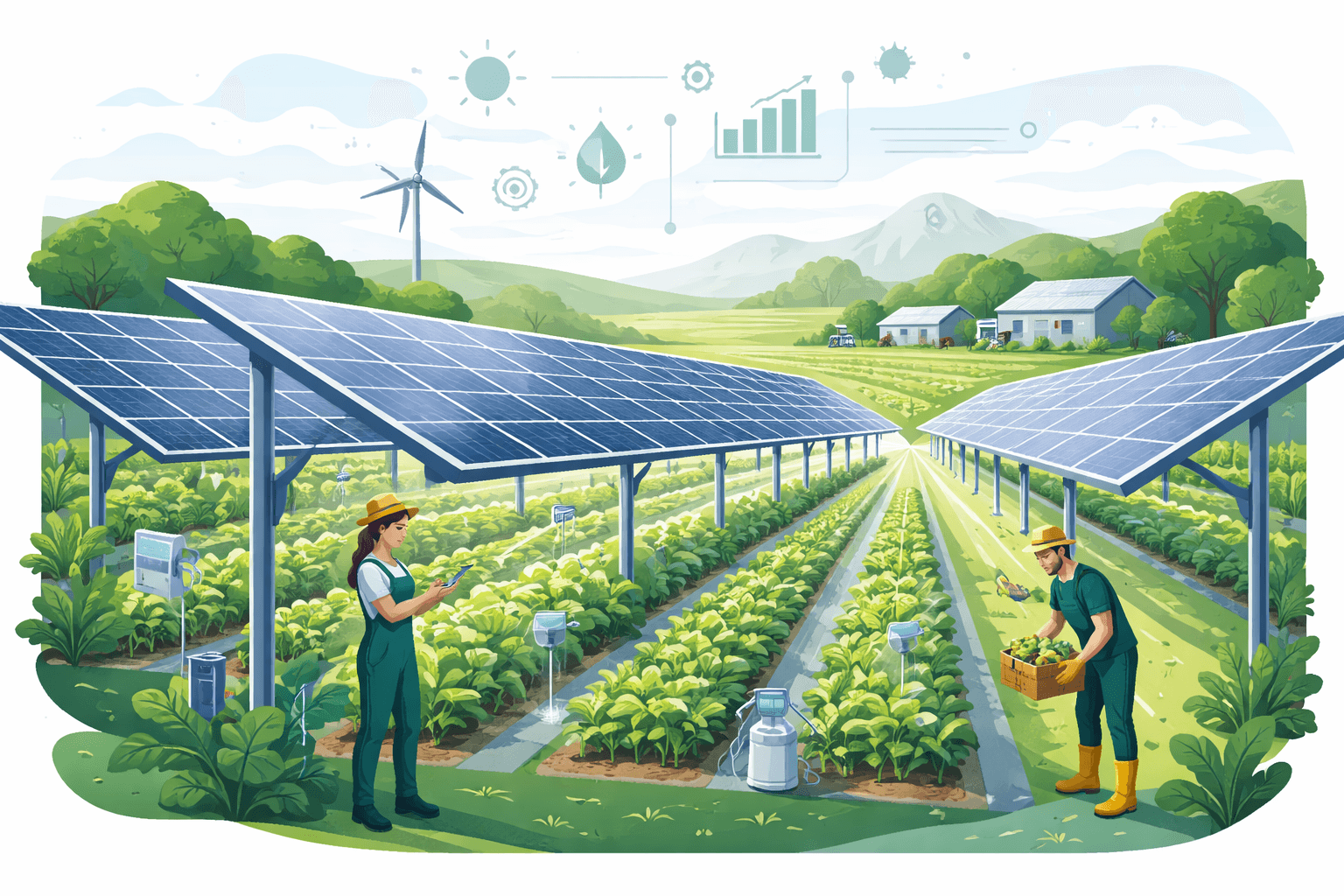
Agrivoltaics solar farming is moving from pilot plots to policy playbook. Field trials in Europe and the United States report land-equivalent ratios (LER) of 1.2–1.7—meaning the same acre can produce 20–70% more combined food and electricity than if farming and solar were done separately (Fraunhofer ISE; INRAE/Dupraz et al.). In hot, arid conditions, a 2019 Nature Sustainability study from the University of Arizona found shaded plots under PV produced twice the cherry tomato yield and used far less water thanks to cooler air and higher humidity. As grids decarbonize and farms face heat and water stress, agrivoltaics offers a data-backed way to co-locate clean power and productive agriculture.
What is agrivoltaics solar farming?
Agrivoltaics (also called dual-use solar or agro-PV) is the intentional design of photovoltaic (PV) systems so that agricultural production—crops, pasture, or livestock—continues on the same land. Unlike conventional solar farms that exclude tractors or animals, agrivoltaic arrays raise or space panels to allow light, equipment access, and managed shade.
Agrivoltaics: A Sustainable Integration of Solar Energy and Agriculture: Saturno, Giuseppe
The book covers a wide range of topics, including the fundamentals of solar energy, cultivation techniques compatible with Agrivoltaics, design and installation of Agrivoltaic systems, technical and r
Check Price on AmazonThe goal is not just to “fit PV on a farm,” but to optimize the combined output. Land-equivalent ratio (LER) quantifies this: LER = (crop yield under PV / crop yield without PV) + (electricity under PV / electricity on a standalone solar site). Values above 1.0 indicate a net land-use efficiency gain. Trials in Germany (Fraunhofer ISE’s Heggelbach site) and France have repeatedly measured LER between 1.2 and 1.6 with properly designed spacing and crop selection.
For readers new to PV hardware, see our overview of modules, inverters, bifacial technology, and trackers: Solar Panel Technology in 2026: A Complete Guide to Modern Photovoltaics.
Why co-locate? Benefits and tradeoffs
Agrivoltaics works when the microclimate under panels helps plants or livestock—and when the farm layout still yields enough electricity to pencil economically. Here’s what peer-reviewed studies and national labs report.
Crop performance and microclimate
- Heat and drought mitigation: The University of Arizona’s agrivoltaics trials reported lower daytime temperatures, higher relative humidity, and substantially improved water-use efficiency under panels, with cherry tomato yields roughly doubling and peppers performing better than in full sun (Nature Sustainability, 2019; Barron-Gafford et al.).
- Temperate row crops: At Fraunhofer ISE’s Heggelbach site, winter wheat, potatoes, celery, and clover grass grown under 5-meter-high PV had modest yield reductions (typically 5–19%), but electricity from the same land boosted LER to ~1.6—more total output per acre than separate farming and solar (Fraunhofer ISE field reports).
- Specialty crops: European vineyard pilots (Sun’Agri/INRAE) show dynamic shading can reduce heat stress, limit sunburn on grapes, and delay ripening during heatwaves, improving quality in warming climates.
Tradeoff: Shade-sensitive crops (e.g., corn in high latitudes) may underperform if shading is too dense or poorly timed. Designing for appropriate “shade fractions” (often 15–40%) and using adjustable trackers improves outcomes.
Livestock use and O&M savings
- Sheep are the workhorse: Dozens of utility-scale sites in the U.S. and U.K. use sheep to control vegetation, reducing mowing and herbicide costs. Operations and maintenance (O&M) savings of 30–50% compared with mechanical mowing are reported by grazing contractors and developers aggregated by the American Solar Grazing Association.
- Animal welfare: Shaded areas lower heat stress; on hot days, measured surface temperatures under arrays can be several degrees Celsius cooler than open pasture (NREL InSPIRE program observations). Goats can damage wiring or racking; cattle typically require higher clearances and reinforced posts.
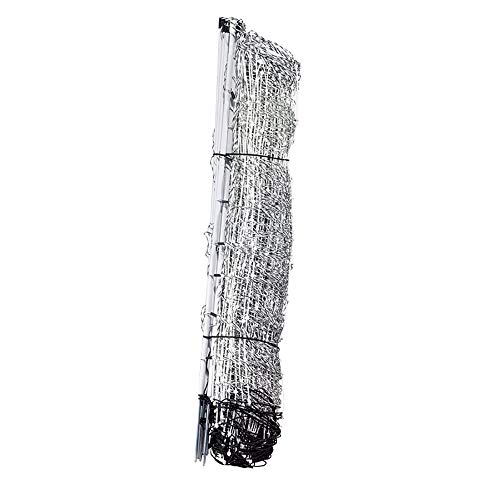
Premier 1 ElectroNet® 35"H x 164'L Portable Electric Fence with Built-in Single Spike Posts | White/Black Fence for Sheep & Goats : Patio, Lawn & Garden
View on AmazonTradeoff: Fencing, water, and handling infrastructure must be adapted. Stocking rates are usually lower than on open pasture due to row spacing and access lanes.
Water savings and soil health
- Evapotranspiration: Across NREL’s InSPIRE sites, soil moisture under and just north of panel rows is often higher, and evapotranspiration lower, than in full sun. In drylands, that translates to irrigation savings and greater drought resilience.
- Erosion and biodiversity: Vegetative groundcovers (including pollinator mixes) stabilize soils, reduce dust deposition on modules, and support beneficial insects—improving integrated pest management.
Tradeoff: Inter-row areas can become hydrologically uneven. Designers should manage runoff from panel drip edges to avoid rill erosion and to spread precipitation more uniformly.
Land-use efficiency
- Stacking outputs: With LER commonly >1, agrivoltaics can produce more combined food and energy per acre. A 2021 Oregon State University analysis estimated that deploying agrivoltaics on a small fraction of suitable agricultural land could meet a significant share of U.S. electricity demand while maintaining agricultural activity.
Tradeoff: Because rows are spaced wider for light and equipment, nameplate solar capacity per acre is typically 30–60% of conventional solar farms. The farm gains food + power, but pure electricity yield per acre declines.
Farm operations and economics
- Revenue diversification: Power sales (or lease payments), plus continued crop/livestock revenue, spread risk across weather and commodity cycles.
- Labor and logistics: Row spacing must fit equipment. Many farms need 12–15 feet (3.7–4.6 m) of clearance for tractors or harvesters; turning radii and headlands require careful layout.
Tradeoff: Elevated racking and longer piles increase capital cost—often by 10–20% versus standard ground-mount PV—while interconnection and permitting add time. Financing can be harder without long-term agronomic data for the specific crop.
Types of agrivoltaic systems
Agrivoltaics is not a single design. The right choice depends on crop physiology, equipment, climate, and grid interconnection.
Raised fixed-tilt arrays (2.5–5 m clearance)
- Structure: Rows of tilted modules with the lower edge 2.5–3.5 m above ground to clear tractors or allow sheep movement; higher (4–5 m) for combines or cattle.
- Spacing: Wider inter-row spacing (6–12 m) to deliver partial sunlight and equipment lanes.
- Best for: Cool-season vegetables, berries, leafy greens, pasture grasses, alfalfa, and sheep grazing. In temperate zones, shade fractions of 15–30% are common targets.
Elevated single-axis trackers (north–south)
- Structure: Trackers mounted higher than typical (2.8–3.5 m lower edge) to allow passage, with backtracking logic adjusted to balance shade and yield.
- Energy profile: Higher capacity factor than fixed-tilt; trackers can also be stowed to provide maximum shade during heat or hail events.
- Best for: Row crops with moderate shade tolerance; regions where dynamic shade benefits crops during midday heat.
Vertical bifacial “fence” arrays
- Structure: Bifacial modules mounted vertically in north–south lines like trellises.
- Benefits: Minimal interference with farm machinery, good winter generation in snowy latitudes due to low sun angles, and even light distribution across rows.
- Tradeoffs: Lower total energy per module than optimally tilted arrays; higher wind loads demand robust foundations.
Overhead/trellis and greenhouse PV
- Overhead agro-PV: Semi-transparent or spaced modules mounted like orchard nets above vines or high-value specialty crops; some systems use automated louver-like panels to modulate light.
- Greenhouse PV: Semi-transparent thin-film or micro-perforated modules in greenhouse roofs to harvest electricity while transmitting crop-usable spectra. Research shows certain transmittance patterns can preserve yields for lettuce and tomatoes while offsetting greenhouse electricity.
Planning and implementation: from site to harvest
Designing a successful agrivoltaic project means treating the PV, the crop or herd, and the farm workflow as one system.
Site selection and agronomy
- Soils and slope: Prefer well-drained soils and slopes under ~10%. Avoid compacting prime soils; use low-pressure tires and defined service lanes.
- Crop–shade matching: Start with shade-tolerant or heat-sensitive species (leafy greens, brassicas, berries, pasture grasses). In arid climates, peppers and tomatoes have shown strong responses to partial shade; in cooler climates, cereals may accept only limited shading.
- Trial plots: Establish 1–2 seasons of side-by-side trials to calibrate shade fractions and irrigation before scaling across fields.
Layout, spacing, and equipment access
- Headlands and turning: Maintain adequate headlands at array edges; map turning radii for each machine.
- Clearance: Set minimum lower-edge heights for the tallest equipment; reinforce posts where livestock rub or where traffic is frequent.
- Ground cover: Choose low-growing species compatible with shading and traffic; avoid species that attract rodents near wiring.
Irrigation and water management
- Distribution: Drip irrigation aligns well with row crops under PV; for overhead systems, ensure sprinklers clear modules or use low-trajectory nozzles.
- Runoff control: Install shallow swales or level spreaders along panel drip lines to distribute water and prevent erosion. Consider guttering on overhead systems.
- Monitoring: Soil moisture sensors under, between, and outside rows help fine-tune irrigation; expect different zones.
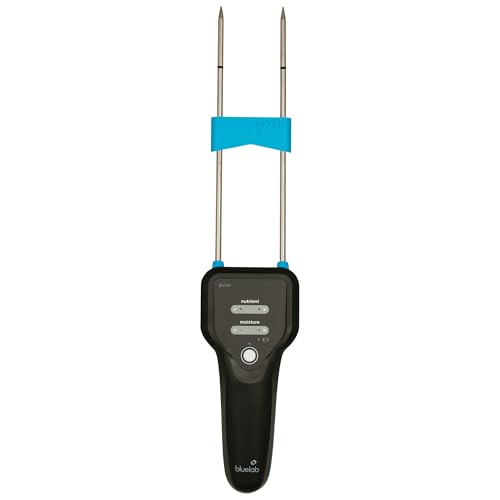
Bluelab Pulse Meter - Handheld Digital Soil Meter Measures Nutrients (TDS), Moisture & Temperature directly from the Root Zone - Grow Healthier Plants with Fast, Accurate Measurements - Amazon.com
View on AmazonElectrical and safety
- Conduit and wiring: Elevate or bury wiring to avoid livestock contact and damage from implements. Use armored cable or conduit in traffic areas.
- Interconnection: Start utility studies early. Agrivoltaics does not change grid constraints—transformer capacity and feeder limits still govern.
- Operations: Train farm staff on shutdown and lock-out procedures; coordinate seasonal access windows for O&M.
Energy yield and economics
- Capacity density: Expect fewer watts per acre (often 0.3–0.7 MWac per 5–7 acres versus ~1 MWac for conventional layouts), depending on spacing and height.
- Costs: Elevated structures and deeper foundations increase capex. However, stacked revenues (power + crops/livestock), O&M savings from grazing, and policy incentives can balance the ledger.
- Financing: Insurers and lenders may ask for agronomic data; partnerships with universities or extension services can de-risk first-of-kind plantings.
For help interpreting capacity factor, irradiance, and other PV performance metrics you’ll encounter in feasibility studies, see our Solar Energy Comparison Charts: Key Metrics, Data Sources & How to Read Them.
Permitting and policy
- Zoning: Some jurisdictions classify agrivoltaics as continued agricultural use; others treat it as energy infrastructure. Early engagement with planning boards is critical.
- Dual-use standards: Massachusetts’ SMART program specifies design criteria (minimum clearances, row spacing, and crop productivity reporting) and provides incentive adders for certified “dual-use” arrays. New York and other states are drafting guidance to standardize best practices.
- Farmland preservation: Demonstrating maintained or improved agricultural viability is often key to siting on protected soils.
End-of-life planning
- Durability: Elevated and livestock-exposed sites may require tougher backsheets, frames, and cable management.
- Recycling plan: Panel recycling infrastructure is scaling in the U.S. and EU. Designing with common module formats and accessible fasteners eases decommissioning. Learn more: What Happens to Solar Panels at End of Life? Recycling, Reuse & Disposal.
By the numbers
- 1.2–1.7: Typical land-equivalent ratio (LER) reported by European field trials with optimized spacing (Fraunhofer ISE; INRAE).
- 2×: Cherry tomato yield under PV shade in Arizona dryland trials, with markedly higher water-use efficiency (Nature Sustainability, 2019).
- 30–50%: O&M vegetation management savings when replacing mowing with managed sheep grazing at solar sites (industry surveys; ASGA case studies).
- 10–20%: Typical capex premium for elevated, wider-spaced agrivoltaic structures relative to standard ground-mount PV (developer estimates; NREL InSPIRE synthesis).
- 30–60%: Reduction in solar nameplate capacity per acre compared with conventional utility PV due to wider row spacing and equipment lanes.
Real-world use cases: where agrivoltaics works best
- Temperate mixed farms (Europe): Fraunhofer ISE’s Heggelbach agro-PV demonstrated multi-year stability growing wheat, potatoes, celery, and clover under 5 m arrays, with modest yield changes offset by electricity and total LER ~1.6. Sheep grazing maintained vegetation and reduced O&M.
- Vineyards (France, Italy, Spain): Dynamic shade from overhead modules reduced sunburn and water demand, particularly valuable during heatwaves. Winemakers report improved phenolic profiles when heat stress is moderated (INRAE/Sun’Agri pilots).
- Dryland vegetables (U.S. Southwest): University of Arizona trials found that partial shade decreased plant water stress, increasing yields of tomatoes and peppers while cutting irrigation needs—aligning with projections of hotter, drier summers.
- Pasture and pollinators (U.S. Midwest/Northeast): Solar pastures with native flowering mixes increase pollinator abundance—a service for nearby orchards and row crops—and support rotational sheep grazing.
- Berry and specialty crops (Pacific Northwest): Partial shade reduces sunscald on blueberries and protects blossoms from late frosts and hail when arrays are stowed overhead; research and commercial pilots are ongoing with universities and growers.
Challenges to solve
- Agronomy at scale: Results are crop- and climate-specific. Shade that helps in Arizona may hinder in Maine. More multi-year, replicated trials are needed across latitudes and soils.
- Standardized designs: Racking and trackers optimized for agrivoltaics (high-clearance, modular bays, livestock-safe wiring) are emerging but not yet commodity-priced everywhere.
- Financing and insurance: Dual-use yields introduce new risks for lenders and insurers; standardized performance data and contract templates will lower costs.
- Interconnection and grid constraints: As with all utility PV, queues and upgrades—not land—often cap deployment speed.
- Workforce: Coordinating solar O&M and farm operations requires new training and communication protocols.
Practical implications for farmers, developers, and policymakers
- Farmers: Start with a pilot plot of shade-tolerant, high-value crops or managed grazing. Map your equipment envelopes first, then design the array around operations—not the other way around. Consider revenue stacking: power sales, grazing contracts, and potential agrivoltaic premiums for specialty crops.
- Developers: Engage agronomists early. Co-develop a cropping plan with the landowner, and budget for higher structures, soil restoration, and water management. Target feeders with available capacity; agrivoltaics won’t solve interconnection limits.
- Policymakers: Incentive adders tied to measurable agricultural activity (crop yields, grazing density, pollinator habitat) help scale good designs while preventing greenwashing. Clear dual-use permitting pathways reduce soft costs.
Where agrivoltaics is heading
Three technology shifts are accelerating adoption:
- Smarter shade with bifacial and dynamic tracking: Higher-clearance single-axis trackers and adjustable louvers let operators tune light for plant phenology—shielding during flowering or heat spikes and opening for ripening.
- Vertical PV and winter generation: In snow-prone regions, vertical bifacial “fences” produce best on clear winter days when demand for heating is high, while leaving wide lanes for machinery.
- Data-driven farming: Canopy sensors, soil moisture probes, and AI-driven irrigation integrate with PV tracker schedules to optimize both kilowatt-hours and kilograms.
On the policy side, dual-use standards (like Massachusetts’ SMART) and agrivoltaic research consortia (NREL’s InSPIRE, IEA PVPS Task groups, EU-funded pilots) are building a shared evidence base. If ongoing multi-year trials keep returning LER above 1 and water savings in heat-stressed regions, agrivoltaics solar farming will move from niche to norm for certain crops and climates. The payoff is tangible: more resilient harvests, new farm income, and low-carbon electricity from the same ground.
Recommended Products
Agrivoltaics: A Sustainable Integration of Solar Energy and Agriculture: Saturno, Giuseppe
The book covers a wide range of topics, including the fundamentals of solar energy, cultivation techniques compatible with Agrivoltaics, design and installation of Agrivoltaic systems, technical and r
Bluelab Pulse Meter - Handheld Digital Soil Meter Measures Nutrients (TDS), Moisture & Temperature directly from the Root Zone - Grow Healthier Plants with Fast, Accurate Measurements - Amazon.com
Other features: Adjustable depth guage, vibrating notification when your device receives data from Pulse Meter; Combine with pH pen, EC meters, and other digital hydroponics tools for full indoor gard
Premier 1 ElectroNet® 35"H x 164'L Portable Electric Fence with Built-in Single Spike Posts | White/Black Fence for Sheep & Goats : Patio, Lawn & Garden
Starkline 35" x 164' Premium Electric Sheep & Goat Netting w/Double Spike Fiberglass Posts (9/35/8) Pre-Assembled Electric Fence for Backyards, Homesteaders, Farms and Ranches · Electric