
Solar in Pennsylvania: Costs, Incentives & Top Installers (2026)
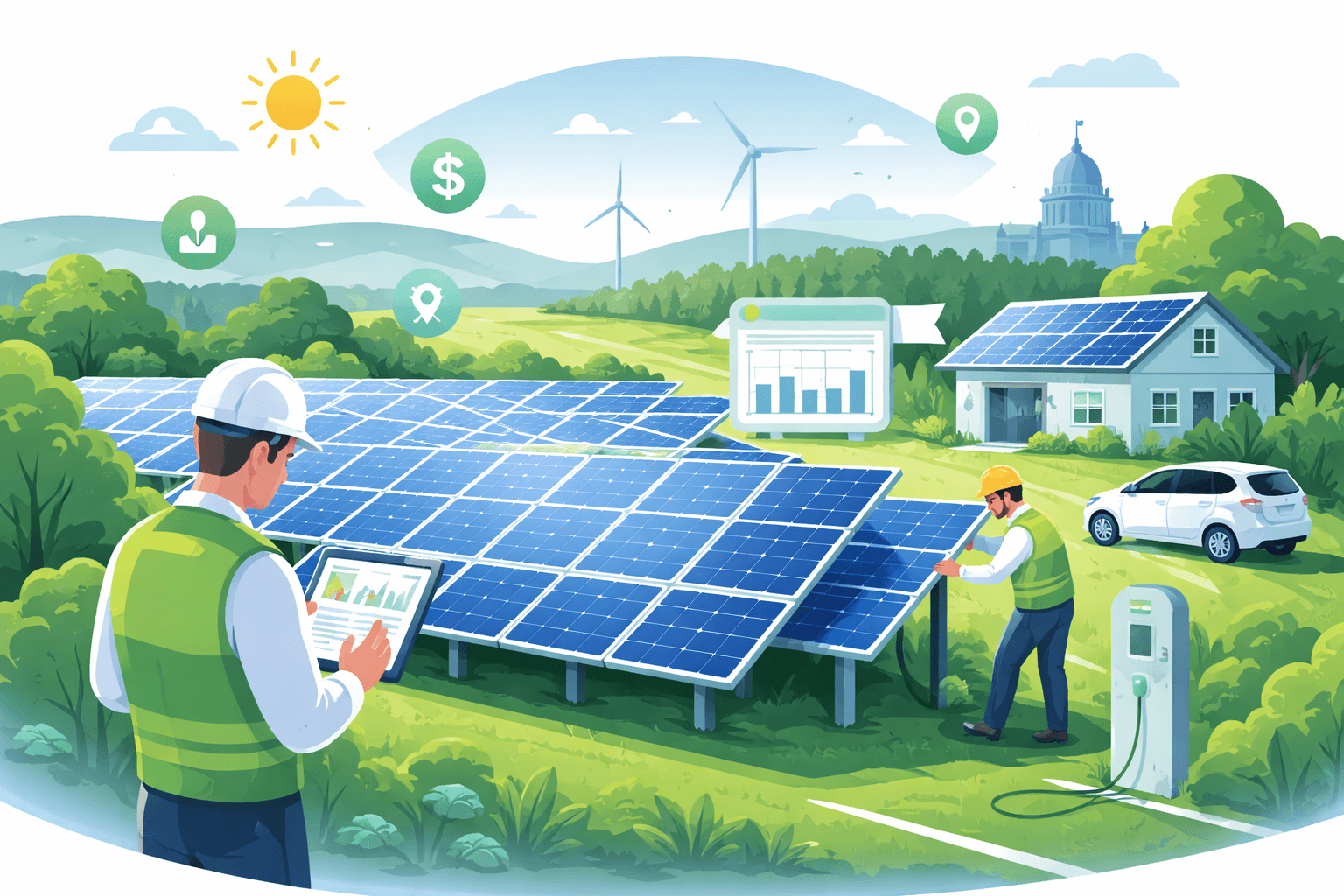
Pennsylvania homeowners are taking a fresh look at solar in Pennsylvania as retail electricity prices hover around 15–17¢/kWh (EIA 2024) while residential solar costs have fallen more than 60% since 2010 (NREL). With statewide net metering and a tradable SREC market, the Keystone State can deliver 7–11 year paybacks for well-sited rooftops—especially in PECO, PPL, and FirstEnergy utility territories.
This 2026 guide covers Pennsylvania’s solar resource, costs, incentives (including SRECs), installers, ROI, and the steps to connect your system to the grid.
By the Numbers: Pennsylvania Solar Snapshot (2026)
- Peak sun hours (average): ~4.0–4.6 per day depending on location (NREL PVWatts)
- Typical residential capacity factor: 15–19% for fixed-tilt systems (NREL)
- Installed cost (pre-incentive): ~$2.60–$3.20/W for most homes; 7–10 kW common sizes (NREL benchmarks, EnergySage market data 2025)
- 30% federal tax credit (IRA) available through at least 2032; applies to PV and standalone storage ≥3 kWh (U.S. Treasury/IRS)
- Net metering: retail-rate credit with annual cash-out policy details set by each utility (PA PUC)
- SRECs: 1 SREC per 1,000 kWh; tradable value varies by market conditions (PJM GATS/AEPS)
Solar Electricity Handbook - 2023 Edition: A simple, practical guide to solar energy – designing and installing solar photovoltaic systems: Boxwell, Michael
Solar Electricity Handbook - 2023 Edition: <strong>A simple, practical guide to solar energy – designing and installing solar photovoltaic systems</strong> [Boxwell, Michael] on Amazon.com. *FREE* shi
Check Price on AmazonSolar energy potential in Pennsylvania: sun hours, irradiance, and climate factors
Pennsylvania sits in the Mid-Atlantic’s moderate solar resource zone. NREL’s solar resource maps and PVWatts modeling show:
- Philadelphia and the southeast: ~4.4–4.6 peak sun hours (PSH) on an annual average day
- Central Pennsylvania: ~4.2–4.4 PSH
- Pittsburgh and northwest: ~4.0–4.3 PSH
What this means: A well-sited 8 kW array in the Philadelphia area typically produces ~9,000–10,000 kWh/year. In western Pennsylvania, expect ~8,200–9,200 kWh/year. Capacity factor (the percentage of time a system generates at its rated output, averaged over the year) commonly lands around 15–19% for fixed-tilt rooftop systems.
Climate notes:
- Snow: Most winters, snow-related production losses are modest (often 1–5% annually) because sunny days and panel heat shed snow quickly. Tilted mounts help.
- Temperature: PV efficiency declines slightly as temperatures rise, but Pennsylvania’s moderate summers mean manageable thermal losses.
- Shading and trees: Mature tree canopies are common. A site assessment and shade analysis (e.g., with a Solmetric SunEye) can quantify impacts and inform design choices like string layout or microinverters.
Average cost of solar panels in Pennsylvania and price-per-watt breakdown
Residential solar pricing in Pennsylvania generally ranges from $2.60 to $3.20 per watt (W) before incentives as of 2026. For common system sizes:
- 6 kW: $15,600–$19,200
- 8 kW: $20,800–$25,600
- 10 kW: $26,000–$32,000

Enphase IQ8M Microinverter for 260-460 Watt Solar Panels - Works with Grid Tied and Off Grid Solar PV Systems - Compatible with Batteries - IQ8M-72-2-US 240V - UL Listed for Safety : Patio, Lawn & Garden
View on AmazonAfter the 30% federal tax credit, net effective costs look like:
- 6 kW: ~$10,920–$13,440
- 8 kW: ~$14,560–$17,920
- 10 kW: ~$18,200–$22,400
These figures reflect all-in turnkey pricing (equipment + labor + permitting/interconnection). NREL’s most recent residential cost benchmarks and EnergySage marketplace data for the Mid-Atlantic align with these ranges, though actual quotes vary by roof complexity, equipment brand, and installer capacity.
Price-per-watt drivers:
- Equipment mix: Premium modules (e.g., 400–430 W, N-type TOPCon/heterojunction), microinverters, or DC optimizers cost more but can improve energy yield on shaded roofs.
- Roof complexity: Steep pitch, multiple planes, and structural upgrades add labor.
- Electrical work: Service panel upgrades (to 200A) or long conduit runs increase balance-of-system costs.
- Soft costs: Permitting, engineering, and interconnection fees differ by jurisdiction and utility.
Equipment value picks for Pennsylvania’s mixed shading and seasonal climate:
- High-efficiency, shade-tolerant modules (REC Alpha Pure, Qcells Q.TRON) paired with microinverters like Enphase IQ8 can maximize production on complex roofs. Based on their efficiency ratings and field reliability, the REC Alpha Pure and Enphase IQ8 Microinverters represent strong value for residential installations.
Pennsylvania solar incentives: state tax credits, rebates, net metering, and SRECs
Pennsylvania’s state-level incentives focus on market-based credits and consumer protections rather than an income tax credit.
State tax credits and sales/property tax treatment:
- No broad state personal income tax credit for residential solar.
- Sales and property tax exemptions are not statewide for residential PV. Some local jurisdictions offer property tax abatements or assessment guidance—check your county assessor. DSIRE (the Database of State Incentives for Renewables & Efficiency) maintains the most current list of local programs.
Net metering (PA PUC rules):
- Residential systems up to 50 kW are eligible.
- Excess generation offsets consumption at the retail rate and carries forward monthly.
- At a utility’s annual “true-up,” remaining credits are typically cashed out at a supply rate (often the utility’s Price-to-Compare or a similar avoided-cost proxy). Policy details vary slightly by electric distribution company (EDC), so review PECO, PPL, Duquesne Light, or FirstEnergy’s Pennsylvania utilities’ tariffs.
SRECs (Solar Renewable Energy Credits):
- 1 SREC = 1 MWh (1,000 kWh) of PV generation.
- Homeowners can sell SRECs minted via PJM GATS through aggregators or brokers (who may charge ~5–10% fees). Prices are market-based and fluctuate depending on Pennsylvania’s Alternative Energy Portfolio Standards (AEPS) demand and supply. Historically, Pennsylvania SRECs have ranged from the low tens to the mid double-digits per MWh; always check current quotes before you model ROI.
- SRECs are taxable income. Keep production and sale records for tax reporting.
Local and utility rebates:
- Pennsylvania doesn’t have a major statewide rebate program for residential PV at this time. Select municipal utilities or local initiatives may offer limited incentives; verify with your city or EDC and DSIRE.
Note on community solar: As of late 2025, Pennsylvania lacked a fully enabled statewide community solar program; legislation has been proposed multiple times. If that changes, renters and shaded-roof homeowners could subscribe to offsite solar and receive bill credits.
Federal ITC and how it applies to Pennsylvania homeowners
The federal Residential Clean Energy Credit (often called the ITC) provides a 30% tax credit for eligible costs of residential solar and battery storage installed through at least 2032 (Inflation Reduction Act/IRS guidance).

EF ECOFLOW Smart Home Panel 2, the Center of the Whole
Alternatively connect <strong>3 x EcoFlow DELTA Pro 3 units with 6 x Extra Batteries for energy storage up to 36kWh</strong>. It's not just for longer backup but lets you to control and run every
Check Price on AmazonKey points for Pennsylvania homeowners:
- What qualifies: Panels, inverters, racking, balance-of-system hardware, labor, permitting, and electrical work necessary for installation. Standalone batteries ≥3 kWh also qualify.
- Transferability: It is a nonrefundable credit—unused portions can roll forward to future tax years but you must have sufficient federal income tax liability to claim it.
- Timing: The credit applies in the tax year the system is placed in service (permission to operate from the utility), not the contract date.
- Bonus credits: Residential projects do not receive the commercial bonus “adders” (e.g., for domestic content or energy communities). Those apply to business ITC/PTC claims.
Storage economics: Pennsylvania’s winter peak usage and occasional outages make storage appealing for resilience. Coupling a battery with your PV may not speed payback unless your utility offers time-of-use rates or you place a high value on backup power. The 30% credit on storage improves the value equation. Popular options like the Tesla Powerwall 3 or SolarEdge Home Battery integrate well with most PA utilities’ interconnection rules.
Best solar installers and companies serving Pennsylvania
Pennsylvania has a strong bench of regional and national installers. Always compare multiple quotes, check NABCEP-certified staff, and read interconnection experience with your specific utility.
Reputable providers operating across the state (selection, no particular order):
- PECO/PPL/FirstEnergy territories: Exact Solar (PA/NJ), Paradise Energy Solutions (Lancaster-based), Lumina Solar (Mid-Atlantic), Green Power Energy, Trinity Solar, Momentum Solar, SunPower-authorized dealers, Tesla (in-house or third-party crews), Sunrun, Trinity/ADT Solar (market coverage varies), Vision Solar, and local independents.
- Western PA/Pittsburgh focus: EIS Solar, True Home Solar (coverage varies), Valley Energy Solar, and national brands with Pittsburgh crews.
How to choose in Pennsylvania:
- Verify interconnection track record with your EDC (PECO, PPL, Duquesne Light, Met-Ed, Penelec, Penn Power, West Penn Power).
- Ask for PVWatts or HelioScope production models using your roof pitch, azimuth, and shading.
- Require equipment spec sheets and warranties (module product warranty 12–25 years; performance 25–30 years; inverter 10–25 years; workmanship 10+ years).
- Confirm SREC registration service, net metering paperwork, and monitoring platform are included.
If you’re comparing incentives and pricing just over the border, see our neighboring state guides: Solar in New Jersey: Costs, Incentives & Top Installers (2026), Solar in Maryland: Costs, Incentives & Top Installers (2026), and Solar in Ohio: Costs, Incentives & Top Installers (2026).
ROI and payback period for solar in Pennsylvania
Payback depends on installed cost, production, retail rates, SREC revenue, and whether you add storage. Let’s model two typical cases for an 8 kW system.
Assumptions (illustrative; use your quotes and utility tariff):
- Installed cost: $24,000 pre-ITC ($3.00/W); net $16,800 after 30% ITC
- Production: 9,400 kWh/year (SE Pennsylvania roof with good orientation)
- Retail electricity value: 16¢/kWh blended (supply + delivery)
- SRECs: $30/MWh average over time (highly variable; excludes aggregator fee)
Case A: PV without SRECs
- Annual bill savings: 9,400 kWh × $0.16 = $1,504
- Simple payback: $16,800 / $1,504 ≈ 11.2 years
Case B: PV with SRECs
- SREC income: 9.4 MWh × $30 = $282/year (pre-tax)
- Total annual value: $1,504 + $282 = $1,786
- Simple payback: $16,800 / $1,786 ≈ 9.4 years
Western PA example (Pittsburgh) with ~8,600 kWh/year and same pricing yields a ~10.3–12.2 year range, depending on SRECs. If your installed price lands at $2.70/W or you have higher retail rates (e.g., on a time-of-use plan), payback shortens.
Long-term performance factors:
- Degradation: Modern modules lose ~0.25–0.5% capacity per year (manufacturer warrantied), leaving ~84–92% output after 25 years.
- O&M: Inverter replacement may occur once in 12–20 years unless you choose microinverters/long-warranty string inverters. Budget a few hundred dollars annually over the life of the system for monitoring, potential repairs, or insurance differentials.
- Escalation: If grid rates rise ~2–3%/year, avoided-cost savings compound and shorten payback.
Pennsylvania-specific permitting, HOA rules, and interconnection process
Permitting
- Most municipalities require an electrical permit and sometimes structural review. Your installer typically provides stamped drawings and load calcs if needed.
- Expect plan review timelines of 2–6 weeks in many jurisdictions; some are faster.
HOA rules and solar access
- Pennsylvania enables solar easements (legal agreements to protect access to sunlight), but the state does not have a broad “solar rights” statute that universally prevents HOAs from restricting installations. Many HOAs allow solar with placement guidelines (roof-facing streets, flush-mount requirements). Always review your Covenants, Conditions & Restrictions (CC&Rs) and obtain Architectural Review Committee approval early.
Interconnection and net metering steps (PA PUC standards; utility-specific portals vary)
- Application: Your installer submits an interconnection and net metering application with single-line diagrams, spec sheets, and site plan to your EDC (PECO, PPL, Duquesne Light, or FirstEnergy utilities).
- Technical review: Most residential projects qualify for “Level 1” (inverter-based, small systems). Utilities evaluate for safety and grid impacts.
- Installation and inspection: After permit approval, the system is installed and inspected by the local AHJ (Authority Having Jurisdiction).
- Meter swap and Permission to Operate (PTO): Utility installs a bi-directional net meter and issues PTO. Timeline from submission to PTO is commonly 4–10 weeks but varies by utility workload and season.
- SREC registration: Your installer or aggregator registers the system with PJM GATS to mint SRECs from your production data (often via your inverter’s monitoring platform or a revenue-grade meter).
Practical tips:
- Reserve utility interconnection slots early in peak season (spring/summer) to avoid delays.
- Confirm your main service panel ampacity; many homes benefit from a 200A upgrade to accommodate PV and future EV charging.
- If roof replacement is due within 5–8 years, consider reroofing before PV to avoid future de-install/reinstall costs.
FAQ: common questions about going solar in Pennsylvania
How good is solar in Pennsylvania compared with neighboring states?
- Pennsylvania’s solar resource is similar to New Jersey and Maryland, with slightly lower irradiance than the Mid-Atlantic coastal plain but higher than much of the Northeast. Policy levers differ—New Jersey and Maryland have robust state incentives—so compare total economics across borders: New Jersey and Maryland.
Will net metering change?
- The PA PUC occasionally updates interconnection and net metering rules. Any major changes typically involve public comment periods. Existing systems are often grandfathered under prior rules, but this is not guaranteed—monitor your utility’s filings and PUC dockets.
What happens to excess credits?
- Monthly excess rolls forward. At the annual true-up, utilities usually purchase any remaining net excess generation at a supply or avoided-cost rate defined in their tariff. Check your EDC’s net metering rider for specifics.
Do batteries qualify for the 30% credit without solar?
- Yes. Under the IRA, standalone batteries ≥3 kWh installed at your residence qualify for the 30% Residential Clean Energy Credit, even without new PV.
Can I still go solar if my roof is shaded?
- Possibly. Production will drop with shade, but microinverters or DC optimizers, higher-efficiency modules, and creative array placement can recover meaningful output. A site survey will quantify the tradeoffs. In heavy shade, community solar (if authorized) or a ground mount may be better.
Are there state rebates for low-to-moderate income households?
- Pennsylvania’s largest supports are net metering and SRECs. Some local programs and utility-administered energy efficiency funds may help with weatherization or electrification, which can improve solar ROI by reducing overall load. Check DSIRE and your county energy office.
What maintenance do panels need?
- Minimal. Rain handles most cleaning. In pollen-heavy springs, a gentle rinse can help. Avoid walking on modules. Monitor system output; a sudden drop may indicate a tripped breaker, failed inverter, or shading change.
Can a heat pump plus solar make sense in PA?
- Yes. Cold-climate heat pumps now achieve seasonal COPs >2 in Pennsylvania’s climate. Pairing them with rooftop PV can stabilize heating costs and cut emissions, especially if you also electrify water heating and EV charging.
Practical next steps for Pennsylvania homeowners
- Get three quotes using the same system size and module/inverter class to compare apples-to-apples.
- Ask each installer for: (1) PVWatts or equivalent production model, (2) shading analysis results, (3) line-item costs, (4) interconnection timeline, (5) SREC and net metering administration.
- Evaluate premium vs. value equipment. In shaded or complex roofs, Enphase microinverters and high-efficiency modules like Qcells Q.TRON often justify their cost through higher yield and stronger warranties.
- Consider adding a battery if you value backup power; layer in the 30% credit and discuss time-of-use rates with your utility.
Where solar in Pennsylvania is heading
- Gradual policy refinement: Expect continued PUC docket activity on interconnection, smart inverter standards (IEEE 1547-2018 functions), and potentially community solar authorization if the legislature advances a bill.
- Domestic manufacturing tailwinds: U.S.-made modules and inverters are increasingly available, potentially improving lead times and serviceability for PA projects.
- Grid services: As more inverters enable volt/VAR and frequency ride-through, distributed PV and batteries will support local grid resilience—especially relevant in PECO and PPL’s dense distribution networks.
Pennsylvania may not boast desert-level sunshine, but with retail-rate net metering, tradable SRECs, and 30% federal support, the economics of solar in Pennsylvania are competitive—particularly for south-facing roofs with limited shade. A careful design and a seasoned installer can turn your roof into a long-lived asset that hedges energy inflation and cuts carbon for decades.
Recommended Products
Solar Electricity Handbook - 2023 Edition: A simple, practical guide to solar energy – designing and installing solar photovoltaic systems: Boxwell, Michael
Solar Electricity Handbook - 2023 Edition: <strong>A simple, practical guide to solar energy – designing and installing solar photovoltaic systems</strong> [Boxwell, Michael] on Amazon.com. *FREE* shi
Enphase IQ8M Microinverter for 260-460 Watt Solar Panels - Works with Grid Tied and Off Grid Solar PV Systems - Compatible with Batteries - IQ8M-72-2-US 240V - UL Listed for Safety : Patio, Lawn & Garden
Amazon.com: Enphase IQ8M Microinverter for 260-460 Watt Solar Panels - Works with Grid Tied and Off Grid Solar PV Systems - Compatible with Batteries - IQ8M-72-2-US 240V - UL Listed for Safety : Patio
EF ECOFLOW Smart Home Panel 2, the Center of the Whole
Alternatively connect <strong>3 x EcoFlow DELTA Pro 3 units with 6 x Extra Batteries for energy storage up to 36kWh</strong>. It's not just for longer backup but lets you to control and run every