
Solar in New Jersey: Costs, Incentives & Top Installers (2026)
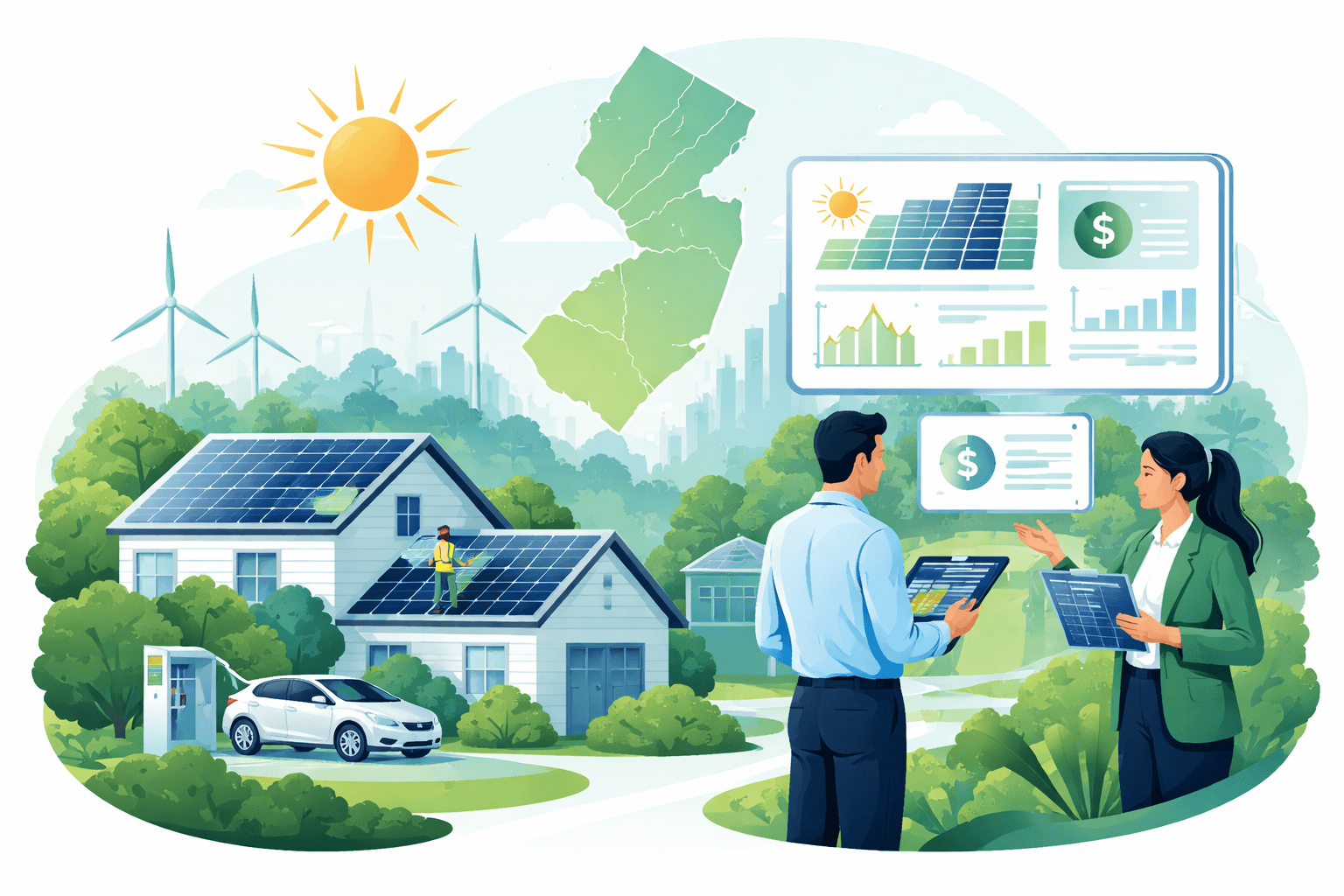
New Jersey punches above its weight in solar. By late 2024, the state had more than 4.5 GW of installed solar capacity, supplying roughly 7–9% of in‑state electricity on an annual basis (SEIA; EIA). With average peak sun hours around 4.2–4.6 and strong policies, solar in New Jersey remains one of the most compelling clean‑energy investments for homeowners in 2026.
This guide breaks down New Jersey’s solar resource, system costs, incentives (including SREC‑II/ADI), top installers, permitting, and real‑world payback.
By the numbers: New Jersey solar
- Installed capacity: ~4.5–5.0 GW statewide (SEIA, 2024)
- Typical residential system size: 6–9 kWdc
- Production: ~1,150–1,300 kWh per kWdc per year (NREL PVWatts)
- Average retail electricity price: ~19–20¢/kWh (EIA, 2024)
- Residential installed price: ~$2.75–$3.75/Wdc before incentives (LBNL; marketplace quotes)
- Federal tax credit: 30% of system cost (IRA, through 2032)
- NJ Successor Solar Incentive (SREC‑II/ADI): ~$85–$110 per MWh for 15 years depending on project category (NJBPU)
Solar Electricity Handbook - 2023 Edition: A simple, practical guide to solar energy – designing and installing solar photovoltaic systems: Boxwell, Michael
Solar Electricity Handbook - 2023 Edition: <strong>A simple, practical guide to solar energy – designing and installing solar photovoltaic systems</strong> [Boxwell, Michael] on Amazon.com. *FREE* shi
Check Price on AmazonSolar energy potential in New Jersey: sun hours, irradiance, and climate factors
Despite its latitude, New Jersey’s solar resource is robust. NREL’s PVWatts tool estimates fixed‑tilt, south‑facing arrays in Newark or New Brunswick generate roughly 1,180–1,260 kWh per kWdc annually; coastal sites like Atlantic City are often at the higher end due to clearer skies and strong irradiance. That translates to 8,000–9,000 kWh per year from a 7 kWdc system—close to the median household’s annual usage.
- Peak sun hours: Around 4.2–4.6 (average daily solar irradiance in kWh/m²/day)
- Seasonal swing: Winter yields about half the daily energy of summer due to lower sun angles and shorter days. Spring and fall often deliver high production on cool, clear days when panels operate more efficiently.
- Snow and wind: Snow loads are a design factor but rarely a long‑term production issue; most arrays clear quickly under sunlight. New Jersey’s coastal wind zones require attention to racking and anchoring; reputable installers will specify equipment tested to relevant wind uplift ratings.
Why this matters: With production per kW on par with much of the Mid‑Atlantic and retail electricity near 20¢/kWh, each kW of residential solar in New Jersey can offset roughly $220–$260 in annual utility costs before incentives.
Average cost of solar panels in New Jersey and price‑per‑watt breakdown
Installed residential prices in New Jersey generally fall between $2.75 and $3.75 per watt (Wdc) before incentives for standard monocrystalline modules, according to a synthesis of Lawrence Berkeley National Laboratory’s Tracking the Sun data and regional marketplace quotes in 2024–2025. Premium high‑efficiency modules (e.g., heterojunction or interdigitated back contact) and complex roofs can push pricing into the $3.75–$4.50/W range.
Example system budgets (before incentives):
- 6 kWdc: $16,500–$22,500
- 7.5 kWdc: $20,600–$28,100
- 9 kWdc: $24,800–$33,800
What drives price differences:
- Equipment: Modules (35–45% of hardware), inverters (10–15%), racking (5–10%), balance‑of‑system wiring and protection (5–10%).
- Soft costs: Labor, design/engineering, permitting, interconnection, overhead, and customer acquisition—together often 45–55% of total, per LBNL.
- Site factors: Roof material (asphalt vs. tile/metal), number of roof faces, shading, service panel upgrades, and structural retrofits.
- Premium options: Higher‑efficiency panels, microinverters, smart monitoring, and batteries.
Price‑per‑watt isn’t everything. A 6.8 kWdc system with premium 21–22% efficient panels can match the output of an 8.0 kWdc array with commodity modules while using less roof area. Evaluate $/annual kWh and warranty terms alongside $/W.
Affiliate pick: Based on widespread availability, long warranties, and strong real‑world performance in the Mid‑Atlantic, Qcells high‑efficiency modules (e.g., Q.TRON or Q.PEAK DUO) are a solid value for residential installs. For most homeowners, Qcells Q.TRON panels balance cost and production well.
Solar in New Jersey incentives: state tax credits, rebates, net metering, and SRECs
New Jersey has one of the nation’s most supportive policy stacks. Here’s how the major incentives work.
Sales and property tax exemptions
- Sales tax: Solar energy equipment is exempt from New Jersey’s 6.625% sales tax (N.J.S.A. 54:32B‑8.47), effectively reducing your upfront cost compared with taxable home improvements.
- Property tax: The added value of a residential solar system is excluded from property tax assessments (N.J.S.A. 54:4‑3.113a). You benefit from higher home value without higher property taxes.
Net metering
New Jersey offers robust net metering for residential systems interconnected to utilities like PSE&G, JCP&L, Atlantic City Electric, and Rockland Electric (N.J.A.C. 14:8‑4):
- Credits: Excess generation exports earn retail‑rate bill credits that roll over month to month.
- Annual true‑up: Any remaining net excess at the end of the annualized period is compensated at the utility’s avoided‑cost rate (typically much lower than retail).
- System sizing: Net‑metered systems are generally intended to offset up to 100% of a customer’s annual consumption. Oversizing beyond historical usage may limit eligibility for full retail netting.
Practical tip: Set the annualized period to end just before your highest‑use season (e.g., early summer) to minimize non‑retail cash‑outs.
SRECs under the Successor Solar Incentive (SuSI): ADI (SREC‑II)
New Jersey replaced its legacy SREC market with the Successor Solar Incentive (SuSI) in 2021, which has two tracks:
- ADI (Administratively Determined Incentive): Fixed price per MWh of generation for small net‑metered and community solar projects.
- CSI (Competitive Solar Incentive): For larger, grid‑supply projects.
For residential rooftop systems in the ADI program, the incentive commonly falls around $90 per MWh (i.e., $0.09/kWh) for 15 years, with actual values by project category typically in the ~$85–$110/MWh range as set by the New Jersey Board of Public Utilities (NJBPU). Blocks can fill and values may adjust over time—check the current ADI table before signing a contract.
How it pays: ADI credits (often called SREC‑II) are minted based on your meter‑verified production and purchased at the fixed $/MWh rate, independent of your utility bill. You can receive both net‑metering savings and ADI payments.
Community Solar Energy Program (CSEP)
If your roof isn’t a match, New Jersey’s permanent community solar program lets you subscribe to a local solar project and earn bill credits (with at least 51% of capacity serving low‑ and moderate‑income subscribers). Typical savings range from 10–20% off the portion of your bill covered by credits, depending on project terms (NJBPU program materials).
Federal ITC and how it applies to New Jersey homeowners
The federal Residential Clean Energy Credit (Internal Revenue Code §25D), expanded by the 2022 Inflation Reduction Act, provides a 30% tax credit on qualified solar costs through 2032, stepping down afterward.
Key points for New Jersey households:
- Eligible costs: PV modules, inverters, racking, balance of system, sales tax (not applicable in NJ), labor for on‑site prep and installation, and energy storage installed with solar or as a standalone system.
- Batteries: Standalone residential batteries qualify for the 30% credit starting in tax year 2023, even without PV. Many homeowners pair a 10–15 kWh battery for backup and time‑shifting.
- Tax appetite: The ITC is nonrefundable but can be carried forward if your federal tax liability is lower than the credit in year one.
- No income cap: Unlike some rebates, the ITC has no income phase‑outs for residential.
Affiliate pick: For homeowners prioritizing resilience, the Tesla Powerwall 3 or the Enphase IQ Battery 5P integrate cleanly with New Jersey’s net metering and ADI programs. Coupled with module‑level optimization, they provide seamless backup and detailed monitoring.
Best solar installers and companies serving New Jersey
New Jersey’s mature market includes strong local firms and national brands. Look for installers with NABCEP‑certified staff, clear workmanship warranties (10+ years), robust production guarantees, and transparent ADI enrollment support.

Enphase ENPHASE IQ8PLUS-72-2-US IQ8+ ...
View on AmazonNotable providers operating in New Jersey (alphabetical; verify current service areas):
- Green Power Energy: Known for custom residential designs and in‑house crews across central and northern NJ.
- Momentum Solar: New Jersey‑founded, large regional player offering full‑service residential installs.
- Sea Bright Solar: Regional installer with a focus on premium equipment and high‑touch service.
- Solar States: Regional company with projects across NJ/PA, emphasizing education and design quality.
- SunPower‑authorized dealers (varies by county): Offer high‑efficiency Maxeon panels with long warranties.
- Sunrun: National provider with lease/PPA and loan options, plus battery packages.
- Trinity Solar: New Jersey‑based regional installer with residential and small commercial offerings.
Selection tips:
- Equipment: For complex roofs or partial shading, microinverters can boost yields. The Enphase IQ8 microinverter line enables “sunlight backup” functionality and high granularity monitoring—useful in New Jersey’s variable weather.
- Contracts: Compare cash, loan (APR, term, dealer fees), and PPA/lease offers. Ensure you’ll own the ADI credits if that’s part of your financial plan.
- Warranties: Aim for 25 years on panels and production, 10–25 on inverters, and 10–15 on batteries. Ask for detailed workmanship coverage.
ROI and payback period for solar in New Jersey
With retail electricity near 19–20¢/kWh and strong incentives, paybacks are attractive.

Sense Energy Monitor - Track Electricity Usage in Real Time and Save Money
View on AmazonBaseline assumptions for scenarios below:
- 7.2 kWdc array, $3.20/W installed price → $23,040 gross cost (before ITC)
- Production: 1,220 kWh/kW‑yr → ~8,784 kWh/yr (NREL PVWatts, fixed‑tilt, minimal shading)
- Retail rate: $0.19/kWh (EIA, 2024)
- ADI value: $90/MWh for 15 years (illustrative; confirm current NJBPU rate for your category)
- Sales tax: Exempt in NJ (already reflected in installed price)
Annual benefits:
- Utility bill savings via net metering: 8,784 kWh × $0.19 ≈ $1,669/yr (assuming credits offset most consumption and minimal non‑retail cash‑out)
- ADI payments: 8.784 MWh × $90 ≈ $790/yr (for 15 years)
- Total year‑1 benefit: ≈ $2,460
Cash purchase:
- Federal ITC (30%): −$6,912 → net cost ≈ $16,128
- Simple payback: $16,128 / $2,460 ≈ 6.6 years
- 25‑year savings (conservative 0.5%/yr degradation, 2.5%/yr utility rate escalation): $35,000–$45,000 net after O&M (inverter/battery replacements not included)
Solar loan (12‑year, 5.99% APR, 20% down):
- Annual loan payments ≈ $1,920
- Net cash flow year‑1: Bill savings + ADI − payments ≈ $540 positive; turns more favorable as rates escalate and after ADI/loan period endpoints.
Lease/PPA:
- Low or $0 upfront, but ADI credits typically go to the third‑party owner. You trade ownership economics for simplicity and a fixed discount to utility rates. Useful for households without tax appetite, but total lifetime savings are often lower than with ownership.
Sensitivity:
- Lower installed price ($2.90/W) or higher ADI value shortens payback by ~6–12 months.
- Shading or lower production (1,100 kWh/kW‑yr) can add ~6–10 months.
- Batteries do not materially improve simple payback under flat retail rates but add resilience value.
New Jersey‑specific permitting, HOA rules, and interconnection process
Permitting and interconnection in New Jersey are straightforward for typical homes but vary by municipality and utility.
Permitting
- Codes: Projects follow New Jersey’s Uniform Construction Code. Expect electrical and building permits; structural letters are common for older roofs.
- Timelines: 1–4 weeks is typical, depending on the municipality’s workload and completeness of your application.
- Roofing: If your roof has <10–12 years of life remaining, most installers recommend reroofing before panel installation to avoid future removal/reinstall costs.
HOA considerations
- Solar access: New Jersey limits HOA restrictions that “effectively prohibit” solar on single‑family homes in planned developments. HOAs may request reasonable placement modifications for aesthetics, but not outright bans. Provide your HOA with professional drawings addressing setback, conduit routing, and color matching when possible.
Utility interconnection (N.J.A.C. 14:8‑5)
- Levels: Most residential systems qualify for Level 1 (≤10 kW inverter‑based). Application fees are typically minimal or waived at Level 1.
- Process: Submit interconnection application and single‑line diagram → utility review → installation → inspection → utility meter swap → permission to operate (PTO).
- Timelines: Utilities generally target Level 1 reviews within 10–20 business days. PTO often follows municipal final inspection by 1–3 weeks.
Tip: Ask your installer to confirm you’ll have production metering sufficient for ADI crediting, and verify who is responsible for SuSI registration and ongoing SREC‑II reporting.
FAQ: Common questions about going solar in New Jersey
How big should my system be?
- Aim to offset 90–100% of your annual usage with your historical 12 months of kWh data. Oversizing beyond expected consumption can reduce the value of exports at annual true‑up.
Will snow hurt my production?
- Snow can temporarily reduce output for days, but most arrays shed quickly during sunny periods. Yearly snow‑related losses in New Jersey are usually in the low single digits percent.
What about batteries—are they worth it?
- For pure ROI, batteries add cost without increasing ADI revenue and only modestly affect net metering economics under flat rates. However, they provide backup power for outages and can support time‑of‑use arbitrage if you enroll in an optional TOU tariff. Many homeowners choose a 10–15 kWh system for resilience.
How long do ADI (SREC‑II) payments last?
- New Jersey’s ADI pays a fixed $/MWh for 15 years from interconnection, with the rate set by category at the time you reserve capacity. Verify your exact category and value with your installer.
What maintenance is required?
- Solar arrays are largely maintenance‑free: keep an eye on monitoring, address shading growth, and consider a mid‑life inverter replacement if using string inverters. Microinverters and optimizers distribute risk but still carry warranty terms you should understand.
Will solar increase my property value?
- Multiple appraisals and studies (including Lawrence Berkeley National Laboratory) show owned solar systems add value, often roughly $3–$4 per annual watt of production, with no increase in property taxes in NJ due to the exemption.
Can I install solar on a townhouse or condo?
- Yes, but shared roofs and HOA bylaws add complexity. Secure approval and confirm roof ownership/maintenance responsibilities. Community solar may be simpler for some condo owners.
How does shade affect production?
- Even partial shade can reduce output if not mitigated. Module‑level power electronics (microinverters or DC optimizers) help isolate shaded modules and improve annual yields.
What warranties should I expect?
- Panels: 25‑year performance warranty (e.g., 84–92% power at year 25) and 12–25‑year product warranty. Inverters: 10–25 years depending on technology. Workmanship: 10 years is common; longer is better.
What equipment performs well in NJ?
- Look for panels with strong low‑light performance and solid degradation specs. For complex roofs or multiple orientations, microinverters like Enphase IQ8 can improve uptime and monitoring granularity.
Where solar in New Jersey is heading
- Policy stability: The ADI structure provides long‑term certainty. As blocks fill, expect periodic adjustments that still favor residential adoption.
- Storage adoption: As storms stress the grid and battery prices fall, more homeowners will add storage—especially as utilities expand optional time‑varying rates.
- Electrification synergy: Pairing solar with heat pumps and EV charging increases self‑consumption and total savings. New Jersey’s energy‑efficiency and EV programs complement solar economics.
- Grid modernization: Smart inverters and flexible interconnection rules will help integrate higher penetrations of distributed solar without compromising reliability.
Bottom line: With solid sun, high retail power prices, and best‑in‑class incentives, solar in New Jersey continues to deliver 6–8 year paybacks for well‑sited homes. Locking in ADI eligibility and the 30% federal tax credit in 2026 remains a compelling move for households looking to reduce bills, cut emissions, and build resilience.
Recommended Products
Solar Electricity Handbook - 2023 Edition: A simple, practical guide to solar energy – designing and installing solar photovoltaic systems: Boxwell, Michael
Solar Electricity Handbook - 2023 Edition: <strong>A simple, practical guide to solar energy – designing and installing solar photovoltaic systems</strong> [Boxwell, Michael] on Amazon.com. *FREE* shi
Enphase ENPHASE IQ8PLUS-72-2-US IQ8+ ...
Enphase · 240v · Solar · Hoymiles · Iq8 See more · Eligible for Free Shipping · Free Shipping by Amazon · Get FREE Shipping on eligible orders shipped by Amazon · Delivery Day · Get It by Tomorrow · D
Sense Energy Monitor - Track Electricity Usage in Real Time and Save Money
Sense <strong>identifies patterns in your energy use to help your family be more efficient, informed, and secure</strong>. MONITOR YOUR HOME'S ENERGY USE FROM ANYWHERE: Real-time data through our