
Solar in Tennessee: Costs, Incentives & Top Installers (2026)

Tennessee’s solar story is changing fast. While the state lacks a traditional net metering law, system costs have fallen roughly 50% over the past decade (Lawrence Berkeley National Laboratory’s Tracking the Sun 2024) and the 30% federal tax credit remains in place through 2032 under the Inflation Reduction Act (IRA). For many homeowners, solar in Tennessee now pencils out—especially when systems are sized for high self-consumption and paired with smart inverters or batteries.
Below, we unpack the solar potential, costs, incentives, installers, and the interconnection realities unique to Tennessee’s TVA-centric grid.
By the numbers: Solar in Tennessee (2026)
- Peak sun hours (average): ~4.5–5.0 kWh/m²/day (NREL NSRDB), with West Tennessee slightly higher than the Appalachians
- Annual output: ~1,350–1,550 kWh per kW of DC capacity (NREL PVWatts for fixed-tilt arrays in Nashville/Knoxville/Memphis)
- Typical residential system size: 6–9 kW
- Installed price (before incentives): $2.40–$3.20/W for host-owned systems (LBNL Tracking the Sun 2024; NREL cost benchmark 2025, regional installer quotes)
- Federal tax credit: 30% of total system cost through 2032 (U.S. DOE/IRS guidance under the IRA)
- Average residential retail electricity price: ~12–13¢/kWh in 2024 (EIA Electric Power Monthly)
- Typical simple payback (host-owned, optimized for self-use): 10–15 years, project-specific
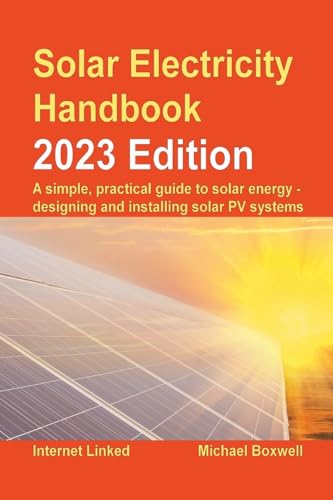
Solar Electricity Handbook - 2023 Edition: A simple, practical guide to solar energy – designing and installing solar photovoltaic systems: Boxwell, Michael
Solar Electricity Handbook - 2023 Edition: <strong>A simple, practical guide to solar energy – designing and installing solar photovoltaic systems</strong> [Boxwell, Michael] on Amazon.com. *FREE* shi
Check Price on AmazonSolar energy potential in Tennessee: sun hours, irradiance, and climate factors
Tennessee receives moderate, highly usable solar resource. According to NREL’s National Solar Radiation Database, most of the state sees 4.5–5.0 peak sun hours (PSH) on average—meaning each square meter receives 4.5–5.0 kWh of solar energy per day. In practical terms, a well-sited 7 kW DC array near Nashville can generate about 9,500–10,500 kWh per year on a fixed-tilt racking system (NREL PVWatts typical meteorological year data).
Climate considerations:
- Seasonal variance: Winter generation can drop ~35–45% versus summer due to shorter days and cloudiness in the Cumberland Plateau/Appalachians. Oversizing slightly or using higher-efficiency modules can smooth seasonal variability.
- Humidity and heat: High summer temperatures reduce panel efficiency 10–15% on hot afternoons. Modern modules list a temperature coefficient (e.g., −0.30 to −0.35%/°C); lower absolute values perform better in heat.
- Shading: Mature trees are common. A production estimate should include a shade analysis (e.g., Solmetric SunEye or drone-based models) to avoid surprises.
Average cost of solar panels in Tennessee and price-per-watt breakdown
Residential solar costs in Tennessee generally range from $2.40–$3.20 per watt (W) before incentives for cash or loan purchases of 6–10 kW systems. This aligns with LBNL’s Tracking the Sun 2024 medians for host-owned systems and NREL’s 2025 residential cost benchmarks, with regional variation based on labor, permitting, and customer acquisition costs.
Where your dollars go (typical split for a 7 kW system):
- Equipment (~45–55%): Modules, inverters, racking, wiring, monitoring.
- Soft costs (~35–45%): Design/engineering, permitting, interconnection, project management, overhead, marketing.
- Labor (~10–15%): Onsite installation, electrical work, commissioning.
Price-per-watt examples:
- 6 kW at $2.60/W = $15,600 (before incentives)
- 7.5 kW at $2.85/W = $21,375
- 9 kW at $3.00/W = $27,000
High-efficiency modules and premium inverters add cost but can improve lifetime energy yield and reliability—valuable in Tennessee where maximizing self-consumption (rather than exporting) drives economics.
Tennessee solar incentives: state tax credits, rebates, net metering, and SRECs
Tennessee-specific incentives are limited for residential customers:
- State income tax credits: Tennessee has no state income tax on wages and no statewide solar tax credit for homeowners.
- Sales tax: There is no universal residential sales tax exemption for solar equipment. Check your installer’s quote for applicable state and local sales tax.
- Property tax: Tennessee does not provide a statewide property-tax exemption for residential PV. Local treatment can vary—consult your county assessor to understand how improvements are assessed.
- Net metering: Tennessee has no statewide net metering law. Most Tennesseans are served by local power companies (LPCs) under the Tennessee Valley Authority (TVA). TVA and its LPCs generally use net billing or “parallel generation” arrangements—excess solar exported to the grid is credited at an avoided-cost rate (often ~3–6¢/kWh) rather than the full retail rate (usually ~12–13¢/kWh). The old TVA Green Power Providers (retail-rate buyback) closed to new applicants years ago.
- SRECs/RECs: Tennessee has no renewable portfolio standard (RPS) and no state SREC market. Homeowners typically cannot monetize SRECs at meaningful values. Some third-party platforms may purchase generic voluntary RECs, but prices are low (often a few dollars per MWh) and program availability varies.
What this means for design: To maximize savings, Tennessee systems are often sized to match daytime loads and paired with load-shifting (e.g., EV charging at noon) or storage—so fewer kilowatt-hours are exported at low avoided-cost rates.
If you’re comparing policies across the Southeast, see how neighboring states approach solar interconnection and customer incentives:
- North Carolina’s higher solar adoption and utility programs differ from TVA territory: Solar in North Carolina: Costs, Incentives & Top Installers (2026)
- Georgia markets also use net billing; pricing and installer networks vary: Solar in Georgia: Costs, Incentives & Top Installers (2026)
- Kentucky’s policy environment is similar in some service areas: Solar in Kentucky: Costs, Incentives & Top Installers (2026)
Federal ITC and how it applies to Tennessee homeowners
The federal Residential Clean Energy Credit (Internal Revenue Code §25D) provides a 30% tax credit on eligible project costs for solar PV, solar plus storage, and standalone batteries ≥3 kWh of capacity. Key points (IRS/DOE guidance):
- 30% applies to equipment, labor, permitting fees, and associated electrical work (e.g., roof attachments, balance-of-system hardware). Roofing beyond what’s necessary to mount PV is not eligible.
- Standalone battery storage qualifies at 30% if capacity is at least 3 kWh (Powerwall-sized systems usually qualify). Solar-charged or grid-charged both eligible under the IRA rules.
- The credit is nonrefundable but can roll forward to future tax years if you don’t have enough liability in the installation year.
- Available for systems placed in service through 2032, stepping down after 2032 unless extended by Congress.
Example: A 7.5 kW system priced at $2.85/W = $21,375. The 30% credit is $6,413, bringing net cost to ~$14,962 (excluding any sales tax and financing costs). Adding a 10–13.5 kWh battery for resilience increases upfront cost but can significantly improve self-consumption in TVA territory.
Best solar installers and companies serving Tennessee
Tennessee’s installer landscape includes experienced local firms with TVA interconnection expertise and national brands operating statewide. When evaluating, prioritize:
- NABCEP-certified PV Installation Professionals on staff
- Strong TVA/LPC interconnection track record (NES, KUB, EPB, MLGW, etc.)
- 25-year module and production warranties; 10–25-year inverter and racking warranties
- Clear workmanship warranty (≥10 years) and monitoring/operations support
Notable companies active in Tennessee (coverage varies by county and utility; verify current service areas):
- LightWave Solar (Nashville-based; extensive TVA experience; residential and commercial)
- Solar Alliance (Knoxville; residential and small commercial)
- Tennessee Solar Solutions (Chattanooga area; residential/commercial)
- Big Frog Mountain (regional EPC; check residential availability)
- ADT Solar (national brand; Tennessee coverage varies)
- Blue Raven Solar (national; select Tennessee metros)
- Freedom Forever (national EPC; available in parts of Tennessee)
- Palmetto (national network; uses partner installers)
- Greene Tech Renewable Energy (East Tennessee; off-grid and grid-tied expertise)
- ARP Solar and regional EPCs that serve border counties (availability changes)
How to choose among bids:
- Ask for a detailed production estimate (NREL PVWatts inputs shown), assumptions on shading, soiling, and degradation (~0.3–0.5%/yr typical).
- Confirm interconnection tariff and export credit rate for your LPC (e.g., NES, KUB, EPB, MLGW). Your economics depend on it.
- Compare inverter architectures. Microinverters offer module-level optimization and shade resilience; string inverters with DC optimizers can be cost-effective with high efficiency.
Based on recent field performance data and reliability records, products like Enphase IQ8 microinverters and REC/ Qcells high-efficiency modules have tested well across hot, humid climates. For Tennessee homeowners prioritizing durability and self-consumption, the Enphase IQ8 Microinverters paired with a south- or southwest-facing array, or a hybrid inverter with high round-trip efficiency like SolarEdge Home Wave, represent strong value. For resilience, the Tesla Powerwall 3 enables whole-home backup and time-shifting to capture more retail-rate savings where export credits are low.
ROI and payback period for solar in Tennessee
Because export energy is typically credited at avoided-cost rates (not full retail), Tennessee economics hinge on self-consumption. Here’s a representative scenario to frame expectations.

Emporia Gen 2 Smart Home Energy Monitor with 16 50A Circuit Level Sensors | Real Time Electricity Monitor/Meter | Solar/Net Metering - Amazon.com
View on AmazonAssumptions (Nashville area, south-facing roof, 20°–30° tilt, minimal shading):
- System: 7 kW DC, $2.85/W = $19,950 equipment + labor + overhead; 7% average sales tax illustrative → ~$21,347 gross (note: verify local tax rate)
- Federal ITC (30%): −$6,404 → net ~$14,943
- Annual production: ~10,000 kWh (NREL PVWatts)
- Retail rate: 12.5¢/kWh (EIA 2024 TN average)
- Export credit: 4.0¢/kWh (illustrative TVA/LPC avoided cost; check your LPC)
- Self-consumption: 70% (daytime loads + some load shifting)
Annual savings:
- Self-consumed 7,000 kWh × $0.125 = $875
- Exported 3,000 kWh × $0.04 = $120
- Total first-year bill reduction ≈ $995
Simple payback ≈ $14,943 / $995 ≈ 15.0 years
How to improve ROI:
- Increase self-consumption: Run dishwashers, laundry, and EV charging midday; use smart thermostats to pre-cool.
- Right-size your system: Match typical daytime loads to minimize low-value exports.
- Consider battery storage: A 10–13.5 kWh battery can shift evening loads into solar hours and provide backup. The 30% ITC lowers net cost, though payback depends on how much export offset you capture.
- Reduce soft costs: Solicit at least three bids; ask about bundled pricing and local permitting fees.
With careful design, many Tennessee homeowners see 10–13-year paybacks on cash purchases and positive lifetime returns (20–25 year horizon), alongside thousands of pounds of CO₂ avoided annually. The National Renewable Energy Laboratory estimates about 0.7–0.9 lb CO₂ avoided per kWh displaced on the regional grid mix.
Tennessee-specific permitting, HOA rules, and interconnection process
Permitting and interconnection are local in Tennessee, and most electric customers are served by TVA’s network of LPCs.
Permitting
- Building/Electrical permits: Issued by the local Authority Having Jurisdiction (AHJ)—city or county building department. Most AHJs reference recent NEC editions (2017–2023); your installer will design to the code in effect locally and coordinate structural review for rooftop arrays.
- Timelines: 2–6 weeks is common for permit review depending on jurisdiction and completeness of plans.
HOA rules
- Tennessee does not have a statewide “solar rights” law that prevents homeowners’ associations from restricting solar. Many HOAs require architectural review. Practical tip: Submit a clean design (flush-mount, color-matched rails, neat conduit runs) and be open to reasonable placement requirements that don’t materially degrade performance.
Interconnection (TVA/LPCs)
- Application: Submitted by your installer to your LPC (NES, KUB, EPB, MLGW, etc.) for review under TVA’s parallel generation guidelines.
- Metering: Bi-directional meters record imports and exports. Expect net billing—imports at retail, exports at avoided cost.
- Technical requirements: External AC disconnects are common; anti-islanding per IEEE 1547; UL 1741 SA or SB inverters. Some LPCs cap residential PV at 10–15 kW AC and may require proof of homeowner’s insurance.
- Timeline: 2–8 weeks from application to interconnection approval is typical; meter swaps after final inspection can take 1–3 additional weeks.
Ask your installer to provide the exact export credit rate and interconnection tariff for your LPC—it meaningfully shapes projected savings.
FAQ: common questions about going solar in Tennessee
- Does Tennessee have net metering? No statewide net metering. Most customers in TVA territory receive net billing with exports credited at an avoided-cost rate, typically well below the retail price.
- Is there a Tennessee solar tax credit? No state income tax credits for residential PV. The main incentive is the 30% federal ITC under the IRA.
- Can I add a battery and get the 30% credit? Yes. Standalone batteries ≥3 kWh qualify for the 30% Residential Clean Energy Credit, even if they’re charged from the grid.
- Are leases or PPAs available? They are uncommon in TVA territory and may be limited by utility policies. Most homeowners use cash or low-interest solar loans.
- What size system should I buy? Size to annual usage and roof layout, but in Tennessee, it often pays to size for daytime/self-use loads rather than maxing out roof area.
- How do winter and cloudy days affect output? Expect lower winter output and production dips during extended cloudy spells—Tennessee’s annual yield still averages ~1,350–1,550 kWh/kW-year on fixed-tilt.
- Will my property taxes go up? Tennessee lacks a universal property-tax exemption for residential PV. Check with your county assessor on how improvements are valued.
- What if I need a new roof? If your roof is older than ~10–12 years, consider reroofing before PV to avoid future removal/reinstall costs. Some shingle manufacturers offer solar-integrated warranties when paired with specific installers.
- How long do panels last? Most modules carry 25-year performance warranties (often guaranteeing ~84–92% output at year 25) and 10–25-year product warranties.
- What maintenance is required? Minimal—periodic visual inspections and occasional rinsing if soiling is heavy. Monitoring portals flag inverter or string issues.
Practical recommendations for Tennessee homes
- Equipment pairing for heat and humidity: High-efficiency, low-temperature-coefficient modules (e.g., heterojunction or TOPCon) and microinverters for complex roofs. The Qcells Q.TRON or Q.PEAK series and Enphase IQ8 Microinverters are proven performers in warm, humid climates.
- Storage for self-consumption and backup: Where export credits are ~3–6¢/kWh, a battery like the Tesla Powerwall 3 can shift evening loads and provide outage resilience, improving overall project value.
- Load shifting: Program EV charging midday, precool homes during sunny hours, and run high-draw appliances when your system is producing.

EMPORIA Level 2 EV Charger - NEMA 14-50 EVSE w/ J1772 Connector - 48 amp EV Charger Level 2, 240v WiFi Enabled Electric Vehicle Charging Station, 25ft Cable, White : Automotive
View on AmazonWhere solar in Tennessee is heading
Three trends to watch:
- Falling soft costs: As more LPCs standardize interconnection under TVA guidelines and more installers compete, customer acquisition and permitting costs should trend down.
- Smarter tariffs: As TVA and LPCs pilot time-based rates and distributed energy programs, batteries and smart inverters will unlock more value for homeowners.
- Supply chain gains: Module prices eased in 2024–2025 due to global manufacturing scale-up (IEA PV Market Report), and U.S. manufacturing expansions (Qcells in Georgia, others) are improving availability and price stability in the Southeast.
Bottom line: Even without traditional net metering, solar in Tennessee can deliver solid, long-term value—especially when systems are designed for self-consumption, paired with reliable equipment, and installed by contractors fluent in TVA interconnection. The 30% federal credit, competitive equipment pricing, and rising focus on resilience make 2026 a pragmatic time to run the numbers on your home.
Recommended Products
Solar Electricity Handbook - 2023 Edition: A simple, practical guide to solar energy – designing and installing solar photovoltaic systems: Boxwell, Michael
Solar Electricity Handbook - 2023 Edition: <strong>A simple, practical guide to solar energy – designing and installing solar photovoltaic systems</strong> [Boxwell, Michael] on Amazon.com. *FREE* shi
Emporia Gen 2 Smart Home Energy Monitor with 16 50A Circuit Level Sensors | Real Time Electricity Monitor/Meter | Solar/Net Metering - Amazon.com
See how much electricity your home is using anywhere, anytime. ... <strong>Add individual 50A sensors to your Vue to monitor up to 16 individual circuits</strong> — providing accurate energy use for t
EMPORIA Level 2 EV Charger - NEMA 14-50 EVSE w/ J1772 Connector - 48 amp EV Charger Level 2, 240v WiFi Enabled Electric Vehicle Charging Station, 25ft Cable, White : Automotive
Buy EMPORIA Level 2 EV Charger - NEMA 14-50 EVSE w/ J1772 Connector - 48 amp EV Charger Level 2, <strong>240v WiFi Enabled Electric Vehicle Charging Station, 25ft Cable, White</strong>: Charging Stati