
Solar in Utah: Costs, Incentives & Top Installers (2026)

Utah’s high-elevation deserts and long, clear-sky seasons give it some of the best residential solar potential in the Mountain West. If you’re evaluating solar in Utah in 2026, the combination of strong sun, a 30% federal tax credit, and maturing installer competition can deliver compelling paybacks—even as Utah’s main utility credits exported solar at less than full retail.
This guide translates the data into decisions: real-world costs per watt, incentives, net metering/export credits, top installers, permitting, payback math, and gear picks that perform in Utah’s climate.
By the numbers: solar in Utah at a glance
- Solar resource: 5.5–6.5 average peak sun hours/day across much of Utah (NREL solar resource maps)
- Output: ~1,500–1,750 kWh per kW of DC capacity annually in the Wasatch Front (PVWatts typical assumptions)
- Installed price: roughly $2.30–$3.10 per watt (before incentives) for residential systems in 2025–2026 bids; Utah tends to price below the U.S. median reported by LBNL’s Tracking the Sun
- Federal credit: 30% Residential Clean Energy Credit (IRS Section 25D) through at least 2032
- Utility bill savings context: Utah residential electricity averaged about 11–12¢/kWh in 2023–2024 (U.S. EIA). RMP’s export credit rate (ECR) is typically below retail
- Typical payback: ~8–12 years for well-sited homes; battery storage can improve self-consumption where export credits are low

Solar Electricity Handbook - 2023 Edition: A simple, practical guide to solar energy – designing and installing solar photovoltaic systems: Boxwell, Michael
Solar Electricity Handbook - 2023 Edition: <strong>A simple, practical guide to solar energy – designing and installing solar photovoltaic systems</strong> [Boxwell, Michael] on Amazon.com. *FREE* shi
Check Price on AmazonSolar in Utah: sun hours, irradiance, and climate factors
Utah’s solar resource is a major advantage. NREL irradiance maps show much of the state with 5.5–6.5 peak sun hours per day, well above many northern states. High elevation and low humidity reduce atmospheric losses and heat stress on modules, which helps maintain panel efficiency (module efficiency drops as temperature rises; Utah’s cooler nights and dry air temper summertime losses).
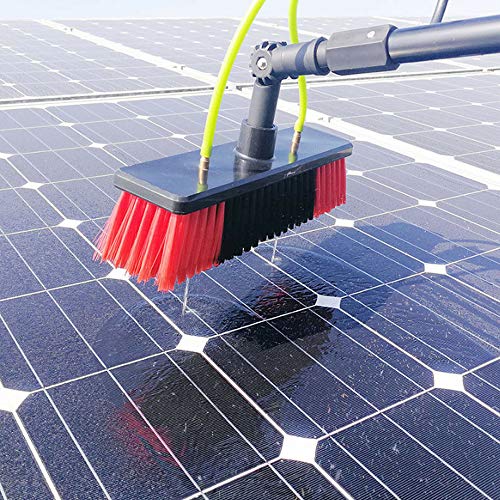
26 Feet Reach Solar Panel Cleaning Brush & Pole Water Fed Pole Kit,Suitable for high Windows Cleaning, Solar photovoltaic Panel Cleaning and Cleaning Cars Trucks Vans caravans Windows : Patio, Lawn & Garden
View on AmazonClimate considerations for design:
- Snow and tilt: Along the Wasatch, a 30–35° tilt balances winter production and snow shedding. Ground mounts or higher-tilt arrays in snowier microclimates can outperform shallow roof pitches during winter.
- Soiling: Dry spells and dust events can reduce output a few percent. A light rinse 1–3 times per year can recover yield—especially after spring dust or late-summer wildfire smoke.
- Temperature coefficient: Panels with lower temperature coefficients (e.g., −0.24%/°C vs. −0.35%/°C) lose less power on hot afternoons in St. George or Moab.
- Elevation: Higher UV and clear skies are a net positive for annual energy (kWh), even if midday module temps still rise.
Average cost of solar panels in Utah (price-per-watt breakdown)
Residential solar in Utah commonly prices in the $2.30–$3.10/W range before incentives for turnkey rooftop systems (modules, inverters, racking, labor, permitting, and typical interconnection). Utah historically comes in below the U.S. median (LBNL Tracking the Sun), thanks to steady installer competition and simpler roof geometries in newer subdivisions.
Example budgets before incentives:
- 6 kW system at $2.60/W: $15,600
- 8 kW system at $2.55/W: $20,400
- 12 kW system at $2.45/W (economies of scale): $29,400
What drives prices in Utah:
- Equipment mix: Premium high-efficiency modules, microinverters, snow-rated racking, and critter guards increase $/W.
- Roof conditions: Steeper pitches, tile roofs, structural upgrades, or long conductor runs add labor.
- Market timing: Seasonal installer backlogs (spring–summer) can nudge quotes up; winter booking sometimes yields discounts.
Tip: Request line-item quotes (modules, inverters, racking, labor, adders). Compare at a common DC wattage basis and ask for modeled annual kWh with assumptions (tilt, azimuth, shading, weather file).
Utah solar incentives: state tax credits, rebates, net metering, and SRECs
- State tax credit: Utah’s Renewable Energy Systems Tax Credit for residential systems has been phasing down in recent years and is slated for a limited value in the mid-2020s. As of the most recent updates (through 2024), the credit amount for new residential installs had stepped down to the low hundreds of dollars and was scheduled to sunset soon after. Because legislative sessions can change timelines, confirm current-year details with the Utah Office of Energy Development or DSIRE before you sign a contract.
- Utility rebates: Utah’s major investor-owned utility, Rocky Mountain Power (RMP), does not currently offer upfront solar rebates for typical residential installs. Some municipal utilities may have distinct programs; check with your local provider.
- Net metering / export credits: Full retail net metering is no longer available to new RMP customers in Utah. Instead, RMP uses an export credit rate (ECR) for surplus solar sent to the grid. The ECR is generally below the retail rate and may vary by season/time block under Public Service Commission dockets. Practically, this encourages higher self-consumption (using your solar as it’s produced) or adding batteries to shift energy into evening peaks. Municipal utilities and rural co-ops may have different crediting rules—always verify your specific tariff.
- SRECs: Utah does not operate a state SREC market. Homeowners can sometimes sell RECs into voluntary markets, but prices are typically low (often a few dollars per MWh), so REC sales rarely move residential payback meaningfully.
Federal ITC and how it applies to Utah homeowners
Utah homeowners qualify for the 30% Residential Clean Energy Credit (IRS Section 25D) through at least 2032 under the Inflation Reduction Act. It applies to:
- Solar PV equipment and labor
- Energy storage (batteries) of 3 kWh or larger, even if installed without new solar
- Balance-of-system gear (inverters, racking, wiring)
Key points:
- It’s a tax credit, not a rebate—you need sufficient tax liability, though unused amounts can generally carry forward.
- There are no residential “bonus” adders (those apply to commercial utility-scale credits). For homes, it’s a straightforward 30% of eligible costs.
- Claim timing depends on when the system is placed in service (passes final inspection/interconnection), not when you sign a contract.
Best solar installers and companies serving Utah
The best installer is the one that optimizes your site with quality gear, transparent pricing, and strong service. Use these criteria:
- Utah DOPL electrical contractor license + NABCEP-certified PV professionals
- 25-year equipment warranties (modules, inverters) and at least 10-year workmanship
- Bankable inverter/platform support (rapid shutdown compliance, local parts availability)
- Verifiable production modeling and shade analysis (e.g., PVWatts, HelioScope)
- Clear service response times and monitoring access
Well-regarded companies active in Utah include a mix of local specialists and national brands. Always verify current licensing and recent customer feedback:
- Creative Energies (Salt Lake City/Utah region): Local, design-forward residential and small commercial experience
- Intermountain Wind & Solar: Large regional installer with residential and commercial portfolios
- Mynt Solar (Lehi-based): Residential focus, offers solar-plus-storage
- ES Solar: Residential installs on the Wasatch Front
- Blue Raven Solar (now part of SunPower’s dealer network): National presence with Utah roots; check specific dealer warranty terms
- Sunrun: National provider; offerings vary by market (ownership, loan, or PPA). Scrutinize contract details
- Smaller local firms: Utah’s market includes boutique installers that compete on service; request multiple bids and compare $/W and warranty terms
Questions for your shortlist:
- Will you model ECR savings vs. self-consumption and a battery scenario?
- What’s your assumed annual kWh/kW and shading loss? Which weather file?
- Who services inverter/battery warranty claims and how fast?
ROI and payback period for solar in Utah
A realistic ROI picture depends on your consumption profile and tariff. Let’s run an illustrative case using conservative, sourced assumptions:
- System: 8 kW DC rooftop, $2.55/W => $20,400 gross cost
- Federal credit: 30% => −$6,120; net cost: $14,280 (state credit, if any, would lower this further)
- Production: 8 kW × 1,600 kWh/kW-year ≈ 12,800 kWh/year (PVWatts-like baseline for the Wasatch Front)
- Retail rate baseline: ~12¢/kWh (EIA UT residential recent average). RMP ECR < retail; assume 55% of solar is self-consumed, 45% exported at an ECR in the mid–single digits (illustrative)

Emporia Gen 2 Smart Home Energy Monitor with 16 50A Circuit Level Sensors | Real Time Electricity Monitor/Meter | Solar/Net Metering - Amazon.com
View on AmazonAnnual bill impact (illustrative):
- Self-consumed: 7,040 kWh × $0.12 ≈ $845
- Exported: 5,760 kWh × $0.06 ≈ $346
- Total first-year value ≈ $1,191
Simple payback ≈ $14,280 / $1,191 ≈ 12.0 years. With:
- Higher self-consumption (smart thermostats, EV charging midday), payback often improves to 9–11 years
- Rising utility rates (Utah’s have trended upward from sub-11¢ to ~12¢ over recent years per EIA), payback shortens
- Batteries can increase self-consumption from ~55% to 75–85% in some homes, improving value under low ECRs. They add cost, so evaluate lifetime cycling benefits, resilience value, and any time-of-day rate arbitrage
Financial metrics to request from installers:
- 25-year NPV and IRR with a realistic degradation rate (0.35–0.6%/yr) and inverter/battery replacement assumptions
- Sensitivity analysis across rate inflation (1–3%/yr), ECR changes, and self-consumption percentages
Utah-specific permitting, HOA rules, and interconnection
Permitting
- Many Utah jurisdictions have standardized residential solar permits. Some communities use NREL’s SolarAPP+ for same-day online permits on qualifying systems. Ask your installer if your city participates.
- Structural and electrical stamps may be needed on complex or heavy roofs (older rafters, snow country). Budget a few hundred dollars if engineering is required.
HOAs and solar rights
- Utah law protects a homeowner’s right to install solar with reasonable restrictions. HOAs can set aesthetic or placement rules, but they generally cannot impose conditions that significantly increase cost or substantially reduce performance. If your HOA requires street-facing arrays to be minimized, request a performance impact estimate (percent kWh reduction) in writing and adjust system size/tilt if needed.
Interconnection (Rocky Mountain Power and others)
- Typical steps: application with single-line diagram and spec sheets; utility review; meter upgrade (if required); authority having jurisdiction (AHJ) inspection; permission to operate (PTO)
- Levels: Small residential systems often qualify for a fast-track review when using UL 1741 SB/IEEE 1547-2018 certified inverters with integrated rapid shutdown
- Timelines: Expect 2–8 weeks from permit submission to PTO depending on jurisdiction, utility workload, and any service upgrades
- Export credit enrollment: If you’re in RMP territory, confirm you’re on the correct export credit tariff at PTO and understand any time-of-day features offered
Equipment picks that perform in Utah’s climate
Based on Utah’s high irradiance, seasonal snow, and the value of self-consumption under ECRs:
- High-efficiency, low-temp-coefficient modules (e.g., 21%+ efficiency, −0.26%/°C or better). Options like the REC Alpha Pure or Qcells Q.PEAK DUO families often balance price and performance.
- Inverters: Module-level power electronics help with snow shedding and partial shading. The Enphase IQ8 Microinverter platform offers panel-level optimization and rapid shutdown compliance; SolarEdge’s latest HD-wave inverters with optimizers are also common in Utah markets.
- Batteries: To boost self-consumption under low ECRs and provide backup, consider the Tesla Powerwall 3 or Enphase IQ Battery 5P. Look for usable capacity per dollar, round-trip efficiency ≥90%, strong warranty (≥10 years), and UL 9540A-tested safety.
These are not one-size-fits-all; ask installers to model your specific load shape (especially if you work from home or charge an EV) and show how storage shifts kWh from daytime to evening.
How Utah compares to nearby states
If you’re near the border or just benchmarking, Utah’s irradiance rivals Arizona and New Mexico, while installed prices and policies are often closer to Colorado and Idaho. For regional context, see our neighboring state guides:
- Solar in Arizona: Costs, Incentives & Top Installers (2026)
- Solar in Colorado: Costs, Incentives & Top Installers (2026)
- Solar in Idaho: Costs, Incentives & Top Installers (2026)
Getting multiple quotes the right way
- Provide a 12-month usage history (kWh) and note any planned load changes (EV, heat pump, hot tub)
- Specify goals: bill reduction, resilience, or both; whether you prefer ownership vs. loan/lease/PPA
- Ask for both a “net present value-optimized” design and a “bill-offset-maximized” design under your actual tariff/ECR
- Request production guarantees and monitoring app access
FAQ: common questions about going solar in Utah
- Is solar in Utah “worth it” with export credits instead of net metering? For most well-sited homes, yes—especially if you can self-consume 55%+ of production. Paybacks in the 8–12 year range are common with current pricing and the 30% federal credit. Batteries can further improve economics under low ECRs.
- Do panels work in winter and with snow? Yes. Cold boosts panel efficiency. Production dips during heavy snow but rebounds quickly as snow slides. A steeper tilt helps; microinverters limit the effect of partial coverage.
- What size system do I need? Divide your annual kWh by ~1,600 kWh/kW-year to estimate kW DC for the Wasatch Front (adjust to 1,750 for sunnier St. George). Then consider roof tilt/azimuth and shading.
- Best orientation in Utah? South-facing at ~30–35° tilt maximizes annual kWh. West-southwest can better match late-afternoon loads under ECRs; ask for an orientation tradeoff analysis.
- Will an HOA block solar? Utah law restricts outright prohibitions. Reasonable rules are allowed but shouldn’t materially increase cost or reduce performance. Get HOA approvals in writing before installation.
- How long do permits and PTO take? Commonly 2–8 weeks end-to-end. SolarAPP+ jurisdictions can be faster. Seasonal backlogs in spring can add time.
- Do I need a battery? Not required. Economically, a battery can raise self-consumption and provide backup. If you have critical-load needs (medical equipment, well pump), storage adds resilience.
- Maintenance in Utah’s climate? Minimal: occasional rinsing for dust, periodic visual inspections, and monitoring app alerts. Snow often self-clears on sunlit days.
Sources and data
- National Renewable Energy Laboratory (NREL) solar resource maps; PVWatts performance modeling assumptions for Salt Lake City region
- Lawrence Berkeley National Laboratory (LBNL), Tracking the Sun (latest edition): installed price benchmarks and system characteristics
- U.S. Energy Information Administration (EIA): state-level residential electricity prices (Utah)
- Utah Public Service Commission/utility filings: Rocky Mountain Power export credit rate framework for customer generation
- Utah Office of Energy Development; DSIRE (Database of State Incentives for Renewables & Efficiency): details on the Renewable Energy Systems Tax Credit and local policies
What this means for Utah homeowners
If you have a reasonably unshaded roof and daytime energy use, solar in Utah remains a strong investment in 2026. The keys are right-sizing, optimizing for self-consumption under current export credit structures, and selecting reliable equipment with robust warranties. Layer in the 30% federal credit—and, if applicable, any remaining state credit—and you can lock in decades of predictable, low-cost power while insulating your household from future rate hikes.
Recommended Products
Solar Electricity Handbook - 2023 Edition: A simple, practical guide to solar energy – designing and installing solar photovoltaic systems: Boxwell, Michael
Solar Electricity Handbook - 2023 Edition: <strong>A simple, practical guide to solar energy – designing and installing solar photovoltaic systems</strong> [Boxwell, Michael] on Amazon.com. *FREE* shi
Emporia Gen 2 Smart Home Energy Monitor with 16 50A Circuit Level Sensors | Real Time Electricity Monitor/Meter | Solar/Net Metering - Amazon.com
See how much electricity your home is using anywhere, anytime. ... <strong>Add individual 50A sensors to your Vue to monitor up to 16 individual circuits</strong> — providing accurate energy use for t
26 Feet Reach Solar Panel Cleaning Brush & Pole Water Fed Pole Kit,Suitable for high Windows Cleaning, Solar photovoltaic Panel Cleaning and Cleaning Cars Trucks Vans caravans Windows : Patio, Lawn & Garden
Buy <strong>26 Feet Reach Solar Panel Cleaning Brush & Pole Water Fed Pole Kit,Suitable for high Windows Cleaning, Solar photovoltaic Panel Cleaning and Cleaning Cars Trucks Vans caravans Windows<