
Tesla Powerwall in Hawaii: Cost, Availability & Is It Worth It?
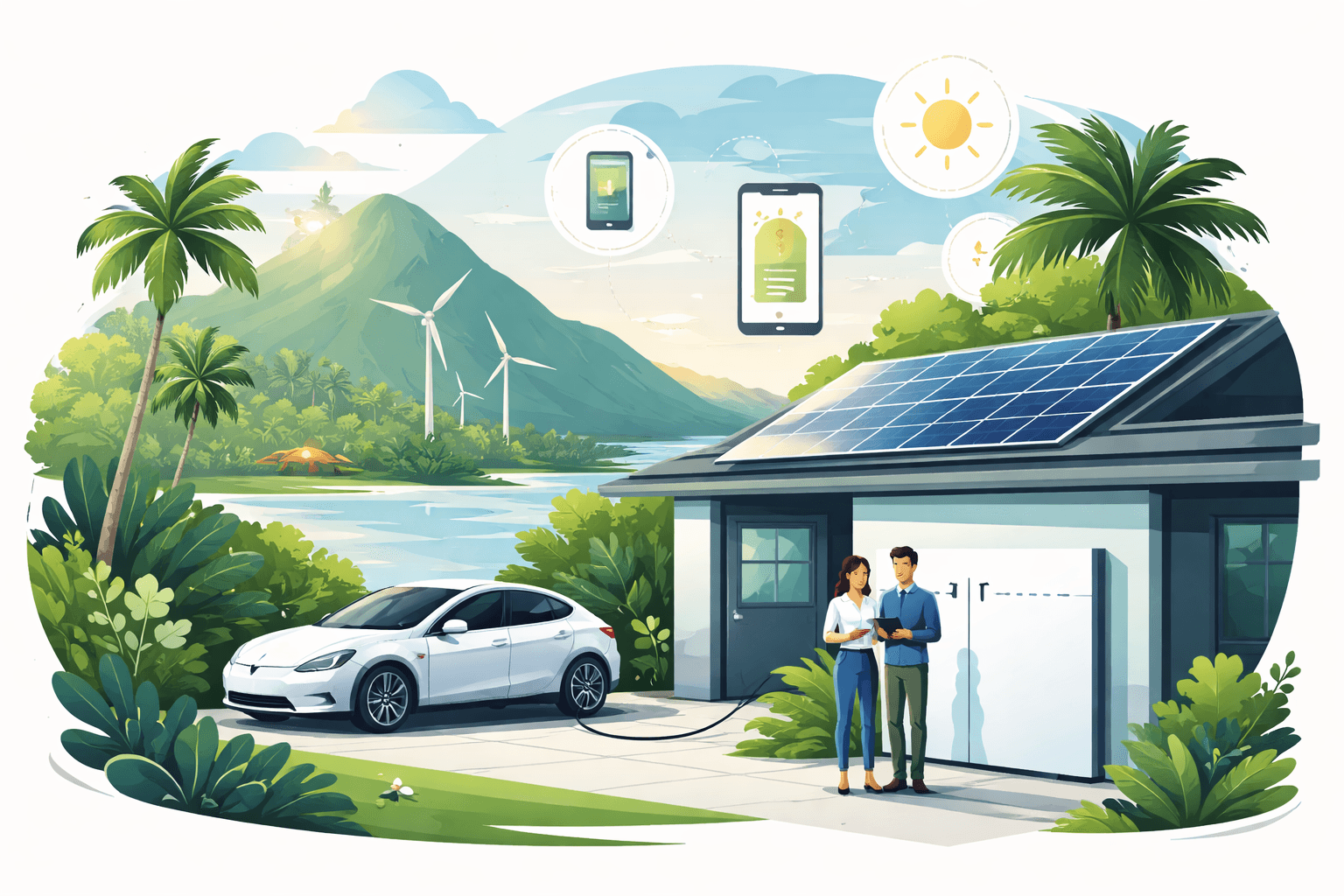
Hawaii’s electricity prices are the highest in the U.S. — residential customers paid roughly 40–45¢/kWh in 2024, according to the U.S. Energy Information Administration (EIA). That makes the Tesla Powerwall in Hawaii one of the most impactful home energy upgrades for stabilizing bills, increasing resilience during storms, and unlocking value from rooftop solar.
This guide details Powerwall specs, real-world pricing in Hawaii, incentives and utility programs, how it pairs with solar, and whether it pencils out for your home.
Tesla Powerwall in Hawaii: specs, capacity, and how it works
Tesla Powerwall is a rechargeable lithium-ion home battery that stores solar energy or grid power for use when you need it most — during evening peaks, outages, or to avoid high time-of-use (TOU) rates.
Key models and specs you’ll see in Hawaii installations:
- Energy capacity (usable): 13.5 kWh per unit (Powerwall 2, Powerwall+, and Powerwall 3)
- Continuous power:
- Powerwall 2/+: ~5 kW continuous (7 kW peak for short bursts)
- Powerwall 3: higher integrated inverter power output (commonly cited up to ~11.5 kW continuous when configured per Tesla’s datasheet; installer settings and grid codes apply)
- Round-trip efficiency: ~90% (AC-coupled systems)
- Chemistry: lithium-ion (Powerwall 2 typically NMC; Powerwall 3 has moved toward LFP)
- Scalability: stack up to 10+ units for larger homes
- Warranty: 10 years with capacity retention to 70% (Tesla provides unlimited cycles when charged by solar for self-consumption/backup; throughput limits may apply for grid-charging use cases)
- Operating conditions: outdoor-rated (NEMA 3R weather resistance), wall or floor mounted
How it works with your home and solar:
- AC-coupled (Powerwall 2/+): Tesla’s Gateway monitors home load, solar production, and the grid. The battery charges from solar (or grid, if enabled) and discharges when solar drops or prices spike.
- Hybrid inverter architecture (Powerwall 3): integrates a solar inverter with the battery to reduce equipment count and improve efficiency; simplifies new solar-plus-storage installs.
- Backup power: During an outage, the Gateway instantly “islands” your home. Critical loads stay powered, and if you have solar, the array can recharge the Powerwall while the grid is down (subject to system design and interconnection rules).
By the Numbers: Hawaii and home batteries
- 40–45¢/kWh: typical residential electricity price range in Hawaii in 2024 (EIA)
- ~1 GW: cumulative rooftop solar on Hawaiian Electric’s system by 2023 (Hawaiian Electric)
- 13.5 kWh: usable energy per Tesla Powerwall unit
- ~90%: round-trip efficiency (battery in/out losses ~10%)
- 10 years: Tesla warranty to 70% remaining capacity
- 30%: federal ITC for residential battery storage (Inflation Reduction Act; IRS Section 25D)
Freeing Energy: How Innovators Are Using Local-scale Solar and Batteries to Disrupt the Global Energy Industry from the Outside In: Nussey, Bill
Nussey is comprehensive and convincing in his portrayal of the relentless technological innovation driving down costs for small-scale solar and battery solutions, and the ability of these systems to i
Check Price on AmazonPowerwall pricing in Hawaii (equipment + installation)
Installed costs in Hawaii are higher than the mainland due to shipping, labor, and permitting. Based on installer quotes we track and industry benchmarks through 2025, typical ranges are:
- Hardware (Powerwall 2/+ or 3): $6,000–$8,000 per unit
- Balance-of-system (Gateway, breakers, wiring, mounts): $1,500–$3,000
- Labor and permitting: $3,000–$5,000 (site-dependent)
What homeowners actually pay (all-in):
- First Powerwall: $12,000–$16,000 before incentives
- Each additional Powerwall: $8,000–$12,000 (marginal cost is lower because you already have a Gateway and much of the labor complete)
- Hawaii General Excise Tax (GET): typically 4–4.5% applies to the project total
After the 30% federal Investment Tax Credit (ITC), net cost for a single-unit install often lands around $8,500–$11,500. Site-specific electrical upgrades (service panel, trenching, load-shedding equipment) can push totals higher. Conversely, participating in eligible utility programs (details below) can defray costs.
For deeper national pricing context and what drives quotes up or down, see our broader explainer: Tesla Powerwall: Complete Buyer's Guide — Cost, Installation & Alternatives.
Hawaii battery storage incentives: tax credits and utility programs
Here’s how incentives stack up for the Tesla Powerwall in Hawaii. Always confirm current program status with your installer and the utility, as dockets and enrollment caps change.
Federal ITC (30%): The Inflation Reduction Act expanded the ITC so standalone residential storage of 3 kWh or greater qualifies at 30% through 2032 (IRS Section 25D). This applies whether or not you install new solar. The credit is calculated on the full installed cost and generally includes permitting and sales/GET taxes paid. Consult a tax professional.
Hawaii state incentives: Hawaii’s Renewable Energy Technologies Income Tax Credit (RETITC) covers solar PV and solar water heating, but standalone batteries have not historically been independently eligible. In some cases, portions of a battery installed concurrently with a new PV system may be treated as part of the PV system basis; rules, caps, and interpretations evolve — check with a Hawaii tax advisor and the Department of Taxation guidance.
Hawaiian Electric “Battery Bonus” and successor programs (Oahu, Maui, Hawaii Island): Battery Bonus launched in 2021 with upfront incentives (commonly cited $850/kW in early phases, then step-downs) plus monthly bill credits (e.g., ~$5/kW for 36 months) for customers committing to discharge during an evening peak window. Earlier phases filled quickly; program availability by island and phase has fluctuated. Hawaiian Electric has proposed and begun transitioning to longer-term “bring-your-own-device” (BYOD) style programs that provide capacity payments for dispatchable customer batteries. Check current offerings and tariff sheets with Hawaiian Electric or your installer.
Export tariffs (Smart Export, CGS+, etc.): Net Energy Metering (NEM) ended years ago. Under Smart Export, daytime solar exports may not be credited, but evening/morning exports can earn fixed credits per kWh that vary by island. Batteries make participation practical by shifting solar to the export windows. Credit values and eligibility vary — review the latest tariff for your island and interconnection date.
Kauai Island Utility Cooperative (KIUC): KIUC runs separate programs and TOU options. While classic NEM is closed, KIUC customers can still benefit from solar-plus-storage via TOU arbitrage and any available dispatch or export programs. Confirm with KIUC’s current schedules.
Credible sources to monitor: Database of State Incentives for Renewables & Efficiency (DSIRE), Hawaiian Electric tariffs and program pages, Hawaii Public Utilities Commission dockets.
How the Powerwall pairs with solar in Hawaii: backup vs. self-consumption
Hawaii’s post-NEM policies heavily favor “self-consumption” — using your own solar on-site rather than exporting it midday. Batteries make this practical, especially in condos or neighborhoods where export capacity is constrained.
Common operating strategies:
- Backup-first: Keep a reserve (e.g., 20–50%) so you always have emergency power for critical circuits (fridge, lighting, networking, some outlets). During an outage, Powerwall seamlessly powers those loads and, with compatible solar, recharges in daylight.
- Time-Based Control (TOU optimization): Charge with solar (or off-peak grid power if allowed), then discharge during the evening peak when rates are highest. This reduces your utility bill even if you don’t export.
- Programmed dispatch: If enrolled in a utility program (Battery Bonus or its successor), the system automatically discharges during required windows to earn incentives — while still maintaining backup reserves you set with the installer.
Right-sizing for Hawaii homes:
- 1 Powerwall (13.5 kWh, ~5 kW continuous) is typically enough for critical-load backup or daily TOU shifting of ~7–10 kWh.
- 2–3 Powerwalls are common for whole-home backup with central AC, multiple refrigerators, or well pumps.
- For extended outages, pairing with even a modest rooftop solar array can keep batteries cycling indefinitely, weather permitting.
Hawaii utility rate structures and how Powerwall saves with time-of-use
Hawaiian Electric has rolled out TOU options that make arbitrage meaningful. While exact prices change by island and tariff, the pattern is consistent: mid-day power can be significantly cheaper than early-evening peak rates.
A simplified example using round numbers aligned with recent tariffs:
- Midday (solar-friendly hours): ~25–30¢/kWh
- Evening peak (roughly 5–9 p.m.): ~45–55¢/kWh
- Overnight off-peak: ~30–38¢/kWh
In Time-Based Control, a Powerwall can shift 8–10 kWh from low-cost solar hours to the evening peak daily. With a 20–25¢/kWh price spread, that’s roughly $1.60–$2.50 saved per day, or $580–$910 per year per battery. Larger spreads and export credits under Smart Export or program participation can increase value. Real savings depend on your load shape, solar size, TOU enrollment, and whether you export.
For a deeper look at island-by-island solar economics and installer insights, see our state guide: Solar in Hawaii: Costs, Incentives & Top Installers (2026).
Powerwall availability and certified installers in Hawaii
- Availability: Powerwall 2 and Powerwall+ have been widely installed across Oahu, Maui, and Hawaii Island. Powerwall 3 began rolling out in the U.S. in 2024–2025; by 2026, most Hawaii installers expect regular access, but inventory can fluctuate with demand and shipping.
- Installers: Tesla maintains a network of Certified Installers in Hawaii; many local solar contractors offer Powerwall alongside Enphase and other options. Most are based on Oahu with crews serving neighbor islands; schedules on Maui, Hawaii Island, and Kauai can book out further.
- Timelines: Site survey to PTO (permission to operate) typically takes 6–12 weeks, depending on permitting backlogs and interconnection reviews. Battery add-ons to existing PV can be faster than full solar-plus-storage projects.
- Permitting and code: Hawaii jurisdictions follow modern editions of the National Electrical Code (NEC) with energy storage provisions. Expect rules about indoor vs. outdoor placement, clearances, and fire code setbacks. Your installer will design to the local AHJ (authority having jurisdiction) requirements.
Pro tip for coastal homes: Ask about corrosion-resistant fasteners and enclosures. Powerwall is outdoor-rated, but salt air defense (stainless hardware, sealed conduits, periodic rinse-downs) extends equipment life.
Alternatives to Powerwall available in Hawaii: Enphase, LG, Generac
Hawaii homeowners often compare Tesla with these proven systems:

Emporia Gen 2 Smart Home Energy Monitor with 16 50A Circuit Level Sensors | Real Time Electricity Monitor/Meter | Solar/Net Metering - Amazon.com
View on AmazonEnphase IQ Battery 10T/5P (AC-coupled): 10–15 kWh class modular batteries using microinverter architecture; strong for homes with existing Enphase microinverters. Typical continuous output 3.8–7.6 kW depending on configuration. High reliability and granular monitoring. Based on these reliability and integration advantages, the Enphase IQ Battery 10T represents strong value for homes already on Enphase microinverters.
LG RESU Prime 16H (DC-coupled): 16 kWh usable capacity paired with compatible hybrid inverters (e.g., SolarEdge). DC-coupling reduces conversion losses vs. AC. For new solar-plus-storage builds focused on efficiency, the LG RESU Prime 16H is a well-supported choice with long track record.
Generac PWRcell (DC-coupled): Modular 9–18 kWh+ systems with robust whole-home backup options via automatic transfer switches. Good fit for larger homes needing higher surge power.
Other helpful add-ons:
- Whole-home energy monitoring can boost savings by letting you target loads during peak windows. The Emporia Vue Energy Monitor is a low-cost way to visualize load profiles and fine-tune battery settings.
What to compare across systems:
- Continuous and peak power (kW) vs. your largest appliances
- Usable energy (kWh) and stackability
- Round-trip efficiency (DC- vs. AC-coupled losses)
- Warranty terms (years, throughput, capacity retention)
- Software features for TOU, export windows, and utility program integrations
Is the Tesla Powerwall in Hawaii worth it?
Where Hawaii shines is the combination of very high electricity rates, strong rooftop solar adoption, and programs that reward evening capacity. For many homes:
- With solar: A single Powerwall often pays back in 7–12 years through TOU arbitrage, backup value, and (if available) utility program payments — shorter with larger TOU spreads or program incentives.
- Without solar: It still qualifies for the 30% ITC and can reduce bills on TOU by charging off-peak and discharging at peak, but economics are usually stronger paired with solar.
- For resilience: If you value outage protection (storms, wildfire-related public safety shutoffs, or maintenance outages), backup value may justify the system even if strict payback is longer.
We recommend getting at least two quotes: one for Tesla Powerwall (2/+ or 3, depending on availability) and one for a top alternative (e.g., Enphase or LG) sized to your loads. Ask each installer to model TOU and export scenarios on your island.
FAQ: Tesla Powerwall in Hawaii
- How many Powerwalls do I need for central AC?
- Many homes run a single smaller split or room AC on one Powerwall. For central AC or multiple splits, plan on 2–3 units, depending on compressor size, soft-starts, and total whole-home loads.
MICRO-AIR EasyStart 368 Bluetooth Soft Start Kit for Home Air Conditioner, RV & Commercial Use, Works with Generators, Reduces Power Surge, Efficient Start-Up - Up to 2-3.5 Tons(ASY-368-X48 BlueTooth) : Automotive
View on AmazonWill a Powerwall keep my fridge and lights on during an outage?
- Yes. A standard design backs up a critical loads subpanel with fridge, lights, outlets for devices, ceiling fans, internet, and possibly a small window AC.
Do I get the 30% federal tax credit if I don’t add solar?
- Yes, standalone residential batteries of 3 kWh or more qualify under the IRA (through at least 2032). Check with your tax professional.
Can I export battery energy in the evening under Smart Export?
- If your interconnection allows it and you’re on an eligible tariff, yes — that’s a key use case. Your installer will configure the system to prioritize export windows while preserving backup reserve.
How long will one Powerwall run my home?
- A typical home uses 20–30 kWh/day. One Powerwall (13.5 kWh) can cover many critical loads for 12–24 hours, longer if you have solar to recharge it and manage loads.
What’s the maintenance like in Hawaii’s salt air?
- Powerwall is outdoor-rated. Rinsing the enclosure with fresh water occasionally, avoiding direct surf exposure, and using corrosion-resistant hardware help maximize lifespan.
How noisy is a Powerwall?
- Very quiet — comparable to a refrigerator. Most homeowners don’t notice it indoors or outdoors.
How fast can I get one installed?
- Site visit to commissioning is typically 6–12 weeks, depending on island permitting and utility approval. Storm season demand can extend timelines.
What about whole-home backup for longer outages?
- Consider 2–3 units and load management (e.g., shift water heating to midday solar, limit central AC runtime). A small generator can also be integrated for rare extended events, but many Hawaii homes prefer solar-plus-storage only.
Practical next steps for Hawaii homeowners
- Pull 12 months of bills and ask installers to model TOU savings and Smart Export scenarios with your load profile.
- Decide your backup priorities: critical loads vs. whole-home. This determines how many kWh and kW you need.
- Compare Tesla with at least one alternative and ask for island-specific program enrollment assumptions in the proposal.
- Verify equipment lead times and whether you’ll receive Powerwall 2/+ or Powerwall 3.
For a broader look at PV payback, installer vetting, and island-specific incentives, see our guide to Solar in Hawaii: Costs, Incentives & Top Installers (2026) and, for national Powerwall fundamentals, our Tesla Powerwall: Complete Buyer's Guide — Cost, Installation & Alternatives.
Where the market is heading: Hawaiian Electric’s grid needs reliable evening capacity as more daytime solar comes online. Expect successor BYOD-style programs that pay homeowners for flexible battery dispatch, plus wider TOU adoption. As Powerwall 3 and next-gen LFP batteries scale, higher power output and streamlined installs should improve value — making 2026 a particularly good time to evaluate or upgrade home storage in Hawaii.
Recommended Products
Freeing Energy: How Innovators Are Using Local-scale Solar and Batteries to Disrupt the Global Energy Industry from the Outside In: Nussey, Bill
Nussey is comprehensive and convincing in his portrayal of the relentless technological innovation driving down costs for small-scale solar and battery solutions, and the ability of these systems to i
Emporia Gen 2 Smart Home Energy Monitor with 16 50A Circuit Level Sensors | Real Time Electricity Monitor/Meter | Solar/Net Metering - Amazon.com
See how much electricity your home is using anywhere, anytime. ... <strong>Add individual 50A sensors to your Vue to monitor up to 16 individual circuits</strong> — providing accurate energy use for t
MICRO-AIR EasyStart 368 Bluetooth Soft Start Kit for Home Air Conditioner, RV & Commercial Use, Works with Generators, Reduces Power Surge, Efficient Start-Up - Up to 2-3.5 Tons(ASY-368-X48 BlueTooth) : Automotive
COMPATIBILITY WITH GENERATORS: ... power-limited locations. This Easy Start flex home ac soft starter is <strong>compatible with 2-stage compressors and heat pump units</strong>, making it a versatile