
Tesla Solar in Hawaii: Panels, Roof & Pricing Guide (2026)
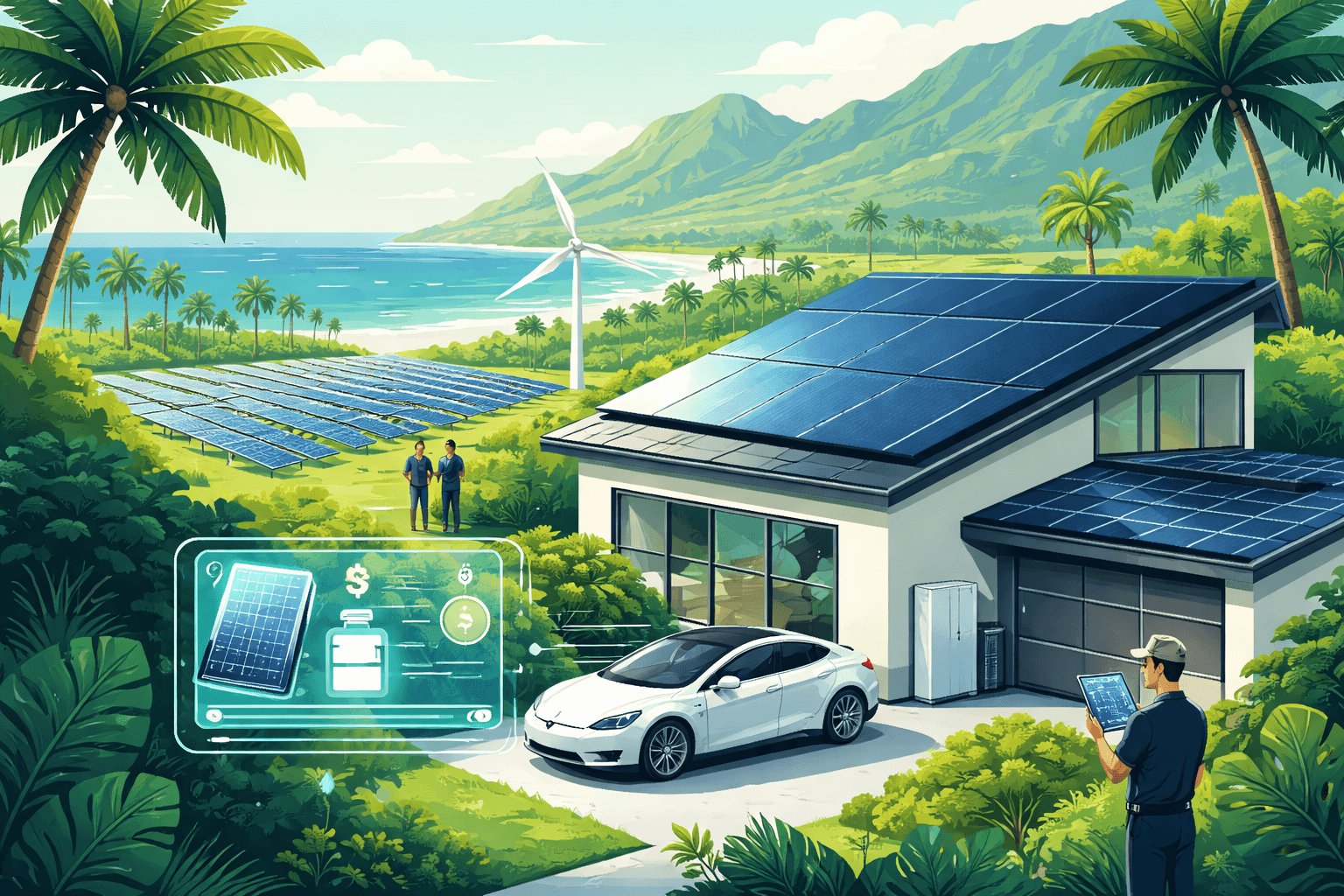
Hawaii homeowners pay the highest electricity prices in the United States, averaging roughly 43–45¢/kWh in 2025 according to the U.S. Energy Information Administration (EIA). With sunshine-rich islands and expensive grid power, Tesla Solar in Hawaii can deliver some of the fastest residential paybacks in the country—often 5–8 years when systems are paired with batteries and sized for self-consumption.
This 2026 guide explains Tesla’s products available in Hawaii, current pricing ranges, incentives, installation timelines, and what local customers report after living with the systems.
By the Numbers: Hawaii and Tesla Solar
- 43–45¢/kWh: Average Hawaii residential electricity rate in 2025 (EIA) — around 2.5–3x the U.S. average
- 1,600–1,850 kWh per kW-year: Typical PV output on Oʻahu/Maui (NREL PVWatts), capacity factor ~18–21%
- 30%: Federal Clean Energy ITC for residential solar and storage (Internal Revenue Code §25D, in effect through 2032 under the IRA)
- 35%: Hawaii renewable energy technologies income tax credit (state RETITC), subject to per-system caps and eligibility rules (Hawaii Dept. of Taxation)
100,000: Rooftop solar systems connected across Hawaiian Electric islands, indicating high grid penetration (Hawaiian Electric reporting)
Solar Electricity Handbook - 2023 Edition: A simple, practical guide to solar energy – designing and installing solar photovoltaic systems: Boxwell, Michael
Solar Electricity Handbook - 2023 Edition: <strong>A simple, practical guide to solar energy – designing and installing solar photovoltaic systems</strong> [Boxwell, Michael] on Amazon.com. *FREE* shi
Check Price on AmazonTesla Solar products available in Hawaii: panels, Solar Roof, and Powerwall bundles
Tesla sells two rooftop generation options in Hawaii—conventional all-black solar panels and the Tesla Solar Roof—typically bundled with a Powerwall home battery for reliability and tariff optimization.
Tesla solar panels
- Module class: Black, monocrystalline panels typically in the ~420–440 W range, with efficiencies around 20% (Tesla’s spec sheets vary slightly by batch and supplier year). Panels are tested for salt-mist corrosion (IEC 61701) — important for coastal Hawaii.
- Inverter: Recent installs pair panels with Tesla’s string inverter; Powerwall 3 includes an integrated solar inverter when installed as a bundle. Rapid-shutdown compliance is standard for HECO interconnection.
- Mounting: Low-profile racking designed to meet high-wind code requirements. Installers use corrosion-resistant hardware suitable for marine environments.
- Monitoring: The Tesla app provides real-time and historical generation, consumption, and battery state-of-charge.
Tesla Solar Roof
- What it is: Glass, electricity-generating tiles integrated with non-generating tiles to replace conventional roofing. The system can be paired with Powerwall for backup.
- Where it fits: Best for new builds or full reroofs where aesthetics and long roof life are priorities. Engineering for high-wind zones and watertight underlayment is central to the design.
- Considerations in Hawaii: Shipping, specialized crews, and complex roofs can lengthen timelines and increase costs compared with panels.
Tesla Powerwall (Powerwall 3)
- Use case: Nighttime self-consumption, outage protection, and participation in HECO export or grid-service programs where available. Batteries also help avoid low export credits by storing midday excess.
- Specs snapshot: Usable energy ~13.5 kWh per unit; stackable; 10-year warranty to 70% retained capacity. Powerwall 3 integrates a solar inverter for simpler installs.
- Relevance in Hawaii: With frequent afternoon trade winds and clouds, plus the islands’ evolving export rules, most buyers pair PV with storage for resilience and better economics. For a deeper dive on configurations, island availability, and pricing, see our guide: Tesla Powerwall in Hawaii: Cost, Availability & Is It Worth It?.
Tesla Solar pricing in Hawaii: panels vs. Solar Roof cost comparison
Actual quotes depend on roof complexity, island, and the balance-of-system components. National benchmarks from NREL’s cost studies show U.S. residential PV around $2.70–$3.25/W (all-in) in recent years; Hawaii typically trends higher due to shipping, labor, and marine-grade hardware requirements.
What we see in 2025–2026 quotes on the islands:
- Tesla panels (no battery): Roughly $2.60–$3.10 per watt before incentives
- Tesla panels + Powerwall 3: Add ~$10,000–$13,000 per battery installed in Hawaii
- Tesla Solar Roof: Commonly $35–$60 per square foot of total roof area all-in (active + inactive tiles), with complete projects often landing $65,000–$110,000+ depending on size and complexity
Example scenario (typical Oʻahu single-family home):
- System size: 7.5 kW panels
- Gross price: 7.5 kW × $2.85/W ≈ $21,375 (before incentives)
- Federal ITC (30%): −$6,412
- Hawaii RETITC (35%, capped per system): For many residential PV systems the cap effectively applies; assuming a $5,000 cap applies, −$5,000
- Net post-credit outlay: ≈ $9,963
- Expected annual production (PVWatts Oʻahu ~1,700 kWh/kW-year): 7.5 × 1,700 ≈ 12,750 kWh
- Bill offset value at 44¢/kWh retail: ≈ $5,610/year if fully self-consumed (less if part is exported at lower credits)
- Simple payback (panels-only, high self-consumption): ~1.8 years; with realistic export credits and household load shaping, many homes land in the 4–7 year range. Adding a Powerwall extends payback but increases resilience and can improve time-of-use savings.
Important: Hawaii export programs pay much less than retail for most daytime exports, and rules differ by island and program vintage. Batteries significantly improve economics by shifting solar to evenings when retail rates are highest.
For statewide price ranges beyond Tesla—including top local installers and market averages—see: Solar in Hawaii: Costs, Incentives & Top Installers (2026).
How to order Tesla Solar in Hawaii: timeline, site assessment, and installation
Tesla’s process is streamlined, but island logistics and interconnection queues can add weeks. A typical path:
- Online design and estimate
- Enter your address and recent utility usage. Tesla proposes a system size and panel layout. A small refundable order fee is collected to start engineering.
- Virtual site assessment
- You’ll submit roof photos, breaker panel details, and any HOA requirements. Tesla verifies rafter spacing, roof condition, and setback clearances.
- On-site assessment (as needed)
- For complex roofs, older electrical services, or Solar Roof projects, Tesla schedules a field visit to confirm measurements, structural conditions, and main-service upgrades.
- Permit and interconnection
- Tesla prepares engineered plans for county building permits and submits interconnection to Hawaiian Electric (or KIUC on Kauaʻi). Expect 2–8+ weeks depending on island and program.
- Installation day(s)
- Panels: 1–2 days for typical 6–10 kW systems; add 0.5–1 day per Powerwall
- Solar Roof: Often 1–3 weeks depending on roof size/complexity
- Inspections and Permission to Operate (PTO)
- County inspection plus utility PTO. Tesla will not energize export until PTO is granted. Storage-only backup may be enabled earlier for resilience.
- Activation and app setup
- You’ll see live production, consumption, and customizable battery modes (Backup-Only, Self-Powered, Time-Based Control) in the Tesla app.
Total timeline: 6–12 weeks for panels; 10–20+ weeks for Solar Roof, with outer ranges driven by permitting, interconnection queue, and shipping windows.
Hawaii solar incentives that apply to Tesla installations
- Federal Clean Energy ITC (30%): Applies to residential PV and battery storage charged by solar, available through 2032 under the Inflation Reduction Act. Claimed on IRS Form 5695.
- Hawaii RETITC (state solar tax credit): 35% credit with per-system caps for residential PV; credit structures and caps can vary by technology and system definition. The state has issued guidance over the years clarifying “per system” and how credits apply on multi-subarray homes. Consult the Hawaii Department of Taxation or a tax professional for current-year rules—especially if pairing storage or installing a Solar Roof.
- Utility export and grid-service programs: Net Metering is closed. Customers interconnect under programs such as Smart Export or Customer Grid-Supply Plus (program availability changes and may be island-specific). These typically credit exports below retail; Smart Export historically credited overnight exports only. Check Hawaiian Electric’s current tariff sheets before finalizing system size.
- Time-of-Use (TOU): If available on your island, TOU can improve battery ROI by shifting solar energy to peak-evening periods.
Because incentive rules and program queues evolve, always verify current details with your installer and utility. Our statewide snapshot is updated here: Solar in Hawaii: Costs, Incentives & Top Installers (2026).
Tesla Solar reviews from Hawaii customers: what owners actually report
What we hear most from Hawaii homeowners who installed Tesla Solar:
Strengths
- Competitive pricing: Tesla’s per-watt pricing is often among the lowest quotes, especially for straightforward roofs.
- Clean aesthetic and app: Black panels, hidden conduit where feasible, and a polished monitoring app. Owners value the “Self-Powered” and “Time-Based Control” battery modes during TOU periods.
- Outage performance: Powerwall systems ride through short outages seamlessly and provide day-and-night operation in longer events by recharging from solar.
Common pain points
- Scheduling and communication: National-scale logistics plus island shipping can lead to reschedules. Some customers report gaps between engineering updates and actual install dates.
- Interconnection timelines: At high rooftop PV penetrations, HECO reviews can be deliberate. Export limits on certain feeders may require design tweaks or added batteries.
- Service expectations: Warranty coverage is solid, but response times can be longer on the islands than on the mainland. Many homeowners value local partners for periodic maintenance, cleaning, or post-storm inspections.
Operational notes for island rooftops
- Salt air and hardware: Tesla’s marine-grade fasteners and anodized racking are designed for coastal conditions; owners near the shoreline often rinse modules periodically and schedule annual visual inspections.
- VOG and soiling: On Hawaiʻi Island and leeward Oʻahu, volcanic haze and dust can accumulate. Light cleaning can recover a few percentage points of output if soiling is visible.
Tesla vs. local Hawaii installers: pros, cons, and price comparison
Price ranges reflect 2025–2026 quotes we’ve reviewed and national benchmarks adjusted for Hawaii’s logistics.
Tesla Solar (panels)
- Typical price: ~$2.60–$3.10/W before incentives
- Pros: Aggressive pricing, integrated app, streamlined Powerwall bundles, familiar brand
- Cons: Less layout flexibility; communication cadence can feel corporate; change orders may move dates
Local installers (panels)
- Typical price: ~$2.90–$3.90/W before incentives (varies by island and equipment brand)
- Pros: Custom design for shade/microclimate; local permitting/interconnection relationships; often offer microinverters or DC optimizers; faster on-site service
- Cons: Higher prices on average; app experience varies by inverter brand; battery pairings and control logic differ
Which to choose?
- Straightforward roofs and budget focus: Tesla often wins on cost and aesthetics, especially if you want Powerwall.
- Complex roofs, heavy shade, or bespoke equipment: A top local firm may propose microinverters, module-level shutdown with advanced shade mitigation, and island-specific layout tweaks that outperform a generic design.
Tip: Get at least two quotes—including one from Tesla and one from a reputable local installer—using the same system size and storage capacity for apples-to-apples comparisons.
Tesla Solar warranty and what it covers in Hawaii
- Panels: 25-year performance warranty (typical guarantee ~80% of nameplate at year 25) and 10–12 years on product/workmanship depending on the exact panel generation.
- Inverter: Tesla inverter warranties are commonly 12 years; Powerwall 3’s integrated inverter follows the battery’s warranty for the storage portion.
- Solar Roof: 25-year tile warranty and weatherization coverage, plus power output warranty on the active tiles.
- Powerwall: 10 years with 70% retained usable capacity when used with solar; unlimited cycles typically allowed under solar self-consumption use. Backup power capability is included, with terms defined in Tesla’s warranty booklet.
Warranty terms are manufacturer-backed and apply in Hawaii; service dispatch times can vary by island and season.
Practical picks to boost ROI and resilience (optional add-ons)
- EV charging aligned with solar: Based on time-of-use savings and load-shifting benefits, the ChargePoint Home Flex Level 2 (up to 50A) is a strong value for maximizing daytime solar charging on Oʻahu and Maui.
- Whole-home visibility: A circuit-level monitor like the Emporia Vue Energy Monitor helps tune loads around battery discharge windows, often improving self-consumption by 5–15%.
- Water heating with solar: Heat pump water heaters deliver 3–4x the efficiency of resistance tanks; the Rheem ProTerra Heat Pump Water Heater helps soak up midday PV and cut bills materially.

Emporia Gen 2 Smart Home Energy Monitor with 16 50A Circuit Level Sensors | Real Time Electricity Monitor/Meter | Solar/Net Metering - Amazon.com
View on Amazon
ChargePoint HomeFlex Level 2 EV Charger J1772 - Fast Smart Battery Power Charging at Home for Electric Automobile Vehicles - NEMA 14-50 Plug for Electric Car : Automotive
View on AmazonFAQ: common questions about Tesla Solar in Hawaii
How well does Tesla Solar work with Hawaii’s utility programs?
- New Net Metering is closed. Customers interconnect under programs like Smart Export or CGS+. Credits are below retail for most exports; Smart Export historically credited nighttime exports. Batteries let you store midday energy to avoid low daytime rates and use power when it’s most valuable.
Is Tesla installing on all islands?
- Tesla commonly installs on Oʻahu, Maui, and Hawaiʻi Island. Kauaʻi is served by KIUC, a separate cooperative; availability can differ. Check Tesla’s site by ZIP code for current coverage.
Will a Powerwall back up my whole house?
- A single Powerwall (≈13.5 kWh) can run essentials (fridge, lights, internet, a few outlets) for many hours. Whole-home backup with central AC typically needs 2–3 units; large homes or multi-split ACs may need 3–4, depending on start-up currents.
What roof types are compatible?
- Tesla panels mount to asphalt shingle, metal, and tile roofs with appropriate attachments. Tesla Solar Roof replaces the entire roof and is best for new construction or when the existing roof needs replacement.
How does wind and salt air affect longevity?
- Tesla’s racking and fasteners are corrosion-resistant, and panels carry salt-mist certifications. Hawaii owners near the ocean often rinse modules occasionally and book periodic inspections—especially after high-wind events.
What’s the typical timeline from order to PTO in Hawaii?
- For panels, 6–12 weeks is common; Solar Roof can run 10–20+ weeks. Interconnection and shipping windows are the biggest variables.
How do I decide between Tesla panels and Solar Roof?
- If your current roof is in good condition and aesthetics are secondary to ROI, panels offer the lowest cost per watt. If you’re reroofing and want a high-aesthetic system with a long roof warranty, Solar Roof is worth a look—just budget more time and cost.
Where can I learn more about Powerwall program economics on the islands?
Where the market is heading
Hawaii’s grid is evolving from daytime-solar-abundant to storage-centric. The state’s 100% RPS by 2045 means more rooftop PV, more distributed batteries, and smarter tariffs. NREL and utility pilots show batteries can provide firm capacity and shift solar to evenings. For homeowners, that means Tesla Solar in Hawaii will increasingly be sold as a solar-plus-storage bundle with automation that follows time-varying prices and export windows.
Actionably, that favors right-sizing arrays for on-site use, adding at least one Powerwall for evening loads and outages, and pairing the system with flexible loads (EV charging, heat pump water heating) that absorb midday production. With those choices, island households can push effective paybacks toward the low end of the range while gaining resilience for the next storm season.
Recommended Products
Solar Electricity Handbook - 2023 Edition: A simple, practical guide to solar energy – designing and installing solar photovoltaic systems: Boxwell, Michael
Solar Electricity Handbook - 2023 Edition: <strong>A simple, practical guide to solar energy – designing and installing solar photovoltaic systems</strong> [Boxwell, Michael] on Amazon.com. *FREE* shi
ChargePoint HomeFlex Level 2 EV Charger J1772 - Fast Smart Battery Power Charging at Home for Electric Automobile Vehicles - NEMA 14-50 Plug for Electric Car : Automotive
Home Flex Hardwired offers the fastest charge at up to 50A. NEMA 6-50 and 14-50 versions <strong>provide up to 40A and work with existing 240V wall outlets</strong>. Yes! Choose from our list of prefe
Emporia Gen 2 Smart Home Energy Monitor with 16 50A Circuit Level Sensors | Real Time Electricity Monitor/Meter | Solar/Net Metering - Amazon.com
See how much electricity your home is using anywhere, anytime. ... <strong>Add individual 50A sensors to your Vue to monitor up to 16 individual circuits</strong> — providing accurate energy use for t