
Tesla Solar in South Carolina: Panels, Roof & Pricing Guide (2026)
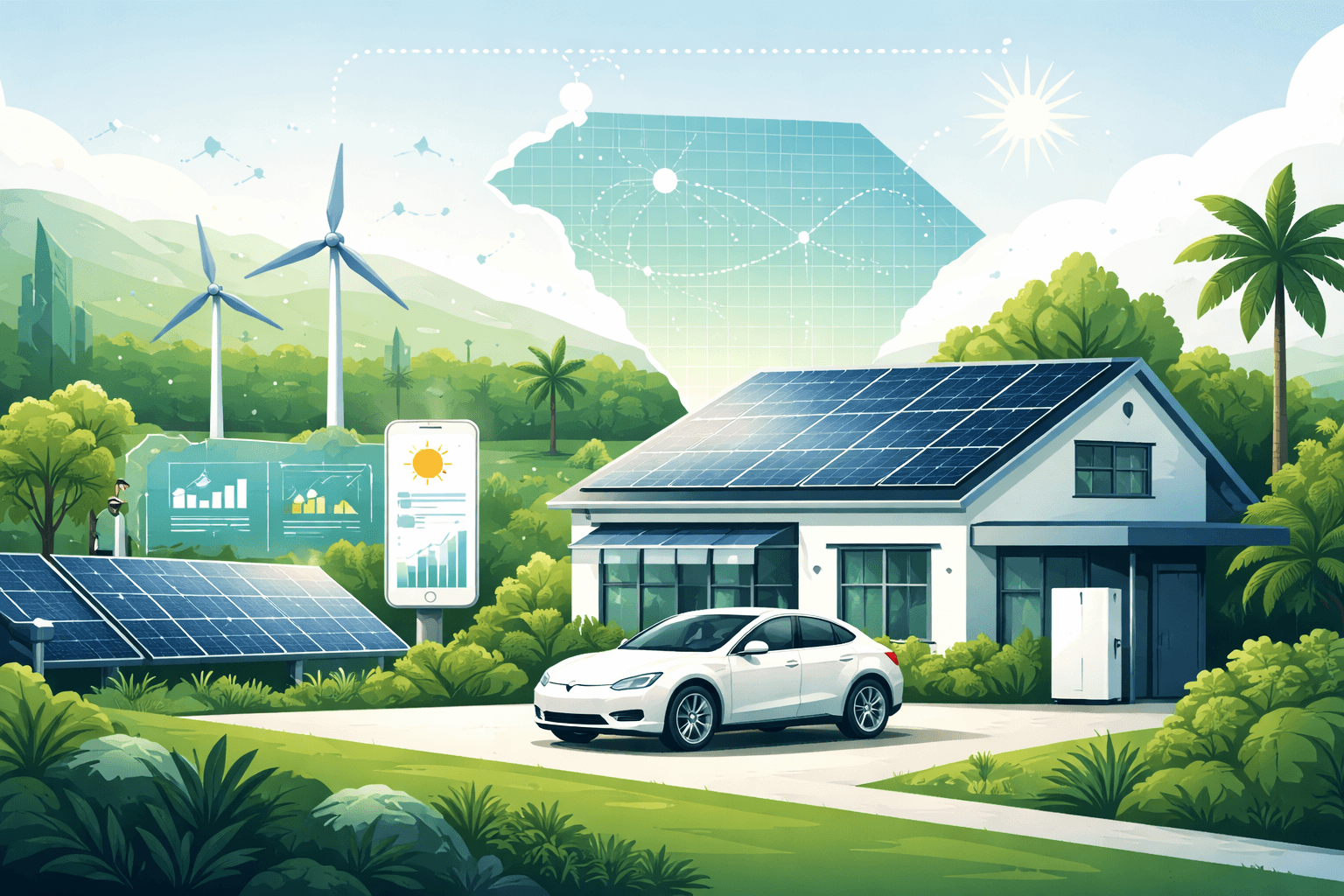
South Carolina homeowners are adopting solar at one of the fastest clips in the Southeast. SEIA estimates the state surpassed roughly 2.9 GW of installed solar capacity by 2024, with strong residential growth supported by a 25% state tax credit and competitive installer pricing. If you’re comparing Tesla Solar in South Carolina — panels, Solar Roof, and Powerwall bundles — here’s what to know in 2026, with real costs, incentives, and how the process works in your utility territory.
What Tesla Solar products are available in South Carolina?
Tesla sells three core options statewide: traditional solar panels, the integrated Solar Roof, and Powerwall home batteries. Systems can be purchased as solar-only or with Powerwall bundles.
Solar Electricity Handbook - 2023 Edition: A simple, practical guide to solar energy – designing and installing solar photovoltaic systems: Boxwell, Michael
Solar Electricity Handbook - 2023 Edition: <strong>A simple, practical guide to solar energy – designing and installing solar photovoltaic systems</strong> [Boxwell, Michael] on Amazon.com. *FREE* shi
Check Price on AmazonTesla Solar Panels
- All-black monocrystalline modules typically in the 420–440 W range with 20–22% nameplate efficiency (Tesla sources Tier-1 modules and badges them; exact make/model can vary by batch).
- Paired with the Tesla Solar Inverter (3.8 kW or 7.6 kW AC units; California Energy Commission efficiency near 98%), or with Powerwall 3’s integrated solar inverter for DC-coupled designs.
- Low-profile mounting, black racking, and hidden conduit when feasible for a cleaner roofline.
Tesla Solar Roof
- Glass solar tiles replace your roofing material entirely; non-solar tiles match the look to create a uniform roof.
- Best suited for full roof replacements or new construction where you’d otherwise pay for a premium roof and solar.
Tesla Powerwall (2 and 3)
- Usable capacity about 13.5 kWh per unit and up to 11.5 kW peak output for Powerwall 3 with whole-home backup options; designed for daily cycling under time-of-use rates.
- Pairs with rooftop solar to provide outage backup, self-consumption, and time-shifting; managed through the Tesla app.
Tesla focuses on a standardized design/build model: fixed inverter pairings, neat wire management, and app-based monitoring. The result is generally faster quoting and often lower soft costs than many bespoke installations.
Tesla Solar pricing in South Carolina: panels vs. Solar Roof
Residential installed costs vary by utility, roof complexity, and equipment. National marketplace data (EnergySage, NREL benchmark reports) put typical residential solar at about $2.80–$3.50 per watt (W) before incentives in 2024. In South Carolina’s competitive market, quotes frequently land toward the lower half of that range. Tesla often undercuts local averages by 5–15% with standardized designs.
Typical Tesla Solar Panels (South Carolina, 2026 planning ranges)
- 7–10 kW systems: $2.40–$3.00/W before incentives
- Example: 8 kW system priced at $20,000–$24,000 before incentives
Tesla Solar Roof (with new roof included)
- Highly variable because roof size/complexity dominates cost
- Common quotes reviewed across the Southeast in 2024–2025: $70,000–$120,000 total before incentives for average single-family homes (8–12 kW solar portion), with simple gable roofs at the low end and complex/steep roofs at the high end
Powerwall adders (installed with solar)
- First unit: $9,000–$11,500 installed
- Additional units: $7,500–$9,500 each installed
These are planning ranges; your exact quote will reflect your roof, service panel, and interconnection details. Use Tesla’s online configurator for a fast ballpark, then expect a site assessment to confirm final design and price.
How incentives change the net cost
- 30% Federal Investment Tax Credit (ITC): Applies to both Tesla Solar Panels and Solar Roof (solar portion), plus Powerwall when installed with solar for storage of solar energy.
- 25% South Carolina state solar tax credit: Calculated on the total eligible installed cost, with two key constraints — you can only claim up to $3,500 per year or 50% of your state tax liability (whichever is less), carrying unused credit forward up to 10 years (S.C. Dept. of Revenue guidance).
Illustrative example for an 8 kW Tesla panel system priced at $22,000 before incentives:
- Federal ITC (30%): -$6,600
- SC tax credit (25%): -$5,500 total credit, but claimed over multiple years if your annual SC liability doesn’t cover it
- Net effective cost after full utilization: about $9,900
Note: Credits reduce tax liability; they are not rebates. You must have sufficient tax appetite to monetize them. Many homeowners realize the SC credit over several tax years due to the $3,500/year cap.
For deeper state-level pricing context, see our market overview: Solar in South Carolina: Costs, Incentives & Top Installers (2026).
How to order Tesla Solar in South Carolina
Tesla’s process is streamlined and mostly app-driven.
- Online design and instant estimate
- Enter your address and utility bill; the configurator proposes a system size based on roof imagery and your usage. You’ll see estimated production (kWh/year), price, and optional Powerwall adders.
- Virtual or on-site assessment
- Tesla validates roof condition, shading, service panel capacity, and structural details. In South Carolina, many homes with 150–200A service can accommodate 7–12 kW systems without panel upgrades, but older homes may need main panel or service mast work.
- Final design, contracts, and financing
- Options include cash purchase, third-party loans, or HELOCs. Review design, component layouts, and interconnection terms (export crediting depends on Dominion or Duke tariffs — more below).
- Permits, HOA approvals, and utility interconnection
- Tesla files building/electrical permits and initiates interconnection. Expect 2–6 weeks for approvals depending on municipality. HOAs often require aesthetic reviews even when covenants permit solar.
- Installation day(s)
- Panel systems commonly install in 1–2 days; Solar Roofs can take 5–10+ days. Powerwall adds half to a full day per battery.
- Inspections and permission to operate (PTO)
- City/county inspections precede utility meter swap or reprogramming. PTO timelines in South Carolina often run 1–4 weeks after installation.
End-to-end, a standard Tesla Solar project in South Carolina typically completes in 6–12 weeks from contract to PTO, subject to permit queues and utility timelines.
If you’re leaning toward a battery, our deep-dive on storage economics and specs may help: Tesla Powerwall in South Carolina: Cost, Availability & Is It Worth It?
South Carolina solar incentives that apply to Tesla installations
Federal ITC (30%)
- Applies to solar and storage (if charged by solar). No dollar cap. Carryforward available if federal tax liability is insufficient in year one.
South Carolina 25% solar tax credit
- 25% of eligible installed costs, claimed up to $3,500 per year or 50% of tax liability per year, 10-year carryforward.
- Stacks with the federal ITC; combined credits cannot exceed total project cost.
Utility export crediting (net metering successor tariffs)
- Dominion Energy South Carolina: Solar Choice tariffs use time-of-use (TOU) pricing and provide export credits closer to avoided cost than full retail. Export values vary by season/hour; daytime credits are often in the 3–6¢/kWh range, below retail rates.
- Duke Energy Carolinas/Progress (SC): TOU-centric successor tariffs with seasonal/critical peak periods; exported kWh credited at rates linked to avoided energy costs.
Sales/property tax
- South Carolina generally exempts renewable energy equipment from state sales tax in certain contexts and provides favorable property tax treatment to utility-scale projects; homeowners should confirm current residential sales tax rules with their installer and tax advisor, as local implementations can vary.
EIA reports average South Carolina residential electricity prices near the mid-teens cents/kWh in 2024, with TOU spreads that can reward daytime self-consumption and battery arbitrage. Batteries can meaningfully improve economics under successor tariffs by shifting solar to evening peaks.
By the Numbers: Tesla Solar in South Carolina
- Solar resource: NREL PVWatts indicates 4.5–5.0 peak sun hours/day for much of South Carolina; a 1 kW DC system can generate about 1,300–1,600 kWh/year depending on tilt/orientation.
- Typical home system: 7–10 kW DC, producing roughly 10,000–14,000 kWh/year.
- Avoided utility energy: At 14¢/kWh retail, each 10,000 kWh/year offsets ~$1,400/year before considering TOU/export rules.
- Battery sizing rule-of-thumb: One Powerwall (~13.5 kWh) covers essential loads for multi-hour evening peaks and most short outages; two units can back most 2,000–3,000 sq. ft. homes, including larger HVAC loads.
- Carbon impact: The U.S. EPA’s eGRID suggests the regional grid intensity in the Southeast is ~0.5–0.7 lb CO2/kWh; a 10 kW array offsetting 12,000 kWh can avoid ~3–4 tons CO2 annually.
What South Carolina Tesla owners report: reviews and reliability
Owner feedback in the Carolinas tends to cluster around these themes:
Pricing and value
- Many choose Tesla for transparent, competitive bids and clean aesthetics. Quotes often undercut bespoke installers by several thousand dollars for similar capacity.
Communication and scheduling
- Strong app experience and clear milestone updates; some report delays during busy seasons or when utility interconnection queues stretch.
Performance vs. projections
- NREL-based production estimates are generally hit when shading and roof pitch are accurately modeled. Underperformers often trace to unexpected shading, soiling, or inverter clipping on very sunny days.
Service response
- Warranty service is handled through the Tesla app. Response can be prompt in metro areas; rural customers sometimes report longer scheduling windows. Keep your monitoring alerts enabled.
Powerwall satisfaction
- High satisfaction for backup and TOU savings; owners appreciate seamless switchover and granular control of backup reserve levels.
As with any large installer, local crew quality matters. Ask to see recent South Carolina installations and confirm who performs the work (Tesla-employed crews vs. certified subcontractors) in your county.
Tesla vs. local South Carolina installers: pros, cons, and prices
Where Tesla excels
- Standardization drives lower soft costs; strong value on straightforward, asphalt-shingle roofs in the 7–12 kW range.
- Integrated ecosystem (app, inverter, Powerwall) and a single point of contact for system monitoring and service.
- Clean aesthetics and low-profile mounting.
Where local installers can win
- Complex roofs, metal/standing seam, shaded sites requiring module-level power electronics (e.g., Enphase microinverters) and custom array layouts.
- Faster in-person service in some markets; tailored support for critter guards, snow guards, or hurricane tie-down details.
- Deep familiarity with Dominion and Duke successor tariffs, local permit offices, and HOA nuances.
Price comparison (typical 2024–2026 planning ranges before incentives)
- Tesla: ~$2.40–$3.00/W for standard panel systems in SC
- Local EPCs: ~$2.60–$3.40/W, with wider variance by equipment brand and roof complexity
If you’re evaluating across state lines (e.g., for a second home), see our neighboring market overview: Tesla Solar in North Carolina: Panels, Roof & Pricing Guide (2026).
Tesla Solar warranty in South Carolina: what’s covered
Panels (Tesla-badged Tier-1 modules)
- Product warranty commonly 12–25 years depending on the exact module supplied in your project.
- Performance warranty typically guarantees 80–85% of nameplate output at year 25 (degradation ~0.5–0.6%/year). Check your final datasheet for the specific guarantee.
Tesla Solar Inverter
- Limited warranty often 12 years, with an option to extend in some markets.
Powerwall 2/3
- 10-year warranty for residential use, designed for daily cycling (solar self-consumption) with throughput conditions defined in Tesla’s warranty.
Solar Roof
- Weatherization/tiles up to 25 years (materials/workmanship) plus a 25-year power output warranty on active tiles. Inverter/balance-of-system warranties similar to panel systems.
All warranties are honored in South Carolina; service is initiated through the Tesla app. Verify final terms in your contract, as warranty specifics can vary by batch and year of purchase.
Practical buying tips and recommended gear
- TOU and export rules matter
- Under Dominion and Duke successor tariffs, each exported kWh is generally worth less than retail. Right-size your system to maximize self-consumption and consider at least one battery if your peak usage is in the evening.

Enphase ENPHASE IQ8PLUS-72-2-US IQ8+ ...
View on Amazon
Emporia Vue 3 Home Energy Monitor - Smart Home Automation Module and Real Time Electricity Usage Monitor, Power Consumption Meter, Solar and Net Metering for UL Certified Safe Energy Monitoring - Amazon.com
View on AmazonMicroinverter or optimizer alternatives
- If you have complex shading or multiple roof planes, module-level power electronics can boost yield. Based on strong field reliability and rapid shutdown compliance, the Enphase IQ8 Microinverter represents strong value for residential installations.
Panel-level monitoring and smart loads
- Pairing solar with a smart electrical panel helps shift flexible loads (EV charging, heat pump water heating) to sunny hours. The Span Smart Panel can optimize self-consumption and backup priorities.
Monitoring and energy insights
- A dedicated energy monitor reveals hidden loads and validates savings. The Emporia Vue Energy Monitor is a cost-effective option to track whole-home and circuit-level usage.
FAQ: common questions about Tesla Solar in South Carolina
Will Tesla Solar work with my HOA?
- Most HOAs allow solar with aesthetic guidelines. Expect requirements for flush mounting, conduit concealment, and black hardware. Submit Tesla’s design set early to avoid schedule slips.
How many Powerwalls do I need?
- One unit (~13.5 kWh) typically backs essentials (lights, fridge, Wi-Fi, some outlets) and covers short outages; two units handle larger HVAC loads and multi-day storms more comfortably. Your installer will model your critical loads and recommend a size.
Can Tesla back up my whole home?
- Yes, with adequate battery capacity and a whole-home transfer switch. Many homes opt for essential-load subpanels to reduce battery count and cost.
What about hurricanes and wind ratings?
- Tesla’s racking is engineered to local wind codes; South Carolina coastal counties have higher design wind speeds. Ask for stamped structural/wind calculations and verify lag bolt pull-out values for your roof sheathing.
How long will installation take?
- 1–2 days for typical panel systems; 5–10+ days for Solar Roofs. End-to-end project timelines run 6–12 weeks factoring permits, inspections, and utility PTO.
Does Tesla offer critter guards or snow guards?
- In the Carolinas, critter guards are common where squirrels nest under arrays. Ask to add them if you have overhanging trees. Snow guards are rarely needed in most of South Carolina.
What maintenance is required?
- Solar is low maintenance. Rinse dust/pollen as needed; inspect annually for debris. The Tesla app will flag inverter or string issues automatically.
What production should I expect?
- NREL PVWatts suggests 1,300–1,600 kWh/kW-year in South Carolina depending on roof tilt/azimuth. An 8 kW system often produces ~10,000–12,000 kWh/year on a south-facing roof at 25–30° tilt.
Are leases or PPAs available?
- Tesla’s offerings in the Southeast focus on customer-owned systems (cash or loans). Third-party ownership options are limited in South Carolina compared to other states.
Where the market is heading
- More battery-centric designs: As export values align with avoided costs, pairing solar with storage becomes more compelling — not just for outages, but for TOU optimization.
- Higher-efficiency modules: Expect more 430–460 W panels on residential roofs with 21–23% efficiencies, helping shrink array footprints.
- Smarter load control: EV charging, heat pump water heaters, and smart panels will integrate directly with solar/battery systems, maximizing self-consumption without homeowner micromanagement.
South Carolina’s strong sun, stackable state and federal credits, and falling soft costs make 2026 a favorable year to go solar. For straightforward roofs, Tesla Solar in South Carolina remains a sharp value play; for more complex projects, weigh local installer proposals that tailor equipment to your roof and tariff. Either way, model your savings under your exact Dominion or Duke TOU/export schedule and consider at least one battery if your peak use is after sunset.
Recommended Products
Solar Electricity Handbook - 2023 Edition: A simple, practical guide to solar energy – designing and installing solar photovoltaic systems: Boxwell, Michael
Solar Electricity Handbook - 2023 Edition: <strong>A simple, practical guide to solar energy – designing and installing solar photovoltaic systems</strong> [Boxwell, Michael] on Amazon.com. *FREE* shi
Emporia Vue 3 Home Energy Monitor - Smart Home Automation Module and Real Time Electricity Usage Monitor, Power Consumption Meter, Solar and Net Metering for UL Certified Safe Energy Monitoring - Amazon.com
<strong>Add individual 50A sensors to your Vue to monitor up to 16 individual circuits</strong> — providing accurate energy use for the appliances and equipment that is important to you. No guesswork.
Enphase ENPHASE IQ8PLUS-72-2-US IQ8+ ...
Enphase · 240v · Solar · Hoymiles · Iq8 See more · Eligible for Free Shipping · Free Shipping by Amazon · Get FREE Shipping on eligible orders shipped by Amazon · Delivery Day · Get It by Tomorrow · D