
Why Recycling Plastic Matters: Environmental, Economic and Health Benefits
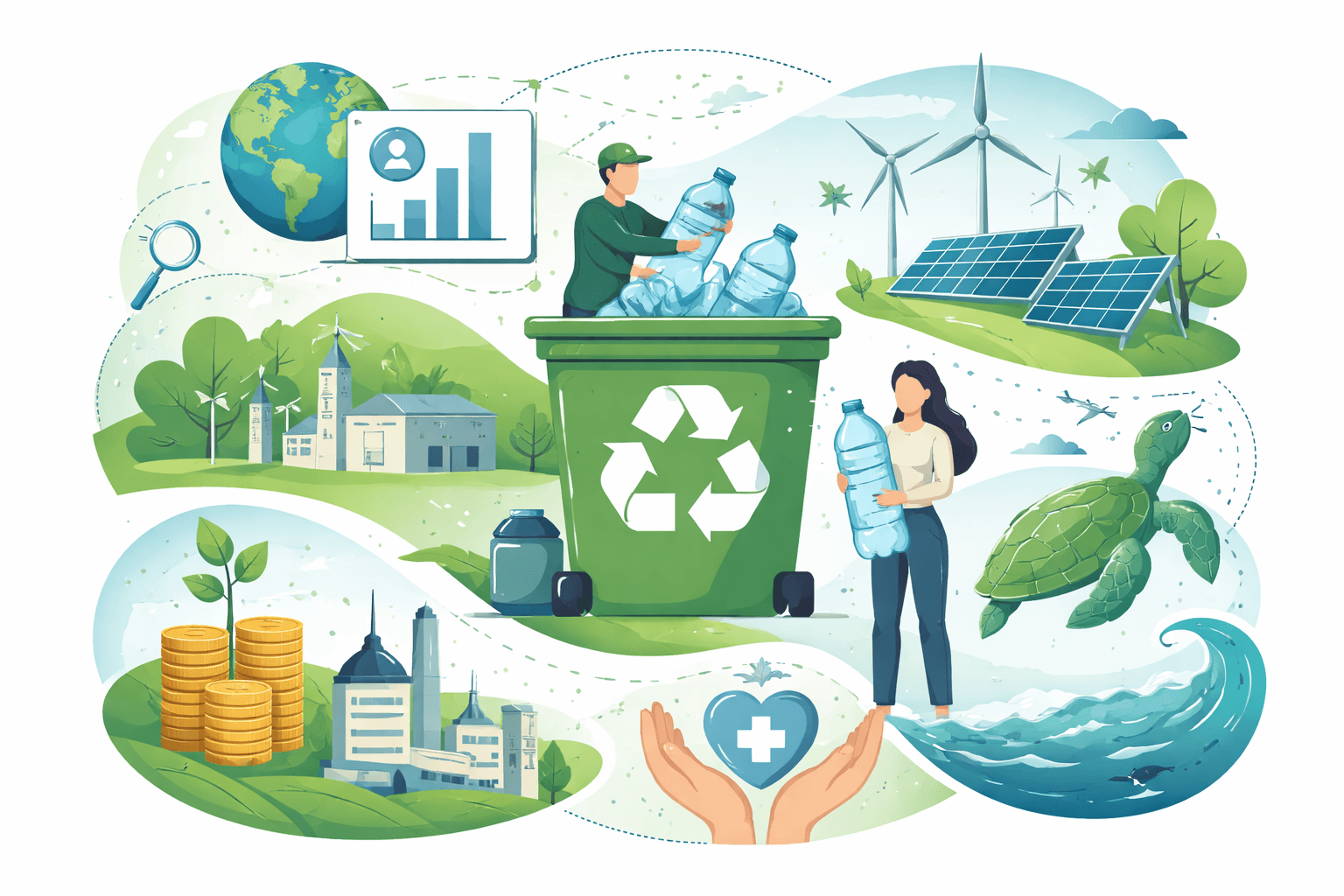
Recycling rates, climate targets, and ocean health are converging into one clear signal: the benefits of recycling plastic are large, measurable, and increasingly necessary. In 2019 the world generated about 353 million tonnes of plastic waste; only 9% was recycled, 19% was incinerated, nearly 50% was landfilled, and 22% was mismanaged through open dumping, littering, or open burning (OECD, 2022). Even modest improvements in collection and recycling translate into real cuts in pollution and greenhouse gases.
By the numbers
- 353 million tonnes: Global plastic waste generated in 2019; 9% recycled (OECD, 2022)
- 1.8 gigatonnes CO2e: Life‑cycle greenhouse gas emissions from plastics in 2019 (OECD, 2022)
- Up to ~70–80%: Typical GHG reduction when making recycled PET or HDPE instead of virgin resin in Europe (Quantis/Plastics Recyclers Europe, 2020)
- ~80%: Potential reduction in annual ocean plastic flows by 2040 under a system-change scenario centered on collection, recycling, and design (Pew & SYSTEMIQ, 2020)
- $80–120 billion: Estimated annual value of plastic packaging material lost to the economy after a short first use (Ellen MacArthur Foundation, 2016)
The Future of Packaging: From Linear to Circular: Szaky, Tom
This extraordinary collection <strong>shows how manufacturers can move from a one-way take-make-waste economy that is burying the world in waste to a circular, make-use-recycle economy</strong>. Steer
Check Price on AmazonThe environmental benefits of recycling plastic
Diverting waste from landfills and the environment
Because plastics are lightweight and durable, they accumulate in landfills and landscapes for decades. Scaling collection and high‑quality recycling reduces the share of waste sent to landfills and cuts mismanaged waste that leaks into rivers and coastal areas. Countries with deposit-return systems (DRS) for beverage containers routinely achieve 85–95% collection of PET bottles, sharply reducing litter and boosting supply for recycled plastic; Norway’s DRS has reported PET return rates above 90–95% for years (Infinitum, system operator reports).
Measured at scale, higher collection and recycling directly reduce leakage to nature. A global analysis found that with a concerted shift to a circular system—better product design, expanded collection, and a tripling of recycling—the annual flow of plastic into the ocean could fall by roughly 80% by 2040 compared with business as usual (Pew & SYSTEMIQ, 2020).
Cutting lifecycle greenhouse gas emissions
Plastics are fossil-derived materials, mostly from oil and gas. Making virgin polymers requires energy-intensive cracking and polymerization. Producing recycled resin replaces those upstream steps. Life‑cycle assessments consistently show sizable climate benefits when recycled content displaces virgin plastic:
- Recycled PET (rPET) and recycled HDPE (rHDPE) in Europe typically reduce cradle‑to‑gate GHG emissions by about 60–80% relative to virgin resin, depending on electricity mix and process efficiency (Quantis/Plastics Recyclers Europe, 2020).
- The U.S. EPA’s WARM model indicates that recycling one metric tonne of mixed plastics avoids on the order of 1–1.5 metric tonnes of CO2e compared with landfilling and producing equivalent virgin material (EPA WARM, v15 methodology).
Given plastics’ global life‑cycle footprint of about 1.8 Gt CO2e in 2019 (OECD, 2022), displacing even a fraction of virgin production with recycled content is a material wedge in climate strategies.
Reducing marine debris and wildlife harm
Hundreds of marine species are affected by plastic ingestion and entanglement, including seabirds, turtles, and marine mammals (UNEP). Because most ocean plastic originates from land-based mismanaged waste, expanding collection and recycling—especially in rapidly urbanizing coastal regions—directly lowers the load entering waterways. The benefits of recycling plastic here are twofold: less waste becomes litter, and demand for virgin resin falls, shrinking pre‑production pellet loss, a documented source of microplastic pollution (IUCN, 2017).
Resource and energy savings from recycling plastic
Lower fossil feedstock demand
Plastics are central to petrochemicals, a sector projected to drive more than a third of the growth in oil demand and nearly half of the growth in gas demand to 2030–2050 (IEA, 2018). Each tonne of recycled polymer displaces a comparable amount of virgin resin, which cascades upstream to avoid extracting and processing additional barrels of oil or cubic meters of natural gas.
Manufacturing energy reductions
Virgin PET and HDPE typically require tens of megajoules of process energy per kilogram. Mechanical recycling largely skips energy-intensive cracking and polymerization. European eco-profiles and LCAs indicate that rPET and rHDPE can cut cumulative energy demand by roughly 40–70% compared with virgin, depending on the recycling route and power grid (PlasticsEurope eco-profiles; Quantis/Plastics Recyclers Europe, 2020). Where grids are decarbonizing, the emissions savings grow further.
Logistical efficiencies
Because recycled resin markets often develop regionally (for example, bottle‑to‑bottle loops within a country), transportation distances for feedstock and finished goods can fall compared with importing virgin resin or finished packaging from afar. While transport is usually a small slice of plastics’ overall footprint, local loops are a pragmatic way to chip away at both emissions and logistics costs.
Economic and social benefits
Municipal cost savings and budget stability
Landfilling and waste export both carry rising costs and liabilities. U.S. municipal landfill tipping fees average roughly $50–60 per ton and can exceed $100 in some regions (EREF, 2023). When programs capture clean, high‑value plastic streams like PET and HDPE, revenues from bales can offset collection and processing costs, improving the economics of curbside systems and reducing landfill volumes. Contract structures such as revenue‑share with material recovery facilities (MRFs) can buffer municipal budgets against commodity swings.
Recycle Sticker Trash Bin Label 8 Pack-4"x4"-Waterproof Organize & Coordinate Garbage Waste from Recycling Indoor & Outdoor,Great for Metal Aluminum Steel or Plastic Trash Cans,Use at Kitchen &Office
View on AmazonMunicipalities that improve sorting—through standardized bins, clearer labels, and targeted outreach—reduce contamination, which lowers processing costs and increases the value of bales. For practical, step‑by‑step approaches that improve program performance and safety, see Safer Recycling Methods: Practical Steps to Protect People, Property, and the Planet (/sustainability-policy/safer-recycling-methods-practical-steps-protect-people-property-planet) and How to Recycle Waste Effectively: Practical Guidance to Reduce Contamination and Maximize Recovery (/sustainability-policy/how-to-recycle-waste-effectively-practical-guidance).
Jobs and local enterprise
Recycling and reuse are labor‑intensive compared with landfilling. The U.S. EPA’s Recycling Economic Information (REI) study estimates that recycling and reuse activities support about 681,000 jobs and $37.8 billion in wages nationwide (EPA REI, 2020). Plastics collection, sorting, washing, reprocessing, and remanufacturing underpin thousands of small and mid‑sized businesses—from community-run collection cooperatives to sophisticated bottle‑to‑bottle plants. Extended producer responsibility (EPR) systems and recycled‑content mandates create predictable demand that encourages private investment and stable jobs.
Recovering lost material value
The Ellen MacArthur Foundation estimates that $80–120 billion in plastic packaging value is lost annually after a short first use. Designing packaging for recyclability and building reliable end‑markets help capture a meaningful fraction of that value. For example, clear PET bottles designed without pigments and with compatible labels and adhesives keep rPET quality high, enabling closed‑loop bottle‑to‑bottle recycling with price premiums over mixed or contaminated streams.
Ecosystem and public‑health benefits
Less harm to wildlife and habitats
Effective recycling systems reduce litter and illegal dumping, protecting rivers, beaches, and urban green spaces where fauna encounter plastic. With fewer items entering the environment, entanglements and ingestion drop, improving survival odds for species already stressed by climate and habitat loss. Clean-up costs also fall for municipalities and tourism economies that rely on pristine environments.
Lower microplastic release
Plastic’s fragmentation into microplastics is accelerated by sun and abrasion. By capturing items earlier in their life and reprocessing them, recycling slows the generation of secondary microplastics from litter. It also reduces demand for virgin polymer pellets, lowering the risk of accidental pellet loss (a primary microplastic source) along the supply chain. While tires and textiles remain major microplastic contributors (IUCN, 2017), reducing virgin demand through the benefits of recycling plastic is one of the actionable levers available today.
Reduced exposure to toxic emissions from production
Virgin plastic production clusters in petrochemical corridors where communities face cumulative air toxics from facilities emitting benzene, 1,3‑butadiene, styrene, and ethylene oxide (EPA risk assessments). Slowing growth in virgin capacity through increased recycled content can modestly reduce upstream emissions and associated health risks over time, especially when paired with stronger permitting and emissions controls.
Note: Mechanical recycling can carry forward legacy additives (like certain flame retardants or plasticizers) if input streams are poorly controlled. That’s why design‑for‑recycling, source‑segregated collection, and robust standards for food‑contact applications are essential. Chemical recycling pathways that truly depolymerize to monomers (for PET, nylon) can remove many additives, but they come with higher energy needs and mixed economics today; transparent reporting is critical to ensure net environmental gains.
The benefits of recycling plastic in a circular‑economy strategy
Recycling is one pillar of a broader circular strategy that includes reduction, reuse, and redesign. Policies and market signals are aligning to make recycling more effective and valuable:
- Recycled‑content mandates: The EU requires at least 25% recycled plastic in PET beverage bottles by 2025 and 30% in all plastic bottles by 2030. California mandates 25% rPET in beverage bottles by 2025 and 50% by 2030 (CalRecycle).
- Deposit‑return systems: Proven to lift beverage container collection rates to 85–95%, supplying clean feedstock and cutting litter.
- Extended producer responsibility (EPR): Producers fund collection and processing, aligning design choices with end‑of‑life costs and performance.
- Design standards: Simplifying polymers, eliminating problematic additives, and standardizing labels make recycling cheaper and higher‑quality.
For a broader view of how circular systems create economic and social value beyond waste diversion, see Why the Circular Economy Pays Off: Economic, Environmental and Social Benefits (/sustainability-policy/benefits-of-circular-economy).
Case examples with measurable outcomes
- High‑return bottle loops: Countries with mature DRS—such as Norway and Germany—report PET bottle return rates around or above 90%, enabling high‑quality rPET suitable for food‑grade applications and cutting litter dramatically (system operator reports; EU monitoring under the Single‑Use Plastics Directive).
- South Africa’s PETCO model: An industry‑funded system has sustained PET bottle collection rates above 60% in multiple years, while supporting tens of thousands of income opportunities in collection and sorting (PETCO annual reports). The model demonstrates how predictable funding and buy‑back rates can scale recycling in emerging markets.
- Brand and city procurement: Public and private procurement specifying minimum recycled content stimulates steady demand, improving the business case for local reprocessors. This has helped justify investments in wash lines, flake quality upgrades, and food‑grade pelletization.
Realistic limits—and how to unlock greater benefits
Recycling is not a silver bullet. Understanding its limits helps target reforms where they matter most.
Key constraints
- Contamination and sorting challenges: Food residue, films mixed with rigid plastics, and multi‑layer packaging lower bale quality. Advanced near‑infrared (NIR) sorting helps but benefits from better upstream separation.
- Polymer degradation: Mechanical recycling can reduce molecular weight and performance; closed‑loop applications may need stabilizers or blending with virgin to meet specs.
- Economics and market volatility: Resin prices fluctuate with oil and gas markets. Stable policy signals (recycled‑content rules, DRS, EPR) reduce boom‑bust cycles.
- Export risks: Basel Convention plastic amendments tightened controls on waste exports. Building domestic capacity is increasingly important for compliance and environmental integrity.
Actionable levers
- Standardize what’s collected and how it’s labeled to reduce consumer confusion and contamination.
- Prioritize high‑impact streams first (PET and HDPE bottles; rigid PP), where markets and technologies are mature.
- Invest in MRF and reprocessing upgrades (optical sorters, hot‑wash lines) that lift yield and resin quality.
- Pair mechanical recycling with targeted depolymerization for hard‑to‑recycle, high‑value streams (e.g., PET trays, nylon carpets), but require transparent, audited energy and mass‑balance reporting.
- Use procurement to lock in steady demand for recycled resin; recycled‑content mandates level the playing field.
If you’re standing up or improving a local program, our Plastic Recycling Program Guide: Practical Planning, Operations, Markets, and Measurement (/sustainability-policy/plastic-recycling-program-guide-planning-operations-markets-measurement) offers detailed steps, from contracts to contamination control. For community‑level projects with clear metrics and budgets, see Plastic Recycling Projects: Practical Ideas, Costs, and Measurable Impact (/sustainability-policy/plastic-recycling-projects-practical-ideas-costs-measurable-impact).
What this means for households, businesses, and policymakers
- Households: Focus on the highest‑value items—clean, empty PET (#1) and HDPE (#2) bottles and jugs. Keep bags and film out of curbside bins unless your program explicitly accepts them. Cleanliness and correct sorting dramatically improve recycling outcomes.
- Businesses: Redesign packaging for recyclability; eliminate pigments and labels that contaminate streams; standardize formats. Contract for recycled content to signal demand and de‑risk supplier investments.
- Policymakers: Implement DRS, EPR, and recycled‑content standards; publish clear acceptance lists; invest in modern MRFs; and track performance with transparent data.

simplehuman 58 Liter / 15.3 Gallon Rectangular Dual Compartment Recycling Step, Brushed Stainless Steel with Soft-Close Plastic Lid Kitchen Trash Can
View on AmazonThe benefits of recycling plastic are not abstract. They show up as fewer bottles in rivers, lower municipal disposal bills, new local jobs, and measurable drops in lifecycle emissions. With smart design, reliable collection, and policies that reward circularity, the gains compound—and the losses from a take‑make‑waste model shrink.
Recommended Products
The Future of Packaging: From Linear to Circular: Szaky, Tom
This extraordinary collection <strong>shows how manufacturers can move from a one-way take-make-waste economy that is burying the world in waste to a circular, make-use-recycle economy</strong>. Steer
Recycle Sticker Trash Bin Label 8 Pack-4"x4"-Waterproof Organize & Coordinate Garbage Waste from Recycling Indoor & Outdoor,Great for Metal Aluminum Steel or Plastic Trash Cans,Use at Kitchen &Office
❤Recycle Sticker trash labels-Made ... lettering and picture decals to label each bin <strong>(2 black trash cans, 2 blue recycling signs, 2 green recycling signs, 2 gray compost symbols</strong>) ❤SI
simplehuman 58 Liter / 15.3 Gallon Rectangular Dual Compartment Recycling Step, Brushed Stainless Steel with Soft-Close Plastic Lid Kitchen Trash Can
Buy simplehuman 58 Liter / 15.3 Gallon Rectangular Dual Compartment Recycling Step, <strong>Brushed Stainless Steel with Soft-Close Plastic Lid Kitchen Trash Can</strong>: In-Home Recycling Bins - Ama
More in Sustainability Policy
- Plastic Recycling Projects: Practical Ideas, Costs, and Measurable Impact
- Plastic Recycling Program Guide: Practical Planning, Operations, Markets, and Measurement
- Plastic Pollution Explained: Causes, Impacts, and What You Can Do
- How to Recycle Effectively: Practical Guidance to Reduce Waste and Avoid Contamination