
Electric Bike vs Electric Car: Which Is the Better Choice?
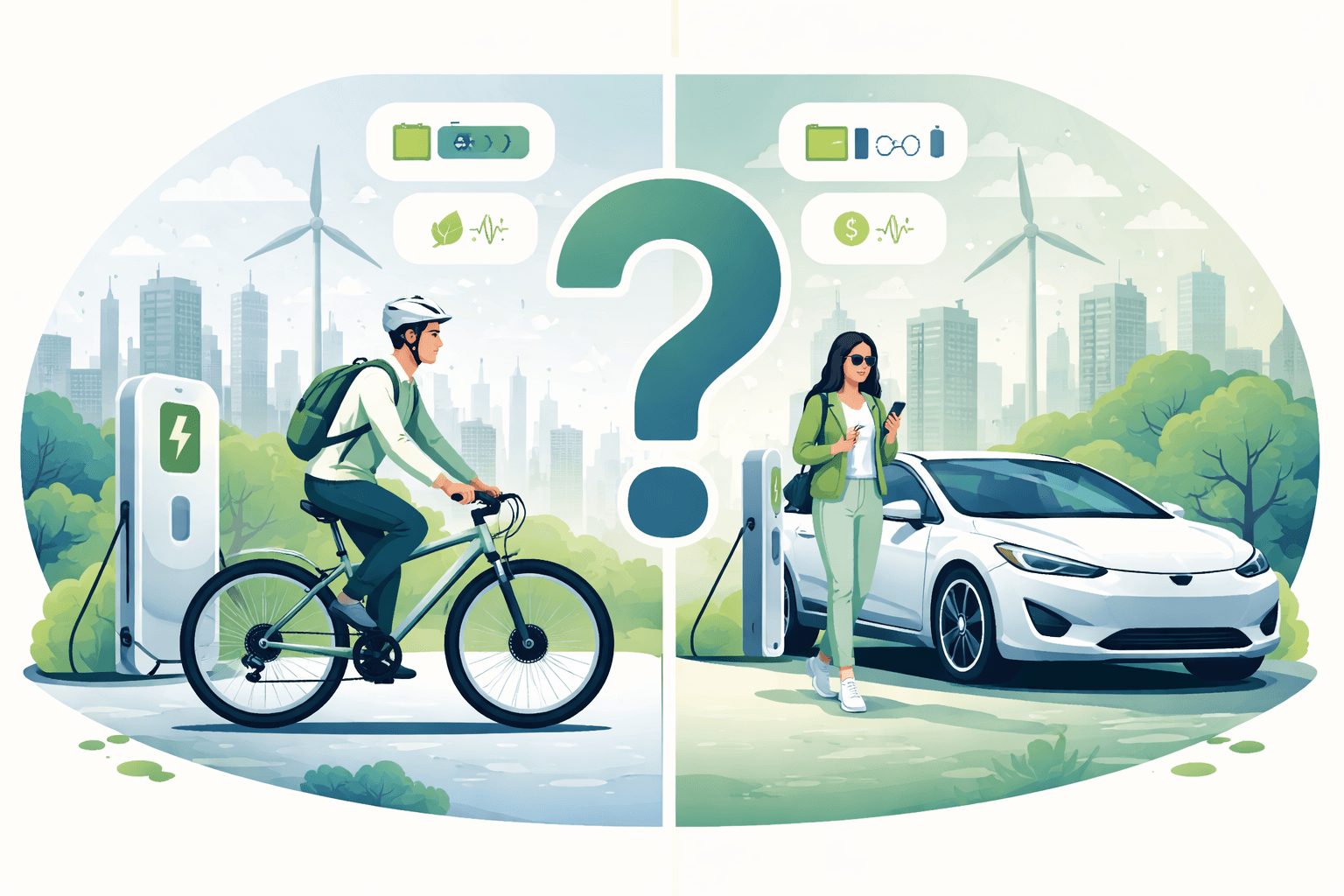
More than half of U.S. trips are under three miles, according to the Federal Highway Administration’s National Household Travel Survey, yet most of those trips are still made by car. At the same time, electric mobility is surging at every scale: U.S. electric car sales topped 1.2 million in 2023 (Cox Automotive), while over 1 million electric bikes were imported to the U.S. in 2022 (Light Electric Vehicle Association). If you’re weighing an electric bike vs electric car for your next move toward cleaner mobility, the best choice depends on cost, emissions, convenience, and how you travel day‑to‑day.
Electric bike vs electric car: the core trade-offs
Both e-bikes and EVs slash tailpipe emissions to zero and dramatically cut operating costs compared with gasoline. But they solve different mobility jobs:
- Range and speed: An e-bike typically offers 20–60 miles of assisted range at 15–28 mph. A mainstream EV delivers 200–350 miles at highway speeds.
- Payload and passengers: E-bikes excel for one rider, or two with a child seat, and light cargo. EVs carry multiple passengers and hundreds of pounds of gear.
- Infrastructure: E-bikes charge from any wall outlet. EVs are best with home Level 2 charging and supplemented by public DC fast charging for road trips.
- Urban efficiency: E-bikes thrive in congested cities where parking and short hops dominate. EVs are better for longer, multi-use travel and family needs.
The key is matching the tool to the trip. A growing number of households use both: an e-bike for short daily trips and an EV (or shared car) for longer ones.
By the numbers: energy, emissions, and cost
- Energy per mile: E-bike ~10–25 Wh/mi; EV ~250–320 Wh/mi (U.S. DOE, lab and field studies; manufacturer data)
- Electricity cost per mile: At $0.15/kWh, e-bike ~$0.3 cents/mi; EV ~4–5 cents/mi
- Carbon per mile (U.S. grid ~387 g CO₂/kWh, EPA eGRID): E-bike ~4–10 g CO₂/mi; EV ~95–125 g CO₂/mi
- Purchase price: Quality e-bikes $1,200–$4,000 (cargo: $3,000–$7,000+); New EVs commonly $35,000–$55,000 before incentives (2024–2025 market data)
- Annual maintenance: E-bike ~$100–$300; EV ~$300–$600 (Consumer Reports; DOE; industry service data)
- Battery life: E-bike 500–1,000 cycles (3–5+ years typical); EV packs warranted 8 yr/100,000 mi (many last 150,000–200,000+ mi per automaker and fleet data)

City Cycling (Urban and Industrial Environments): Pucher, John, Buehler, Ralph
He is the <strong>coauthor of The Urban Transport Crisis in Europe and North America and The Urban Transportation System: Politics and Policy Innovation</strong> (MIT Press). Ralph Buehler is Assistan
Check Price on AmazonTotal ownership costs: what you’ll actually spend
Purchase price and incentives
- E-bikes: Expect $1,200–$4,000 for a commuter e-bike and $3,000–$7,000+ for cargo models. Some cities and states offer rebates (e.g., Denver’s e-bike rebate program), but there is no federal U.S. tax credit at this time.
- EVs: Transaction prices are falling as supply grows and competition intensifies; many mainstream models are $35,000–$55,000 before incentives in 2025. Federal and state incentives can substantially reduce cost depending on vehicle and buyer eligibility. See Electric Vehicle Incentives by State for current programs and rules: /sustainability-policy/electric-vehicle-incentives-by-state
Charging and energy costs
- E-bike: A 500 Wh battery costs about $0.08 to fully charge at $0.15/kWh. At 20 Wh/mi, that’s roughly 25 miles for eight cents—about 0.3 cents per mile. Charging is as simple as a laptop: plug into any 120V outlet. Charging time is typically 3–6 hours depending on charger power and battery size.
- EV: A typical EV uses ~0.28–0.32 kWh/mi (EPA ratings; DOE). At $0.15/kWh residential, that’s ~4–5 cents/mi. Home Level 2 charging (240V) is the most convenient and cheapest option; public DC fast charging is faster but can cost 2–3x home rates. If you’re new to EV charging, see Electric Car Charging Options: /sustainability-policy/electric-car-charging-options-choose-right-charger and How to Charge an Electric Vehicle: /sustainability-policy/how-to-charge-an-electric-vehicle-guide-home-public-costs-best-practices
Equipment and installation
- E-bike: Included charger; optional costs for secure locks, fenders, racks, helmets, and lights ($150–$500). If you share housing, confirm safe indoor charging rules. Store batteries at room temperature and avoid charging immediately after very cold or hot rides to reduce stress on cells (battery manufacturer guidance; UL standards).
- EV: Many owners install a Level 2 home charger for $800–$1,500 for hardware, plus $500–$2,000 for installation depending on panel capacity and run length. Workplace or public charging can offset the need for home upgrades but may raise operating costs.

ChargePoint HomeFlex Level 2 EV Charger J1772 - Fast Smart Battery Power Charging at Home for Electric Automobile Vehicles - NEMA 14-50 Plug for Electric Car : Automotive
Home Flex Hardwired offers the fastest charge at up to 50A. NEMA 6-50 and 14-50 versions <strong>provide up to 40A and work with existing 240V wall outlets</strong>. Yes! Choose from our list of prefe
Check Price on AmazonMaintenance and insurance
- E-bike: Expect $100–$300 per year for chains/belts, brake pads, tires, and annual tune-ups. Batteries often last 3–5+ years; replacements typically cost $400–$900 depending on capacity and brand. Insurance is optional; specialty policies range from ~$100–$300/yr and can cover theft, liability, and medical—check your homeowner/renter policy exclusions.
- EV: EVs have fewer moving parts than gasoline cars and generally lower maintenance/repair costs—Consumer Reports found EV maintenance can be about half that of ICE over the vehicle’s life. Budget $300–$600/yr for tires, cabin filters, brake fluid, and occasional service; tires can wear faster due to vehicle mass and torque. Insurance varies by location and model; premiums have historically been higher for EVs but are narrowing as repair networks mature.
Depreciation and resale
- E-bike: Higher-quality brands hold value, especially cargo and utility models. Batteries that still test at >70–80% of original capacity help resale.
- EV: Depreciation has been volatile with rapid model refresh cycles and price reductions. Total cost of ownership improves if you plan to keep the car longer, drive higher annual miles, or qualify for strong incentives.
Environmental impact: what changes most per mile of travel
Energy efficiency and emissions
- E-bikes are the most energy-efficient motorized transport commonly available. Multiple studies place e-bike energy use around 10–25 Wh/mile (NREL and peer-reviewed micromobility research). Using the U.S. average grid intensity (~387 g CO₂/kWh, EPA eGRID), that’s roughly 4–10 grams of CO₂ per mile.
- Electric cars use ~280–320 Wh/mile, translating to roughly 95–125 g CO₂ per mile on today’s U.S. grid—about one-quarter to one-third of an efficient gasoline hybrid’s emissions per mile. As the grid adds more wind and solar (IEA and EIA report falling grid carbon intensity), EV operational emissions decline over time.
- Occupancy matters: If two people ride one EV, per-passenger emissions can be roughly halved; similarly, cargo e-bikes that replace car errands deliver large per-trip savings.
For broader EV context—grid mix, vehicle-to-grid potential, and lifecycle trends—see The Real Benefits of Electric Vehicles: /sustainability-policy/benefits-of-electric-vehicles
Manufacturing footprint and materials
- Battery production: Life-cycle assessments estimate 60–100 kg CO₂e per kWh of lithium-ion battery manufactured (IVL Swedish Environmental Research Institute; updated meta-analyses 2019–2021). That implies ~4–6 t CO₂e for a 60 kWh EV pack versus ~30–70 kg CO₂e for a 0.5–0.7 kWh e-bike battery.
- Whole-vehicle manufacturing: An EV’s upfront manufacturing footprint is typically 6–10 t CO₂e (varies by size and factory energy), while an e-bike is on the order of 100–300 kg CO₂e. EVs “pay back” this manufacturing carbon through much lower operating emissions compared with ICE cars—often within 1–2 years of average driving on today’s grids (ICCT; IEA).
- Critical minerals: An EV battery can contain tens of kilograms of nickel, manganese, and sometimes cobalt, and around 8–10 kg of lithium carbonate equivalent per 60–80 kWh pack. An e-bike battery uses orders of magnitude less—generally well under 1 kg LCE and minimal nickel/cobalt in newer chemistries (e.g., LFP). Recycling and second-life uses are advancing for both, with policy support in the U.S. (DOE Battery Recycling Prize; IRA domestic content rules) and EU.
Suitability for low-carbon commuting
- Where bike infrastructure is safe and connected, shifting short trips to e-bikes yields the biggest near-term emissions reduction per dollar spent. Pilot programs back this up: Denver’s 2023 e-bike rebate participants reported replacing multiple weekly car trips and significant monthly miles with e-bike travel (City and County of Denver evaluation).
- For households that need frequent long trips or to carry multiple passengers, an EV dramatically cuts emissions versus a gasoline car and can be paired with an e-bike for short trips to maximize savings.
Practical lifestyle factors
Trip length, speed, and time
- Typical daily errands under 5 miles are often faster by e-bike in urban traffic once you factor parking and door-to-door time. For 10–30 mile cross-town commutes or highway travel, EVs win on speed and comfort.
- Cold and hot weather reduce range for both: studies show EV range can drop 20–40% in subfreezing conditions (AAA), while e-bike range may drop 10–30% depending on battery chemistry, tire choice, and rider input.
Weather and gear
- E-bikes: With fenders, lights, rain shell, and winter-rated tires, year-round riding is practical in many climates, though ice and high winds can be limiting. Heated gloves and bar mitts help in winter.
- EVs: Climate control makes any weather manageable; preconditioning while plugged in reduces range loss and improves comfort.
Cargo and family hauling
- E-bikes: Payload ratings often 250–400 lb. Longtails and bakfiets-style cargo e-bikes carry kids, groceries, or large parcels with ease, but hills and headwinds still matter.
- EVs: Seat five to seven, handle bulky loads, and handle child seats and highway safety requirements effortlessly.
Parking, storage, and security
- E-bikes: Park almost anywhere legally, often for free. Secure locking and, ideally, indoor storage are essential; high-quality locks and GPS trackers reduce theft risk.
- EVs: Require more space and may incur parking fees, but offer secure storage for cargo and equipment.

Kryptonite New York FAHGETTABOUDIT Mini Bike U-Lock, Heavy Duty Anti-Theft Bicycle U Lock Sold Secure Gold, 18mm Shackle with Keys, 10/10 Security Rating for E-Bike, Motorcycle, Scooter : Bike U Locks
View on AmazonSafety
- E-bikes: Helmets, lights, and predictable riding are critical. Per-mile injury risk on bicycles is higher than in cars, and e-bikes’ higher average speeds increase kinetic energy. Local infrastructure—protected lanes, traffic calming—dramatically improves safety (IIHS and urban safety research). Many regions classify e-bikes by power and speed; know local rules.
- EVs: Modern EVs score highly in crash tests (IIHS, NHTSA). Their greater mass can increase pedestrian and cyclist injury severity in collisions; driver assistance features and careful driving remain essential.
Charging and refueling time
- E-bikes: Remove the battery to charge indoors or charge on-bike from any outlet. Top-ups are quick because packs are small.
- EVs: Home Level 2 adds ~25–35 miles of range per hour at 7–11 kW. DC fast charging can add 150–200 miles in ~20–30 minutes on 150–250 kW chargers, but availability varies by corridor and brand. If you’re new to EV technology broadly, see Electric Vehicles Explained: /green-business/electric-vehicles-explained-types-costs-benefits-impact
Which fits your priorities? Scenarios and decision guide
Budget-conscious daily transport
- Best fit: E-bike as a primary vehicle in bikeable areas.
- Why: Lowest purchase price and operating cost; near-zero parking cost; fastest door-to-door for short trips.
- Consider: Weather gear, secure storage, and occasional access to a car or carshare for special trips.
Urban commuting (1–10 miles each way)
- Best fit: E-bike or cargo e-bike.
- Why: Avoid congestion and parking, predictable trip times, minimal cost, large emissions reduction per dollar. Choose a model with lights, fenders, and racks.
- Consider: Backup transit or ride-hail for severe weather days; workplace charging for the e-bike is trivial but nice to have.
Suburban commuting (10–40 miles each way) and mixed errands
- Best fit: EV, possibly paired with an e-bike for local trips.
- Why: Speed and comfort at distance; eliminate gasoline; home charging simplifies logistics. Pairing with an e-bike trims local miles, cost, and emissions further.
- Consider: Install Level 2 at home and map nearby fast chargers along routine routes.
Family travel and multi-passenger trips
- Best fit: EV (two-row or three-row) for safety seats, cargo, and highway range.
- Why: Meets a broad set of family needs with low operating emissions; road-trip ready.
- Consider: Keep an e-bike for solo errands to avoid short, cold-start car trips that are energy-inefficient.
Sustainability-first households with access to transit
- Best fit: E-bike plus occasional carshare/EV rental.
- Why: Largest emissions reduction for the least money and material use; flexible access to a car when needed.
- Consider: A cargo e-bike can replace many car trips entirely; pair with transit passes.
Rural areas and long distances
- Best fit: EV for daily use, keep or share an ICE vehicle for extreme distances if charging is sparse; e-bike as a recreational or in-town tool.
- Why: EVs handle daily miles efficiently; public fast charging is expanding but may be uneven in remote areas.
- Consider: Battery preconditioning and route planning for winter; carry a 120V EVSE for emergency trickle charging.
Key trade-offs at a glance
- Cost: E-bikes win on upfront and operating cost by a wide margin. EVs can be cost-competitive per mile versus gasoline when driven enough miles and when incentives apply.
- Emissions: E-bikes deliver the lowest operational and manufacturing emissions per mile. EVs slash emissions vs. gasoline and improve as the grid decarbonizes.
- Convenience: E-bikes dominate short trips and parking. EVs dominate passenger capacity, weather protection, and highway travel.
- Infrastructure: E-bikes need almost none. EVs benefit from home charging and a maturing fast-charging network.
What this means for your decision
- If most of your trips are under 5 miles and your city has safe bike routes, an e-bike will transform your mobility at the lowest cost and footprint.
- If you need to carry people and gear across town or take frequent highway trips, an EV is the more capable all-rounder—and pairing it with an e-bike yields the best combined savings.
- If you’re on the fence, consider a trial: rent or borrow an e-bike for a month and track how many car trips it replaces. Many households discover an e-bike removes 30–60% of their short car trips, freeing them to downsize a second car or delay an EV purchase until incentives, charging access, or prices improve.
Where policy is heading: IEA and national energy agencies project continued grid decarbonization this decade, which lowers EV operating emissions each year. Cities are accelerating protected bike lane buildouts, and several states and municipalities are piloting e-bike incentives alongside EV tax credits. The most sustainable outcome for many households is not electric bike vs electric car, but a right-sized mix: default to two wheels for short trips, four for the jobs only a car can do.
Recommended Products
City Cycling (Urban and Industrial Environments): Pucher, John, Buehler, Ralph
He is the <strong>coauthor of The Urban Transport Crisis in Europe and North America and The Urban Transportation System: Politics and Policy Innovation</strong> (MIT Press). Ralph Buehler is Assistan
ChargePoint HomeFlex Level 2 EV Charger J1772 - Fast Smart Battery Power Charging at Home for Electric Automobile Vehicles - NEMA 14-50 Plug for Electric Car : Automotive
Home Flex Hardwired offers the fastest charge at up to 50A. NEMA 6-50 and 14-50 versions <strong>provide up to 40A and work with existing 240V wall outlets</strong>. Yes! Choose from our list of prefe
Kryptonite New York FAHGETTABOUDIT Mini Bike U-Lock, Heavy Duty Anti-Theft Bicycle U Lock Sold Secure Gold, 18mm Shackle with Keys, 10/10 Security Rating for E-Bike, Motorcycle, Scooter : Bike U Locks
DURABLE DESIGN: <strong>This Anti-Theft bike lock features a 18mm hardened max-performance steel shackle that resists bolt cutters and twisting leverage attacks</strong>. The lock disc-style cylinder