
Electric Lawn Equipment vs Gas: Which Is Better for Your Yard?
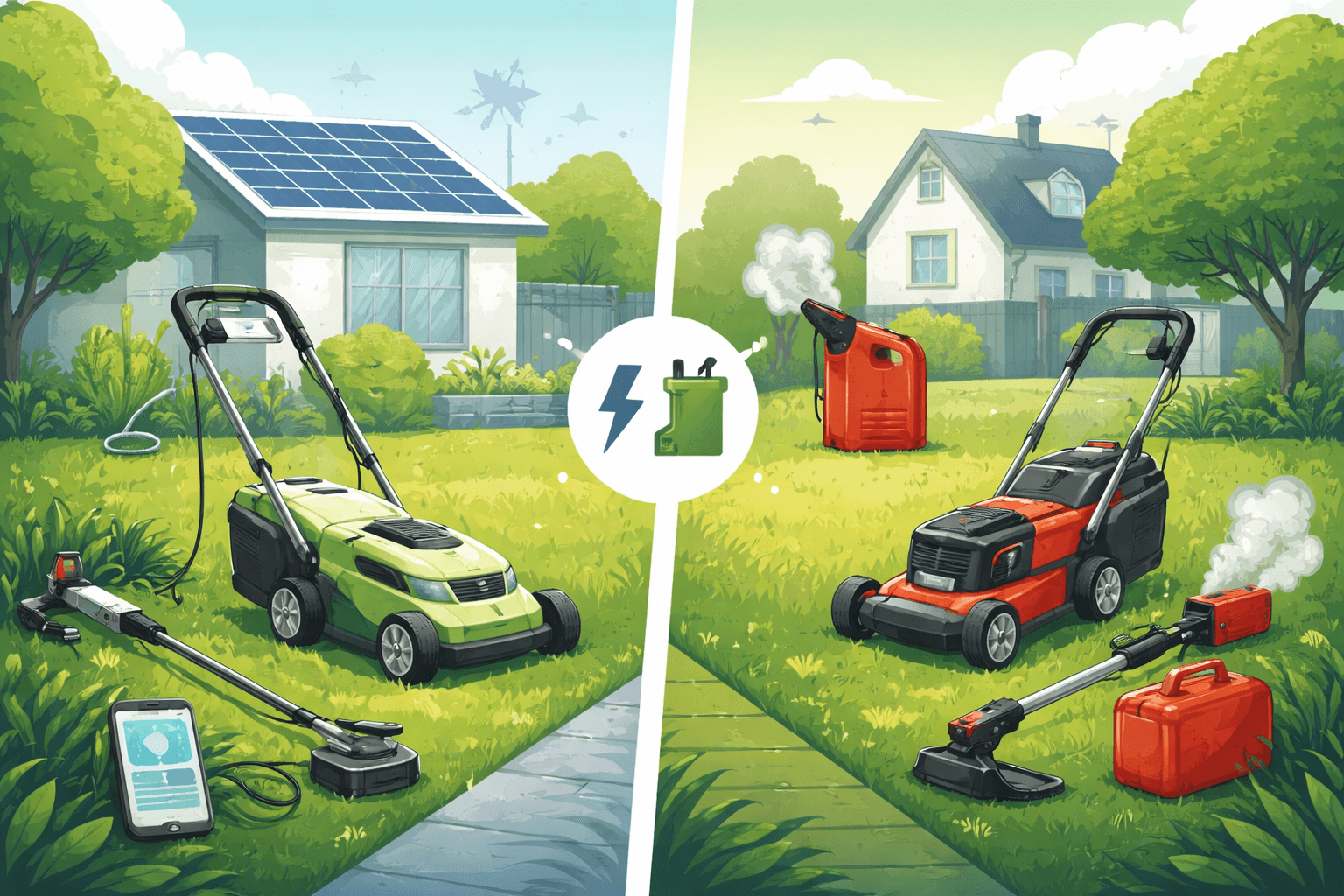
Electric lawn equipment vs gas is no longer a niche debate. Battery systems have matured, grids are cleaner, and states are tightening rules on small off‑road engines. California’s Air Resources Board (CARB) estimates that by 2023, small off‑road engines (mowers, blowers, trimmers) produced more smog‑forming emissions than passenger cars in the state. CARB also reports that running a commercial gas leaf blower for one hour emits as much ozone‑forming pollution (NOx + reactive organic gases) as driving a passenger car about 1,100 miles. Those numbers are driving homeowners to take a fresh look at electrics.
This guide compares power, runtime, noise, maintenance, emissions, and total cost of ownership; explains corded, battery, and gas options; and helps you match the right toolset to your yard.
Electric lawn equipment vs gas: the core differences
- Power and cutting ability
- Gas: Small walk‑behind mowers typically use 3.5–5.5 horsepower engines (roughly 2.6–4.1 kW at the shaft), delivering strong sustained power in thick, tall, or wet grass. Two‑stroke engines (common in handheld tools) have high power-to-weight but dirtier exhaust.
- Electric: Modern brushless motors on 36–82 V platforms deliver high torque instantly and can match gas power for most residential tasks. Corded tools are limited by 120 V household circuits (12–15 A), yielding roughly 1.4–1.8 kW max. Battery systems can peak higher but may throttle under heavy load to protect the pack.

The Organic Lawn Care Manual: A Natural, Low-Maintenance System for a Beautiful, Safe Lawn: Tukey, Paul
<strong>This comprehensive guide covers everything you need to know to grow and maintain a thriving lawn using organic gardening methods. With expert advice on planting the best grass varieties, nouri
Check Price on AmazonRuntime and refueling
- Gas: 0.5–0.8 gallons of gasoline per mowing hour is typical for walk‑behind mowers. Refueling is immediate; spare cans extend runtime.
- Electric: Battery capacity is rated in watt‑hours (Wh) = volts × amp‑hours. A 56 V, 5 Ah pack holds ~280 Wh. Push mowers usually draw 600–1,500 W depending on grass height and deck width; expect 30–60 minutes per 250–300 Wh pack in average conditions, less in heavy grass. Corded tools run indefinitely but require managing a cord.
Noise
- Gas: 85–95 dBA at the operator’s ear is common for mowers; blowers and trimmers can exceed 95 dBA. NIOSH recommends hearing protection above 85 dBA for extended use.
- Electric: Typically 65–75 dBA for many mowers and 70–85 dBA for handheld tools. A 10 dB reduction is perceived as roughly half as loud, improving neighborhood and operator comfort.
Maintenance
- Gas: Regular oil changes, air filters, spark plugs, carburetor upkeep, fuel stabilizer for storage, and winterization. Two‑stroke tools require mixing oil with gasoline.
- Electric: Little routine maintenance beyond blade sharpening, string/chain replacement, bar oil for chainsaws, and battery care (proper charging/storage). No oil changes or carburetors.
Emissions and local air quality
- Gas: Burning 1 gallon of gasoline emits about 8.89 kg (19.6 lb) of CO2 (U.S. EPA). Small engines also emit carbon monoxide (CO), nitrogen oxides (NOx), volatile organic compounds (VOCs), and fine particulates—key drivers of smog and health impacts.
- Electric: Zero tailpipe emissions. Grid emissions vary; the U.S. average electricity CO2 intensity is about 0.855 lb/kWh (0.388 kg/kWh) per EPA eGRID 2022. A mower using ~1 kWh/hour produces under 1 lb CO2/hour on the average grid—roughly 80–95% lower operational CO2 than a comparable gas mower at 0.5–0.8 gal/hour (9.8–15.7 lb CO2/hour). Rooftop solar can drive operational emissions near zero.
Total cost of ownership (TCO)
- Gas: Lower upfront for many models; higher ongoing fuel and maintenance costs.
- Electric: Higher upfront with batteries and chargers; very low energy cost (often $0.10–$0.25/hour) and minimal maintenance; battery replacement may be needed after several years depending on use.
By the numbers
- 1 hour with a commercial gas leaf blower ≈ NOx + ROG from driving ~1,100 miles (CARB 2021).
- Gasoline CO2: ~19.6 lb per gallon (U.S. EPA). Typical mower burn: 0.5–0.8 gal/hour → 9.8–15.7 lb CO2/hour.
- Grid CO2: ~0.855 lb/kWh U.S. average (EPA eGRID 2022). Battery mower at ~1 kWh/hour → ~0.855 lb CO2/hour.
- Noise: Gas mowers 85–95 dBA; many electric mowers 65–75 dBA. NIOSH recommends hearing protection above 85 dBA.
- Energy cost: At $0.16/kWh, 1 kWh/hour ≈ $0.16; gasoline at $3.75/gal, 0.6 gal/hour ≈ $2.25/hour.
- Battery life: Many lithium‑ion packs last 500–1,000 full charge cycles to ~80% capacity (NREL/industry data), often translating to 5–10+ years for typical homeowners.
Types of lawn equipment: electric vs gas
Battery‑powered electric (cordless)
- How it works: A lithium‑ion pack powers a brushless DC motor. Packs are defined by voltage (e.g., 36 V, 56 V, 60 V, 80 V) and amp‑hours (Ah). Total energy is watt‑hours (Wh = V × Ah). Higher voltage can reduce current for the same power, minimizing heat and allowing higher peak output.
- Strengths: Quiet, low vibration, instant start, minimal maintenance, zero tailpipe emissions. Swappable packs allow continuous work with spares. Great for frequent, short sessions.
- Limits: Runtime depends on pack size and grass conditions; heavy loads can trigger thermal or current throttling. Cold weather reduces available capacity; expect 10–30% less runtime near freezing (DOE/NREL findings on Li‑ion behavior). Replacement batteries can be costly.
- Best for: Small to medium yards; routine weekly mowing; neighborhoods with noise rules; users who value low maintenance and easy starts.

EGO POWER+ Electric Lawn Mower, Self-Propelled Cordless with Select Cut and Touch Drive, Includes 56V 7.5Ah Battery and Rapid Charger – LM2135SP : Patio, Lawn & Garden
View on AmazonCorded electric
- How it works: Continuous power from a 120 V outlet; tools typically draw 8–15 A (up to ~1.8 kW on a 15 A circuit). No battery limits.
- Strengths: Unlimited runtime, lowest operating cost, lightest tool weight.
- Limits: Tethered by an extension cord (usually up to 100 ft). Cord management is cumbersome, especially around trees or obstacles; not ideal for complex layouts or large lots. Cord safety on slopes requires extra care.
- Best for: Small, open yards; budget‑minded users; trimming/edging within a short radius of outlets.
Gasoline (two‑stroke and four‑stroke)
- How it works: Internal combustion engines convert fuel energy to shaft power. Two‑stroke engines (common in blowers and trimmers) mix oil with gasoline and fire every crank revolution; they’re lighter and punchy but emit more unburned fuel and higher VOCs. Four‑stroke engines (common in mowers) are cleaner and more fuel‑efficient.
- Strengths: High sustained power and torque; long runtime with quick refueling; robust in tall, wet, or dense vegetation; abundant service options.
- Limits: Noise, fumes, higher maintenance, winterizing needs, and on‑site CO/NOx/VOC exposure. Fuel and tune‑ups raise long‑term costs.
- Best for: Large or overgrown properties; extended continuous work; remote sites without easy charging access.
Practical buying considerations for homeowners
Yard size and layout
- Small (≤5,000 sq ft): Battery or corded electric excels. A single 250–300 Wh pack often covers 30–60 minutes of mowing under average conditions; many small yards need ~20–40 minutes weekly.
- Medium (5,000–10,000 sq ft): Battery remains competitive with 2–3 packs or a fast charger. Corded becomes cumbersome; gas is viable if you prefer single‑session, uninterrupted runtime.
- Large (≥10,000 sq ft or multi‑acre): Gas holds an advantage for continuous work. Pro‑grade battery systems can do it with multiple high‑capacity packs and rapid chargers, but upfront cost and battery logistics rise.
Grass conditions and terrain
- Tall/wet grass: Gas mowers handle high, dense, or wet growth with fewer slowdowns. Battery models can bog under heavy loads; many include “load‑sensing” to ramp power, which shortens runtime.
- Hills and slopes: Battery mowers deliver instant torque and are easy to start/stop on inclines. Corded tools add trip hazards. Self‑propel features help on slopes; check power and weight.
- Obstacles: Battery’s cable‑free freedom is a major advantage around trees, beds, and furniture.
Charging needs and workflow
- Charging time: Divide battery Wh by charger watts for a rough estimate. Example: 280 Wh pack / 280 W charger ≈ ~1 hour from near empty. Fast chargers (300–500 W) cut downtime; dual‑bay chargers help.
- Number of packs: For a 60–90 minute mow, plan on 2–3 medium packs or 1–2 high‑capacity packs. Consider handheld tool needs (trimmer, blower) that can share the same platform.
- Cold and storage: Don’t charge Li‑ion below freezing; store batteries around 40–60% charge in a cool, dry place during winter.
Fuel storage and safety
- Gasoline handling: Keep fuel in approved containers; add stabilizer if stored >30 days; avoid stale fuel that gums carburetors. Fuel storage and spill risks add hassle and odor.
- Emissions exposure: Even outdoors, operators inhale exhaust close to the source. If you must use gas tools, stand upwind when possible and use hearing/respiratory protection as appropriate.
Weight, ergonomics, and ease of use
- Battery handheld tools are often lighter and vibrate less than gas equivalents, reducing fatigue. Battery mowers can be heavier than gas due to packs, but the weight improves traction and self‑propel offsets pushing effort.
- Instant start (no pull‑cords), easy speed control, and low vibration make battery tools accessible for more users.
Maintenance and service
- Gas: Plan for seasonal oil, plug, and filter changes; occasional carburetor cleaning; blade sharpening; and winterization. DIYers can manage these, but shop service adds cost and downtime.
- Electric: Sharpen blades, replace string/chain as needed, keep contacts clean, manage batteries. Little to no seasonal service.
Environmental and health impacts
- Smog‑forming pollution: CARB finds small off‑road engines now rival or exceed the smog‑forming emissions of California’s passenger cars due to cleaner vehicles and the lack of modern pollution controls in many lawn tools. Two‑stroke engines are especially high emitters of VOCs and unburned fuel.
- Climate: A gas mower at 0.6 gal/hour emits ~11.8 lb CO2/hour. A battery mower at ~1 kWh/hour on the average U.S. grid emits ~0.855 lb CO2/hour (EPA eGRID 2022)—a reduction of ~90% in operational CO2. In regions with cleaner grids or with home solar, reductions are larger.
- Noise and health: Prolonged exposure above 85 dBA increases risk of hearing damage (NIOSH). Battery tools substantially reduce operator and community noise. Lower vibration also reduces fatigue and long‑term repetitive‑stress risks.
- Spills and storage: Avoiding gasoline reduces spill risk and evaporative emissions (a nontrivial contributor to VOCs on hot days). Properly recycle used oil and filters from gas equipment.
- End‑of‑life: Recycle lithium‑ion packs through authorized programs; do not landfill. Recycling infrastructure is growing, and many municipalities or retailers accept used packs. Consult local guidance for options; the U.S. EPA provides consumer battery disposal best practices.

3M WorkTunes Connect + AM/FM Hearing Protector ...
View on AmazonCost of ownership: simple scenarios
Assumptions below are illustrative; actual costs vary by brand, deck size, and local fuel/electricity prices.
- Energy prices: electricity $0.16/kWh; gasoline $3.75/gal
- Usage: mowing + handheld tools rounded to mowing‑equivalent hours
- Maintenance: gas $25/year; electric $10–$15/year
Small yard (about 20 mowing hours/year over 5 years)
- Gas: Upfront $350; fuel 20×5×$2.25 ≈ $225; maintenance $125 → Total ≈ $700
- Battery: Upfront $450; energy 20×5×$0.16 ≈ $16; maintenance $50 → Total ≈ $516
Medium yard (about 35 hours/year over 5 years)
- Gas: Upfront $400; fuel 35×5×$2.25 ≈ $394; maintenance $125 → Total ≈ $919
- Battery: Upfront $500; energy 35×5×$0.16 ≈ $28; maintenance $50 → Total ≈ $578
Large yard (about 60 hours/year over 5 years)
- Gas: Upfront $500; fuel 60×5×$2.25 ≈ $675; maintenance $125 → Total ≈ $1,300
- Battery: Upfront $700 (extra pack/fast charger); energy 60×5×$0.16 ≈ $48; maintenance $75 → Total ≈ $1,023
Notes
- If you need many high‑capacity batteries or replace packs within 5–7 years, battery TCO rises. Conversely, higher gasoline prices or frequent carburetor service tilt the math further toward electric.
- Sharing batteries across mower, trimmer, and blower reduces cost per tool for electric platforms.
Where each option performs best
Choose battery electric if:
- You have a small or medium yard with typical weekly mowing.
- You value low noise, easy starts, minimal maintenance, and clean operation.
- You can charge between sessions and/or keep 1–2 spare packs.
- Neighborhood noise rules or personal health considerations favor quieter, fume‑free tools.
Choose corded electric if:
- Your yard is small and within 50–100 feet of outlets with minimal obstacles.
- You want the lowest operating cost and weight, and don’t mind managing a cord.
Choose gas if:
- You maintain large areas, tackle very tall or wet grass, or run tools for hours without breaks.
- You need maximum power density and instant refueling with minimal battery logistics.
- Service availability and upfront price matter more than emissions or noise.
Key tradeoffs explained
- Power vs runtime: Gas excels at continuous high load; battery matches typical residential loads but trades peak bursts for shorter runtime. Corded caps peak power to circuit limits but runs indefinitely.
- Noise and neighborhood fit: Electric’s 10–20 dB reduction changes early‑morning or evening usability and reduces community complaints.
- Operating costs: Electricity is 5–15× cheaper per hour than gasoline at typical prices; maintenance favors electric.
- Emissions: Electric slashes local air pollution and often cuts CO2 by ~80–95% per hour on today’s grid; with cleaner grids or solar, savings grow.
- Convenience: Electric wins on instant start, low vibration, and no seasonal fuel issues; gas wins on all‑day work without planning for charging.
How to decide: a simple checklist
- Yard size and time per mow: Under 60 minutes → electric is usually ideal; 60–120 minutes → electric with extra batteries or gas; 2+ hours continuous → gas or pro‑grade battery with multiple packs and fast charging.
- Grass conditions: Frequently tall/wet or neglected? Favor gas or high‑end battery with multiple packs.
- Noise sensitivity: Sensitive neighbors, sleeping kids, early/late mowing? Electric.
- Storage and power access: Limited space or no safe fuel storage? Electric. No outdoor outlets? Gas or plan for extension/charging solutions.
- Budget and long‑term value: Willing to invest more upfront to save on energy and maintenance? Electric. Prioritizing purchase price and serviceability? Gas.
- Health and environmental priorities: Reducing fumes and noise exposure? Electric.
What this means for homeowners and communities
- Homeowners: For most suburban lots, battery systems now deliver a better day‑to‑day experience with lower lifetime cost and emissions, provided you size batteries to your yard and charging routine.
- Communities: Widespread adoption of electric lawn equipment reduces neighborhood noise and local air pollution. CARB’s data indicate meaningful ozone‑forming emissions reductions are possible as fleets transition.
- Businesses and municipalities: Commercial electric options are emerging rapidly. Upfront costs, charging logistics, and battery cycle life remain considerations, but total cost parity is approaching in many duty cycles—especially where fuel prices and noise regulations are stringent.
The road ahead
Battery energy density is improving at ~5–7% per year in many applications, while motors and power electronics keep getting more efficient. Meanwhile, the U.S. grid’s CO2 intensity continues to fall as wind, solar, and storage expand (IEA and EPA trend data). Regulators are tightening standards for small engines; California has adopted rules to accelerate the shift to zero‑emission lawn and garden equipment, and other states are evaluating similar steps.
For homeowners, the practical upshot is clear: unless you routinely mow for hours in heavy conditions, electric lawn equipment offers quieter operation, cleaner air, and lower running costs without sacrificing a tidy yard. For larger or tougher properties, gas still has a role—but the gap is narrowing as batteries, chargers, and tool platforms evolve.
Sources and references
- California Air Resources Board (CARB), Small Off‑Road Engines: Emissions and Regulations, 2021 fact sheets and staff reports
- U.S. Environmental Protection Agency (EPA), Greenhouse Gases Equivalencies Calculator; eGRID 2022 emission rates
- National Institute for Occupational Safety and Health (NIOSH), Noise exposure recommendations
- National Renewable Energy Laboratory (NREL), Lithium‑ion battery performance and cycle‑life literature
Recommended Products
The Organic Lawn Care Manual: A Natural, Low-Maintenance System for a Beautiful, Safe Lawn: Tukey, Paul
<strong>This comprehensive guide covers everything you need to know to grow and maintain a thriving lawn using organic gardening methods. With expert advice on planting the best grass varieties, nouri
EGO POWER+ Electric Lawn Mower, Self-Propelled Cordless with Select Cut and Touch Drive, Includes 56V 7.5Ah Battery and Rapid Charger – LM2135SP : Patio, Lawn & Garden
Amazon.com : <strong>EGO POWER+ Electric Lawn Mower, Self-Propelled Cordless with Select Cut and Touch Drive, Includes 56V 7.5Ah Battery and Rapid Charger</strong> – LM2135SP : Patio, Lawn & Garde
3M WorkTunes Connect + AM/FM Hearing Protector ...
Explore 3M WorkTunes hearing protection with Bluetooth technology. Enjoy music, podcasts, and calls while staying safe on the job.