
How AI Is Used in Conservation: Technologies, Real-World Uses, and Key Challenges
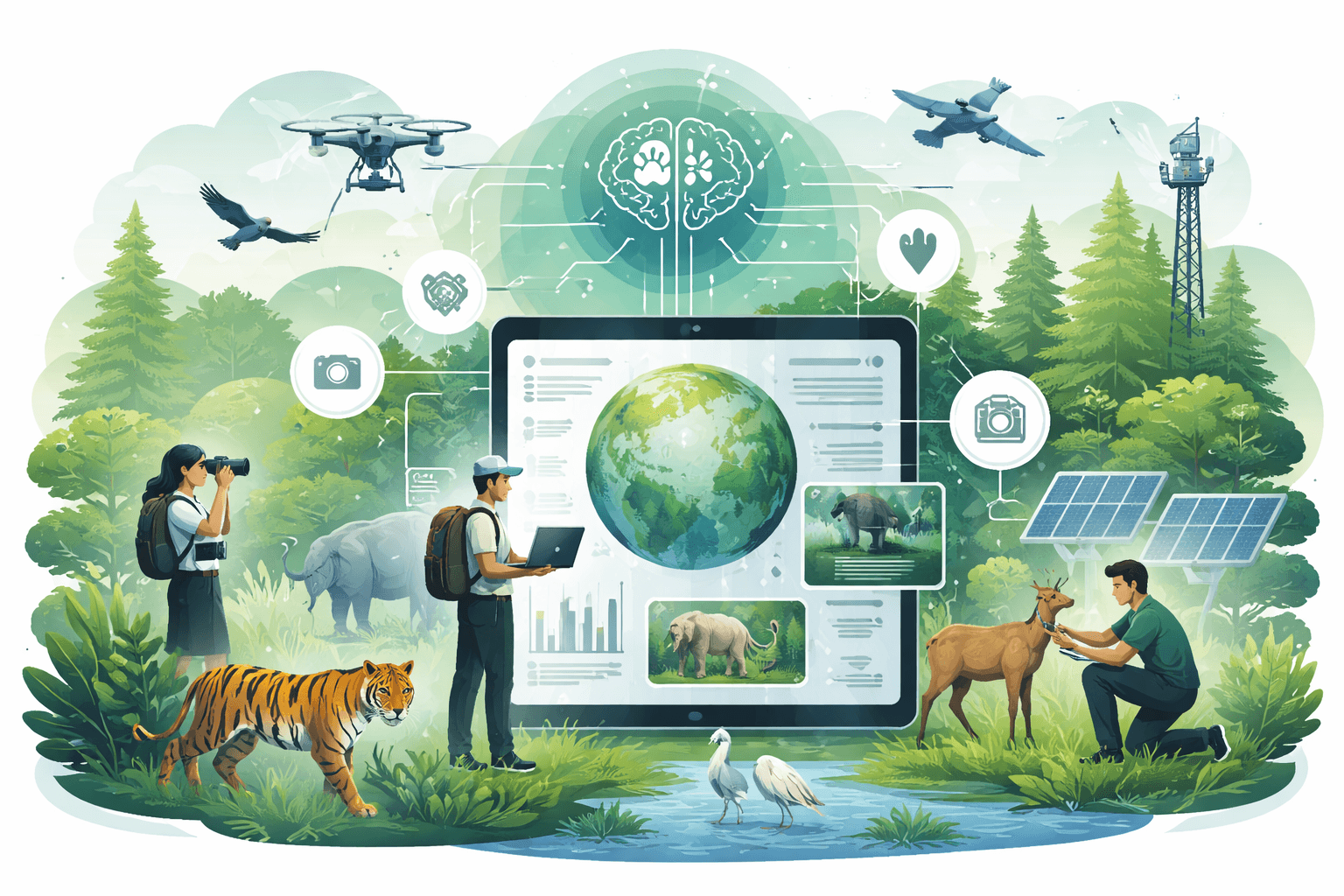
Biodiversity indicators are flashing red: the 2022 WWF Living Planet Report estimates an average 69% decline in monitored vertebrate populations since 1970. Against this backdrop, conservation groups are turning to artificial intelligence to accelerate monitoring, guide protection, and target scarce resources. This explainer details how AI is used in conservation today—the core technologies, real-world results, operational realities, and governance questions that determine whether these tools deliver measurable ecological benefits.
How AI is used in conservation: core technologies
AI in conservation isn’t one thing; it’s a stack of methods matched to specific ecological questions and field constraints. The most common building blocks are:
Machine Learning for Ecology and Sustainable Natural Resource Management: Humphries
“If you are looking for a book that describes how ML has been used or could be used on your own spatial ecology data sets, I recommend this book. I also recommend it for readers looking for a book tha
Check Price on AmazonComputer vision for camera-trap imagery
Camera traps—motion-activated cameras deployed in forests and savannas—generate tens of millions of images each year. Deep learning models (typically convolutional neural networks, or CNNs) automate three tasks:
- Empty-frame filtering: Removing wind-triggered or blank images to cut manual review time.
- Object detection: Locating animals, people, and vehicles (e.g., Microsoft’s open-source MegaDetector widely used by NGOs; Beery et al., 2019).
- Species classification: Identifying species, often via platforms like Wildlife Insights, which applies Google’s AutoML to camera-trap datasets curated by Conservation International and partners.

Browning Trail Cameras Recon Force Edge Trail Camera, Camo
View on AmazonWhy it matters: Manual annotation scales linearly with images; computer vision scales sublinearly. Teams report 70–90% reductions in human review effort by auto-filtering blanks and flagging humans/vehicles before species ID, freeing biologists to focus on quality control and analysis.
Acoustic machine learning for species detection
Passive acoustic monitoring (PAM) uses autonomous audio recorders to pick up vocalizations across large, often inaccessible areas. AI models (CNNs and spectrogram-based classifiers) detect:
- Birdsong and bat calls (e.g., Cornell Lab’s BirdNET, which recognizes thousands of bird species globally; Kahl et al., 2021).
- Cetacean calls for ship-strike mitigation and spatial planning (e.g., NOAA collaborations applying deep learning to hydrophone data).
- Anthropogenic sounds linked to threats, such as chainsaws or gunshots in tropical forests (e.g., Rainforest Connection’s real-time alerting).
Why it matters: Acoustic ML extends monitoring to nocturnal, cryptic, and canopy-dwelling species, and can run continuously to provide near-real-time presence/absence and activity trends at landscape scale.
Remote sensing + ML for habitat mapping
Satellite and aerial imagery feed machine learning classifiers (random forests, gradient boosting, CNNs) to produce land cover, habitat quality, and change-detection maps. Key examples include:
- Near-real-time tree cover loss alerts in the tropics (GLAD alerts from the University of Maryland underpin Global Forest Watch; Landsat at 30-meter resolution).
- Global mangrove extent mapping (Global Mangrove Watch estimates ~14.8 million hectares of mangroves worldwide; Bunting et al., 2018–2020 updates).
- Coral reef habitat and bleaching monitoring (Allen Coral Atlas fuses high-resolution satellite imagery with ML to map shallow reefs globally).
Why it matters: Consistent, wall-to-wall coverage enables prioritization (where to patrol, restore, or protect) and tracking of outcomes over time.
Predictive models for populations and threats
Where the goal is to anticipate change, AI and statistical ML provide:
- Species distribution modeling (SDMs): Predicting where species are likely to occur based on environmental variables under present and future climates.
- Population trend forecasting: Bayesian and ML-based integrated population models that synthesize telemetry, counts, and citizen science.
- Threat-risk prediction: Game-theoretic and ML tools (e.g., PAWS from USC/Harvard) that learn poaching patterns to suggest patrol routes with higher expected detection.
Why it matters: Forecasts convert limited, noisy ecological data into forward-looking plans that can prevent losses rather than merely document them.
Edge AI and autonomous platforms
Power and connectivity constraints shape conservation tech. Edge AI—running models directly on devices—enables:
- On-camera detection (e.g., RESOLVE’s TrailGuard AI filters and transmits only relevant images, reducing bandwidth and extending battery life for months to a year+).
- Drones and autonomous surface/underwater vehicles with onboard detection for wildlife counts or threat surveillance.

NVIDIA Jetson Orin Nano Super Developer Kit : Electronics
View on AmazonWhy it matters: Moving compute to the field reduces latency, data transmission costs, and energy use compared to cloud-only workflows.
Real-world applications and measurable impacts
Wildlife monitoring and identification at scale
- Camera traps + computer vision: Wildlife Insights reports processing tens of millions of images from over 100 countries, accelerating species ID workflows. Open-source detectors like MegaDetector are now standard for pre-processing, enabling teams to cut manual review by the majority of frames.
- Individual identification for mark–recapture: The Wildbook platform applies pattern-matching and deep learning to identify individual whale sharks, giraffes, and zebras from natural markings, scaling population estimates used in IUCN Red List assessments.
- Acoustic biodiversity monitoring: BirdNET and similar bioacoustic models have democratized avian monitoring, with large deployments supporting rapid assessment of species richness and seasonal dynamics in protected and working landscapes.
Measured impacts: Faster turnaround from raw data to ecological indicators (occupancy, richness, abundance indices) allows rangers and managers to adapt actions within a season rather than years later. Peer-reviewed evaluations show that automated pre-filtering can reduce human annotation time by 70–80% without sacrificing accuracy when combined with expert validation (Beery et al., 2019; Norouzzadeh et al., 2018).
Detecting poaching and other illegal activities
- Predictive patrol planning: PAWS (Protection Assistant for Wildlife Security) combines poaching-risk modeling with game theory to recommend patrol routes. Field trials in Uganda and Southeast Asia reported significantly increased detection of illegal activities compared to status quo routes (Fei Fang et al., PNAS/JAIR, 2016–2018 series).
- Real-time acoustic threat detection: Rainforest Connection’s AI listens for chainsaws and gunshots, sending alerts to rangers. Partners in Latin America, Africa, and Southeast Asia report earlier interdictions and deterrence effects when alerts are integrated with ranger response protocols.
- Edge-vision alerts: TrailGuard AI detects humans and vehicles at park perimeters and choke points, transmitting only high-confidence events via low-bandwidth links—reducing false alarms and extending deployments to a year or more per unit (RESOLVE/Intel field notes).
Measured impacts: While rigorous causal attribution is challenging, protected areas using risk-based patrol planning often report higher contraband and snare detection per patrol hour. Integrations with patrol software (e.g., SMART, EarthRanger) enable before–after comparisons of effort-normalized detection rates.
Habitat change detection and restoration prioritization
- Deforestation and degradation: GLAD alerts power Global Forest Watch’s weekly alerts for tropical tree cover loss. NGOs and governments use these to triage enforcement and community engagement, moving from retrospective annual maps to near-real-time response (University of Maryland; WRI).
- Coastal ecosystems: Global Mangrove Watch’s ML-derived maps of ~14.8 million hectares of mangroves support national accounting, blue carbon projects, and restoration siting by highlighting hotspots of loss and potential recovery.
- Coral reefs: Allen Coral Atlas provides habitat classification and bleaching alerts from satellite imagery, informing reef management and prioritizing resilience-based interventions.
Measured impacts: Countries have integrated these datasets into national forest monitoring systems and NDC (climate) accounting; project developers use them to target restoration with the highest additionality and permanence.
Invasive species detection and management
- Remote sensing for aquatic and terrestrial invasives: ML classifiers trained on Sentinel‑2 and Landsat data have mapped water hyacinth, buffelgrass, and other invasives with high overall accuracies in multiple peer-reviewed studies, guiding rapid removal before spread.
- Acoustic detection of pests: Models trained on species-specific calls (e.g., cane toads, invasive birds) can flag presence ahead of visual confirmation, improving early detection and rapid response.
Measured impacts: Earlier detection windows reduce eradication costs substantially; economic studies routinely find orders-of-magnitude lower costs when invasions are caught early versus established.
Climate-impact scenario modeling for conservation planning
- Species range shifts: SDMs leveraging climate projections (CMIP6) help identify climate refugia and corridors; eBird’s Status & Trends program combines citizen science with ML to map seasonal abundance, supporting dynamic conservation planning by season and future climate.
- Marine planning: Global Fishing Watch used ML on vessel Automatic Identification System (AIS) data to infer fishing effort and revealed that industrial fishing activity touches 55% of the global ocean by area (Kroodsma et al., Science, 2018). These insights inform temporal closures and bycatch mitigation.
Measured impacts: Scenario models steer investments toward areas with the highest long-term persistence under warming and shifting precipitation regimes, helping avoid stranded conservation assets.
By the numbers
- 69%: Average decline in monitored vertebrate populations since 1970 (WWF Living Planet Report 2022).
- 55%: Share of the global ocean with detectable industrial fishing activity, inferred by ML from AIS data (Kroodsma et al., Science, 2018; Global Fishing Watch).
- ~14.8 million hectares: Global mangrove extent mapped with ML (Global Mangrove Watch 2020 update).
- 30 m: Resolution of Landsat-based GLAD forest loss alerts used for near-real-time monitoring (University of Maryland, Global Forest Watch).
- 6,000+ species: BirdNET’s reported coverage for acoustic bird identification (Cornell Lab of Ornithology, 2021–2023 updates).
- 60M+: Camera-trap images processed on Wildlife Insights to date, accelerating species ID at continental scales (Conservation International/partners).
Data and operational realities
Data collection and labeling are the hardest parts
- Long-tail species problem: Most datasets are dominated by a few common species or “blanks,” while threatened species have few examples. This skews training and evaluation.
- Domain shift: Models trained in one forest may falter in another due to different backgrounds, lighting, or species assemblages. Studies show substantial accuracy drops when models are applied “out of distribution” (Beery et al., 2018: Recognition in Terra Incognita).
- Label quality: Mislabels propagate errors; expert review and active learning loops (model suggests labels, experts correct) are crucial.
Practical approaches:
- Combine global pre-trained models (e.g., a general animal detector) with site-specific fine-tuning.
- Use hierarchical classification (animal vs. background; then family; then species) to manage class imbalance.
- Leverage citizen science (eBird, iNaturalist) and semi-supervised learning to expand training data cautiously, with bias checks.
Compute, energy, and connectivity constraints
- Field power budgets: Many deployments must run for months on batteries or solar trickle charge. Edge AI models must be small (TinyML) and energy-efficient.
- Connectivity: Satellite or intermittent cellular links limit data transfer. On-device filtering (sending only events) is often decisive for feasibility.
- Cloud vs. edge trade-offs: Cloud offers larger models and easier updates but can raise costs, latency, and energy use. Edge reduces bandwidth and may lower overall energy per detection. For broader context on AI’s energy footprint and ways to reduce it, see The Environmental Cost of AI: Understanding the Carbon Footprint of Large Language Models.
Integration with field workflows
Technology succeeds when it fits ranger schedules, data entry habits, and reporting needs:
- Interoperability with patrol and reporting systems (e.g., SMART, EarthRanger) avoids duplicate effort.
- Training and turnover: Staff capacity varies; simple UIs, multilingual support, and local champions matter.
- Maintenance: Camera placement, sensor health checks, and drone regulations can make or break consistency.
Monitoring and evaluating AI interventions
- Measure outcomes, not just outputs: Fewer blank images is good; reduced snaring or higher nest success is better. Use effort-normalized indicators (e.g., detections per patrol hour) and counterfactuals when possible.
- Independent validation: Hold out sites or seasons for testing to reduce confirmation bias.
- Publish protocols: Open methods enable replication and learning across sites. For rigorous frameworks on measuring conservation impact, see Beyond Intentions: A Data‑Driven Analysis of the Impact of Conservation Efforts.
Ethical, social, and governance considerations
Bias, uncertainty, and false positives
- Misclassification risks: False positives can divert patrols; false negatives can miss threats. Communicate model confidence and maintain human-in-the-loop review for critical decisions.
- Equity in data: Training data often come from well-funded regions; models may underperform for underrepresented biomes or languages (acoustics). Invest in data collection where the model will be used.
Privacy, consent, and community rights
- Human bycatch in camera traps: Images of local people raise privacy and safety concerns. Best practice is to auto-detect and blur humans and to establish clear data governance and deletion policies.
- Indigenous and local community consent: Apply Free, Prior, and Informed Consent (FPIC) when deploying sensors on customary lands. Share benefits and results in accessible formats.
Access and capacity
- Avoid “AI parachute science”: Co-design projects with local institutions; ensure data access, training, and long-term ownership reside locally.
- Cost barriers: Compute and connectivity can exclude smaller NGOs. Lightweight models, open-source tools, and shared cloud credits can help close gaps.
Policy and regulatory context
- Drone and acoustic surveillance laws vary by country; permissions and data handling must comply with national regulations.
- Emerging AI governance: The EU AI Act and UNESCO AI ethics guidance emphasize transparency, risk management, and human oversight—principles applicable to conservation AI even when not legally mandated.
Responsible deployment practices
- Problem-first design: Start with a management question (e.g., “Where are snares likely this week?”) and decide if AI is necessary.
- Model cards and datasheets: Document training data, known biases, and appropriate uses.
- Continuous audit: Track performance drift and unintended impacts; sunset tools that do not deliver benefits or that cause harm.
Practical implications for managers, funders, and policymakers
- For protected area managers: Prioritize edge AI for real-time threat detection where bandwidth is limited; pair risk models with patrol protocols and staff training. Integrate outputs with existing systems (SMART/EarthRanger) and commit to periodic model re-training with local data.
- For restoration planners: Use ML-derived habitat maps to target cost-effective sites, then ground-truth. Combine remote sensing with acoustic biodiversity baselines to evaluate recovery.
- For funders: Budget for the full lifecycle—data collection, labeling, model maintenance, and independent evaluation—not just devices. Require open methods and equitable data governance.
- For policymakers: Embed AI-derived datasets into national monitoring (forests, fisheries, wetlands) with transparent methodologies; ensure privacy safeguards and FPIC for sensor deployments.
Where this is heading
Three trends are set to define the next five years of AI in conservation:
- Foundation models for biodiversity: Large bioacoustic and vision models pre-trained on millions of clips and images will generalize better across regions and species, reducing per-project data needs and improving zero-shot identification.
- Edge-first autonomy: Ultra-low-power chips will push more detection and even local learning to devices—camera traps that only wake radios on high-confidence events; recorders that adapt sampling to dawn chorus peaks.
- Fusion and forecasting: Integrating eDNA, acoustics, vision, and satellite data into unified Bayesian/ML frameworks will produce more robust population and threat forecasts with quantified uncertainty—actionable for adaptive management.
AI can be a force multiplier for conservation, but only if paired with rigorous measurement, ethical deployment, and deep integration with field realities. For a broader view of how AI is accelerating climate and Earth system science, see How Artificial Intelligence Is Accelerating Climate Science Research. For methodological context on non-AI conservation tools and evaluation, see Wildlife Conservation Methods: Practical Approaches, Tech Tools, and How to Measure Success.
Recommended Products
Machine Learning for Ecology and Sustainable Natural Resource Management: Humphries
“If you are looking for a book that describes how ML has been used or could be used on your own spatial ecology data sets, I recommend this book. I also recommend it for readers looking for a book tha
NVIDIA Jetson Orin Nano Super Developer Kit : Electronics
The NVIDIA Jetson Orin Nano Developer Kit <strong>sets a new standard for creating entry-level AI-powered robots, smart drones, and intelligent cameras</strong>,and simplifies getting started with the
Browning Trail Cameras Recon Force Edge Trail Camera, Camo
With that in mind, innovation continues to be the driving force before our success and over the years those cutting edge developments have included High-Performance Cellular Cameras, Military Grade IR
More in Sustainability Policy
- AI for Wildlife Monitoring: Technologies, Data Needs, and Practical Conservation Applications
- Using AI for Habitat Conservation: Practical Applications, Data Needs, and Ethical Implementation
- Beyond the Algorithm: How AI Is Transforming — and Challenging — Wildlife Protection
- Wildlife Conservation: Key Strategies, Threats, and How You Can Help