
Wildlife-Friendly Gardening: Practical Tips to Attract Pollinators, Birds and Backyard Wildlife
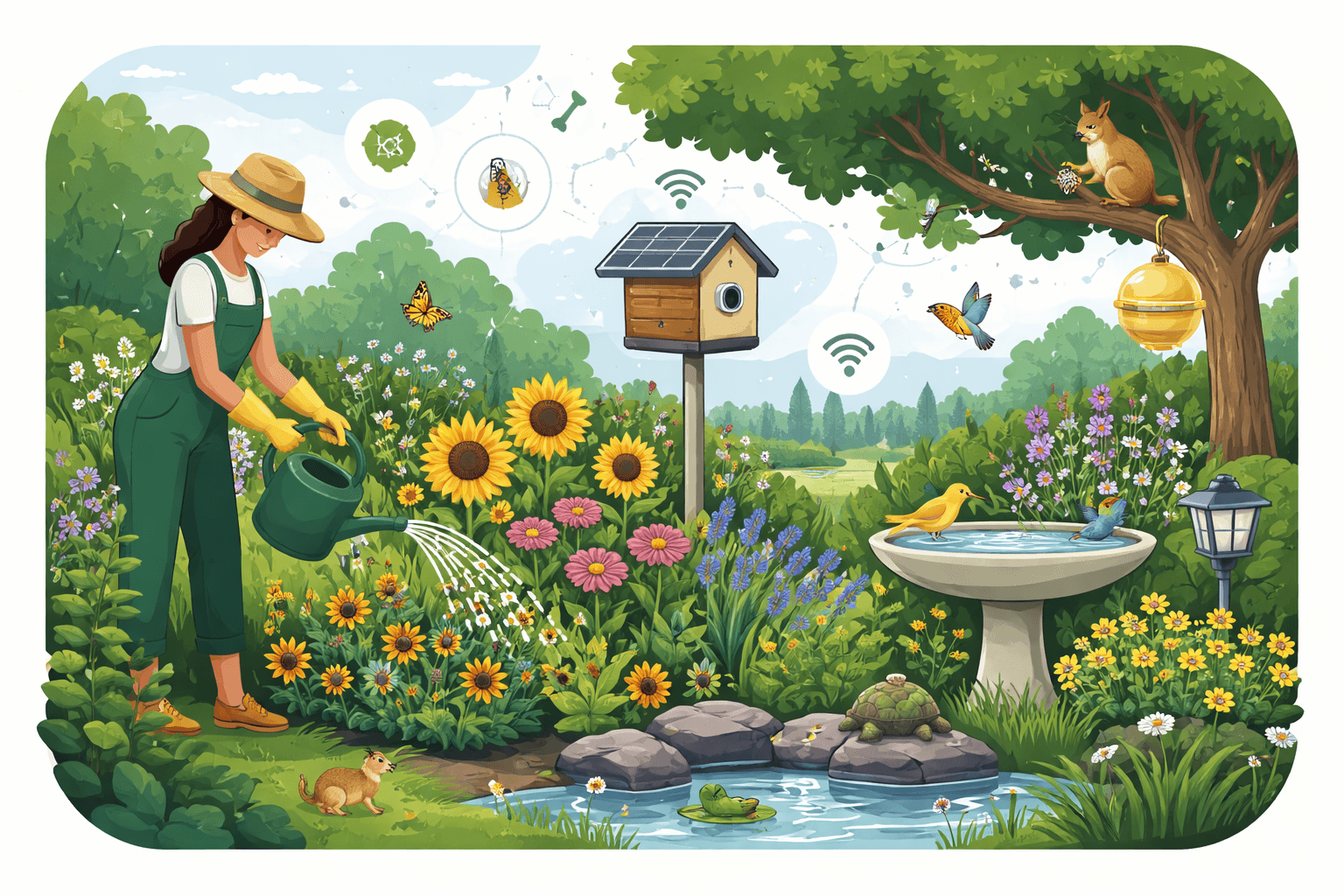
Creating habitat where you live works. A 2018 PNAS study of U.S. suburban yards found that when more than 70% of plant biomass was native, Carolina chickadees successfully raised young; below that threshold, reproduction often failed (Narango, Tallamy & Marra, 2018). That same keystone-plant logic underpins these wildlife friendly gardening tips: stack native plants, add clean water, build shelter, and manage pests without chemicals. With pollination worth an estimated $235–$577 billion annually worldwide and many pollinators in decline (IPBES, 2016), gardens—from balconies to backyards—are now critical habitat.
Native plants and structural diversity
Design your garden like a small ecosystem. Native plants coevolved with local insects and birds, supplying high‑quality nectar, pollen, fruit, and—crucially—caterpillar host plants that feed nestlings.

Nature's Best Hope: A New Approach to Conservation That Starts in Your Yard - Kindle edition by Tallamy, Douglas W.. Crafts, Hobbies & Home Kindle eBooks @ Amazon.com.
In this new book, Tallamy takes the next step and outlines his vision for a grassroots approach to conservation. Nature’s Best Hope <strong>shows how homeowners everywhere can turn their yards into co
Check Price on AmazonChoose regionally native plants first
- Why it matters: Native plants support far more insect herbivores (bird food) than non‑natives. In the eastern U.S., native oaks (Quercus spp.) can host 900+ species of caterpillars (Tallamy, University of Delaware). In the UK, native oak supports over 2,300 associated species (Woodland Trust).
- How to choose: Use regional guides from your native plant society or extension service. Aim for at least 70% native plant biomass in woody and herbaceous layers (PNAS, 2018).
- Avoid double‑flowered cultivars that reduce nectar/pollen access, and skip invasive species listed by your state or country.
Layer your planting for structural diversity
Layered structure increases niches and year‑round resources:
- Canopy/trees: Oaks, willows (Salix), maples (Acer), serviceberry (Amelanchier)
- Shrubs: Viburnum, dogwood (Cornus), elderberry (Sambucus), native roses (Rosa spp.)
- Perennials and grasses: Asters (Symphyotrichum), goldenrods (Solidago), coneflowers (Echinacea), sunflowers (Helianthus), milkweeds (Asclepias), penstemons, native bunchgrasses (Schizachyrium, Sporobolus)
- Groundcovers: Wild strawberry (Fragaria), prairie dropseed, sedges (Carex)
Layering mirrors the “rewilding” principle of letting complex structure return to landscapes, scaled to your yard. For the broader context of restoring ecological function, see What Is Rewilding? How Ecosystem Restoration Is Changing Conservation (/conservation/what-is-rewilding-ecosystem-restoration-conservation).
Plant keystone host plants for caterpillars
Birds feed their young mostly insects; even seed‑eating adults switch to caterpillars during nesting. Research shows a handful of native genera provide disproportionate support:
- Eastern North America: Quercus (oaks), Prunus (cherries/plums), Salix (willows), Betula (birches), Populus (aspens), Acer (maples), Vaccinium (blueberries)
- Western North America: Quercus (coast live oak & others), Salix, Populus, Ceanothus, Ribes, Artemisia
- Europe: Quercus, Salix, Prunus, Crataegus (hawthorn), Corylus (hazel), Malus (crab apple), Rubus (bramble)
- Monarchs: Milkweeds (Asclepias spp.) are essential host plants. WWF–Mexico reported the eastern migratory population’s overwintering area dropped 59% in 2023–2024, underscoring urgency.
Plan a season‑long bloom calendar
Continuity is as important as diversity. The Xerces Society recommends planting at least three species blooming in each season and grouping 3–5+ plants of each species:
- Early (late winter–spring): willows, red maple, pussytoes (Antennaria), columbine (Aquilegia), penstemon, native violets (Viola)
- Mid (summer): bee balm (Monarda), coneflower, blanketflower (Gaillardia), milkweeds, native sages (Salvia), phacelia
- Late (late summer–fall): goldenrods, asters, native sunflowers, joe‑pye weed (Eutrochium), sedum (where native)
- Winter resources: seed‑bearing grasses, coneflower heads, and berry shrubs like viburnum and winterberry (Ilex verticillata)
Food, water, shelter, and habitat features
Small, well‑placed features can dramatically increase wildlife use while keeping a tidy, intentional look.
Water: birdbaths and wildlife ponds
- Birdbaths: Use a shallow basin with a gradual slope; 2–5 cm (1–2 in) depth at the edge, max ~8 cm (3 in). Rough surfaces or a stone for perching help small birds and pollinators. Place about 3–5 m (10–15 ft) from dense cover to reduce ambush by cats while allowing an escape route. Clean weekly; for disinfection, use a 1:9 bleach solution, scrub, then rinse thoroughly (Cornell Lab of Ornithology/Audubon guidance).
- Moving water: A dripper or small recirculating pump increases attraction and reduces mosquitoes.
- Ponds: Even a 1–2 m² (10–20 ft²) pond supports amphibians and dragonflies. Include a gently sloped beach (10:1), a deepest point of 40–60 cm (16–24 in) to buffer heat, and emergent native plants (e.g., rushes, sedges). Skip fish if you want amphibians; fish eat eggs/larvae. Provide a ramp for mammals.

AISITIN Solar Fountain Pump 6.5W Panel with Battery Backup Solar Water Pump Floating Fountain, 6 Nozzles, for Bird Bath : Patio, Lawn & Garden
View on AmazonNesting boxes: right size, right place
Match dimensions, entrance size, and height to target species; mount on poles or buildings with predator guards.
- Examples (North America):
- Bluebird: 3.8 cm (1.5 in) entrance, 1.2–1.8 m (4–6 ft) high, facing open area
- Chickadee/tit: 2.8 cm (1 1/8 in) entrance, 1.8–3 m (6–10 ft) high near shrubs/edge
- Screech owl/little owl: larger box, 3–6 m (10–20 ft) high in mature trees
- General rules: Ventilation at top, drainage holes, hinged panel for annual clean‑out, no perches (reduce predator grip). Install before late winter.
Brush piles, log habitat, and hedgerows
- Brush/logs: Stack a base of thick logs in crisscross, add branches toward a 1–1.5 m (3–5 ft) high, 2–3 m (6–10 ft) wide mound. Place in a back corner. Decaying wood feeds beetles and fungi; wrens and small mammals use the structure (National Wildlife Federation guidance).
- Standing dead stems: Leave some perennial stems 20–60 cm (8–24 in) tall after winter pruning. Many cavity‑nesting bees use pithy stems.
- Hedgerows: A mixed native hedge (hawthorn/blackthorn/field maple in Europe; serviceberry/dogwood/viburnum in North America) provides nectar, berries, and dense cover. Stagger plants at 60–90 cm (2–3 ft) spacing in zigzag rows for a living corridor.
Pollinator patches and nesting zones
- Patch size and density: Pollinators find clusters. A minimum 1 m² (10 ft²) patch helps; larger is better. Group each species in 0.5–1 m² drifts.
- Nesting substrates:
- Ground‑nesting bees: Leave a sunny, well‑drained bare soil patch (0.5–2 m²), south‑facing if possible.
- Cavity‑nesting bees: If you use bee blocks, choose clean, replaceable paper liners or drilled holes 15 cm (6 in) deep; 8 mm (5/16 in) for mason bees, 6 mm (1/4 in) for leafcutters, spaced under an overhang to stay dry. Replace/clean annually to prevent parasites (Xerces Society).
- Overwintering: Keep some leaf litter and hollow stems through winter. Many butterflies/moths overwinter as eggs, larvae, or pupae in leaves.

Crown Bees Mason Bee Holes, Easytear Tubes : Patio, Lawn & Garden
View on AmazonPesticide‑free management and beneficial species
A healthy garden can be productive and beautiful without routine pesticides. Integrated Pest Management (IPM) is the evidence‑based framework used by agriculture and extension services.
Integrated Pest Management (IPM) in four steps
- Prevention: Choose disease‑resistant native plants, right plant/right place, improve soil organic matter, diversify plantings to break pest cycles.
- Monitoring: Scout weekly. Note which plant, which pest, life stage, and percent of damage. Many chewing insects can be tolerated at 10–15% leaf damage with no yield or aesthetic loss.
- Thresholds and targeted action: Only intervene when damage exceeds your threshold. Start with least‑risk controls:
- Physical: Hand‑pick, blast aphids with water, use row covers on veggies, prune infected material (sterilize tools).
- Cultural: Adjust watering to morning; increase plant spacing to improve airflow.
- Biological: Encourage predators and parasitoids; in some cases, use microbial controls such as Bacillus thuringiensis var. kurstaki (Bt‑k) for caterpillars on food crops, applied carefully to avoid non‑target impact on butterfly larvae.
- Evaluation: Did it work? Can you further strengthen prevention?
Large‑scale reviews link neonicotinoid insecticides to harm in bees and other beneficials (e.g., Woodcock et al., 2017, Nature Communications; U.S. National Academies, 2017). Avoid prophylactic pesticide use, especially systemic products that contaminate pollen/nectar. If a chemical control is absolutely necessary, choose spot applications of least‑toxic options (horticultural oils/soaps), follow labels, and avoid bloom periods.
Attract beneficial insects with “insectary” plants
- For predators (lady beetles, lacewings, hoverflies): Yarrow (Achillea), sweet alyssum (Lobularia), dill/fennel (allow to flower), calendula, buckwheat, goldenrods, and asters provide nectar for adults whose larvae eat pests.
- For pollinators: Native composites (asters/sunflowers), milkweeds, penstemons, shrubby willows—clustered and blooming spring to fall.
- For bats and swifts: Night‑blooming flowers and a chemical‑free yard increase nocturnal insect prey; bat boxes require sun exposure and specific designs per region.
Soil health, composting, and lawn downsizing
- Compost: Add 2–5 cm (1–2 in) of finished compost annually on beds to build soil organic matter, water‑holding capacity, and nutrient cycling. Healthy soils reduce disease pressure (USDA NRCS).
- Mulch: Maintain 5–8 cm (2–3 in) of leaf mulch or wood chips, keeping mulch off trunks and crowns.
- Test soil every 3–5 years to right‑size amendments and avoid over‑fertilizing, which can increase pests.
- Rethink lawn: Lawns are ecological deserts. Replacing even 25% of lawn with native meadow or shrub beds creates habitat while cutting water and fertilizer use. Mow any remaining lawn high (8–10 cm / 3–4 in) and consider “No Mow May”‑style reduced mowing to allow blooms; verify local weed/pollen considerations.
Climate‑smart, space‑adaptable practices and monitoring
Climate change intensifies heat, drought, and extreme rain. Design for resilience in any space, then measure your garden’s ecological return.
Water‑wise and heat‑smart design
- Harvest rain: A typical 185 m² (2,000 ft²) roof in a 25 mm (1 in) rainfall can yield ~1,240 liters (327 gallons). Use screened rain barrels (190–380 L / 50–100 gal) with overflow directed to a rain garden.
- Irrigate efficiently: Drip or soaker hoses reduce evaporation by 30–60% compared with overhead watering; water early morning.
- Choose drought‑tolerant natives adapted to local soils. Deep, infrequent watering trains deep roots; mulch to reduce evaporation by up to 25%.
- Create microclimates: Place shade trees west/southwest of hardscape; use reflective mulches sparingly in hot zones; shelter wind‑sensitive plants.
Small spaces and containers
- Pollinator planters: A 60–75 cm (24–30 in) deep trough can host a mini‑meadow: spring bulbs, summer natives (penstemon/black‑eyed Susan), fall aster/goldenrod. Prioritize nectar‑rich natives; avoid peat in potting mixes to protect peatland carbon.
- Vertical and balcony habitats: Trellis native vines (e.g., clematis, trumpet honeysuckle where native). Add a shallow pollinator water dish with stones. Leave a small tray with sand/clay for puddling butterflies.
Seasonal maintenance that protects wildlife
- Fall: “Leave the leaves” where feasible; shred and mulch paths, but keep some intact leaf litter under shrubs/trees for overwintering invertebrates. Mark “messy corners” with a simple sign.
- Winter: Keep seed heads and stems for food and nesting; only cut back what’s flopping onto paths.
- Spring: Delay major cleanup until several warm weeks above 10°C/50°F so overwintering natives can emerge (Xerces guidance). When cutting stems, leave 20–60 cm (8–24 in) stubble.
Monitor, share data, and minimize conflict
- Simple monitoring: Spend 10 minutes weekly noting flower visitors, bird species, and caterpillars on host plants. Photograph and log dates.
- Citizen science: Submit observations to community science platforms (e.g., eBird, iNaturalist, Bumble Bee Watch, Nature’s Notebook). To plug into local habitat projects and planting days, see Find and Join Conservation Projects Near You: What to Look For and How to Get Involved (/conservation/conservation-projects-near-me-guide).
- Measuring outcomes: Track metrics like number of native plant species, bloom weeks per year, caterpillar counts on keystone plants, and bird fledglings observed. For structured evaluation approaches, see Wildlife Conservation Methods: Practical Approaches, Tech Tools, and How to Measure Success (/sustainability-policy/wildlife-conservation-methods-practical-approaches-tech-tools-measure-success) and Beyond Intentions: A Data‑Driven Analysis of the Impact of Conservation Efforts (/conservation/beyond-intentions-impact-of-conservation-efforts).
- Reduce window and cat mortality: Up to 1 billion birds die annually from U.S. window collisions; place feeders/baths either within 1 m (3 ft) or beyond 9 m (30 ft) of windows and use bird‑safe window treatments (Smithsonian). Keep cats indoors; outdoor cats kill an estimated 1.3–4.0 billion birds in the U.S. each year (Loss et al., 2013, Nature Communications).
- Avoid rodenticides: Second‑generation anticoagulant rodenticides poison owls, hawks, and foxes. Use exclusion, sanitation, and enclosed snap traps instead (American Bird Conservancy).
Wildlife‑friendly gardening tips: By the numbers
- 235–577 billion: Annual global value of pollination to crops (IPBES, 2016)
- ~40%: Proportion of invertebrate pollinators (bees, butterflies) threatened with extinction in the IPBES assessment
900: Caterpillar species supported by native oaks in the eastern U.S. (Tallamy)
- 70%: Native plant biomass threshold linked to songbird reproductive success in suburban yards (PNAS, 2018)
- 1–2 m²: Minimum pond size that can boost amphibian and dragonfly use in small gardens, with gentle slopes and no fish
- 1:9: Bleach-to-water ratio recommended for periodically disinfecting birdbaths
- 1.3–4.0 billion: Estimated birds killed annually by outdoor cats in the U.S. (Loss et al., 2013)
Practical plant palettes by region (examples)
Always verify local ecotypes and soil/light needs; consult your native plant society or extension.
- Northeast/Mid‑Atlantic U.S.:
- Trees/shrubs: white oak, serviceberry, black cherry, red maple, arrowwood viburnum
- Forbs/grasses: swamp milkweed, blue vervain, New England aster, foxglove beardtongue, little bluestem, goldenrods
- Upper Midwest/Great Plains:
- Trees/shrubs: bur oak, chokecherry, willow, American plum, red osier dogwood
- Forbs/grasses: prairie blazing star (Liatris), purple coneflower, showy goldenrod, prairie dropseed, switchgrass
- West Coast:
- Trees/shrubs: coast live oak, toyon, California lilac (Ceanothus), red osier dogwood (north), elderberry
- Forbs/grasses: California poppy, blue flax, penstemon, seaside daisy, yarrow, Idaho fescue
- UK/Ireland:
- Trees/shrubs: pedunculate oak, hawthorn, blackthorn, goat willow, hazel, dog rose
- Forbs/grasses: common knapweed, field scabious, oxeye daisy, birdsfoot trefoil, meadow buttercup, fine fescues
What this means for you and your community
- Homeowners and renters: Even one 1 m² pollinator patch or a balcony trough with native blooms from spring to fall measurably increases foraging visits. Add a shallow water dish with stones and commit to pesticide‑free care.
- Schools and workplaces: Convert lawn edges and under‑used corners into native hedges and pocket meadows; cluster seating away from the highest‑value habitat to reduce trampling.
- Cities and HOAs: Update planting lists and maintenance specs to favor natives, reduce routine pesticide use, and allow “messy corners” for overwintering wildlife. Adopt bird‑safe window standards in common buildings.
Where this is heading
The evidence is clear: locally adapted native plants, structural diversity, clean water, and chemical‑free management turn small spaces into functioning habitat. Networked across neighborhoods, these patches form pollinator pathways and bird corridors that buffer climate and land‑use change. Expect more municipalities to pass bird‑safe building ordinances, restrict high‑risk rodenticides, and update landscape codes to allow wilder, seasonal aesthetics. For gardeners, the frontier is measurement—using simple monitoring and community science to document gains in bloom continuity, pollinator richness, and fledgling success. With these wildlife friendly gardening tips, your yard can shift from ornament to ecosystem in a single growing season—and improve year after year as keystone plants mature.
Recommended Products
Nature's Best Hope: A New Approach to Conservation That Starts in Your Yard - Kindle edition by Tallamy, Douglas W.. Crafts, Hobbies & Home Kindle eBooks @ Amazon.com.
In this new book, Tallamy takes the next step and outlines his vision for a grassroots approach to conservation. Nature’s Best Hope <strong>shows how homeowners everywhere can turn their yards into co
AISITIN Solar Fountain Pump 6.5W Panel with Battery Backup Solar Water Pump Floating Fountain, 6 Nozzles, for Bird Bath : Patio, Lawn & Garden
Buy <strong>AISITIN Solar Fountain Pump 6.5W Panel with Battery Backup Solar Water Pump Floating Fountain, 6 Nozzles, for Bird Bath</strong>: Pumps - Amazon.com ✓ FREE DELIVERY possible on eligible pu
Crown Bees Mason Bee Holes, Easytear Tubes : Patio, Lawn & Garden
Elcoho 60 Sets of Outdoors Mason Bee Nesting Tube Refill Kit Includes 60 Pieces 6-Inch Replacement Tubes & 60 Pieces Refill Tubes, Bee Nest House Hotels Tubes Bee Paper Inserts Cardboard Nest Tube
More in Sustainability Policy
- Create Wildlife Habitat: Practical Topics to Cover in a Step-by-Step Guide
- Practical Sustainable Gardening: Greener, Resilient Practices for Every Garden
- How to Create Sustainable Gardens: Practical Strategies for Biodiverse, Low‑Impact Landscapes
- Wildlife Habitat Restoration Projects: Goals, Techniques, and Measuring Long-Term Success