
Blockchain for Renewable Energy Trading: How It Works, Benefits, and Challenges
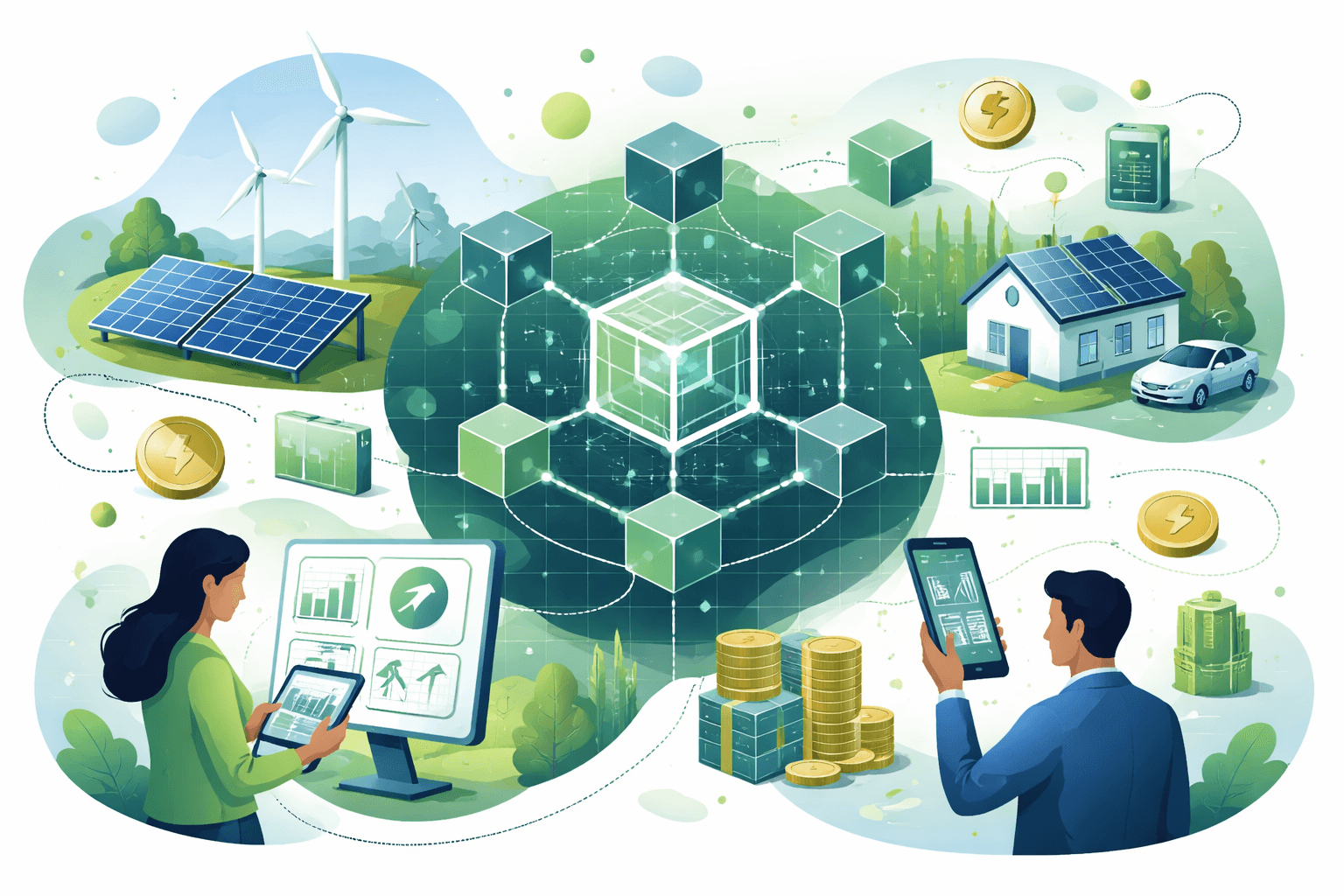
Why blockchain for renewable energy trading is on the agenda now
Global renewable capacity additions hit a record 507 GW in 2023, with solar PV accounting for roughly three-quarters of the growth, according to the IEA. At the same time, more households and businesses are becoming “prosumers,” installing rooftop PV and batteries and exporting power to the grid. In the United States alone, the Energy Information Administration reports about 115 million advanced (smart) electricity meters in service as of 2022—essential plumbing for granular, real-time energy accounting. Against this backdrop, blockchain for renewable energy trading is gaining attention as a digital mechanism to automate settlement, certify provenance, and enable peer-to-peer (P2P) exchanges at the grid edge.
Corporations are also pushing for 24/7 carbon-free energy (CFE), which requires hour-by-hour matching of consumption with clean generation. BloombergNEF estimates companies signed roughly 36–37 GW of clean power purchase agreements in 2023, a record that underscores the need for transparent, traceable certificates and faster reconciliation. Blockchain—essentially a shared ledger secured by cryptography and executed by smart contracts—offers a way to coordinate thousands to millions of small trades and attributes with a common source of truth.
For a primer on technologies reshaping the power sector, see our explainer on Renewable Energy Explained: Why Solar Leads the Transition.
Blockchain, simply explained—and why energy markets care
- What it is: A blockchain is a distributed database shared across multiple computers (nodes). Rather than relying on one central intermediary, participants maintain a synchronized ledger of transactions. Blocks of transactions are cryptographically linked (hence “block-chain”) so past records are tamper-evident.
- Smart contracts: These are small programs stored on the blockchain that run automatically when conditions are met (for example: “if meter A exports 5 kWh to meter B at 3–4 pm, then transfer $X and issue a certificate”).
- Permissionless vs permissioned: Public chains (e.g., Ethereum) allow anyone to participate, while permissioned chains (e.g., Hyperledger Fabric, Energy Web Chain) restrict validators to known entities like utilities or market operators—often preferred for compliance, throughput, and data privacy.
- Energy use: Early blockchains used proof-of-work (PoW), which consumes significant electricity. Newer designs use proof-of-stake (PoS) or proof-of-authority (PoA). For example, the Ethereum Foundation estimates Ethereum’s 2022 shift to PoS cut its network energy use by about 99.95%. Most energy-sector deployments favor permissioned PoA/PoS or layer-2 solutions with minimal energy overhead.
Token Economy: How the Web3 reinvents the Internet (Token Economy: How the Web3 reinvents the internet (English original & foreign language translations)): Voshmgir, Shermin
This is the second edition of the book Token Economy, <strong>originally published in 2020.</strong>
Check Price on AmazonWhy it matters for energy: Power markets need trustworthy records of who generated what, where, and when. They also need low-friction settlement and auditable environmental attributes (like renewable energy certificates, or RECs). Blockchain’s core strengths—shared state, automation via smart contracts, and immutable audit trails—map well to these needs.
How peer-to-peer energy trading works with blockchain
Peer-to-peer (P2P) energy trading lets producers (e.g., a home with rooftop PV) sell surplus electricity directly to neighbors or to local businesses, often within a microgrid or distribution network. Here’s a practical architecture for blockchain-enabled P2P trading.
The participants
- Producers: Households, businesses, or community solar sites with surplus generation; some with behind-the-meter batteries or EVs.
- Buyers: Nearby consumers seeking local, possibly cheaper, clean energy; can include community facilities or EV fleets.
- Distribution system operator (DSO) / utility: Ensures grid safety, voltage/thermal limits, and manages interconnection and billing frameworks.
- Aggregators / market operators: Run local marketplaces, bundle small resources, and handle compliance.
- Technology stack: Smart meters and inverters; IoT gateways; a blockchain ledger; smart contracts; and data “oracles” that feed verified meter data onto the chain.

CanaKit Raspberry Pi 4 8GB Starter Kit - 8GB RAM : Electronics
View on AmazonThe data and transaction flow
- Measurement: Smart meters record net exports/imports in short intervals (e.g., 1–15 minutes). Advanced meters can timestamp data to the minute or second.
- Verification: The DSO or a certified metering service validates readings, signs them digitally, and publishes hashes (fingerprints) on-chain. Raw data can remain off-chain to protect privacy.
- Matching: Buyers post bids (price, quantity, time window) and sellers post offers. A matching engine—implemented via smart contracts or an off-chain solver—matches trades subject to grid constraints.
- Execution: Smart contracts lock in the trade at the agreed price, referencing metered quantities.
- Settlement: When the delivery interval ends and meter data confirm delivery, funds move automatically (e.g., tokenized fiat in a permissioned chain or real-world payment rails integrated via an escrow/settlement agent). Any renewable attributes (like granular RECs) are minted and assigned simultaneously.
- Reconciliation and reporting: The ledger provides an auditable record for regulators, tax, and sustainability reporting. Certificates can be bundled, retired, or transferred to prove consumption of clean power.

Sense Energy Monitor with Solar – Track Electricity Usage and Solar Production in Real Time
View on AmazonIf you’re integrating forecasting and optimization—like predicting rooftop PV output or EV charging flexibility—AI tools can complement blockchain’s settlement layer. We cover grid AI use cases in AI in Renewable Energy: Use Cases, Measurable Impacts, and How to Deploy.
By the numbers: digitalization meets decarbonization
- 507 GW: Global renewable capacity added in 2023 (IEA 2024), the fastest growth on record, led by solar PV.
- ~115 million: Advanced metering infrastructure (AMI) smart meters in the United States as of 2022 (U.S. EIA), enabling time-stamped measurement vital for automated settlement.
- 36–37 GW: Corporate clean energy PPAs signed in 2023 (BloombergNEF), increasing the need for transparent, traceable certificates and faster settlement.
- 99.95%: Estimated reduction in Ethereum network energy use after shifting from PoW to PoS (Ethereum Foundation), illustrating that modern blockchain designs no longer carry large energy penalties.
For how storage complements these digital markets with flexibility and arbitrage, see Latest Trends in Battery Storage: Tech, Markets, Sustainability, and Grid Integration.
Benefits of blockchain for renewable energy markets
1) Transparency and auditability
Every trade and certificate issuance is recorded on a shared ledger. This creates a verifiable trail from generator to consumer, simplifying audits for regulators, market operators, and corporate sustainability teams. Because entries are time-stamped and tamper-evident, disputes over volumes or timing can be resolved quickly using a common record.
2) Traceability and 24/7 matching
Traditional RECs or Guarantees of Origin (GOs) are typically issued monthly or annually, obscuring the hour-by-hour carbon intensity of consumption. Blockchain systems can issue granular, timestamped Energy Attribute Certificates (EACs)—for example, hourly certificates aligned with emerging EnergyTag guidance—enabling 24/7 CFE claims. This supports buyers seeking to match consumption with clean generation in real time and to verify emissions reductions under evolving accounting frameworks.
For background on how certificate markets work and why quality matters, see our explainer on Carbon Credits Explained: How Emissions Trading Markets Actually Work.
3) Faster settlement and lower back-office friction
- Automated settlement: Smart contracts can execute payouts automatically once metered delivery is verified, shrinking settlement cycles from weeks to hours or minutes.
- Reduced reconciliation errors: With on-chain data hashes and digitally signed meter readings, charge-back disputes and manual reconciliations decline.
- Programmable compliance: Rules for caps, tariffs, or local network limits can be encoded directly, reducing the risk of non-compliant trades.
4) Potential cost reduction and better price signals
Permissioned chains can process thousands of simple transactions per second in controlled settings, with near-zero marginal transaction costs. When back-office processing, certificate issuance, and settlement are automated, total administrative overhead per MWh can decline. More granular local price signals also emerge (locational marginal pricing at the distribution level, in effect), guiding flexible loads and storage to shift consumption and reduce congestion.
5) Inclusion and market access
By lowering the minimum tradable unit (e.g., from 1 MWh certificates to 0.1 MWh or even 1 kWh), small producers can participate, and community energy projects can attract local buyers who value provenance.
Challenges and limitations
Scalability and latency
- Throughput: Large-scale retail markets could involve millions of trades per day. Matching engines may need to run off-chain, posting results on-chain to anchor finality. Permissioned chains and layer-2 solutions address throughput but add complexity.
- Latency: Real-time grid operations require sub-second control; blockchain is better suited for settlement and certification operating on minute-scale intervals, not instantaneous protection or control (which remain in SCADA/EMS/DMS systems).
Regulation and market design
- Licensing and consumer protection: P2P trading can blur the line between a customer and a supplier. Jurisdictions like the UK (Ofgem’s regulatory sandbox) and Australia (AEMC consultations) have tested new models, but most markets still require a licensed supplier to sit between retail customers and the wholesale market.
- Network charges and tariffs: Fair cost recovery for wires and system services must be embedded in any P2P model to avoid cross-subsidies. That often means sophisticated tariff design and DSO coordination.
- Legal recognition of digital certificates: Some regions recognize EACs issued only by accredited registries (e.g., REC, GO, I-REC). Blockchain-based certificates generally need to interoperate with or be recognized by these registries.
Interoperability with grid systems
- Standards: Energy systems speak IEC 61850 (substations), IEEE 2030.5/SEP2 (DER), OpenADR (demand response), and utility market platforms (e.g., EDI). Blockchain layers must integrate via well-defined APIs and data models.
- Identity and access: Decentralized identifiers (DIDs) and verifiable credentials can unify identity across utilities, prosumers, and devices, but governance frameworks are essential.
Data privacy and cybersecurity
- Meter data is personal data: In many jurisdictions (e.g., GDPR), interval meter data is sensitive. Designs typically keep raw data off-chain, store hashes on-chain, and use permissioned access with consent. Advanced cryptography—zero-knowledge proofs—can prove facts (e.g., “this power is solar from feeder X between 3–4 pm”) without exposing raw data.
- Oracle risk: If the metering/oracle layer is compromised, on-chain assurances don’t help. Certification and attestation for devices and gateways are as critical as chain security.
Economic viability
- Value vs complexity: For low-volume markets with stable tariffs, the administrative cost of new platforms may outweigh benefits. The strongest cases combine high DER penetration, dynamic tariffs, congestion management, and strong demand for granular certificates.
Real-world pilots and implementations
- Brooklyn Microgrid (LO3 Energy, U.S.): One of the earliest demonstrations (mid-2010s) of neighbors trading local solar power on a blockchain-enabled marketplace. While mostly a pilot, it inspired a wave of similar trials and regulatory sandboxes.
- TenneT–sonnen–IBM (Netherlands/Germany): A pilot used blockchain to aggregate thousands of behind-the-meter batteries for grid balancing and congestion management—demonstrating how distributed storage can provide system services when coordinated via a shared ledger.
- Power Ledger (Australia, Asia, Europe): Multiple trials of P2P energy trading and renewable certificate marketplaces, including projects in Australia and Thailand, showing how permissioned chains can settle local trades and handle certificate issuance.
- Electron (UK): Built blockchain-based flexibility marketplaces tested with UK distribution network operators, enabling DERs to bid services for local constraint management.
- SP Group (Singapore): A blockchain-based marketplace for renewable energy certificates launched to let corporates buy and retire RECs across Asia, improving traceability and reducing issuance/retirement lag.
- Energy Web (global): The Energy Web Chain (PoA) and toolkits (e.g., EW-Origin) have been used by utilities and corporates to issue granular certificates and match consumption with clean generation, supporting 24/7 CFE pilots aligned with EnergyTag.
These examples underscore a pattern: early deployments focus on certificate traceability and local flexibility services—domains where timestamped proofs and automated settlement deliver immediate value—before scaling to mass-market retail trading.
Where blockchain fits in local energy markets, microgrids, and grid decarbonization
Local energy markets and microgrids
- Congestion relief and deferral of upgrades: Local price signals and automated trades can encourage batteries and flexible loads to absorb solar midday peaks and discharge during evening ramps, potentially deferring feeder upgrades.
- Community benefits: Microgrids can prioritize critical loads during outages and maintain local commerce. Blockchain-based accounting makes it easier to distribute costs/benefits fairly across participants and to transparently manage resilience credits.
24/7 carbon-free energy and granular EACs
- Hourly matching: Corporates and cities can prove that each hour of consumption is matched with clean generation, not just annualized. Blockchain-anchored hourly EACs provide verifiable, tamper-evident claims.
- Portfolio optimization: Smart contracts can automate procurement—e.g., auto-buying wind at night and solar at midday, with storage filling gaps—based on carbon intensity forecasts and price.
DER orchestration and flexibility services
- Distribution-level markets: As regulators open flexibility markets, blockchain can provide a common registry for asset identity, qualification, availability, and settlement of services like voltage support or peak shaving.
- EVs and V2G: Fleets can enroll in local markets, earning revenue for providing controlled charging or discharge. Settlement complexity across thousands of sessions is a strong use case for automated ledgers.
System-level decarbonization
- Better signals accelerate DER adoption: Transparent, granular prices and traceable attributes can improve the business case for rooftop PV, batteries, and demand-side participation, speeding deployment and reducing curtailment.
- Improved credibility of claims: As climate disclosure rules tighten, auditable ledgers reduce greenwashing risk and align voluntary markets with regulatory-grade verification.
Practical implications: what this means for key stakeholders
- Consumers and prosumers: Expect more options to sell surplus energy locally, subscribe to community solar with verified attributes, or choose 24/7 CFE tariffs. Look for offerings backed by certified registries and clear tariff structures.
- Utilities and DSOs: Start with use cases that solve immediate pain points—certificate traceability, flexibility settlement, non-wires alternatives—and design governance for identity, data access, and tariffs. Coordinate with regulators early.
- Policymakers and regulators: Enable sandboxes for P2P pilots, clarify legal status of digital certificates and smart contracts, and require interoperability with existing registries and grid data standards. Protect consumers with clear disclosure and dispute mechanisms.
- Corporate buyers: Pilot hourly certificates and 24/7 matching for high-emission hours. Align procurement with EnergyTag-style granularity and ensure integration with sustainability reporting systems.
- Developers and vendors: Design privacy-first architectures (off-chain data, on-chain hashes), robust device attestation, and clear roles for oracles. Measure value against status quo processes to prove ROI.
What to watch next
- Standardization of granular certificates: Expect broader adoption of hourly EACs and alignment among registries (REC, GO, I-REC) to accept blockchain-backed issuance and retirement logs.
- Regulatory clarity: More jurisdictions will define supplier-of-last-resort models, network charge allocation, and licensing for P2P markets, unlocking commercial scaling.
- Interoperable identity: Utility-grade decentralized identity (DID/VC) frameworks for assets, organizations, and devices will reduce onboarding friction.
- Integration with storage and AI: As battery costs decline and AI forecasting improves, the combination will supercharge local markets, with blockchain handling settlement and provenance at scale.
For a foundational overview of energy sources and how they interact on modern grids, visit our guide to Renewable Energy Sources: A Clear Guide to Solar, Wind & More.
Recommended Products
Token Economy: How the Web3 reinvents the Internet (Token Economy: How the Web3 reinvents the internet (English original & foreign language translations)): Voshmgir, Shermin
This is the second edition of the book Token Economy, <strong>originally published in 2020.</strong>
Sense Energy Monitor with Solar – Track Electricity Usage and Solar Production in Real Time
KNOW WHAT’S ON: Track how much electricity you’re using, what time your kids got home, or when someone leaves the basement light on. Sense <strong>identifies patterns in your energy use to help your f
CanaKit Raspberry Pi 4 8GB Starter Kit - 8GB RAM : Electronics
RasTech Raspberry Pi 4 8GB Starter Kit with Pi4 8GB Board,with 32GB Card 4 Copper Heatsink 2 Micro HD Out Cable 5V 3A Power Supply with ON/Off Case Cooling Fan Card Readers Screwdriver · CanaKit Raspb