
Mangrove Restoration Benefits: Why These Coastal Forests Matter
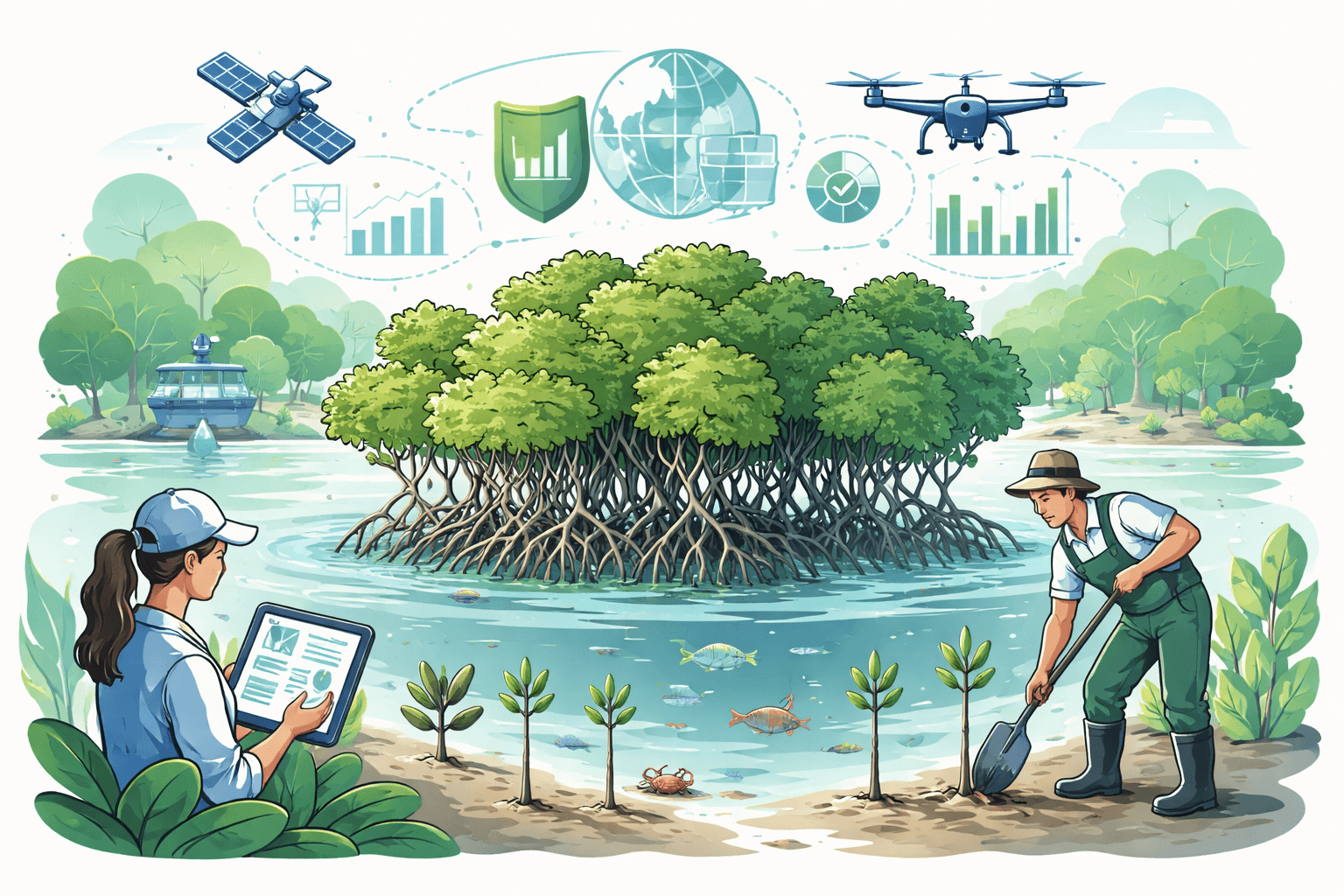
Mangroves line roughly 147,000 km² of tropical and subtropical shorelines worldwide, yet one-fifth to one-third of historical extent has been lost since the 1970s (Global Mangrove Watch; IUCN). That loss carries a steep price: mangroves reduce annual flood damages by about $65 billion and help protect over 15 million people each year (Menéndez et al., Nature Sustainability; The Nature Conservancy). As countries scale up restoration, understanding mangrove restoration benefits—ecological, coastal protection, climate, and community—is essential for getting projects right.
Why mangroves matter ecologically
Mangroves are intertidal forests—trees and shrubs adapted to brackish water, tidal flooding, and salt. Roughly 70 mangrove tree species exist globally, with the highest diversity in the Indo-Pacific. Their prop roots and pneumatophores (aerial roots used for gas exchange) slow water, trap sediment, and build soil, creating complex habitats that support biodiversity.
- Coastal nurseries: Mangroves serve as nurseries for juvenile fish, crabs, and shrimp. Studies in the Caribbean and Indo-Pacific show higher juvenile abundance and fish biomass on reefs and seagrass beds connected to mangroves compared to isolated sites (NOAA; Mumby et al., Nature). This habitat connectivity boosts local fisheries and enhances reef resilience.
- Food webs and species richness: Mangrove detritus (fallen leaves and woody debris) fuels detrital food webs, feeding invertebrates and fish. Endangered species—from West African manatees and Proboscis monkeys to sea turtles and migratory birds—use mangroves for feeding, shelter, or nesting (IUCN Red List).
- Natural water engineers: By trapping sediment and organic matter, mangroves raise the elevation of the forest floor over time, a process known as vertical accretion. This can help intertidal habitats keep pace with moderate sea-level rise where sediment supply remains adequate (IPCC Special Report on the Ocean and Cryosphere).
For readers interested in the broader seascape context, mangroves are one link in a coastal corridor that includes seagrass meadows and coral reefs; protecting that corridor is central to effective ocean conservation and to sustaining marine biodiversity.
Shoreline protection: the physics of natural defense
One of the most widely recognized mangrove restoration benefits is coastal protection. Dense mangrove stands reduce wave height and storm surge by creating drag and turbulence that dissipate wave energy.
- Wave attenuation: Meta-analyses find mangroves can reduce wave height by 13–66% per 100 meters of forest width, with up to 90% attenuation across 500 meters, depending on species, density, and water depth (McIvor et al., The Nature Conservancy; Mazda et al., Wetlands Ecology and Management).
- Erosion control: Mangrove roots stabilize shorelines by binding sediment. After restoration in several deltaic systems, shoreline retreat slowed or reversed as sediments accumulated on the forest floor (UNEP; FAO case studies).
- Flood risk reduction: Globally, mangroves prevent billions in property losses annually—about $65 billion—by reducing inundation during storms and high tides (Menéndez et al.; The Nature Conservancy). In cyclone-prone regions of South Asia, social-ecological studies have linked intact mangrove belts with lower storm damage and mortality relative to unprotected coasts (Das and Vincent, PNAS; World Bank).
Where levees and seawalls dominate, hybrid designs that pair engineered structures with restored mangroves can lower lifetime costs and improve performance under extreme events. Nature-based solutions also adapt over time: as mangroves grow, root density and canopy complexity increase drag, maintaining risk-reduction benefits provided sufficient space and sediment exist.
Climate benefits: blue carbon and resilience
Mangroves are blue carbon ecosystems—coastal wetlands that capture and store large amounts of carbon in waterlogged soils. Unlike many terrestrial forests, a significant share of mangrove carbon is in deep, anoxic sediments where decomposition is slow.
- Exceptional carbon stocks: A global synthesis found average mangrove carbon stocks around 1,000 metric tons of carbon per hectare (Mg C/ha) across biomass and soils—three to five times higher than many tropical upland forests (Donato et al., Nature Geoscience; IPCC Wetlands Supplement). That equates to roughly 3,700 metric tons of CO2e per hectare.
- Ongoing sequestration: Mangroves sequester on the order of 6–10 metric tons of CO2e per hectare per year as new biomass grows and soils accrete (IPCC; NASEM blue carbon assessments). These rates vary with species, tidal range, and nutrient inputs.
- Avoided emissions: When mangroves are degraded or converted (e.g., to aquaculture ponds), the disturbance oxidizes deep organic soils, releasing centuries of stored carbon. Restoration that re-wets and revegetates these soils prevents substantial emissions and can re-start long-term carbon accumulation (UNEP, Blue Carbon Initiative).
- Climate resilience: Beyond mitigation, mangroves buffer climate impacts—reducing heat stress for intertidal fauna, sheltering shorelines from intensifying storms, and maintaining water quality by trapping nutrients and pollutants.
These climate services are increasingly being included in Nationally Determined Contributions (NDCs) and voluntary carbon projects, although high-quality accounting—grounded in IPCC methods and conservative baselines—is essential to ensure integrity.
Biodiversity and community co-benefits
Restored mangroves are biodiversity multipliers and livelihood engines.
Vortex Optics Diamondback 10x42 Roof Prism Binocular ...
View on Amazon- Fisheries and food security: Juvenile stages of many commercially important species (snappers, groupers, prawns, mud crabs) depend on mangroves for shelter and feeding. Empirical studies find higher catch per unit effort and more stable yields in small-scale fisheries near healthy mangrove stands (FAO; WorldFish). Where mangrove-reef-seagrass connectivity is strong, adjacent coral reefs often show higher fish biomass and faster recovery after disturbances.
- Wildlife recovery: Mangrove restoration can rapidly attract shorebirds, herons, and raptors; invertebrate diversity rebounds as leaf litter and structural complexity increase. In some sites, crab and mollusk populations recover within 1–3 years, while tree canopy and bird community complexity build over a decade or more (IUCN; peer-reviewed case studies in Southeast Asia and the Caribbean). For a broader view on how habitat recovery is measured over time, see our guide to wildlife habitat restoration projects.
- Water quality and human health: Mangroves filter sediments and nutrients, improving nearshore water clarity. Better water quality benefits seagrasses and reefs and can reduce harmful algal blooms that affect human health and tourism.
- Livelihoods and equity: Mangrove forests provide timber, fuelwood, honey, medicines, and ecotourism income. Community-managed mangrove fisheries offer subsistence and cash earnings. Multiple economic assessments show that, where storm protection and fishery support are counted, mangrove restoration yields strong benefit-cost ratios—often greater than 3:1 and as high as 6–10:1 in cyclone-prone deltas (Barbier et al., Ecological Economics; World Bank resilience analyses).
Well-designed projects incorporate local tenure and traditional knowledge, creating durable incentives for stewardship and aligning with community conservation priorities.
By the numbers: mangrove restoration benefits
- 147,000 km²: Approximate global mangrove extent (Global Mangrove Watch)
- 13–66%: Average wave height reduction per 100 m of mangrove forest (TNC synthesis; Mazda et al.)
- $65 billion: Annual flood damages avoided due to mangroves (Menéndez et al.; The Nature Conservancy)
- ~1,000 Mg C/ha: Average carbon stock in mangrove ecosystems (Donato et al.)
- 6–10 t CO2e/ha/yr: Typical sequestration rates in restored, functioning sites (IPCC Wetlands)
3:1: Typical benefit-cost ratios reported for protection and fishery services in high-risk coasts (Barbier et al.; World Bank)
What determines successful restoration?
Despite clear benefits, mangrove projects still fail too often when planting is done in the wrong place or with the wrong species. Evidence from Southeast Asia and the Caribbean shows survival rates below 20–30% when propagules are planted on exposed mudflats where hydrology cannot support seedlings (Primavera and Esteban, Ocean & Coastal Management).
Mangrove Ecology, Silviculture and Conservation
Amazon.com: Mangrove Ecology, Silviculture and Conservation: 9781402006869: Saenger, Peter: Books
Check Price on AmazonThe most reliable approach is Ecological Mangrove Restoration (EMR), developed by practitioners like Robin Lewis and colleagues, which emphasizes fixing site conditions first and letting natural regeneration do most of the work.
1) Get the site right: elevation, tides, and sediment
- Elevation relative to mean sea level: Seedlings need the intertidal zone that floods and drains predictably. Sites that are too low (constant inundation) or too high (rare flooding) rarely succeed.
- Tidal hydrology and water flow: Breached dikes, clogged creeks, and undersized culverts create stagnant, hypersaline pools hostile to mangroves. Restoring tidal exchange—often by regrading or reopening channels—is frequently the single highest-impact intervention.
- Sediment supply: Rivers and tidal currents must deliver enough sediment to build soils. In sediment-starved coastlines, pairing restoration with upstream sediment management or living breakwaters may be necessary.
2) Use native species and natural regeneration
- Right species, right zone: Different genera (e.g., Avicennia, Rhizophora, Sonneratia, Bruguiera) occupy distinct microhabitats. Plant a mix that reflects natural zonation instead of a single, fast-growing species.
- Favor assisted natural regeneration (ANR): Once hydrology is restored, nearby seed sources often recolonize quickly. ANR—protecting and guiding natural seedlings—can deliver higher survival and genetic diversity at lower cost than mass planting.
- Planting when needed: Where seed sources are distant, use local-provenance propagules or nursery stock, planted at appropriate spacing and within the correct tidal window.
3) Social license and governance
- Tenure and co-management: Clarify land and resource rights. Long-lived projects involve local fishing and forest user groups in planning, access rules, and benefit-sharing.
- Alternative livelihoods: Pair restoration with livelihood options that reduce pressure on forests—sustainable aquaculture, fuel-efficient stoves, beekeeping, or ecotourism—so communities gain near-term benefits.
4) Monitor, adapt, and verify
- Measurable targets: Track survival rates, canopy cover, species composition, sediment accretion, and fish/crab abundance. Set thresholds that trigger adaptive actions (e.g., re-opening a blocked channel if salinity spikes).
- Tech-enabled monitoring: Satellite products like Global Mangrove Watch, drones, and acoustic sensors can track canopy change and hydrology. AI-assisted image analysis increasingly helps detect stress and illegal clearing; see our explainer on using AI for habitat conservation for practical tools and data needs.
- Long-term commitments: Mangroves often take 10–20 years to regain full structural complexity and carbon function. Budget for multi-year monitoring and maintenance.

DJI Mini 4 Pro Fly More Combo Plus with DJI RC 2, Drones with Camera for Adults 4K, 3 Intelligent Flight Battery Plus for up to 135 Mins Flight Time, Smart Return to Home, Drone for Beginners : Toys & Games
DJI Mini 4 Pro Drone Fly More Combo Plus with <strong>RC 2 Controller (With Screen) Folding Drone with 4K Video, Under 249g, 45 Mins Flight Time, Vision Sensing 3 Batteries Bundle with 2x 128GB Memory
Check Price on AmazonFor practitioners designing programs across habitats, many of these principles echo broader habitat restoration best practices—start with system drivers, build community ownership, and measure outcomes that matter.
Practical implications for policymakers, businesses, and communities
- Policymakers: Prioritize protection first—intact mangroves are cheaper to keep than to rebuild. Where restoration is needed, embed EMR principles in permitting, require hydrological assessments, and plan for landward migration zones to accommodate sea-level rise. Incorporate blue carbon into NDCs using IPCC methodologies and conservative baselines.
- Coastal planners and engineers: Consider hybrid defenses that integrate restored mangroves with embankments or breakwaters. Size setbacks to allow forest width to reach 100–500 meters where feasible, maximizing wave attenuation. Use probabilistic flood models to quantify avoided damages and justify investment.
- Businesses and insurers: Mangrove restoration can reduce asset risk and lower insurance losses. Catastrophe models increasingly include nature-based defenses; premium credits and resilience bonds can finance projects with verifiable risk reduction.
- Communities and NGOs: Focus on livelihoods from the start. Co-design projects with local fishers and women’s groups. Establish community nurseries only where natural recruitment is insufficient, and invest in patrols or stewardship that prevent re-clearing.
Where mangrove restoration is heading
Three trends are reshaping mangrove recovery efforts:
- Scaling with data: High-resolution satellites, open monitoring platforms, and automated change detection are making it easier to target degraded sites, track survival, and demonstrate benefits.
- Finance with integrity: Results-based payments—from climate funds to resilience bonds—are tying disbursements to verified carbon storage and risk-reduction metrics. Expect tighter standards on baselines, leakage, and permanence aligned with IPCC guidance.
- Whole-coast planning: Restoration is increasingly embedded in integrated coastal zone management that coordinates sediment management, wastewater control, and land-use planning. That integration strengthens mangrove health and boosts connected habitats like seagrasses and reefs, a central goal of effective ocean conservation and marine biodiversity strategies.
The science is clear and the tools are ready. When done in the right place, with the right hydrology and species, mangrove restoration delivers outsized returns: it softens storms, stores vast amounts of carbon, rebuilds fisheries, and strengthens coastal economies—an uncommon alignment of ecological function and human well-being.
Recommended Products
Mangrove Ecology, Silviculture and Conservation
Amazon.com: Mangrove Ecology, Silviculture and Conservation: 9781402006869: Saenger, Peter: Books
DJI Mini 4 Pro Fly More Combo Plus with DJI RC 2, Drones with Camera for Adults 4K, 3 Intelligent Flight Battery Plus for up to 135 Mins Flight Time, Smart Return to Home, Drone for Beginners : Toys & Games
DJI Mini 4 Pro Drone Fly More Combo Plus with <strong>RC 2 Controller (With Screen) Folding Drone with 4K Video, Under 249g, 45 Mins Flight Time, Vision Sensing 3 Batteries Bundle with 2x 128GB Memory
Vortex Optics Diamondback 10x42 Roof Prism Binocular ...
Vortex Optics Diamondback HD 8x42 Binoculars - HD Optical System, Non-slip Grip, Waterproof, Fogproof, Shockproof, Included GlassPak - Unlimited, Unconditional Warranty