
Solar in New Mexico: Costs, Incentives & Top Installers (2026)
New Mexico sits in the top tier of U.S. solar resource. NREL’s National Solar Radiation Database shows much of the state receiving 6.0–7.5 peak sun hours per day on a fixed-tilt array—roughly 20–35% higher than the U.S. median. That superior irradiance, combined with a 30% federal tax credit and a 10% New Mexico state tax credit, makes solar in New Mexico one of the strongest residential clean-energy investments in 2026.
By the numbers: Solar in New Mexico (2026)
- Peak sun hours (fixed tilt): ~6.0–7.5 kWh/m²/day (NREL NSRDB)
- Typical residential PV capacity factor: ~22–26% (NREL PVWatts estimates for Albuquerque/Las Cruces)
- Average installed price: $2.50–$3.20/W before incentives (industry quotes in NM, 2025–2026 range)
- Typical system size: 6–9 kWdc
- Average NM residential electricity price: ~14–16¢/kWh (EIA state averages, 2024–2025)
- Simple payback: ~6–9 years for well-sited rooftops
- Annual production: ~1,700–1,900 kWh per kWdc (PVWatts)
- CO₂ avoided: ~0.7–0.9 tons per kW per year, or ~5–7 tons/year for a 7.5 kW system (EPA eGRID factors)

Solar Electricity Basics: A Green Energy Guide: Chiras, Dan
Permits, covenants, utility ... the introduction you need-no PhD required! Dan Chiras is an <strong>internationally acclaimed author who has published over 24 books, including The Homeowner's Gui
Check Price on AmazonSolar in New Mexico: potential and climate edge
New Mexico’s high elevation, dry air, and abundant clear days translate into high irradiance and excellent photovoltaic performance. In practical terms, each installed kilowatt (kW) of rooftop solar in New Mexico can generate roughly 1,700–1,900 kWh per year, according to NREL’s PVWatts calculator. That outperforms most U.S. regions by hundreds of kilowatt-hours annually.
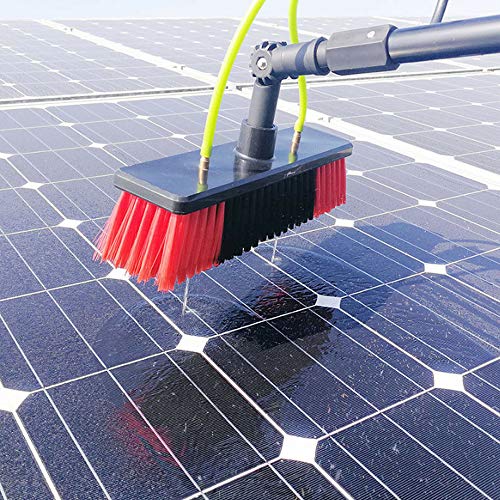
26 Feet Reach Solar Panel Cleaning Brush & Pole Water Fed Pole Kit,Suitable for high Windows Cleaning, Solar photovoltaic Panel Cleaning and Cleaning Cars Trucks Vans caravans Windows : Patio, Lawn & Garden
View on AmazonClimate factors that help—and what to plan for:
- Low humidity and frequent clear skies increase solar output versus more humid or cloudier climates.
- Monsoon season (roughly July–September) brings afternoon clouds, dust, and occasional hail. Dust and soiling can reduce output by a few percent; a semiannual rinse or including anti-soiling coatings in a maintenance plan can recover most of that loss (NREL soiling studies).
- Hail risk varies by county. Look for panels tested to IEC 61215 hail impact standards or UL 61730, and consider mounting tilt and module glass thickness. Many Tier-1 panels meet or exceed 25 mm hail at ~23 m/s; some premium modules advertise enhanced impact ratings.
Average cost of solar panels in New Mexico
Installed residential solar prices in New Mexico typically range from $2.50–$3.20 per watt (W) before incentives, based on 2025–2026 installer quotes. Actual pricing depends on equipment, roof complexity, and labor.
Illustrative pre-incentive price bands:
- Value-focused equipment: ~$2.50–$2.75/W
- Mid-range high-efficiency panels with module-level power electronics: ~$2.70–$3.00/W
- Premium modules (higher efficiency, black-on-black aesthetics) and advanced monitoring/batteries: ~$3.00–$3.20+/W
What drives price-per-watt:
- Roof type and pitch: Tile or steep roofs add labor and mounting costs.
- Electrical upgrades: Older service panels may require a main panel upgrade (~$1,500–$3,500).
- Inverters: Microinverters or DC optimizers cost more upfront but improve shade performance and monitoring.
- Batteries: Adding 10–13.5 kWh of storage typically adds $10,000–$16,000 installed, but qualifies for the 30% federal credit when installed with or without solar (since 2023).
Real-world example (8 kWdc system):
- 8,000 W × $2.75/W = $22,000 (pre-incentive price)
- Federal ITC (30%): −$6,600 (see details below)
- New Mexico solar tax credit (10% up to $6,000): −$2,200 (see details below)
- Net after credits: ~$13,200 (note: the order of applying credits and tax basis rules can vary; consult a tax professional)
New Mexico solar incentives: state tax credits, rebates, net metering, and SRECs
New Mexico’s policy stack is straightforward and homeowner-friendly, administered primarily by the New Mexico Energy, Minerals and Natural Resources Department (EMNRD) and regulated by the New Mexico Public Regulation Commission (NMPRC).
State Solar Market Development Tax Credit (residential):
- Credit amount: 10% of qualified system costs, capped at $6,000 per system (EMNRD program; credit availability subject to annual allocation caps).
- Eligible technologies: Grid-tied PV and solar thermal for residences; must be installed by a licensed contractor and permitted/inspected.
- Claiming: credit is applied against New Mexico personal income tax; unused amounts can typically be carried forward (subject to program rules).
Property and sales taxes:
- Property value: New Mexico has historically protected the added value of residential renewable energy systems from increasing property taxes. Check county assessor guidance for the latest application of renewable energy valuation rules.
- Sales tax: New Mexico levies a gross receipts tax (similar to a sales tax) that varies by locality and is typically included in quoted system prices. There is currently no broad statewide exemption specific to residential PV equipment.
Net metering (NMPRC):
- Structure: Investor-owned utilities (e.g., PNM, SPS/Xcel) and many co-ops provide net metering or net billing for qualifying distributed generation. Under net metering, exported solar energy earns bill credits—often at the retail energy rate excluding fixed charges—offsetting future consumption. Credits generally roll over month-to-month; annual true-up policies vary by utility (some credit excess at an avoided-cost rate).
- System size caps: Commonly up to 10 kW for simplified residential interconnection; larger systems may be allowed with additional review.
- Metering: A bi-directional meter measures imports and exports. Expect a utility meter swap after final inspection.
- Always verify with your specific utility tariff, as rate designs (e.g., time-of-use) and export crediting can change.
SRECs (Solar Renewable Energy Certificates):
- New Mexico does not have an active, tradable residential SREC marketplace like some Eastern states. In most cases, homeowners retain renewable energy certificates by default, but there is limited opportunity to sell them at meaningful values. Some past performance-based incentives (PBIs) that required REC transfer have sunset.
Local rebates:
- Some municipalities or electric co-ops periodically offer limited-time rebates for PV or batteries. Check your city or co-op website for current offers.
The federal ITC and how it applies to New Mexico homeowners
- Credit amount: 30% for residential solar and standalone batteries installed 2022–2032 under the Inflation Reduction Act (Internal Revenue Code §25D). It steps down after 2032 unless extended by Congress.
- Eligible costs: Panels, inverters, racking, balance-of-system, installation labor, sales taxes/gross receipts tax included in the contract, and energy storage (≥3 kWh capacity) even if installed without solar as of 2023.
- Basis coordination: The federal credit typically applies to net costs after any cash rebates. State income tax credits are generally claimed separately; whether they reduce federal tax basis can depend on tax treatment. Consult a CPA.
- Carryforward: If your federal tax liability is insufficient to use the entire 30% credit in year one, you can carry the remainder forward.
Best solar installers and companies serving New Mexico
New Mexico’s solar market includes long-standing local firms and national brands. Strong candidates share common traits: years in business, NABCEP-certified professionals, transparent equipment lists, robust workmanship warranties (10+ years), and strong local references.
Representative companies active in New Mexico residential markets (verify current service areas):
- Positive Energy Solar (local, long-tenured; strong residential portfolio and NABCEP presence)
- Affordable Solar (local EPC with residential and commercial divisions)
- Tesla (national; standardized pricing, in-house equipment ecosystem, popular battery option)
- SunPower dealers (national brand via local partners; high-efficiency modules)
- ADT Solar and Freedom Forever (national installers operating in parts of NM)
- Regional independents around Albuquerque, Santa Fe, Las Cruces, and Farmington (request NABCEP credentials and recent installs)
How to choose:
- Ask for three bids using comparable equipment (e.g., same panel wattage/efficiency and inverter type).
- Request production estimates from NREL PVWatts with your roof’s azimuth/tilt and shade analysis (Solar Pathfinder or LiDAR-based tools).
- Compare warranties: 25-year equipment warranties are standard for Tier-1 panels; seek at least 10 years workmanship, and clarify roof-penetration warranties.
- Verify licensing and insurance in New Mexico and check complaint history with the NM Regulation and Licensing Department.
Equipment picks that perform well in New Mexico’s sun
High irradiance rewards efficient modules and robust electronics, especially on complex roofs.
- High-efficiency modules: REC Alpha Pure or Qcells Q.TRON-series offer strong temperature coefficients and 25-year performance warranties. Based on these specs, the REC Alpha Pure represents strong value for residential installations seeking high kWh per square foot.
- Inverters: On roofs with multiple planes or partial shade, microinverters such as Enphase IQ8 or DC optimizers like SolarEdge Home Wave improve harvest and provide module-level monitoring.
- Batteries: For backup or time-of-use rate optimization, 10–13.5 kWh units like Enphase IQ Battery or Tesla Powerwall 3 integrate smoothly with common inverter stacks in NM.
ROI and payback period for solar in New Mexico
A quick-payback profile in New Mexico stems from high sun and decent retail electricity prices.
Worked example (Albuquerque-area home):
- System: 7.5 kWdc, mid-range equipment at $2.75/W → $20,625 pre-incentive
- Production: ~13,500 kWh/year (7.5 × ~1,800 kWh/kW)
- Bill offset value: At 15¢/kWh average retail, ~$2,025/year
- Credits:
- Federal ITC (30% of qualified costs): ~$6,188
- NM state tax credit (10% capped at $6,000): ~$2,063
- Net homeowner outlay after credits: ~$12,374 (timing depends on tax liability)
- Simple payback: ~$12,374 / $2,025 ≈ 6.1 years
Sensitivity:
- At 14¢/kWh and 1,700 kWh/kW-year, payback shifts toward ~7–8 years.
- Premium equipment or complex roofs may add 5–15% to costs, lengthening payback modestly.
- Adding a 10–13.5 kWh battery primarily adds resilience; financial payback depends on your rate plan and outage risk, not just self-consumption.
Long-term returns:
- Lifespan: 25–30+ years for Tier-1 modules with degradation ~0.25–0.5%/year (manufacturer data; NREL degradation meta-analyses).
- IRR: Many NM homes see double-digit internal rates of return depending on rate escalation and load growth (EV adoption, heat pumps).
- Home value: Multiple appraisals studies (e.g., Lawrence Berkeley National Laboratory) show solar-equipped homes selling at a premium, often approximating part of the system’s net installed cost.
New Mexico-specific permitting, HOA rules, and interconnection
Permitting
- Building and electrical permits are typically required through your city or county. Submittals include a site plan, structural letter or rafter specs, and single-line electrical diagram.
- Review times: 3–15 business days in many jurisdictions for standard rooftop PV; longer if structural upgrades are needed.
- SolarAPP+: Several New Mexico jurisdictions have evaluated or adopted DOE’s SolarAPP+ for instant online permitting of standard rooftop systems. Ask your installer whether your city participates—where adopted, approvals can be same-day.
HOA and solar rights
- New Mexico’s solar rights framework generally prevents homeowners associations from prohibiting solar collectors. HOAs can set reasonable rules (conduit color, setback) that do not significantly increase cost or reduce performance. If placement is disputed, provide a performance comparison; a common benchmark for “reasonable” is avoiding changes that cut expected output by more than ~10%.
Interconnection (utility)
- Process: Application → preliminary approval → permit/installation → city/county inspection → utility meter swap → permission to operate (PTO).
- Timelines: 2–4 weeks for standard net-metered systems after final inspection, depending on utility workload.
- Fees and equipment: Most residential systems require a bi-directional meter; application fees, if any, are typically modest for systems ≤10 kW. Utilities may require a visible AC disconnect.
- Rate options: Some New Mexico utilities offer time-of-use (TOU) or demand-based residential rates. Discuss with your installer whether TOU pairing with a battery can improve economics in your service territory.
Comparing New Mexico with nearby solar markets
If you’re considering a regional move or benchmarking bids, it helps to compare with neighboring states of similar sun and policy frameworks:
- Arizona sees similar irradiance and active net billing structures. See our guide to Solar in Arizona: Costs, Incentives & Top Installers (2026).
- Colorado has cooler temperatures and robust net metering statewide; installed costs per watt can be similar. Explore Solar in Colorado: Costs, Incentives & Top Installers (2026).
- Nevada’s export crediting differs by utility but enjoys strong sun similar to southern NM; compare with Solar in Nevada: Costs, Incentives & Top Installers (2026).
FAQ: common questions about going solar in New Mexico
Q: How many solar panels do I need in New Mexico?
- A typical 7–9 kW system uses ~18–24 panels (at 400–450 W each) and covers ~350–500 sq. ft., depending on panel wattage and layout. Your annual kWh use and roof orientation drive sizing.
Q: What is the best roof orientation and tilt in New Mexico?
- South-facing at ~20–30° tilt generally maximizes annual output. East–west arrays can match household load better and fit more panels, with only a modest (2–8%) annual production penalty.
Q: Do I still get value if my roof has shade?
- Yes, but shade-tolerant designs (microinverters or optimizers) matter. Expect a linear hit to production where shade persists; a good design quantifies monthly shade using LiDAR data or a site survey.
Q: Are batteries worth it in New Mexico?
- For backup during storms, wildfire-related shutoffs, or remote feeders, yes. For pure bill savings, batteries help most under TOU or demand-based rates; under full retail net metering, payback is longer. Batteries do qualify for the 30% federal credit.
Q: How long do permits and utility approvals take?
- Standard rooftop systems often move from contract to PTO in 4–10 weeks, depending on jurisdictional permitting and utility scheduling.
Q: What maintenance do panels need in the desert climate?
- Little beyond occasional rinsing to remove dust and pollen. Plan for an annual check of fasteners, wiring, and monitoring. Most Tier-1 modules carry 25-year performance warranties.
Q: Will installing solar increase my property taxes in New Mexico?
- New Mexico policy has generally prevented renewable energy adders from increasing assessed property taxes. Confirm with your county assessor for the latest guidance.
Q: Does New Mexico have SRECs I can sell?
- There’s no active, consumer-accessible SREC market in NM; any REC value is typically minimal for homeowners.
Q: Can my HOA stop me from installing solar?
- HOAs cannot prohibit solar outright, but may enforce reasonable design rules. If a requested change would materially reduce output or raise cost, you can typically contest it under state solar rights provisions.
Q: Which equipment brands perform best in NM heat?
- Look for panels with low temperature coefficients (−0.30%/°C to −0.35%/°C) and inverters rated for high ambient temperatures. Products like Qcells Q.PEAK DUO, Enphase IQ8, and REC Alpha Pure have strong track records in hot, high-irradiance climates.
Practical next steps
- Pull your last 12 months of utility bills to establish annual kWh and seasonal usage.
- Use NREL PVWatts with your address to estimate energy yield; cross-check against installer projections.
- Get three quotes with detailed line items: panel make/model, inverter type, warranties, permitting timelines, and production estimate methodology.
- Clarify net metering terms and any TOU or demand charges with your specific utility before signing.
- Confirm your eligibility for the 10% New Mexico tax credit and how you’ll claim it relative to the 30% federal ITC (coordinate with a tax advisor).

Emporia Gen 2 Smart Home Energy Monitor with 16 50A Circuit Level Sensors | Real Time Electricity Monitor/Meter | Solar/Net Metering - Amazon.com
View on AmazonWhat’s ahead for solar in New Mexico
- Policy stability: The 30% federal ITC runs through 2032; New Mexico’s 10% state credit is funded through allocated program caps. Expect steady residential adoption so long as these incentives remain.
- Grid modernization: NMPRC and utilities are deploying more smart meters and exploring TOU tariffs; that may increase the value of right-sized arrays and smart inverters.
- Storage growth: As more rooftop systems add batteries, expect faster interconnection for solar-plus-storage and expanded resilience for rural feeders.
- Equipment trends: Higher-wattage N-type modules and UL 1741 SB-compliant smart inverters will continue nudging efficiency up and soft costs down.
With nation-leading sun and solid incentives, solar in New Mexico remains one of the clearest paths for households to cut bills and carbon—often paying for itself in under a decade while adding resilience and long-term certainty.
Recommended Products
Solar Electricity Basics: A Green Energy Guide: Chiras, Dan
Permits, covenants, utility ... the introduction you need-no PhD required! Dan Chiras is an <strong>internationally acclaimed author who has published over 24 books, including The Homeowner's Gui
26 Feet Reach Solar Panel Cleaning Brush & Pole Water Fed Pole Kit,Suitable for high Windows Cleaning, Solar photovoltaic Panel Cleaning and Cleaning Cars Trucks Vans caravans Windows : Patio, Lawn & Garden
Buy <strong>26 Feet Reach Solar Panel Cleaning Brush & Pole Water Fed Pole Kit,Suitable for high Windows Cleaning, Solar photovoltaic Panel Cleaning and Cleaning Cars Trucks Vans caravans Windows<
Emporia Gen 2 Smart Home Energy Monitor with 16 50A Circuit Level Sensors | Real Time Electricity Monitor/Meter | Solar/Net Metering - Amazon.com
See how much electricity your home is using anywhere, anytime. ... <strong>Add individual 50A sensors to your Vue to monitor up to 16 individual circuits</strong> — providing accurate energy use for t