
Solar in South Dakota: Costs, Incentives & Top Installers (2026)
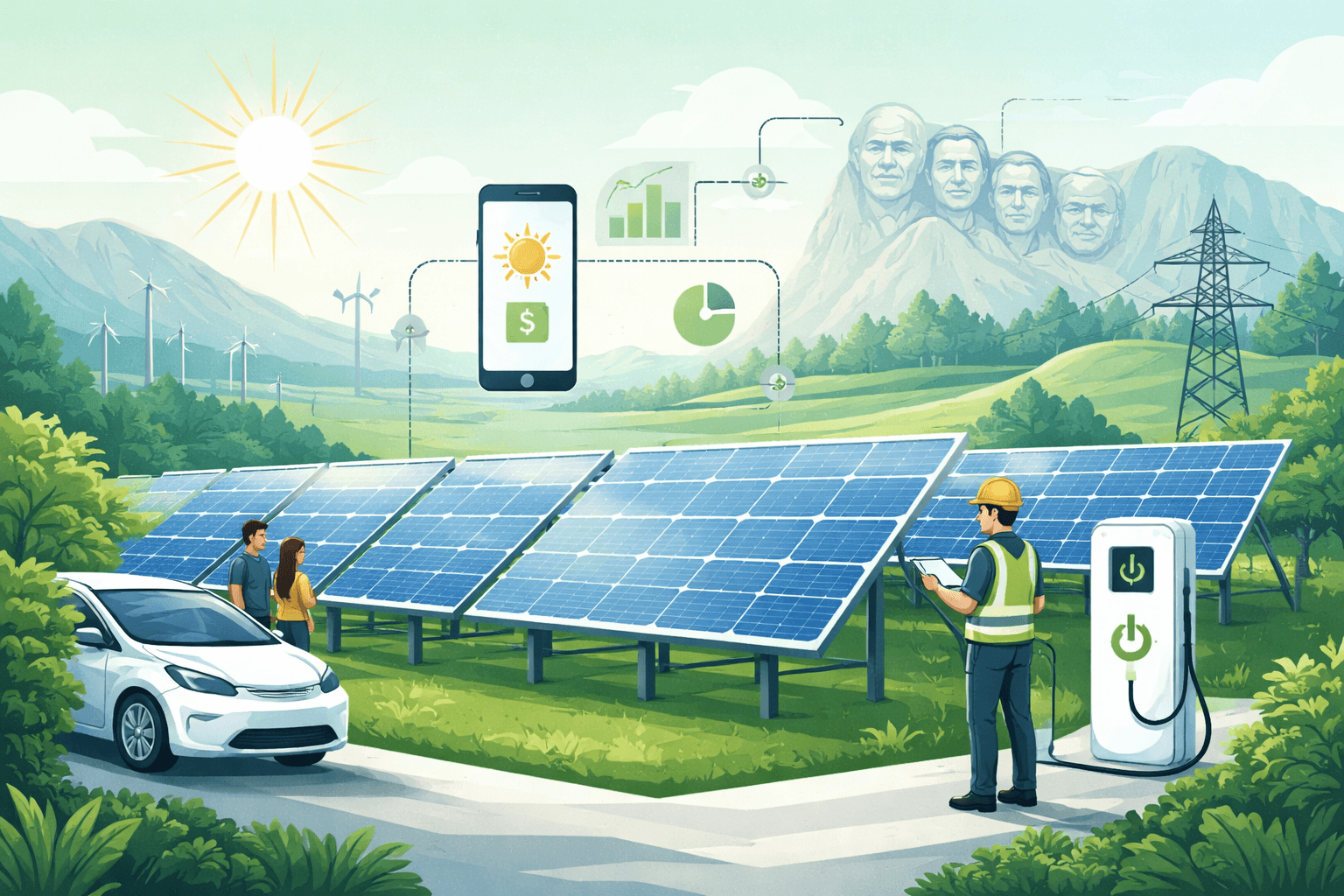
South Dakota has quietly strong fundamentals for residential solar. With average peak sun hours in the 4.5–5.5 range and cold winters that boost photovoltaic efficiency, solar in South Dakota can offset 50–90% of a typical home’s electricity use when systems are sized and sited well. The federal 30% tax credit remains the primary driver of returns through at least 2032, while state-level policies are more limited, making utility tariff selection and equipment choices especially important for payback.
This guide uses the latest data from NREL, LBNL, EIA, and DSIRE to break down costs, incentives, installers, and ROI for 2026—so South Dakota homeowners can make a confident, numbers-first decision.
By the numbers: solar in South Dakota
- Peak sun hours (average): ~4.5–5.5 (higher in the west; NREL PV resource maps)
- Annual production per 1 kW of DC capacity: ~1,300–1,600 kWh (site-dependent)
- Typical residential system size: 6–10 kW
- Installed price (pre-incentive): ~$2.60–$3.40/W in the Midwest; U.S. median around $3.00–$3.30/W (LBNL Tracking the Sun; NREL cost benchmarks)
- Federal tax credit: 30% of total installed cost (through at least 2032 under the Inflation Reduction Act)
- Average residential electricity price: ~12.5–14.0¢/kWh (EIA state averages, 2024)
- Rooftop capacity factor: ~14–18% (climate and shading dependent)
- Snow losses: typically 1–5% annually when arrays are tilted (NREL regional studies)
Solar Electricity Handbook - 2023 Edition: A simple, practical guide to solar energy – designing and installing solar photovoltaic systems: Boxwell, Michael
Solar Electricity Handbook - 2023 Edition: <strong>A simple, practical guide to solar energy – designing and installing solar photovoltaic systems</strong> [Boxwell, Michael] on Amazon.com. *FREE* shi
Check Price on AmazonSolar energy potential in South Dakota: sun hours, irradiance, and climate factors
South Dakota’s solar resource sits above the U.S. average in many locations, with greater irradiance west of the Missouri River and notably strong performance around Rapid City and the Black Hills. NREL’s solar resource data indicate:
- Peak sun hours: roughly 4.6–4.8 in Sioux Falls, 5.0–5.3 in Rapid City
- Global Horizontal Irradiance (GHI): generally in the 4.7–5.3 kWh/m²/day range across the state
Cold, clear winter days help solar modules operate more efficiently because silicon performance improves as temperatures drop. While snowfall creates temporary shading, most pitched, south-facing roofs shed snow quickly under winter sun, keeping annual snow-related losses modest (often 1–5%).
What this means for homeowners:
- A well-sited 7 kW system can generate ~9,000–11,000 kWh/year, enough to offset a significant share of typical annual consumption.
- Sites in western South Dakota often see slightly higher output for the same array size.
- Module-level power electronics (microinverters or DC optimizers) can mitigate partial shading from trees, vents, or occasional snow bands.
Average cost of solar panels in South Dakota and price-per-watt breakdown
Residential installed prices in the Midwest generally track close to national medians reported by Lawrence Berkeley National Laboratory’s Tracking the Sun and NREL’s cost benchmarks. As of late 2024 benchmarks used for 2026 planning:
- Typical residential turnkey price: $2.60–$3.40 per watt (W) DC in South Dakota markets
- Example system budgets (pre-incentive):
- 6 kW: $15,600–$20,400
- 8 kW: $20,800–$27,200
- 10 kW: $26,000–$34,000
What drives the range:
- Equipment: Premium high-efficiency modules and microinverters cost more but can improve yield on complex roofs.
- Labor and permitting: Market size and distance to distributors add variability. Smaller markets like South Dakota can carry slightly higher soft costs per watt than dense metro areas.
- Roof complexity: Multiple roof planes, steep pitches, or structural upgrades increase labor.
- Add-ons: Battery storage, critter guards, and snow-management features (such as snow rails) add cost but may improve resilience and roof protection.
Price-per-watt rule of thumb: Multiply system size (kW) by your quoted $/W to estimate pre-incentive cost, then apply the 30% federal tax credit to find your net outlay.
South Dakota solar incentives: state tax credits, rebates, net metering, and SRECs
State-level incentives for residential solar are limited compared to many neighboring states. Key points (based on DSIRE policy tracking and utility tariffs):
- State income tax credit: South Dakota has no state individual income tax and therefore no state solar income tax credit.
- Sales tax: South Dakota generally assesses state and local sales tax on solar equipment; there is no statewide residential solar sales tax exemption.
- Property tax: There is no widely available statewide property tax exemption specifically for residential solar. Check with your county assessor for how added value is treated.
- Net metering: South Dakota does not have a statewide net metering requirement. Compensation for exports varies by utility and is often “net billing” or buyback at an avoided-cost rate rather than retail credits.
- SRECs: South Dakota does not operate an SREC market and, in practice, out-of-state SREC markets typically require in-state generation. Assume $0 from SRECs.
Utility-specific crediting matters more here than in states with robust net metering. Ask your utility to provide the exact export rate (¢/kWh), whether credits roll over monthly or annually, and whether time-of-use rates are available. Common structures include:
- Net billing: You self-consume solar first; exported kWh are credited at an avoided-cost rate (often 2–6¢/kWh) rather than the retail rate.
- Monthly cash-out vs. rollover: Some utilities credit monthly at wholesale and zero the balance; others roll credits forward for a period.
Because export credits may be low, designing a system toward high self-consumption (right-sized array, load shifting, optional battery) can improve economics.
Note: Policies change. Always confirm with your utility and check DSIRE for the latest program specifics before signing a contract.
Federal ITC and how it applies to South Dakota homeowners
The Inflation Reduction Act (IRA) extended the Residential Clean Energy Credit at 30% for projects placed in service through 2032.
- What qualifies: Solar PV, balance-of-system hardware, permitting and installation labor, and stand-alone or paired battery storage ≥3 kWh usable capacity.
- How it’s claimed: A nonrefundable federal income tax credit claimed on IRS Form 5695 for the tax year the system is placed in service. Unused credits can carry forward to future years subject to IRS rules.
- Example: An 8 kW system at $3.00/W costs $24,000 before incentives. The 30% ITC yields a $7,200 credit, reducing net cost to $16,800 (excluding any sales tax and any utility fees).
- Batteries: A 10–15 kWh battery can also qualify for 30% if installed in 2023–2032. Batteries can improve self-consumption in areas without full net metering, particularly if your utility credits exports at avoided cost.
Consult a tax professional to confirm how the credit applies to your situation.
Best solar installers and companies serving South Dakota
Because South Dakota is a smaller solar market with varied utility rules, the “best” installer is one that:
- Designs for your tariff: Proposes array sizing and (if useful) storage to maximize self-consumption under your specific buyback rate.
- Has NABCEP-certified professionals on staff: This is the industry’s gold-standard credential for PV design and installation quality.
- Offers robust warranties: Look for 25-year module and inverter warranties and at least a 10-year workmanship/water intrusion warranty.
- Provides production guarantees and third-party monitoring: Transparent performance tracking through a customer portal is critical.
Finding strong contenders:
- Ask for at least three quotes and request single-line diagrams plus production estimates from NREL PVWatts or equivalent modeling.
- Verify electrical licensing with the South Dakota Electrical Commission and check recent local permits (Sioux Falls, Rapid City, etc.).
- Request references for a project of similar roof type, pitch, and snow/wind load conditions.
Availability of national brands and dealer networks can change. Many premium panel brands (for example, REC, Qcells, and Canadian Solar) are sold via local certified dealers, and microinverter/optimizer platforms (Enphase and SolarEdge) are widely supported in the region. Focus on the installer’s local track record, not just the logo on the panel.
ROI and payback period for solar in South Dakota
Without a statewide net metering policy and with relatively modest retail electric rates, payback in South Dakota often hinges on right-sizing, self-consumption, and installed cost.
Baseline scenario (illustrative):
- System size: 7 kW DC
- Installed price: $3.00/W ($21,000 pre-incentive)
- Federal ITC (30%): -$6,300
- Net cost: $14,700
- Annual production: ~10,000 kWh (mid-state, south-facing roof, minimal shading)
- Retail electricity value: 13.0¢/kWh average (EIA 2024) → $1,300/year gross bill savings
- O&M/monitoring reserve: ~$20/kW-year → ~$140/year
- Net first-year benefit: ~$1,160
- Simple payback: ~12.5–13.5 years (before degradation and rate escalation)
Sensitivity factors:
- Higher retail rates or time-of-use arbitrage improve ROI.
- Export credits below retail reduce value; designing for ~60–80% self-consumption helps.
- Lower installed prices (e.g., $2.70/W) can shave 1–2 years off payback.
- West-river locations with ~10% higher yield shorten payback.
Long-term performance:
- Module degradation: Modern panels typically degrade ~0.25–0.5%/year. Over 25 years, expect ~88–94% of year-one output.
- Inverter replacements: String inverters often need one replacement in 12–15 years; microinverters carry 20–25-year warranties but factor labor.
Cash flow and financing:
- Cash purchases capture full ITC in year one and maximize lifetime savings.
- Low-fee HELOCs or solar loans can still yield positive monthly cash flow if the payment is less than the blended bill savings.
South Dakota-specific permitting, HOA rules, and interconnection process
Permitting and interconnection are local and utility-specific in South Dakota. Plan for a 2–8 week timeline from contract to utility permission to operate (PTO), depending on jurisdiction.
Permitting
- Building/electrical permits: Required by most cities and counties. Sioux Falls, Rapid City, and other jurisdictions may require structural documentation for roof loads (snow/wind). Your installer should provide stamped plans when needed.
- Structural and wind/snow loads: Expect compliance with local amendments to the International Residential Code. Mounting hardware must meet wind ratings appropriate for gusts often in the 90–120 mph design range.
HOAs and solar rights
- Statewide solar-rights statute: South Dakota does not have a widely cited statewide solar access/solar-rights law for HOAs.
- Practical path: Review covenants early. Many HOAs will approve flush-mounted, roof-parallel arrays with concealed wiring and black-framed modules. Submit professional drawings, color elevations, and spec sheets to streamline approval.
Interconnection and metering
- Application: Your installer submits a one-line diagram, site plan, equipment sheets, and insurance certificates to your utility.
- Review tiers: Small systems (often ≤10–20 kW) typically qualify for a fast-track review; larger or three-phase services may require additional study.
- Metering and tariffs: Confirm whether you’ll receive netting, net billing, or separate production meters, and whether any monthly customer charges or minimum bills apply to solar customers.
Ask your installer to provide written confirmation of: (1) export credit rate and credit rollover rules, (2) any interconnection fees, (3) transformer or service-upgrade costs if applicable, and (4) expected PTO date.
Equipment choices that matter in South Dakota’s climate
- High-efficiency modules: On limited roof area or partial shade, premium modules can maintain output in cold, clear winters. Based on independent efficiency testing, options like the REC Alpha series and Qcells Q.TRON lines are strong performers.
- Module-level power electronics: Microinverters (e.g., Enphase IQ8) or DC optimizers (SolarEdge) help manage partial snow shedding and complex roofs.
- Racking and snow management: Robust, sealed roof attachments and optional snow guards protect shingles and gutters.
- Batteries for self-consumption: Where export credits are low, a 10–15 kWh battery can store mid-day surplus for evening use.

EF ECOFLOW Smart Home Panel 2, the Center of the Whole
Alternatively connect <strong>3 x EcoFlow DELTA Pro 3 units with 6 x Extra Batteries for energy storage up to 36kWh</strong>. It's not just for longer backup but lets you to control and run every
Check Price on AmazonPractical product picks (affiliate placements)
- For shade and winter resilience, the Enphase IQ8 microinverter platform offers module-level shutdown and granular monitoring; Enphase IQ8 Microinverters pair well with mixed roof planes.
- If you want premium efficiency and strong warranty coverage, REC Alpha Pure-R panels consistently test near the top for real-world yield in northern climates.
- To improve self-consumption under net billing, a 13–15 kWh class battery such as the Tesla Powerwall 3 can shift exports into evening loads and provide backup during winter storms.
Comparing policies across the region
If you’re researching options near state borders or comparing regional incentives, explore our neighboring state guides for context on pricing and policy differences:
- Solar in Minnesota: Costs, Incentives & Top Installers (2026)
- Solar in Iowa: Costs, Incentives & Top Installers (2026)
- Solar in Nebraska: Costs, Incentives & Top Installers (2026)
How to size and design for value without full net metering
- Right-size the array: Aim for annual production close to on-site annual consumption if exports are credited below retail. Oversizing can erode ROI.
- Time-shift flexible loads: Run dishwashers, laundry, and EV charging mid-day to increase self-consumption.
- Consider battery storage: Even a modest battery can soak up mid-day surplus and reduce exports at low rates.
- Monitor and adjust: Use your monitoring app to identify consistent exports and tweak usage patterns.

Emporia Gen 2 Smart Home Energy Monitor with 16 50A Circuit Level Sensors | Real Time Electricity Monitor/Meter | Solar/Net Metering - Amazon.com
View on AmazonSolar in South Dakota FAQ
Do South Dakota utilities offer net metering? South Dakota has no statewide net metering mandate. Some utilities offer net billing or buyback at avoided-cost rates. Confirm your exact tariff before final design.
How well does solar work in winter with snow and cold? Cold improves panel efficiency; snow can temporarily reduce output. On tilted arrays, snow typically slides off, with annual snow losses often 1–5%. Module-level electronics help when only part of an array sheds snow.
Should I clear snow off my panels? Safety first. If snow is light and sun is out, it often melts or slides naturally. If you clear snow, use non-abrasive tools and avoid roof hazards.
What’s the typical payback period in South Dakota? Around 11–15 years for well-priced systems designed for high self-consumption and taking the 30% federal tax credit. Export credit rates, equipment choices, and retail tariffs drive the range.
Are leases or PPAs common in South Dakota? They’re less common in smaller markets and may be limited by local finance providers. Most homeowners use cash or loans.
Will solar increase my home’s value? Multiple studies (including research summarized by the U.S. Department of Energy’s labs) show owned solar tends to increase resale value, especially when paired with low utility bills and transferrable warranties. Local appraiser practices vary.
Do I need a new roof first? If your roof is 10–15 years old or shows wear, consider reroofing before or during the solar install. Coordinating both can save on labor and ensure full 25-year coverage.
How long does installation take? On-site work is typically 1–3 days for rooftop systems, but permitting and utility approval can extend the total timeline to 2–8 weeks.
Are batteries worth it without net metering? Often yes, if export credits are low and evening usage is significant. A 10–15 kWh battery can raise self-consumption and provide backup, but add $9,000–$15,000 before the 30% credit.
What maintenance is required? Minimal. Visual inspections, keeping modules clear of heavy debris, and ensuring monitoring stays online are usually sufficient. Budget ~$15–$25/kW-year for occasional service.
Where the market is heading
Module prices fell sharply in 2024 as global manufacturing capacity expanded, and U.S. installed costs are trending lower for 2026. Expect:
- Continued price pressure on panels and inverters, with soft costs (labor, permitting) the main constraint in smaller markets.
- More storage-forward designs in states without full net metering to maximize on-site use.
- Gradual expansion of local installer capacity and improved permitting workflows as adoption grows.
For South Dakota homeowners, the 30% federal credit, solid irradiance, and resilient cold-climate performance make 2026 a compelling window—especially if you can secure competitive $/W pricing and a tariff-aware design focused on self-consumption.
Recommended Products
Solar Electricity Handbook - 2023 Edition: A simple, practical guide to solar energy – designing and installing solar photovoltaic systems: Boxwell, Michael
Solar Electricity Handbook - 2023 Edition: <strong>A simple, practical guide to solar energy – designing and installing solar photovoltaic systems</strong> [Boxwell, Michael] on Amazon.com. *FREE* shi
Emporia Gen 2 Smart Home Energy Monitor with 16 50A Circuit Level Sensors | Real Time Electricity Monitor/Meter | Solar/Net Metering - Amazon.com
See how much electricity your home is using anywhere, anytime. ... <strong>Add individual 50A sensors to your Vue to monitor up to 16 individual circuits</strong> — providing accurate energy use for t
EF ECOFLOW Smart Home Panel 2, the Center of the Whole
Alternatively connect <strong>3 x EcoFlow DELTA Pro 3 units with 6 x Extra Batteries for energy storage up to 36kWh</strong>. It's not just for longer backup but lets you to control and run every