
Charging Stations for Electric Cars: Types, Costs, Networks, and How to Choose
Electric vehicles (EVs) are surging, and charging stations for electric cars are scaling to match. The International Energy Agency (IEA) reports 14 million EVs sold globally in 2023 (18% of new car sales), with total stock topping 40 million. In the United States, the Department of Energy’s Alternative Fuels Data Center (DOE AFDC) counted more than 180,000 public charging ports by late 2024—up roughly 35–40% from 2022. Most charging still happens at home, but faster public DC charging is expanding quickly to enable road trips and serve drivers without private parking.
This data-rich guide explains charger types and speeds, where people charge, installation and costs, major networks and payment models, and how smart charging affects the grid and emissions—so you can choose the right options with confidence.
Charger types, speeds, and connectors
EV charging falls into three broad categories defined by power level and current type. Understanding AC vs. DC and connector standards helps you match a vehicle to the right station and anticipate real-world charging times.
Level 1 (AC, 120 V)
- Power: ~1.2–1.9 kW (typically 120 V at 12–16 A)
- Adds: ~3–5 miles of range per hour for most EVs
- Use case: Overnight home charging on a standard household outlet in North America
- Pros/cons: Cheapest to use; too slow for high-mileage drivers
Level 2 (AC, 208–240 V)
- Power: 3.3–19.2 kW (common home units: 7.7–11.5 kW; many workplace/destination sites: 6.6–19.2 kW)
- Adds: ~20–45 miles of range per hour, depending on charger power and vehicle onboard charger capacity
- Use case: Home, workplace, destination (hotels, parking garages), public curbside
- Pros/cons: Sweet spot for daily needs; installation costs vary with electrical capacity
DC fast charging (DCFC, often called “Level 3”)
- Power: 50–350 kW typical in the U.S. (some sites offer 400+ kW for heavy-duty or future vehicles)
- Adds: 150–900+ miles of range per hour equivalent; real-world metric is “10–80%” battery recharge time
- Real-world time: Many 400 V EVs take ~30–45 minutes to go 10–80% at 150 kW if the full power is sustained; newer 800 V models can do 10–80% in ~18–25 minutes at 250–350 kW, per automaker and third-party testing
- Use case: Long-distance travel, quick top-ups
- Note on charging curves: Peak rates occur when the battery is warm and between roughly 10–50% state of charge; speeds taper as the pack fills to protect battery health
AC vs. DC, explained simply
- AC charging (Levels 1–2) feeds alternating current to the car’s onboard charger, which converts it to DC to store in the battery. The vehicle’s onboard charger rating (e.g., 7.2, 11, or 19.2 kW) caps AC charging speed regardless of the station’s rating.
- DC charging converts AC to DC in the station and sends high-power DC straight into the battery, bypassing the onboard charger. Here, the vehicle’s battery architecture and thermal management determine how much power it can accept and for how long.
Connector standards and compatibility
- North America (AC): SAE J1772 (often called “Type 1”) for Level 1/2 on non-Tesla vehicles; many Teslas include a J1772 adapter for AC charging.
- North America (DC): CCS1 (Combined Charging System) is the prevalent non-Tesla DC fast standard. CHAdeMO supports older Nissan LEAFs and some legacy models; it is being phased out in most new North American deployments.
- Tesla/NACS: Tesla’s connector—now standardized as SAE J3400 and commonly called the North American Charging Standard (NACS)—is being adopted by most automakers. Many new models in 2025–2026 will ship with NACS ports, and adapters will bridge CCS1↔NACS during the transition. Some Tesla Superchargers also have integrated adapters for non-Tesla vehicles at select sites.
- Europe: Type 2 (Mennekes) for AC; CCS2 for DC. (Useful if you travel or import vehicles.)
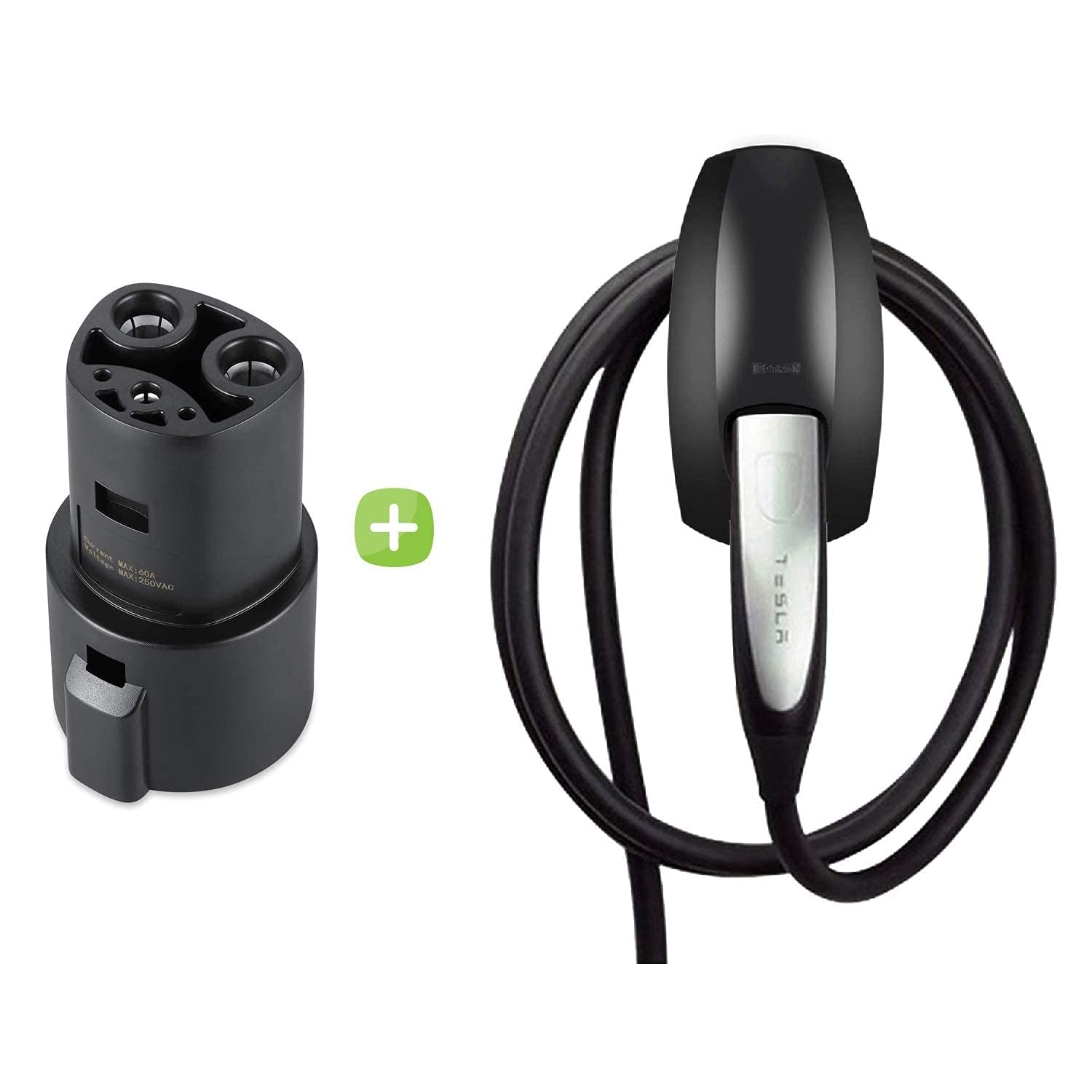
Lectron Bundle - J1772 to Tesla Adapter (250V 60A Level 2) & Tesla Charger Mount and Cable Organizer : Automotive
View on AmazonTip: Always check an EV’s maximum AC charging rate (kW), DC peak rate (kW), supported connectors, and whether an adapter is included or available.
Where drivers charge and what to expect on-site
DOE and automaker telematics indicate 70–80% of charging happens at home, where overnight hours provide low-cost energy. The rest is split across workplace charging, public Level 2 “destination” sites, and DC fast corridors.
- Home: Most convenient and cheapest per kWh, especially with time-of-use (TOU) rates. Level 1 may suffice for low-mileage drivers; Level 2 is ideal for daily needs.
- Workplace: Encourages daytime charging and can balance grid loads when paired with solar. Often provided as a perk or with nominal fees.
- Public Level 2 (destination): Found at hotels, retail, campuses, municipal lots. Expect 2–4 hours to add substantial range while you do other activities.
- DC fast corridors: Located along highways and in urban hubs. Ideal for road trips or quick top-ups.
- Curbside and multifamily: Growing in dense cities; permitting and curb management policies influence availability.
- Fleet depots: Purpose-built, often with managed charging to reduce demand charges and optimize operations.
Accessibility and etiquette
- ADA/Accessibility: Many new public installations provide accessible stalls, clear pathways, and lower-mounted screens and cables; expect improving standards as cities update guidelines.
- Parking rules: “EV charging only” means actively charging; many sites levy idle fees after your session ends to discourage squatting.
- Amenities: Reliable sites typically offer good lighting, restrooms, and nearby food/retail. Federal NEVI-funded stations must meet reliability and 97% uptime targets and include common payment access.
Installation, upfront and ongoing costs
Costs vary by site type, electrical capacity, trenching/groundwork, and hardware. Numbers below synthesize DOE AFDC, NREL, utility filings, and market surveys current through 2024.
Home charging (single-family)
- Level 1: Uses existing outlet; consider a dedicated 15–20 A circuit and outdoor-rated receptacle for safety. Minimal hardware cost; a dedicated cordset often comes with the car.
- Level 2 hardware: ~$300–$900 for a 32–48 A Wi‑Fi–enabled unit; premium or high-amp units can run $1,000–$1,500.
- Installation: ~$500–$2,000 typical for a short run from panel to garage; higher with long conduit runs, trenching to detached garages, or code upgrades.
- Panel/service upgrades: If your home has a 100 A panel and multiple large loads (HVAC, induction cooking), you may need a 200 A upgrade ($1,500–$5,000) or a load management device ($300–$700) that dynamically limits EV charging to avoid breaker trips.
- Permits: $50–$300 depending on jurisdiction; many cities approve within days for standard installs.
- Ongoing costs: Electricity only. U.S. residential average around $0.15–$0.17/kWh (EIA, 2023–2024). Charging an efficient EV at 0.30 kWh/mile costs ~4.5–5.1 cents per mile at $0.15–$0.17/kWh.
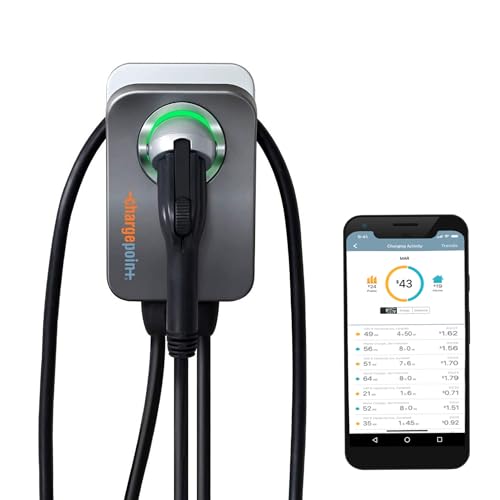
ChargePoint HomeFlex Level 2 EV Charger J1772
View on AmazonIf you’re picking hardware and amperage for home, see our buying guide for user-friendly models and sizing advice: Best EV Home Charger 2026: Top Level 2 Picks & Buying Guide.
Multifamily and workplace Level 2
- Hardware: $800–$2,500 per port depending on features (networked, access control, load sharing).
- Installation: $1,500–$6,000 per port typical; trenching, coring, and panel upgrades can push higher.
- Software/network: $100–$300 per port per year for access control, billing, and reporting.
- Operations: Site hosts often recover costs with per-kWh fees or time-based pricing where required by regulation.
Public DC fast charging (50–350 kW)
- Hardware: ~$30,000–$100,000+ per dispenser depending on power level and liquid cooling.
- Installation and make-ready: Can match or exceed hardware costs, especially if a new transformer or medium-voltage service is required. Total installed cost per DC fast port commonly ranges from $100,000 to $250,000 for 150–350 kW service per NREL case studies; rural sites or constrained grids can be higher.
- Ongoing costs: Electricity plus demand charges (fees based on peak power draw) can dominate bills. Operators use pricing, on-site storage, or managed charging to mitigate demand charges.
- Maintenance: Budget 3–5% of capex annually; uptime is a key metric. Many programs target ≥97% station uptime.
Incentives and tax credits
- U.S. federal: The Alternative Fuel Infrastructure Tax Credit (26 U.S.C. §30C), expanded by the Inflation Reduction Act, offers 30% off installed cost up to $1,000 for residential and up to $100,000 per charger for businesses in eligible census tracts (through 2032).
- State and utility: Many states and local utilities offer rebates covering 30–100% of make-ready and hardware costs for multifamily and public sites; some offer bill credits or reduced demand charges for participating in managed charging.
Find local programs and eligibility details here: Electric Vehicle Incentives by State: What’s Available, Who Qualifies, and How to Claim It.
Charging networks, payment models, and user experience
Major networks (U.S. focus)
- Tesla Supercharger: Largest high-power network; now expanding access to non-Tesla vehicles at select sites. Known for reliability and plug-and-charge simplicity.
- Electrify America: Wide 150–350 kW coverage along highways and metros; membership discounts available.
- EVgo: Urban focus with 100–350 kW, growing highway presence; supports Plug & Charge on compatible vehicles.
- ChargePoint: Extensive Level 2 footprint and growing DC fast via site hosts; pricing set by property owners.
- Others: Shell Recharge (including former Greenlots/Volta assets), Blink, FLO, and regional utilities/co-ops.
Payment and pricing
- Per kWh vs. per minute: Where allowed, many operators price by kWh (more equitable across vehicles). Some states still require time-based billing; operators may use tiered power levels (e.g., 1–90 kW vs. 90–350 kW).
- Session and idle fees: A flat start fee plus energy/time charges is common; idle fees kick in after charging completes to keep stalls available.
- Memberships: Monthly memberships can reduce per-kWh rates or waive session fees; frequent DCFC users may save money with a plan.
- Credit cards and interoperability: Increasingly universal—NEVI-funded sites require card readers. Many networks also offer app or RFID tap-and-go.
- Plug & Charge (ISO 15118): Enables automatic authentication and billing when you plug in a compatible car/cable—no app swipe needed. Support is expanding across models and networks.
Roaming and trip planning
- Roaming: Networks increasingly interoperate (via agreements and platforms like Hubject), so one app/RFID can unlock multiple networks.
- Trip planning: Use in-car navigation, Google Maps EV routing, or community tools like PlugShare and A Better Routeplanner. Precondition the battery before fast charging to hit peak speeds.
- Contingencies: Plan around charging curves and site utilization. Target 10–20% arrival state-of-charge (SoC) and leave with ~70–80% for optimal travel time.
For EV fundamentals, ownership costs, and benefits, see: Electric Vehicles Explained: Types, Costs, Benefits & Impact.
Smart charging, grid impacts, and environmental benefits

Electrify: An Optimist's Playbook for Our Clean Energy Future
In Electrify, <strong>Griffith lays out a detailed blueprint—optimistic but feasible—for fighting climate change while creating millions of new jobs and a healthier environment</strong>. Griffith’s pl
Check Price on AmazonManaged and “smart” charging
- Definitions: Smart charging uses communication between EVs/chargers and utilities or site controllers to schedule and modulate power. Techniques include load sharing (multiple ports on a limited circuit), peak shaving (capping site demand), and TOU optimization (charging when rates and grid emissions are lowest).
- Benefits: NREL modeling indicates managed charging can reduce peak charging load by 20–60%, defer expensive distribution upgrades, and lower operating costs for site hosts. Utilities increasingly offer incentives for customers to enroll in managed charging programs.
- Demand charges: DC fast sites face high demand charges for spiky loads. Operators mitigate with battery storage, solar canopies, or dynamic throttling to limit peaks while meeting service expectations.
Time-of-use pricing and emissions
- TOU: Off-peak residential rates can be 30–50% lower than peak. Scheduling home charging after midnight can cut costs significantly.
- Emissions: The carbon intensity of electricity varies hourly. In many regions, late-night and mid-day (high solar) hours are cleaner. Studies cited by IEA and grid operators show shifting load to low-carbon hours can reduce charging emissions 10–40% without inconveniencing drivers.
Vehicle-to-everything (V2X): V2H, V2B, and V2G
- V2H/B: Bidirectional charging lets an EV power a home or building during outages or peak-price windows. Some models and chargers already support V2H in North America.
- V2G: Aggregated EVs can export power to the grid to provide frequency regulation and peak support. IEA analyses suggest widespread V2G could unlock gigawatts of flexible capacity by 2030. Standards (e.g., ISO 15118‑20) and utility interconnection rules are maturing.
Conservation and air quality impacts
- Replacing a gasoline sedan emitting ~4–5 metric tons CO2e/year with an EV charged on the average U.S. grid typically halves lifecycle emissions; the gap widens as the grid decarbonizes (EPA and IEA assessments).
- Local air quality improves when charging displaces tailpipe NOx and PM2.5 near homes and schools; benefits amplify when charging schedules align with cleaner grid hours.
For medium- and heavy-duty operators exploring depot charging, battery swapping, and policy support, see our fleet-focused analysis: Charging the Fleet Revolution: Price Parity, Swapping, Smart Charging and Policy Support Are Converging for Medium‑ & Heavy‑Duty EVs.
By the numbers
- 14 million EVs sold globally in 2023 (IEA), 18% market share; global stock >40 million.
180,000 U.S. public charging ports by late 2024 (DOE AFDC), with tens of thousands added annually.
- Home charging share: ~70–80% of sessions (DOE and automaker telemetry).
- Typical home Level 2 cost: $300–$900 hardware; $500–$2,000 install; 4.5–5.1¢/mi electricity at $0.15–$0.17/kWh.
- DC fast site cost: $100,000–$250,000 per port all-in for 150–350 kW deployments (NREL case studies).
- Managed charging can cut peak loads 20–60% and defer upgrades (NREL).
How to choose: a practical framework
- Clarify your use case
- Daily driving under 40 miles? Level 1 may suffice if you can plug in nightly. Otherwise, Level 2 at home is the convenience/cost sweet spot.
- Frequent long trips or no home parking? Prioritize access to reliable DC fast corridors and robust public Level 2 near your routine destinations.
- Match power to vehicle capability and panel capacity
- Home: A 32–48 A Level 2 (7.7–11.5 kW) covers most needs. Higher-amp units only help if your car’s onboard charger supports it and your panel can supply it.
- Public: For quick road trips, look for 150 kW+ DC fast, but remember your car’s peak acceptance rate and charging curve determine actual time.
- Confirm connector compatibility
- Today: CCS1 for most non-Tesla DC fast; Tesla/NACS for Tesla; CHAdeMO for older LEAFs. Many new vehicles will ship with NACS ports or include adapters.
- Optimize costs and reliability
- Enroll in TOU rates; schedule off-peak charging.
- At public sites, check pricing in the app: per kWh vs. per minute, session fees, idle fees.
- For apartments/condos, ask about load sharing to avoid costly panel upgrades and ensure equitable access.
- Plan for incentives and future-proofing
- Use federal, state, and utility rebates to lower upfront cost; verify 30C tax credit eligibility.
- If installing multiple ports, choose networked chargers with OCPP support for flexibility and vendor choice.
- Consider conduit oversizing and space for future circuits; if your area is adopting NACS, plan for adapter support or dual-cable hardware where possible.
What this means for consumers, businesses, and policymakers
- Consumers: Home Level 2 is the best value; pair it with TOU rates and smart scheduling. For road trips, rely on high-uptime DC networks and plan around your vehicle’s charging curve.
- Businesses and property owners: Right-size power and use load management to control costs. Provide reliable amenities (lighting, restrooms) and transparent pricing. Tap utility make-ready programs and 30C to improve ROI.
- Cities and regulators: Streamline permitting, standardize signage/enforcement, require accessible design, and support open standards (OCPP, ISO 15118) and multi-network roaming to improve user experience and reliability metrics.
The charging landscape is maturing fast: connector convergence on NACS/CCS, broader Plug & Charge support, rising NEVI-compliant highway coverage, and smarter, cleaner grids. With clear goals—daily charging at home or work, fast charging for trips, and smart controls to save money—you can navigate charging stations for electric cars with ease and confidence.
Recommended Products
Electrify: An Optimist's Playbook for Our Clean Energy Future
In Electrify, <strong>Griffith lays out a detailed blueprint—optimistic but feasible—for fighting climate change while creating millions of new jobs and a healthier environment</strong>. Griffith’s pl
ChargePoint HomeFlex Level 2 EV Charger J1772
Discover the latest in EV charging technology. Explore a diverse selection of smart, efficient, and compatible charging solutions for your electric vehicle.
Lectron Bundle - J1772 to Tesla Adapter (250V 60A Level 2) & Tesla Charger Mount and Cable Organizer : Automotive
Buy Lectron Bundle - J1772 to Tesla Adapter (250V 60A Level 2) & Tesla Charger Mount and Cable Organizer: Charging Station Accessories - Amazon.com ✓ FREE DELIVERY possible on eligible purchases
More in Sustainability Policy
- EV Charging Stations: What You Need to Know About Types, Costs, Installation, and Renewable Integration
- Electric Car Charging Options: How to Choose the Right Charger for Your Needs
- EV Charging Station Installation Cost: What to Expect and How to Plan
- Best EV Home Charger 2026: Top Level 2 Picks & Buying Guide