
Circular Economy Business Models: How Companies Create Value by Doing More with Less
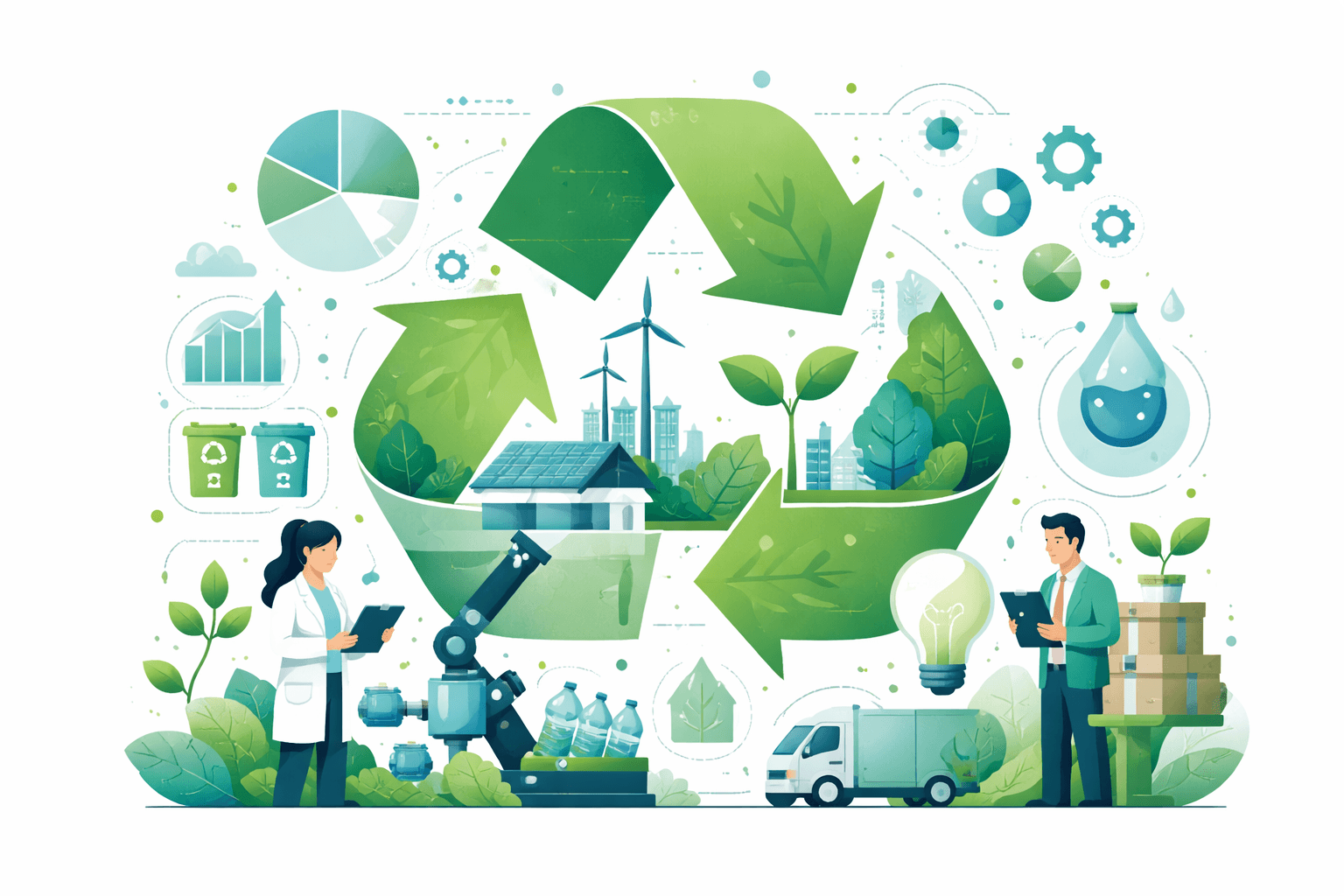
The world is only 7.2% circular, down from 9.1% in 2018, according to the 2024 Circularity Gap Report by Circle Economy. As global materials use is projected to almost double to 167 billion tons by 2060 (OECD, 2019), businesses face rising resource risk, volatile input costs, and growing regulatory pressure. Circular economy business models—the systems that keep products and materials in use at their highest value for as long as possible—offer a direct path to resilience and growth.
This guide explains what circular economy business models are, how they differ from linear take-make-waste approaches, the main model archetypes, where the business value comes from, how to implement them, and sector examples to learn from.
What are circular economy business models?
Circular economy business models structure value creation around durability, reuse, repair, remanufacturing, and recycling, instead of one-way extraction, production, and disposal. Rather than selling as many units as possible, companies earn by delivering outcomes (light, mobility, clean clothes), extending product lifetimes, harvesting parts and materials for next-life use, and regenerating biological inputs.
The Circular Economy Handbook: Realizing the Circular Advantage
Amazon.com: The Circular Economy Handbook: <strong>Realizing the Circular Advantage</strong>: 9781349959679: Lacy, Peter, Long, Jessica, Spindler, Wesley: Books
Check Price on AmazonHow they differ from linear models:
- Linear (take–make–waste): Growth depends on selling more units; products are optimized for low upfront cost, not longevity; end-of-life is externalized to landfills or incineration.
- Circular: Growth depends on more value per unit of material; products are designed for repair, upgrade, and disassembly; end-of-life is planned as a resource recovery step with economic value.
Economic potential is significant: Accenture estimates circular models could unlock up to $4.5 trillion in global economic value by 2030 (Accenture Strategy, 2015). The Ellen MacArthur Foundation (EMF) projects that circularity could deliver a net economic benefit of €1.8 trillion to Europe by 2030 compared with the current development path (EMF, 2015), while also addressing up to 45% of global emissions that energy transition alone cannot solve (EMF, 2019).
Types of circular economy business models
There is no single “right” model; most companies combine several. Below are the main archetypes, with typical revenue logics and enabling capabilities.
1) Product-as-a-Service (PaaS) / Usage-based models
Instead of selling equipment, the provider retains ownership and sells performance (e.g., “pay-per-lux” for lighting, “tires-by-the-kilometer,” “compressed air-as-a-service”). Revenue shifts from one-off sales to recurring service fees; margins come from durability, energy efficiency, and high residual values.
- Why it works: When the provider owns the asset, they profit from longer life and lower operating costs—aligning incentives with repair and upgrade.
- Enablers: Durable design, remote monitoring (IoT), predictive maintenance, robust service network, financing for asset ownership on the balance sheet.
2) Leasing and long-term rental
Similar to PaaS but with time-based fees rather than outcome guarantees. Common in electronics, furniture, machinery, and building components.
- Why it works: Captures residual value via refurbishment and redeployment; customers gain flexibility and lower upfront cost.
- Enablers: Take-back logistics, data on asset condition, secondary markets.
3) Repair, refurbishment, and remanufacturing
Return used products to working condition (repair), to “like-new” quality (refurbish), or to original performance with warranty equivalent to new (remanufacture). Remanufacturing typically saves 50–90% of material and energy compared with new manufacturing (various industry studies; USITC/APRA).
- Why it works: Lower bill-of-materials and energy inputs; premium pricing is possible with warranties.
- Enablers: Design for disassembly, standardized components, part harvesting, quality assurance, reverse logistics.
4) Resale and recommerce platforms
Captures value from pre-owned products via buy-back, trade-in, or peer-to-peer marketplaces. Especially strong in apparel, electronics, tools, furniture, and outdoor gear. The global secondhand apparel market alone is projected to reach roughly $350 billion by the late 2020s (ThredUp, 2023).
- Why it works: Monetizes idle inventory in consumers’ closets; acquires new customers at lower cost; extends lifetime and spreads embedded emissions.
- Enablers: Authentication and grading, cleaning and repair operations, dynamic pricing, logistics.
5) Sharing and access platforms
Digital platforms increase asset utilization—car sharing, tool libraries, equipment pools, co-warehousing. Research from UC Berkeley’s Transportation Sustainability Research Center finds that each round-trip carshare vehicle can replace 9–13 privately owned cars and reduce household vehicle miles traveled by 27–43%.
- Why it works: Higher utilization reduces total assets needed, lowering system costs and environmental impact.
- Enablers: Booking software, telematics, insurance, cleaning/turnover operations.
6) Closed-loop recycling and material take-back
Recover technical materials (metals, plastics, composites) for reprocessing into equivalent-quality feedstock, and biological materials for safe return to biosystems. Interface’s carpet tile “ReEntry” and Aquafil’s ECONYL nylon are well-known examples of high-quality loops.
- Why it works: Reduces virgin material costs and supply risk; supports recycled-content targets and compliance.
- Enablers: Mono-material design, clear labeling, take-back channels, sorting tech, offtake agreements with recyclers.
7) Product life extension and upgradeability
Design products to be modular and upgradable (e.g., replaceable batteries, cameras, memory). Revenue comes from spare parts, service plans, and upgrades rather than full replacements.
- Why it works: Stabilizes revenue and customer relationships; reduces cost-to-serve by swapping modules.
- Enablers: Standard interfaces, firmware support, inventory of modules, right-to-repair compliance.
8) Industrial symbiosis and byproduct valorization
One company’s waste stream becomes another’s feedstock—heat recovery, CO2-to-chemicals, slag to cement. Kalundborg Symbiosis in Denmark is a classic case of multi-firm resource exchanges.
- Why it works: Cuts disposal costs and generates saleable materials; can reduce energy bills via heat cascading.
- Enablers: Co-location, materials mapping, long-term contracts, quality control.
By the numbers: the circular business case
- 7.2%: Share of the global economy that is circular in 2024 (Circle Economy, 2024).
- 167 billion tons: Projected global material use in 2060, nearly double 2015 levels (OECD, 2019).
- $4.5 trillion: Potential economic value by 2030 from circular business models (Accenture Strategy, 2015).
- €1.8 trillion: Net economic benefit to Europe by 2030 under a circular scenario (EMF, 2015).
- 50–90%: Typical material and energy savings from remanufacturing vs. producing new (industry studies; APRA/USITC).
- 9–13: Private cars displaced per carshare vehicle; 27–43% reduction in household VMT (UC Berkeley TSRC).
- Up to 45%: Share of global emissions reductions needed for 1.5°C that product- and land-use strategies (including circularity) can address beyond energy transition (EMF, 2019).
Why circular economy business models create value
1) Cost savings and margin expansion
- Lower bill-of-materials: Recovered parts and recycled feedstock can cost less than virgin, especially for metals and engineered components.
- Lower energy per unit: Refurbish/remanufacture often requires a fraction of new manufacturing energy.
- Lower disposal fees: Take-back replaces landfill/incineration costs with recoverable value.
2) Resource resilience and supply risk mitigation
- Diversified sourcing: In-house loops and offtake agreements reduce exposure to commodity volatility and geopolitical disruptions.
- Policy resilience: Many jurisdictions are phasing in recycled-content mandates and design rules; early movers reduce compliance risk.
3) New revenue streams and higher asset utilization
- Recurring revenue: Subscriptions, leases, and service contracts improve cash flow visibility and lifetime value.
- Secondary markets: Resale, parts harvesting, and certified pre-owned programs monetize used assets.
- Platform fees: Marketplaces and sharing platforms take commissions while building network effects.
4) Customer retention and better experiences
- Outcome guarantees: PaaS ties provider incentives to reliability and performance.
- Lower barrier to entry: Leasing or pay-per-use reduces upfront cost, growing the addressable market.
- Loyalty loops: Trade-in credits and repair programs keep customers in-brand longer.
5) Regulatory, ESG, and capital advantages
- Compliance: Aligns with EU’s Circular Economy Action Plan, Ecodesign for Sustainable Products Regulation (ESPR), emerging Digital Product Passports, and expanding Extended Producer Responsibility (EPR) for packaging and electronics.
- Emissions and reporting: Extends control over Scope 3 emissions and supports credible reductions targets.
- Cost of capital: Demonstrated circular strategies can improve ESG scores and appeal to sustainability-linked financing.
For a deeper dive on the economic upside, see our analysis of Why the Circular Economy Pays Off: Economic, Environmental and Social Benefits.
How to implement circular economy business models
Implementing circularity is an operating model shift. The most successful pilots start focused, quantify value at each loop, and scale through partnerships.
Design for circularity from day one
- Design for disassembly: Use fasteners instead of adhesives; standardize screws; provide access paths for high-failure parts.
- Durability and reparability: Over-spec components subject to wear; publish repair manuals; ensure spare parts availability.
- Modularity and upgrade paths: Separate short-life modules (batteries, displays) from long-life frames.
- Materials strategy: Prefer mono-materials and clearly labeled polymers; plan recycled-content substitutions and maintainability.
- Measure with LCA: Use life cycle assessment early to quantify hotspots and compare “repair vs. replace” scenarios.

iFixit Pro Tech Toolkit - Electronics, Smartphone, Computer ...
View on AmazonStand up reverse logistics and recovery operations
- Collection channels: Offer mail-in kits, in-store drop-off, and doorstep pickup for large items; integrate trade-in at point of sale.
- Backhauling: Use existing delivery routes to collect returns and reduce empty miles.
- Sorting and grading: Establish protocols to triage for repair, refurbishment, parts harvesting, or recycling.
- Network design: Co-locate refurbishment near major markets; outsource specialized recycling with quality specs and offtake contracts.
Build supplier and recycler partnerships
- Recycled-content offtake: Lock in volumes and prices for critical materials to ensure quality and availability.
- Reman and repair ecosystems: Partner with certified refurbishers and authorized repair networks; consider franchise models.
- Symbiosis opportunities: Map waste streams to nearby industries that can valorize byproducts.
Data, tracking, and digital product passports
- Unique IDs and serialization: QR codes or RFID link each unit to its service history.
- IoT for performance: Remote diagnostics enable predictive maintenance and uptime guarantees.
- Circular KPIs: Track return rate, recapture yield, cost-to-recover per unit, residual value, and avoided virgin material.
- Regulatory readiness: Prepare for EU Digital Product Passports in priority sectors (batteries first, with electronics, textiles, and construction to follow) with data models covering materials, repairability, and carbon footprints.

ZEBRA ZD421 Direct Thermal Desktop Printer 203 dpi ...
View on AmazonOrganizational and financial model changes
- Sales incentives: Shift commissions to lifetime value, utilization, and contract renewals—not just units sold.
- Service capability: Invest in field service, refurbishment lines, and customer success functions.
- Accounting and risk: Leasing/PaaS requires asset financing, residual value forecasting, and service-level risk management.
- Pricing: Use total-cost-of-ownership and performance-based pricing; share savings from efficiency improvements.
For step-by-step change management and governance, see How to Implement Sustainable Practices: A Practical Guide to Assessment, Action and Scaling and Why Every Business Needs a Sustainability Strategy — Not Just the Big Ones.
Real-world examples and sector playbooks
Built environment and lighting
- Lighting-as-a-service: Schiphol Airport and other facilities have partnered with lighting providers to deliver “pay-per-lux,” where the vendor retains ownership, designs for long life, and handles maintenance. Reported outcomes include substantial energy savings from high-efficiency LEDs, longer service intervals, and recoverable value at end-of-contract.
- Carpet tile take-back: Interface’s ReEntry program recovers used tiles, separates fibers, and feeds recycled nylon back into new carpet. Interface reports dramatic reductions in product carbon footprint since the 1990s by combining material loops with energy efficiency.
Heavy equipment and industrial machinery
- Remanufacturing at scale: Caterpillar and Cummins operate global reman programs that return used engines and components to “as-new” performance with warranties. Industry analyses report 50–85% energy savings vs. new production and significantly lower material inputs, while customers benefit from lower-cost, warrantied components.
- Compressed air-as-a-service: Industrial providers sell guaranteed air flow at specified pressure, aligning incentives to fix leaks and optimize compressor performance.
Electronics and IT
- Device leasing and fleet management: Many enterprises lease laptops and smartphones; vendors take back devices for certified refurbishment and resale. High residual values in premium devices make this loop profitable.
- Trade-in and certified pre-owned: Major smartphone brands have built robust trade-in programs with automated grading and resale channels, keeping valuable metals in circulation and reducing Scope 3 footprints.
Apparel and consumer goods
- Brand-owned resale: Outdoor and fashion brands run take-back and “worn” shops to resell authenticated used items. ThredUp’s 2023 analysis indicates resale is growing significantly faster than overall retail, improving customer acquisition and lifetime value for participating brands.
- Repair and care services: In-house or partner networks for alterations, resoling, and mending extend product life and differentiate the brand on durability and service.
Mobility and logistics
- Car sharing and fleet-as-a-service: Municipalities and developers integrate carshare to reduce parking requirements and emissions. Higher utilization spreads embedded emissions across more passenger-miles.
- Tires-by-the-kilometer: Fleet contracts align tire life and fuel efficiency with provider incentives, leveraging retreading and predictive maintenance to reduce total cost of ownership.
Packaging and fast-moving consumer goods (FMCG)
- Closed-loop plastics: Brands contract with recyclers for high-quality rPET and rHDPE, locking in supply to meet recycled-content mandates and reduce exposure to virgin resin volatility.
- Reuse pilots: Refillable packaging systems for home and personal care test deposit-return or subscription pickup. Success depends on packaging durability, reverse logistics density, and consumer convenience.
For profiles of companies already doing this, explore Circular Economy Leaders: How Companies Are Eliminating Waste.
Practical steps to get started
- Identify a high-potential product line
- Criteria: High residual value, frequent replacement, costly failures, or regulatory pressure.
- Baseline: Map material flows, warranty returns, repair demand, and secondary market prices.
- Choose a model and define a clear value thesis
- Example theses: “Reduce total cost of ownership for customers by 20% via uptime guarantees,” or “Capture 30% of residual value through certified pre-owned.”
- Pilot with measurable targets
- KPIs: Return rate >40%, reman yield >70%, customer retention +10 pts, gross margin +5 pts, CO2e per functional unit −30%.
- Build the operating stack
- Contracts for take-back, refurbishment partners, telematics/IDs, pricing, and customer service processes.
- Scale through partnerships and policy alignment
- Work with municipalities on collection touchpoints; align with EPR schemes; secure recycled-content offtake.
Risks and how to manage them
- Asset risk and residual values: Use conservative depreciation, insurance, and refurbishment cost data from pilots.
- Quality and brand protection: Implement rigorous grading and warranties; restrict channels for salvage-grade items.
- Cannibalization: Price to segment new vs. pre-owned buyers; use trade-ins to upgrade customers.
- Reverse logistics costs: Combine with forward logistics, incentivize in-store returns, and design for quick triage.
- Data and privacy: Ensure device wiping and material traceability comply with regulations and customer expectations.
Where circular economy business models are heading
- Digital Product Passports: The EU will phase in DPPs for batteries first, with textiles, electronics, and construction materials to follow—making repairability, materials, and carbon data portable across value chains.
- Performance-based contracting: As sensors and AI make asset health visible, outcome guarantees (uptime, efficiency) will expand in HVAC, industrial pumps, mobility, and building systems.
- Advanced sorting and chemical recycling: AI-enabled sorting and solvent- or depolymerization-based recycling could open loops for complex polymers and fiber blends—if economics and environmental performance prove out.
- Embedded finance for circularity: Insurers and lenders are building products around residual values and service contracts, lowering the cost of capital for PaaS and leasing.
- Policy acceleration: EPR expansion, right-to-repair laws, and recycled-content mandates are setting a floor for circular practices, improving the competitiveness of circular models relative to linear disposal.
Circular economy business models let companies grow by delivering more value with fewer resources, building durable customer relationships while cutting costs and emissions. With targeted pilots, smart partnerships, and design-for-circularity, the shift is both practical and profitable—and increasingly, the license to operate in a resource-constrained world.
Recommended Products
The Circular Economy Handbook: Realizing the Circular Advantage
Amazon.com: The Circular Economy Handbook: <strong>Realizing the Circular Advantage</strong>: 9781349959679: Lacy, Peter, Long, Jessica, Spindler, Wesley: Books
iFixit Pro Tech Toolkit - Electronics, Smartphone, Computer ...
Discover iFixit's versatile tool kits, offering a curated selection of bits and tools to tackle a wide range of electronics repair and maintenance tasks.
ZEBRA ZD421 Direct Thermal Desktop Printer 203 dpi ...
Get Zebra ZD421 printers with direct thermal or thermal transfer capabilities. Compact, durable design for office and industrial use.