
Tech-Driven Sustainable Living: A Practical Guide to Lower Your Footprint
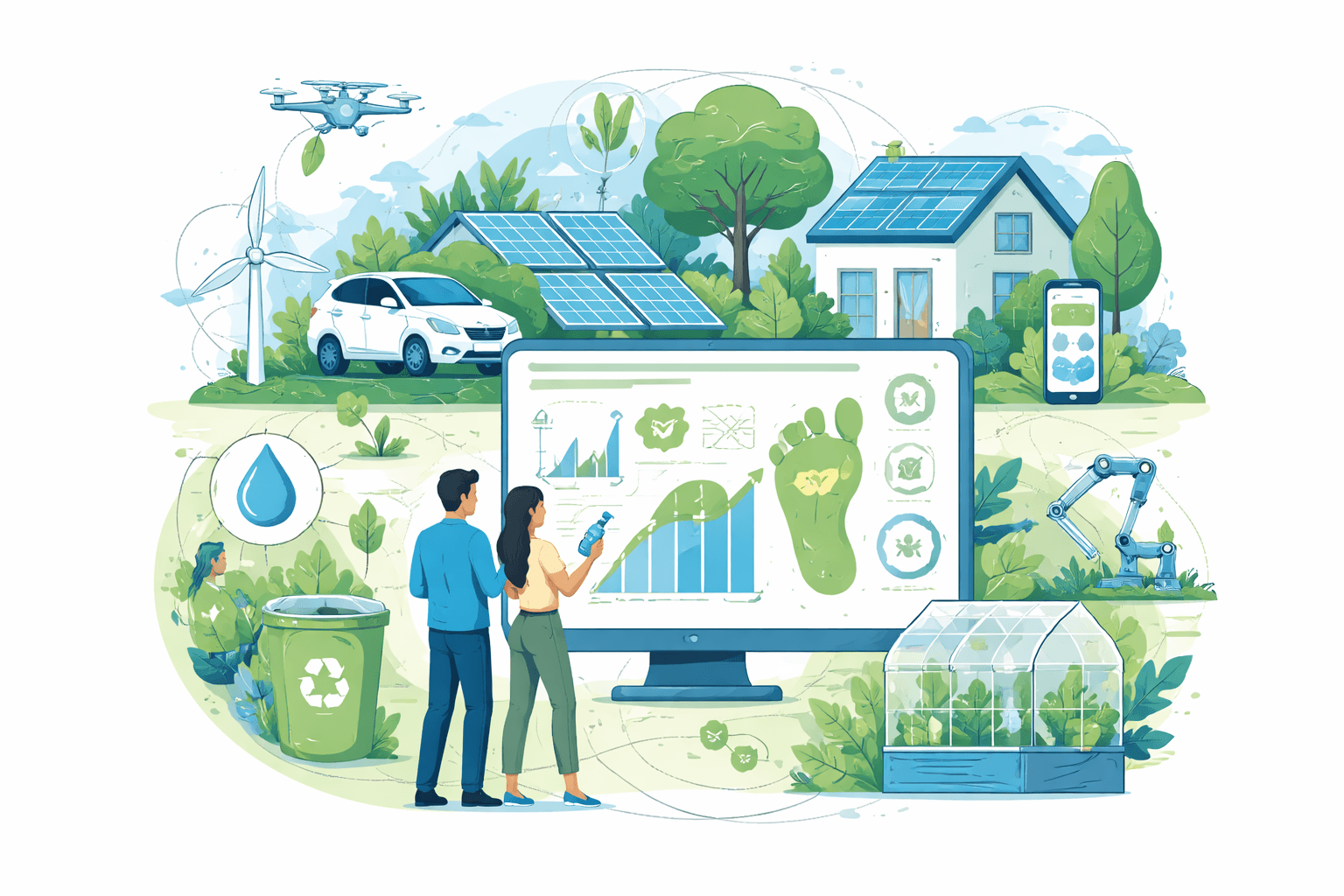
Sustainable living is no longer a niche lifestyle choice; it’s a data-driven path to lower costs, higher comfort, and sharply reduced emissions. Globally, building operations emitted roughly 10 gigatons of CO2 in 2022—about 28% of energy-related emissions (IEA, 2023). In most countries, households can cut 40–60% of their footprint this decade using mature technologies—rooftop solar, heat pumps, electric vehicles (EVs), better insulation, and smart controls—backed by incentives and falling technology costs.
This guide takes a technology-first approach to sustainable living: we define key metrics, show what the evidence says, rank high-impact upgrades by typical CO2e reduction and cost, and give you a 12‑month plan to measure, act, and track progress.
If you’re also looking for everyday, non-technical actions, see our complementary explainer: Everyday Sustainable Living: Practical Tips to Save Money, Reduce Waste, and Lower Your Carbon Footprint.
What is sustainable living? Definitions, metrics, and realistic targets
Sustainable living means running your household within environmental limits—minimizing greenhouse gas emissions (GHGs), conserving energy and water, reducing waste, and supporting biodiversity—while maintaining comfort and affordability.

Electrify: An Optimist's Playbook for Our Clean Energy Future
In Electrify, <strong>Griffith lays out a detailed blueprint—optimistic but feasible—for fighting climate change while creating millions of new jobs and a healthier environment</strong>. Griffith’s pl
Check Price on AmazonKey metrics you can track:
- Carbon footprint (tCO2e/year): Total annual greenhouse gas emissions from home energy, transport, food, goods, and services. Prioritize home energy and mobility first—they’re typically the largest, most addressable sources.
- Energy use (kWh/year; kWh/m²-year): Electricity and heating fuel. Energy intensity (per floor area) allows apples-to-apples comparison across homes.
- Transport emissions (gCO2e/mile or km): Tailpipe plus upstream power or fuel emissions for your vehicles.
- Water use (liters or gallons/day): Track total and per person; hot water savings often deliver both water and energy cuts.
- Waste generation and diversion (kg/week; % diverted): Landfilled vs. composted/recycled.
Setting targets that stick:
- Baseline first: Measure last 12 months of utility use, vehicle miles, and waste where available.
- Be specific, timebound, and realistic for your climate and grid: For example, “Reduce home energy GHGs 40% within 24 months” or “Cut electricity use 15% in 12 months.”
- Sequence by impact and payback: Start with no/low-cost actions and planning; schedule capital upgrades after incentives are confirmed.
Target ranges most households can achieve with current tech and modest behavior changes:
- 15–25% less electricity use in 12 months with efficiency + controls (ACEEE, 2020; Nest, 2015).
- 30–60% lower space and water heating emissions by switching from fossil fuel systems to heat pumps, depending on grid mix and building envelope (IEA, 2023; NREL field data).
- 60–80% lower per‑mile transport emissions by replacing a typical 25‑mpg gasoline car with an EV on an average U.S. grid (ICCT, 2021; U.S. EPA eGRID, 2023).
Why technology matters: evidence on household emissions cuts
- Rooftop solar: Residential PV costs have fallen >60% since 2010 (IRENA, 2023). A typical 6–8 kW system producing 7,000–11,000 kWh/year can displace 2–6 tCO2e/year depending on the local grid emission factor (NREL PVWatts + EPA eGRID).
- Heat pumps: Global heat pump sales rose ~11% in 2022, with record growth in Europe (IEA, 2023). With a seasonal coefficient of performance (COP) of 2–4, heat pumps use 50–75% less site energy than electric resistance and can cut heating emissions 20–60% versus gas or oil, more as grids decarbonize.
- EVs: Battery EVs emit 60–80% less lifecycle GHGs than comparable gasoline cars in the U.S. and EU, even on today’s grids; benefits grow as grids clean (ICCT, 2021; EEA, 2022). Operating costs per mile are typically 30–60% lower.
- Smart controls: Learning thermostats and advanced HVAC controls typically save 5–15% on heating and cooling (ACEEE meta-analyses; Nest white paper), with comfort maintained or improved.
Together, these technologies address the largest household emission sources—space/water heating, electricity, and transport—while often improving comfort (quieter systems, better air quality) and resilience (backup power with solar + storage).
Measure your starting point: calculators, interpretation, and baseline KPIs
Recommended carbon and energy calculators:
- CoolClimate Household Calculator (UC Berkeley): Robust, U.S.-focused, covers home energy, transportation, food, goods, and services.
- U.S. EPA Household Carbon Footprint Calculator: Simple input/output; good for quick baselining.
- WWF or UN carbon calculators: Global options for non-U.S. households.
- NREL PVWatts: Estimates solar production by address and system size.
- U.S. DOE Home Energy Score or local home energy audit programs: Assess building envelope and HVAC performance.
- Utility portals and smart-meter apps: Hourly usage data to profile baseload vs. heating/cooling loads.
How to interpret results:
- Separate scopes: Track “Home Energy” (electricity + heating fuel), “Transport,” and “Other.” Technology upgrades target home energy and transport first.
- Convert to intensity metrics: kWh/m²-year and gCO2e/mile normalize for home size and driving duty cycle.
- Establish monthly KPIs: kWh, therms or liters of heating fuel, EV charging kWh, miles driven, water use, and waste diversion rate. Chart 12‑month rolling averages to remove seasonality.
Baseline benchmarks for context (U.S. averages; your region will vary):
- Electricity use: ~10,700 kWh/year per household (EIA, 2022).
- Natural gas for space/water heating: 40–70 MMBtu/year depending on climate (EPA/RECS), equivalent to ~2.1–3.7 tCO2 direct emissions.
- Gasoline car at 25 mpg, 12,000 miles/year: ~4.3 tCO2 tailpipe emissions (EPA).
By the numbers: household decarbonization potential
- Buildings operations: ~10 GtCO2 in 2022 (~28% of energy-related emissions) (IEA, 2023).
- Residential PV: 1 kW of well-sited rooftop solar typically generates 1,000–1,400 kWh/year; at 0.4 kgCO2/kWh grid intensity, that’s 0.4–0.56 tCO2e avoided per kW (NREL; EPA eGRID).
- Heat pumps: Seasonal COP commonly 2–4; heating energy cut 50–75% vs. electric resistance; emissions cut 20–60% vs. gas/oil (IEA, 2023).
- EVs: Typical EV at ~0.27–0.33 kWh/mile on a 0.38 kgCO2/kWh grid → ~100–125 gCO2/mile vs. ~360–450 gCO2/mile for a 25‑mpg gasoline car (EPA/ICCT).
- Smart thermostats: Heating/cooling energy savings 5–15% (ACEEE/Nest).
High-impact tech upgrades ranked by typical CO2e reduction and cost
Estimates below reflect a typical detached home in a moderately carbon-intensive grid (~0.35–0.5 kgCO2/kWh). Your results depend on climate, home size, grid mix, and driving. Costs are order-of-magnitude, pre‑incentive U.S. figures; check local pricing and rebates.
- Rooftop solar PV
- Typical annual CO2e reduction: 2.5–5.5 tCO2e (6–10 kW system; 6,000–12,000 kWh/year; displacement depends on grid intensity).
- Capex: ~$2.5–3.5/W installed before incentives (NREL cost benchmarks, 2023). A 7 kW system ≈ $17k–$25k pre‑credit; 30% U.S. federal tax credit can reduce this materially.
- Notes: Highest certainty, durable (25‑year+), low O&M. Carbon payback often 1–3 years (NREL/IEA). Add battery storage for resilience and self-consumption.
- Replace a gasoline car with a battery EV
- Typical annual CO2e reduction: 2.5–4.0 tCO2e per vehicle (vs. 25‑mpg ICE, 12,000 miles/year; exact value depends on grid). Larger savings on cleaner grids.
- Capex: Wide range by model; total cost of ownership often lower due to fuel and maintenance savings (IEA/ICCT). Incentives up to $7,500 (U.S. federal) for eligible new EVs; many regions offer rebates.
- Notes: Pair with home charging on off‑peak or renewable hours to further cut emissions and cost. Consider workplace/solar charging.
- Heat pump space heating (air-source or ground-source)
- Typical annual CO2e reduction: 1.0–4.0 tCO2e (depends on climate, displaced fuel, and building envelope). In cold climates, modern cold‑climate models maintain high COP.
- Capex: ~$8k–$20k+ depending on size, ductwork, and configuration; generous incentives in many regions (e.g., U.S. 30% tax credit up to $2,000; higher for low‑/moderate‑income via rebates; EU and UK grant programs).
- Notes: Also provides efficient cooling and dehumidification. Prioritize load reduction (insulation/sealing) for best performance.
- Insulation and air sealing (building envelope)
- Typical annual CO2e reduction: 0.5–2.0 tCO2e via reduced heating/cooling loads (10–30% HVAC energy savings common in leaky homes).
- Capex: ~$1k–$8k+ depending on attic, walls, crawlspace, and air sealing scope.
- Notes: Often the highest ROI efficiency measure; improves comfort (fewer drafts, more consistent temperatures) and can downsize HVAC.
- Induction cooking (vs. gas)
- Typical annual CO2e reduction: 0.1–0.3 tCO2e (gas stoves are a small share of total home energy). Additional climate benefit from reducing unburned methane leakage; health gains from lower NO₂.
- Capex: ~$1k–$3k for full cooktop/range; plug‑in induction hobs cost far less.
- Notes: Fast, precise, safer; requires compatible cookware and potentially an electrical circuit upgrade.
- Home battery storage (paired with solar)
- Typical annual CO2e reduction: 0.1–1.0 tCO2e, scenario-dependent. Maximizes self-consumption of solar and arbitrage to lower‑carbon hours. If charged from a fossil‑heavy grid off‑peak, may not reduce emissions.
- Capex: ~$8k–$15k+ installed for 10–15 kWh usable capacity.
- Notes: Primary value is resilience and bill management under time‑of‑use tariffs. Emissions benefits grow as grids add variable renewables.
For a broader, room‑by‑room efficiency roadmap, see our data‑backed overview: Green Living: Practical, Data‑Backed Guide to a Low‑Carbon Home.
Low-cost and behavior tech with outsized returns
- Smart thermostats and HVAC scheduling
- Impact: 5–15% heating/cooling savings; 0.2–1.0 tCO2e/year depending on climate (ACEEE; Nest).
- Tip: Use occupancy-based setbacks, humidity control, and seasonal auto‑schedules.

ecobee Smart Thermostat Premium with Smart Sensor and Air Quality Monitor - Programmable Wifi Thermostat - Works with Siri, Alexa, Google Assistant - Amazon.com
View on AmazonEnergy monitoring apps and smart plugs
- Impact: 3–9% total electricity savings via load discovery (always‑on devices, inefficient fridges, pool pumps). Meta-analyses show persistent, if modest, reductions when feedback is frequent.
- Tip: Target “vampire” loads and automate shutdown schedules.
Water efficiency tech
- Impact: Heat pump water heaters can halve water heating energy; smart shower timers, low‑flow fixtures, and leak sensors reduce water and hot‑water energy use. Hot water can be 15–25% of home energy.
Meal-planning and waste-reduction apps
- Impact: Cutting household food waste 20–50% can avoid ~0.1–0.6 tCO2e/year depending on diet and waste pathway (EPA/WARM; WRAP analyses). Saves money, too.
Secondhand and repair marketplaces
- Impact: Reuse can avoid the embodied emissions of new products—e.g., ~70 kgCO2e for a smartphone, ~300 kg for a laptop, tens to hundreds of kg for furniture and apparel (Apple/electronics LCAs; apparel LCAs). Pair with local repair to extend lifetimes.
Want more on connected-home options? Explore: Smart Home Technology for Sustainability: High‑Impact Upgrades, Integration, and Real‑World Guidance.
Cost, incentives, and payback: how to evaluate ROI and lifecycle impacts
Simple payback is a start, but net present value (NPV) and levelized cost provide better guidance.
- Simple payback (years) = Upfront cost ÷ Annual bill savings.
- NPV ($) = −Upfront cost + Σ[(Annual savings − Annual O&M) ÷ (1 + discount rate)ᵗ] over system life.
- Levelized cost of energy (LCOE) for rooftop PV ($/kWh) ≈ (Capex × Capital recovery factor + Annual O&M) ÷ Annual kWh.
What to include:
- Energy price escalation and volatility: Gas and electricity prices vary; TOU rates can amplify savings from controls, EV smart charging, and batteries.
- Incentives: Subtract tax credits, rebates, and low‑interest loans before calculating payback.
- Lifecycle emissions: Consider embodied carbon (manufacturing, transport). Typical “carbon payback” is rapid for PV (1–3 years) and EVs (often under 1–2 years vs. ICE), then ongoing net reductions (NREL; ICCT).
Available rebates and tax credits (examples; always verify current programs):
- United States
- Residential Clean Energy Credit: 30% for rooftop solar, battery storage (standalone eligible), geothermal, and more (through 2032).
- Energy Efficient Home Improvement Credit: Up to 30% for heat pumps (annual cap $2,000), panel upgrades, insulation, and windows/doors (subject to category caps).
- EV tax credits: Up to $7,500 for eligible new EVs; up to $4,000 for eligible used EVs, with income and price caps.
- State/utility rebates: Heat pump and weatherization rebates are common; see DSIRE (Database of State Incentives for Renewables & Efficiency).
- Europe and UK
- Heat pump grants (e.g., UK Boiler Upgrade Scheme up to £7,500); various national programs for PV, storage, and building retrofit; country energy agencies maintain portals.
- Canada & Australia
- Federal and provincial/state rebates for heat pumps, insulation, EVs, and PV; check national energy agencies and local utilities.
Lifecycle considerations:
- PV panels: Embodied carbon varies by manufacturing energy mix. High-quality modules with long warranties typically offset embodied emissions within a few years, even on moderately carbon‑intensive grids (NREL/IEA PV LCA).
- EV batteries: Manufacturing has higher upfront emissions than ICE vehicles, but EVs break even quickly and then deliver large lifecycle savings, especially with clean electricity (ICCT, 2021; EEA).
- Heat pumps: Embodied emissions are modest relative to multi‑year operational savings; using low‑GWP refrigerants further improves climate performance.
Build your 12‑month sustainable-living plan: audit → prioritize → implement → monitor
Use this cadence to turn ambition into results. Customize months to your climate and budget windows.
Months 1–2: Audit and baseline
- Gather 12 months of electricity, gas/oil/propane, and water bills; export hourly/daily data if available.
- Inventory major loads: HVAC model/age, water heater, appliances, plug loads, and any on‑site renewables.
- Run calculators: CoolClimate (full footprint) + PVWatts (solar potential) + DOE Home Energy Score (envelope/HVAC).
- Set targets and KPIs: e.g., “Cut electricity 12% in 12 months,” “Electrify space heating by Month 9,” “Replace one ICE vehicle by Month 12.”
Months 3–4: Low-cost fixes and project design
- Implement no/low-cost measures: Smart thermostat scheduling, LED upgrades, weatherstripping, smart power strips, faucet aerators, and leak fixes.
- Load discovery: Use an energy monitor to identify always‑on devices and inefficient appliances.
- Scope capital projects: Get 2–3 quotes each for insulation/air sealing, heat pump, solar (and storage if needed), panel upgrade, and EV charger. Confirm structural/electrical needs.
- Incentives check: Confirm eligibility and pre‑approval steps for rebates/tax credits.
Months 5–7: Envelope first, then electrify
- Complete air sealing and insulation (attic/crawlspace/walls) to reduce loads.
- Install heat pump space heating/cooling; coordinate with panel upgrade if necessary. Optimize thermostat setpoints and zoning.
- If water heating is due, plan a heat pump water heater (HPWH) for additional savings.
Months 8–10: On-site generation and mobility
- Install rooftop solar (size to annual usage; consider future EV/HP loads). If resilience or TOU benefits justify it, add battery storage.
- Transition to an EV as your next vehicle replacement. Install a Level 2 charger; enable scheduled charging for off‑peak or solar hours.
- Switch to induction cooking if your range is due for replacement; add a portable induction hob as a bridge.
Months 11–12: Fine-tune, verify, and lock in savings
- Commissioning and controls: Verify heat pump performance (airflow, refrigerant charge), set proper curves, and test ventilation.
- Data review: Compare monthly energy, emissions, and costs vs. baseline; adjust setpoints, schedules, and behaviors.
- Plan year 2+: Roof/garden opportunities (cool roof, reflective surfaces), advanced automation, demand response enrollment, and continued electrification of lawn equipment and tools.
Templates and checklists (make copies and customize):
- KPI tracker: Monthly table with kWh, therms or liters fuel, water, miles (by fuel type), PV kWh, EV charging kWh, and calculated tCO2e.
- Project prioritization matrix: Columns for CO2e impact (t/year), simple payback (years), NPV, comfort/resilience score, and complexity.
- Vendor scoring sheet: License/insurance, references, warranty terms, refrigerant type (for heat pumps), commissioning plan, and monitoring integration.
For broader lifestyle integration and family engagement, see: How to Live Sustainably: Practical, High‑Impact Actions for Everyday Life.
Practical implications: what this means for households and policymakers
- Households: Prioritize envelope + electrification + renewables; lock in incentives before deadlines. Track KPIs monthly to keep savings on course. Consider whole‑home financing that matches savings to payments.
- Businesses and installers: Bundle audits, incentives navigation, and performance guarantees. Offer heat pump + weatherization packages and solar‑plus‑EV charging bundles.
- Policymakers and utilities: Expand performance‑based rebates, streamline permitting (especially for heat pumps and PV), and scale demand response to reward flexible loads (EVs, HPWHs, batteries) that integrate variable renewables.
Resources, tools, and further reading
Calculators and tools
- CoolClimate Household Calculator (UC Berkeley)
- EPA Household Carbon Footprint Calculator
- NREL PVWatts and System Advisor Model (SAM)
- DOE Home Energy Score / local home energy audit programs
- AFDC (U.S. DOE) for EV charging/fueling and cost calculators
- DSIRE (U.S.) for incentives; check your national or regional energy agency portals elsewhere
Government and incentive portals (examples)
- United States: energy.gov, irs.gov (clean energy credits), DSIRE (state and utility rebates)
- European Union and UK: National energy agencies and grant portals (e.g., UK Boiler Upgrade Scheme)
- Canada: Natural Resources Canada (NRCan) retrofit and EV incentives
- Australia: energy.gov.au for state/territory rebates
DigitalWindmill articles
- Green Living: Practical, Data‑Backed Guide to a Low‑Carbon Home
- Smart Home Technology for Sustainability: High‑Impact Upgrades, Integration, and Real‑World Guidance
- Everyday Sustainable Living: Practical Tips to Save Money, Reduce Waste, and Lower Your Carbon Footprint
- How to Live Sustainably: Practical, High‑Impact Actions for Everyday Life
Key data sources cited
- International Energy Agency (IEA): Buildings emissions and heat pump market updates (2023–2024)
- IRENA: Renewable energy cost trends (2023)
- NREL: PV cost benchmarks and PVWatts production estimates; field performance of heat pumps
- U.S. EIA/EPA: Household energy use, eGRID emission factors, fuel emission factors
- ICCT/EEA: EV lifecycle emissions analyses
- ACEEE/Nest: Smart thermostat savings meta-analyses and field studies
- WRAP/EPA WARM: Food waste emissions factors and reduction potential
Where this is heading
- Electrification and automation are converging: heat pumps, EVs, and flexible loads will increasingly respond to tariffs and carbon signals automatically.
- As grids decarbonize, the emissions advantage of heat pumps and EVs grows; pairing them with on‑site solar and smarter controls compounds gains.
- Cost curves continue to fall for PV, storage, and heat pumps, while policy is shifting from early adoption to mass‑market scale and performance assurance.
With a clear baseline, the right sequence of upgrades, and a monthly tracking habit, sustainable living becomes a system you run—not a list of chores. The payoff is durable: lower bills, quieter and healthier homes, resilience in outages, and a footprint aligned with a net‑zero future.

Emporia Gen 2 Smart Home Energy Monitor with 16 50A Circuit Level Sensors | Real Time Electricity Monitor/Meter | Solar/Net Metering - Amazon.com
View on AmazonRecommended Products
Electrify: An Optimist's Playbook for Our Clean Energy Future
In Electrify, <strong>Griffith lays out a detailed blueprint—optimistic but feasible—for fighting climate change while creating millions of new jobs and a healthier environment</strong>. Griffith’s pl
ecobee Smart Thermostat Premium with Smart Sensor and Air Quality Monitor - Programmable Wifi Thermostat - Works with Siri, Alexa, Google Assistant - Amazon.com
ecobee Smart Thermostat Premium with Smart Sensor and Air Quality Monitor - Programmable Wifi Thermostat - <strong>Works with Siri, Alexa, Google Assistant</strong> - Amazon.com
Emporia Gen 2 Smart Home Energy Monitor with 16 50A Circuit Level Sensors | Real Time Electricity Monitor/Meter | Solar/Net Metering - Amazon.com
See how much electricity your home is using anywhere, anytime. ... <strong>Add individual 50A sensors to your Vue to monitor up to 16 individual circuits</strong> — providing accurate energy use for t
More in AI & Technology
- Everyday Sustainable Living: Practical Tips to Save Money, Reduce Waste, and Lower Your Carbon Footprint
- How to Live Sustainably: Practical, High‑Impact Actions for Everyday Life
- Practical Ways to Live Sustainably: Everyday Actions, Priorities, and Measurable Impact
- Everyday Sustainability: Practical, High-Impact Steps to Reduce Your Environmental Footprint