
Solar in New York: Costs, Incentives & Top Installers (2026)
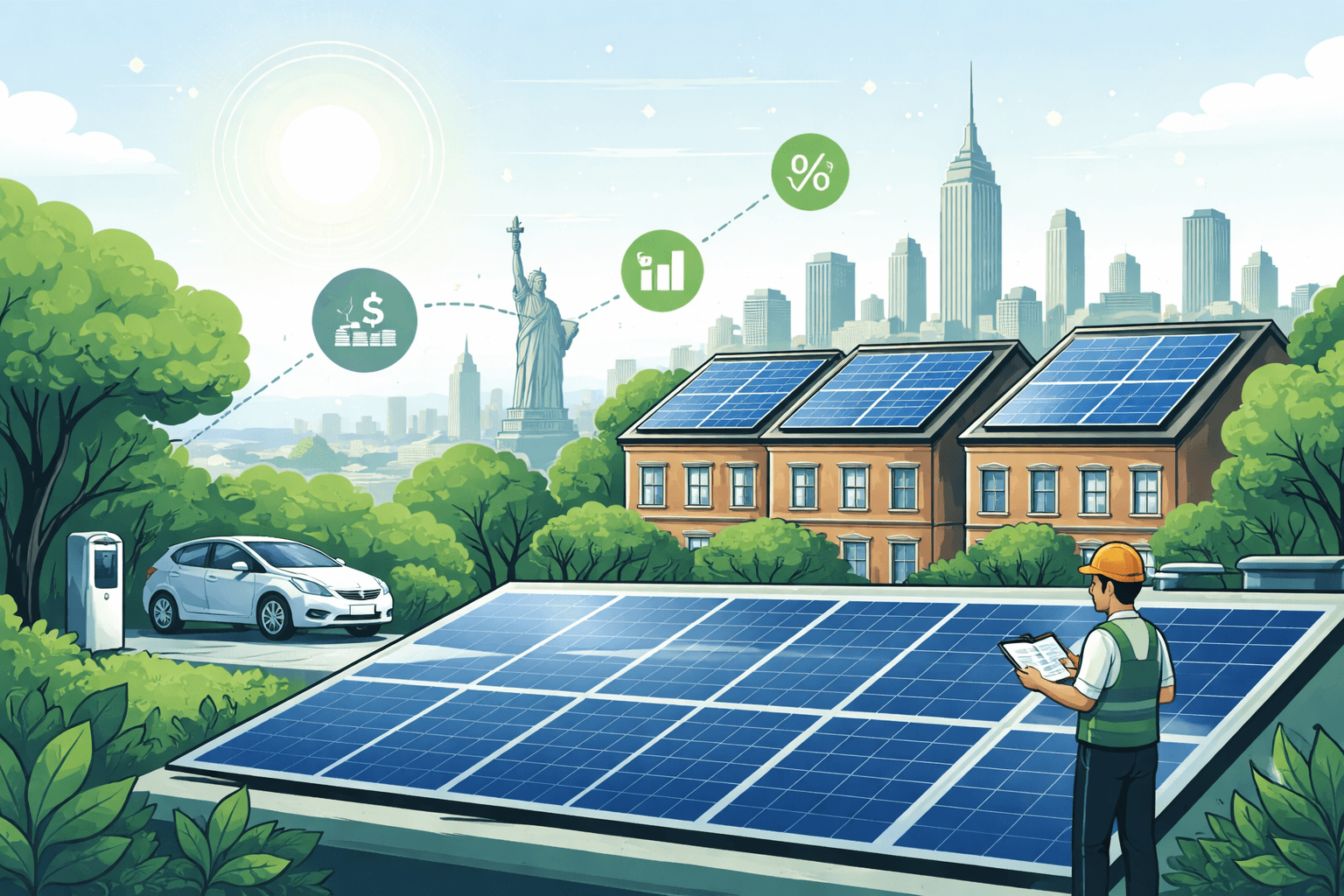
New York residential electricity averaged roughly 22–24¢/kWh in 2024, according to the U.S. Energy Information Administration (EIA)—about 35–60% higher than the U.S. average. With rates this high, solar in New York can offset hundreds of dollars per month for typical homes. Add New York’s 25% state solar tax credit (capped at $5,000), NYSERDA’s NY-Sun rebates, and the 30% federal tax credit, and paybacks of 6–10 years are common for well-sited systems. This guide breaks down the state’s solar potential, prices, incentives, installers, and the real-world ROI for 2026.
Solar in New York: sun hours, irradiance, and climate factors
New York isn’t Arizona, but it’s sunnier than you might think. NREL’s long-term solar resource data shows average global horizontal irradiance (GHI) of roughly 3.6–4.2 kWh/m²/day across the state, with higher values downstate and on Long Island. That translates to typical rooftop capacity factors of about 13–17% for fixed-tilt residential PV (capacity factor = the percentage of time a system generates at its rated output, averaged over a year).
Solar Electricity Handbook - 2023 Edition: A simple, practical guide to solar energy – designing and installing solar photovoltaic systems: Boxwell, Michael
Solar Electricity Handbook - 2023 Edition: <strong>A simple, practical guide to solar energy – designing and installing solar photovoltaic systems</strong> [Boxwell, Michael] on Amazon.com. *FREE* shi
Check Price on Amazon- Annual production: A properly oriented 7.5 kW residential system in New York will often generate 8,000–10,000 kWh/year, depending on location, tilt, shading, and snow cover (NREL PVWatts benchmarks).
- Seasonal profile: Expect 65–75% of annual production from March–October. Winter output dips with shorter days and occasional snow cover, but high snow albedo can boost clear-sky winter production once modules are cleared.
- Climate durability: New York roofs see high winds, freeze–thaw cycles, and—downstate—coastal salt exposure. Look for racking and fasteners rated for local wind/snow loads and modules with robust frames and PID/corrosion resistance (IEC 62804/61701 tested).
- Roof types: Pitched asphalt shingle roofs are common upstate and in suburbs; flat roofs dominate many NYC neighborhoods. Ballasted or hybrid ballasted/anchored racking at 5–15° tilt is typical on flat roofs, designed to meet NYC Department of Buildings (DOB) and FDNY fire access rules.
Average cost of solar panels in New York (2026) and price-per-watt
SEIA/Wood Mackenzie data placed average U.S. residential turnkey pricing around $2.90/W before incentives in 2024. New York usually runs higher because of labor, permitting, and complex rooftops. For 2026, expect:
- Typical range before incentives: $2.80–$3.70 per watt (W)
- Median project size: 7–10 kW for single-family homes
- Example budgets:
- 6 kW: $16,800–$22,200 before incentives
- 8 kW: $22,400–$29,600 before incentives
- 10 kW: $28,000–$37,000 before incentives
What drives price variation:
- Equipment mix: Premium high-efficiency modules and microinverters/optimizers cost more but can lift yield on shaded or complex roofs.
- Roof complexity: Multi-plane, steep, slate, or flat roofs with parapets increase labor and balance-of-system costs.
- Electrical upgrades: Older homes may need main panel or service upgrades.
- Soft costs: Permitting, engineering, and interconnection fees vary by jurisdiction and utility.
New York solar incentives: NYSERDA rebates, state tax credits, net metering, and RECs
New York’s stackable incentives materially cut net cost. Programs evolve, so always confirm current values with NYSERDA and your utility.
NY-Sun (NYSERDA) Megawatt Block incentives
- Structure: Capacity-based incentives that step down as each regional “block” fills. Incentives are paid to the installer (and appear as an upfront discount) or to the project host.
- Values: Vary by utility region (e.g., Con Edison, Upstate, Long Island). Current $/W levels change as blocks sell out; values have historically been higher upstate and lower downstate as markets mature.
- Applicability: Most residential rooftop and small ground-mount systems qualify if they meet program requirements. Installers manage the application.
Why it matters: Because NYSERDA’s incentive usually reduces the project’s tax basis for the federal ITC, the order of operations matters for payback math (see ITC section for details).
New York State Solar Equipment Tax Credit
- Credit: 25% of qualified system costs, capped at $5,000 per dwelling unit, applied to New York State personal income tax (Tax Law §606(g-1)).
- Eligibility: Owner-occupied residences. Leases and PPAs may qualify under certain conditions if the homeowner effectively “pays for” the system via the contract. Confirm with your tax advisor.
- Interaction with other incentives: This is a credit (not a rebate), so it generally does not reduce the federal ITC basis. Unused credit can typically be carried over.
Sales and property tax benefits
- Sales tax: New York provides a 100% state sales tax exemption for residential solar equipment. Many localities also exempt local sales tax, reducing upfront costs.
- Property tax: Real Property Tax Law §487 authorizes a 15-year property tax exemption on the added value from solar. Municipalities can opt out, so check locally.
- NYC bonus: New York City offers a solar property tax abatement that applies a percentage of eligible system costs against property taxes over multiple years, subject to caps and program timelines. Confirm details with NYC DOB and your installer.
Net metering and the Value Stack (VDER)
New York has transitioned from legacy net metering to a pair of successor frameworks:
- Mass-market Net Metering with a Customer Benefit Contribution (CBC): Most new residential systems receive bill credits for exported energy at or near the retail rate and pay a monthly CBC charge set by the PSC. Credits typically roll month to month; some utilities provide annual cash-out of net surpluses at avoided-cost rates.
- VDER Value Stack: Larger on-site and community solar projects earn compensation based on a “stack” of components (energy at LBMP, capacity, environmental value, demand reduction, locational relief). Residential customers mostly see VDER in community solar subscriptions, not typical behind-the-meter rooftop.
Ask your installer which tariff you’ll be under and how credits apply to your bill’s supply and delivery components in your utility territory (Con Edison, National Grid, NYSEG, RG&E, O&R, PSEG Long Island).
Do homeowners earn SRECs in New York?
New York does not run a classic, homeowner-tradable SREC program like New Jersey’s. Environmental attributes from small projects are often transferred to the state or the installer as part of NY-Sun participation, and environmental value for VDER projects is embedded in the compensation formula. If you want to retain RECs or make specific environmental claims, address this in your installer contract.
The 30% federal ITC and how it applies to New Yorkers
The Investment Tax Credit (ITC) under the Inflation Reduction Act provides a 30% federal credit for residential solar through at least 2032.

EF ECOFLOW Smart Home Panel 2, the Center of the Whole
Alternatively connect <strong>3 x EcoFlow DELTA Pro 3 units with 6 x Extra Batteries for energy storage up to 36kWh</strong>. It's not just for longer backup but lets you to control and run every
Check Price on Amazon- Basis: Calculated on the net system cost after any upfront, tax-exempt rebates (e.g., NYSERDA) but generally before state income tax credits. Consult IRS guidance and a tax professional for your situation.
- Batteries: Stand-alone or solar-paired batteries of 3 kWh or more are eligible for the 30% credit, with no requirement they charge solely from solar.
- Example: An 8 kW system priced at $3.30/W = $26,400. If a $2,000 NYSERDA rebate applies, the ITC basis is $24,400; 30% ITC = $7,320. New York’s 25% state credit could add up to $5,000 more in tax savings, depending on tax liability.
Best solar installers and companies serving New York
New York is a mature solar market with a mix of local and national providers. Look for NABCEP-certified teams, strong workmanship warranties (10–25 years), reputable equipment lines, and transparent modeling based on NREL PVWatts.
Well-regarded regional installers and national brands active in New York include:
- EmPower Solar (Long Island/NYC)
- GreenSpark Solar (Rochester/Finger Lakes)
- Kasselman Solar (Capital Region)
- Solar Liberty (Western NY)
- Venture Solar (NYC/metro)
- Long Island Power Solutions (Long Island)
- Trinity Solar, Momentum Solar, Sunrun, Tesla (statewide coverage varies)
- SunPower dealer network (various local partners)
Selection checklist:
- NABCEP PV Installation Professional on staff
- Clear production estimates (kWh/year) using local weather files and shading analysis
- Roof and electrical upgrade plans in writing
- Equipment serials and spec sheets (module efficiency, inverter topology, warranties)
- Post-install service commitments and monitoring platform access
Equipment tips for New York roofs:
- Shade tolerance and module-level control matter on tree-lined streets and multifamily rowhouses. Microinverters or DC optimizers help maximize output and give per-module monitoring.
- Snow and wind ratings: Many NY jurisdictions require 35–55 psf snow loads and 110–130 mph wind ratings. Confirm racking engineering meets your local code.
- Flat roofs: Ballasted or hybrid ballasted systems must pass wind uplift and fire access rules. White or reflective membranes can add small bifacial or albedo gains.
Based on efficiency and reliability metrics, products like the Qcells Q.TRON series or REC Alpha Pure modules pair well with New York’s space-constrained rooftops, and microinverters such as Enphase IQ8 offer strong shade performance and rapid shutdown compliance. If backup is a priority during outages, a 10–20 kWh battery can time-shift solar and cover critical loads; evaluate models with UL 9540A-tested safety and 10-year warranties.
ROI and payback period for solar in New York
The basic math: annual savings ≈ annual solar production × retail rate offset, minus fixed charges and any CBC fee.
- Downstate/NYC (Con Edison, PSEG Long Island): Residential all-in rates frequently exceed 28–32¢/kWh. A 7.5–8 kW system producing ~9,000–10,000 kWh/year can offset $2,300–$3,000 per year, depending on tariff and fixed fees. With NYSERDA + ITC + the $5,000 NY state credit, 6–8 year simple paybacks are common for good sites.
- Upstate (NYSEG, RG&E, National Grid, O&R): Rates often land in the 17–23¢/kWh range. A similar 7.5–8 kW array producing 8,500–9,500 kWh/year might save $1,600–$2,200 annually; expect 7–10 year simple paybacks depending on incentives and roof complexity.
Key variables:
- Shading and orientation: A 10–20% production swing is typical between heavily shaded northeast-facing roofs and sunny south-facing roofs.
- Equipment efficiency and uptime: Module-level electronics can recover 5–15% yield in partial shade compared to string-only inverters.
- Tariff and crediting rules: Time-of-use rates and how credits apply to delivery charges change savings.
- Financing: Loans add interest; cash buyers capture full tax benefits immediately (subject to tax liability).
Home resale value: Multiple studies (e.g., Lawrence Berkeley National Laboratory) have found that host-owned solar adds value roughly in line with net system cost to own, assuming good documentation and transferable warranties.
New York-specific permitting, HOA rules, and interconnection
Permitting and interconnection vary by jurisdiction but follow state frameworks.
- Unified Solar Permit: Many New York municipalities have adopted a standardized residential permit to reduce soft costs (NYSERDA initiative). This can speed approvals for code-compliant, small PV systems.
- NYC Department of Buildings (DOB): NYC projects require DOB filings; flat roofs must comply with FDNY access pathways and setback rules. Expect electrical filings by a Master Electrician, structural letters for ballasted systems, and sometimes Landmarks review in historic districts.
- Interconnection (PSC SIR): The Public Service Commission’s Standardized Interconnection Requirements (SIR) govern systems up to 5 MW. Residential “Level 1” projects typically receive utility initial review decisions within 10–15 business days; final permission to operate (PTO) often follows within 2–8 weeks after installation and inspections, depending on utility workload.
- HOA/condo rules: New York prohibits unreasonable restrictions on residential solar by homeowners’ associations while allowing reasonable aesthetic and safety conditions. Condos/co-ops may require board approval and shared-roof agreements; start early and keep stamped plans handy.
Practical timeline: From signed contract to PTO, expect 2–4 months in much of the state and 3–6 months in NYC, depending on backlog, roof/electrical upgrades, and utility queue.
By the Numbers: Solar in New York (2026)
- Solar resource: ~3.6–4.2 kWh/m²/day GHI statewide (NREL)
- Typical capacity factor: 13–17% for fixed-tilt residential PV
- Installed price: $2.80–$3.70/W before incentives
- Common system size: 7–10 kW
- State tax credit: 25% of cost, up to $5,000
- NYSERDA NY-Sun: Regional $/W rebates; values change as blocks fill
- Federal ITC: 30% through at least 2032 (also covers stand-alone storage ≥3 kWh)
- Retail electricity: ~22–24¢/kWh statewide average in 2024 (EIA); higher in NYC/Long Island
- Typical payback: 6–10 years for well-sited systems
Practical implications for homeowners
- Roof-first approach: Replace roofs with <10 years of life remaining before going solar to avoid double mobilization costs.
- Battery or no battery: Outage-prone areas benefit from 10–20 kWh storage sized to critical loads. Financial ROI from arbitrage is modest today but improves with time-of-use rates and demand response.
- Monitoring matters: Ensure your system includes app-based monitoring and a clear service plan for troubleshooting.

Emporia Vue 3 Home Energy Monitor - Smart Home Automation Module and Real Time Electricity Usage Monitor, Power Consumption Meter, Solar and Net Metering for UL Certified Safe Energy Monitoring - Amazon.com
View on AmazonIf you split time across the tri-state area, see how incentives differ just across state lines in Solar in New Jersey: Costs, Incentives & Top Installers (2026) and Solar in Connecticut: Costs, Incentives & Top Installers (2026).
Recommended products for New York homes (affiliate-supported)
- High-efficiency modules: Based on >21% efficiency and strong 25-year performance warranties, the REC Alpha Pure represents strong value for space-limited rooftops.
- Module-level power electronics: For tree shading and complex roofs, the Enphase IQ8 microinverter platform offers per-module optimization, grid safety compliance, and expandable storage options.
- Home battery: If you want storm backup, the Powerwall-class 13–20 kWh storage system paired with load management can cover refrigerators, Wi-Fi, lighting, sump pumps, and mini-splits.
Always compare spec sheets (round-trip efficiency, usable capacity, warranty cycles, temperature ranges) and confirm eligibility for federal/state incentives.
FAQ: Common questions about going solar in New York
- Do solar panels work in New York winters? Yes. While snow can temporarily cover modules, annual yield remains strong. Systems are tilted to encourage shedding; after storms, output rebounds quickly, and winter albedo can help on clear days.
- What if my roof is flat? Flat roofs are solar-friendly. Ballasted racking at low tilt reduces penetrations. Engineers design to NYC/ASCE wind loads; fire access setbacks apply.
- Will solar cover my whole bill? Many homes offset 70–100% of annual kWh, but fixed charges, CBC fees, and seasonal mismatches mean you may still see a monthly bill. Proper sizing aims to offset your annual energy use without gross overproduction.
- How long do permits and PTO take? Outside NYC, 2–4 months is common from contract to PTO; NYC can take 3–6 months due to DOB filings and utility queues.
- Lease, PPA, or buy? Buying (cash or loan) usually delivers the best long-term value because you capture the ITC and state credit directly. Leases/PPAs can work if you have limited tax liability or want minimal upfront cost—compare lifetime cash flows carefully.
- Are batteries worth it? For outage protection and time-of-use management, yes—especially downstate. Pure financial payback is longer than PV alone, but the 30% ITC improves economics.
- What maintenance is required? PV is low-maintenance: online monitoring, occasional visual checks, and ensuring clear drainage on flat roofs. Inverters typically carry 10–25 year warranties; plan for eventual replacement if using string inverters.
- Can I install solar on a historic or landmarked building? Possibly. Expect additional design/placement constraints and review by local preservation boards; flush mounts and parapet setbacks often help.
Where New York solar is heading
- More electrification: As heat pumps, EVs, and induction cooking spread, household electricity use will rise—making right-sized PV and storage more valuable.
- Smarter tariffs: Expect more time-varying rates and incentives to shift load and export during grid peaks. Batteries and smart panels will earn more value.
- Streamlined permitting: Continued adoption of standardized permits and online plan reviews should trim soft costs.
- Grid-aware design: Interconnection screens and hosting capacity maps will play a bigger role in where and how quickly projects move forward.
With high retail rates, stable incentives, and improving technology, solar in New York remains one of the most compelling home efficiency upgrades in 2026—especially when paired with smart load management and, where outages are a concern, a right-sized battery.
Recommended Products
Solar Electricity Handbook - 2023 Edition: A simple, practical guide to solar energy – designing and installing solar photovoltaic systems: Boxwell, Michael
Solar Electricity Handbook - 2023 Edition: <strong>A simple, practical guide to solar energy – designing and installing solar photovoltaic systems</strong> [Boxwell, Michael] on Amazon.com. *FREE* shi
EF ECOFLOW Smart Home Panel 2, the Center of the Whole
Alternatively connect <strong>3 x EcoFlow DELTA Pro 3 units with 6 x Extra Batteries for energy storage up to 36kWh</strong>. It's not just for longer backup but lets you to control and run every
Emporia Vue 3 Home Energy Monitor - Smart Home Automation Module and Real Time Electricity Usage Monitor, Power Consumption Meter, Solar and Net Metering for UL Certified Safe Energy Monitoring - Amazon.com
<strong>Add individual 50A sensors to your Vue to monitor up to 16 individual circuits</strong> — providing accurate energy use for the appliances and equipment that is important to you. No guesswork.