
Composting at Home: A Practical Guide for Sustainable Living
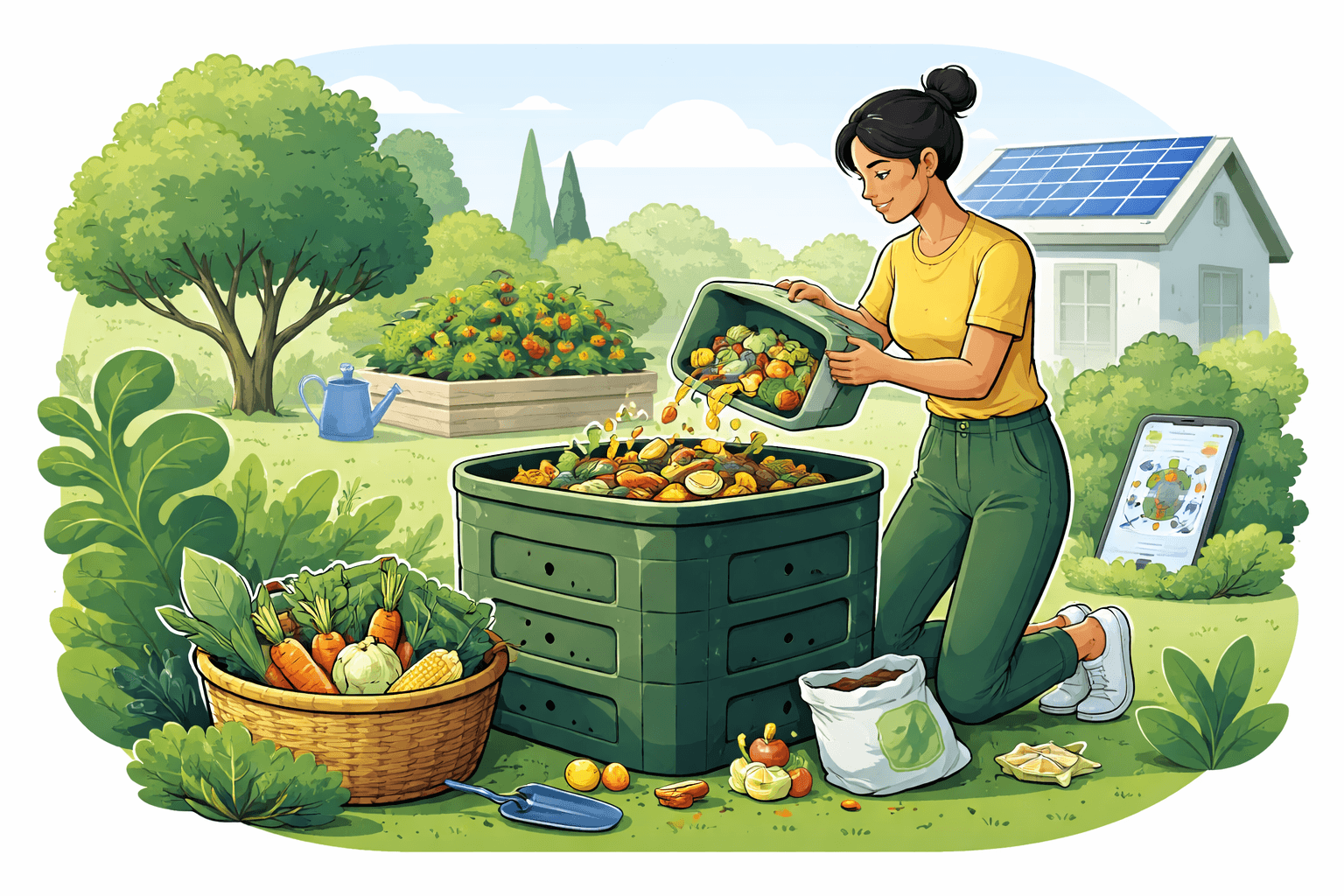
Composting at home is one of the highest-impact habits a household can adopt: the U.S. EPA estimates food waste makes up about 24% of municipal solid waste sent to landfills, where it generates methane, a potent greenhouse gas (EPA, 2023). Diverting kitchen scraps and yard trimmings into compost cuts landfill emissions, builds healthier soils, and can reduce garden watering needs. This guide walks you through methods, ratios, troubleshooting, climate metrics, and how to use finished compost—data first, jargon-free.
Links in this guide: Where relevant, we reference credible sources such as the U.S. EPA, USDA NRCS, Cornell Waste Management Institute, and Project Drawdown.
What is composting—and why it matters
Composting is the controlled decomposition of organic materials (food scraps, leaves, paper, wood chips) into a stable, soil-like amendment rich in humus and microbial life. Microbes break down carbon-rich “browns” and nitrogen-rich “greens,” using oxygen and moisture as fuel.
Compost Science for Gardeners: Simple Methods for Nutrient-Rich Soil (Garden Science Series, 3): Pavlis, Robert
― REBECCA MARTIN, technical editor, Mother Earth News magazine · WITH BREATHTAKING CLARITY, Compost Science for Gardeners <strong>demystifies composting practices and helps readers determine the best
Check Price on AmazonWhy it matters now:
- Waste reduction: Food waste is the single largest component of U.S. landfilled material at ~24% by weight (EPA, 2023). Diverting it through composting at home immediately lightens your trash bin.
- Emissions: Landfills are the third-largest source of U.S. methane emissions—about 14% of national methane (EPA Greenhouse Gas Inventory, 2023). Composting keeps organics out of anaerobic landfill conditions that produce methane.
- Soil and water: Compost increases soil organic matter, which improves structure, nutrient retention, and water-holding capacity—especially in sandy soils. USDA NRCS reports that raising soil organic matter can markedly increase water retention, improving resilience to drought and heavy rain.
- Fertility and biodiversity: Finished compost provides a balanced, slow-release nutrient profile (often around 1–1–1 N–P–K by weight, varying widely) and a diversity of beneficial microbes that support plant health.
For broader household conservation actions that pair well with home composting, see our guide to How to Practice Conservation at Home: Practical Steps to Save Energy, Water, Waste and Support Wildlife.
Types of home composting systems
Different homes and lifestyles call for different approaches. Most households can succeed with at least one of these options:
1) Backyard pile or bin
- Best for: Yards with space. Handles yard trimmings plus kitchen scraps.
- How it works: A ventilated bin or open pile at least 3×3×3 ft (about 1 m³) to retain heat. You layer browns and greens, managing moisture and aeration. Turning accelerates decomposition.
- Pros: Lowest cost, highest capacity, makes “hot” compost when done at scale.
- Cons: Needs outdoor space; can attract pests if mismanaged.
2) Tumbler
- Best for: Small yards, patios, HOA constraints.
- How it works: A sealed, aerated drum you rotate. Rotation mixes materials and introduces air.
- Pros: Faster and cleaner than open piles; helps deter rodents.
- Cons: Limited volume; heavy to rotate when full; still needs good ratios.

FCMP Outdoor IM4000 Dual Chamber Tumbling Composter Canadian-Made, 100% Recycled Resin - Outdoor Rotating Compost Tumbler Bin for Garden, Kitchen, and Yard Waste, Black (37 Gallon) : Outdoor Composting Bins : Patio, Lawn & Garden
View on Amazon3) Vermicomposting (worm bins)
- Best for: Indoors or garages; apartments; winter composting.
- How it works: Red wigglers (Eisenia fetida) digest food scraps in a ventilated bin with moist bedding (shredded paper/cardboard + a little finished compost).
- Pros: Low-odor, compact, quick (worm castings in ~2–4 months).
- Cons: Sensitive to heat/cold; avoid meat, dairy, and oily foods; needs occasional harvesting of castings.

Worm Factory 360 Worm Composting Bin + Bonus "What Can Red Wigglers Eat?" Infographic Refrigerator Magnet (Green) - Vermicomposting Container System - Live Worm Farm Starter Kit for Kids & Adults : Patio, Lawn & Garden
View on Amazon4) Bokashi fermentation
- Best for: Small spaces; people who want to process meat/dairy.
- How it works: Anaerobic fermentation in a sealed bucket inoculated with lactobacilli (“bokashi bran”). After ~2 weeks, fermented scraps are buried in soil or added to a compost bin to finish.
- Pros: Takes all food types; very compact; fast pre-processing step.
- Cons: Requires bran; end product is not finished compost until soil-integrated.
5) Indoor electric “food recyclers”
- Best for: Apartments with odor/pest concerns.
- How it works: Dehydrates and grinds scraps into a dry material. Note: This is not compost; it still needs soil or a compost system to biologically break down.
- Pros: Clean and odor-controlled; volume reduction.
- Cons: Uses electricity; produces an input for soil/compost, not a finished amendment.
Composting at Home: Getting started (location, bin, and the green–brown mix)
Choose a location
- Outdoor bins/piles: Pick a well-drained, partially shaded spot with hose access. Avoid placing directly against wooden structures.
- Vermicompost: Keep at 55–77°F (13–25°C). Indoors, basements, or garages work well.
Pick a bin or system
- Low-cost DIY: Hardware-cloth cylinder, pallets, or a drilled trash can.
- Off-the-shelf: Aerated plastic bins, tumblers, enclosed rodent-resistant bins.
- Worm bin: Stacking trays or DIY totes with ventilation and leachate control.
- Bokashi: Two-bucket system with a spigot for draining fermentate.
Understand the mix: “greens” vs. “browns”
- Greens (nitrogen-rich, wetter): Fruit/vegetable scraps, coffee grounds, tea leaves, fresh grass clippings, manure from herbivores.
- Browns (carbon-rich, drier): Dry leaves, straw, shredded paper/cardboard, wood chips, sawdust (untreated wood), paper egg cartons.
Target ratio: Aim for a carbon-to-nitrogen (C:N) ratio of about 25–30:1 by weight—a well-researched sweet spot for rapid, low-odor composting (Cornell Waste Management Institute). Practically, this translates to about 2–3 parts brown to 1 part green by volume. Adjust by observation:
- Smelly/anaerobic or too wet? Add dry browns and mix.
- Dry and inert? Add greens or a bit of water; mix to aerate.
What not to add to open piles/bins: Meat, fish, dairy, fats/oils, large bones, pet waste, coal/charcoal ash, diseased plants, glossy/colored paper, compostable plastics labeled PLA (these require industrial composting). Bokashi can handle meat and dairy because it’s sealed and fermented first.
Step-by-step routine: layering, moisture, temperature, and timeline
1) Build the base
- Start with 4–6 inches (10–15 cm) of coarse browns (sticks/wood chips) to improve airflow at the bottom.
- Add alternating thin layers: 2–3 parts browns to 1 part greens. Sprinkle handfuls of finished compost or garden soil to inoculate microbes (optional but helpful).
2) Manage moisture
- Target 50–60% moisture—like a wrung-out sponge. Squeeze test: A handful should feel moist with maybe 1–2 drops of water.
- Too wet: Mix in shredded cardboard/dry leaves; open vents. Too dry: Mist with a hose or add juicy greens.
3) Aerate
- Backyard bin/pile: Turn with a fork every 1–2 weeks for “hot” composting; every 3–4 weeks for “steady” composting. Incorporate the outer, drier edges into the center.
- Tumbler: Rotate 2–3 times per week.
- Vermicompost: Don’t turn; gently fluff bedding occasionally to keep it aerated.
4) Heat and hygiene targets
- Active composting runs warm to hot: 110–160°F (43–71°C). Many backyard piles reach 120–150°F (49–66°C) within days if the volume and mix are right.
- For weed seeds and many pathogens, aim for at least 131°F (55°C) for several days in the core. Home systems vary; even without “hot” temps, composting is still beneficial, but avoid adding diseased plant material if you can’t achieve heat.
5) Timeline
- Hot backyard pile (≥1 m³, good C:N, regular turning): 2–4 months to finished compost after an initial 3–6 weeks of active heating.
- Passive/cold pile: 6–12 months.
- Tumbler: 2–4 months, depending on inputs and rotation.
- Vermicompost: 2–4 months to harvest castings once a bin is established.
- Bokashi: ~2 weeks of fermentation, then 2–4 more weeks buried in soil or added to a compost bin to finish.
Troubleshooting common problems
Odors (rotten/anaerobic)
- Cause: Too much green, too wet, or compacted (low oxygen).
- Fix: Add dry browns (shredded cardboard/leaves), mix to aerate, and avoid large, dense layers of wet food scraps. Keep layers thin; cap new food additions with 2–3 inches (5–8 cm) of browns.
Pests (rodents, raccoons, flies)
- Prevention: Use a sealed bin or tumbler; line the base of open bins with 1/4-inch (6 mm) hardware cloth; bury food scraps 6–8 inches (15–20 cm) below browns; avoid meat/dairy/oils; always cap fresh scraps with browns.
- Flies/gnats: Cover every new addition; keep surface dry with leaves/cardboard.
Slow decomposition
- Cause: Too dry, too brown-heavy, pieces too large, pile too small/cold, or low aeration.
- Fix: Chop inputs smaller (1–2 inches), add greens or water to reach sponge-like moisture, build to at least 3×3×3 ft (1 m³), and turn more frequently.
Ammonia smell (sharp/urine-like)
- Cause: Too much nitrogen (greens) or high-protein inputs.
- Fix: Add browns; mix thoroughly; consider adding woody material.
Leachate in worm bins (liquid buildup)
- Cause: Overfeeding wet scraps; poor drainage.
- Fix: Add dry bedding; increase drainage and airflow; feed smaller amounts more often.
Contamination (plastic, glass, treated wood)
- Prevention: Set up a kitchen caddy with a “no” list; tear off tape from boxes; avoid glossy paper; do not add “compostable” PLA items unless your local program explicitly accepts them for home composting.
Using finished compost: curing, testing, and application rates
Is it done?
Finished compost is dark, crumbly, and earthy-smelling, with original materials mostly unrecognizable. It should be near-ambient temperature.
- Curing: Let the pile rest 2–4 weeks after active composting; this stabilizes nutrients and reduces phytotoxic compounds.
- Simple tests: Seed germination (radish or cress)—mix 1 part compost with 1 part seed-starting mix; germination ≥80% of the control indicates plant-safe. Or bag test—seal a handful for 48 hours; opening should reveal an earthy, not sour, aroma.
How to use it
- Garden beds: Top-dress 1–2 inches (2–5 cm) in spring/fall and lightly incorporate into top 6–8 inches (15–20 cm). For new beds, blend up to 25–33% by volume with native soil.
- Lawns: Top-dress 1/4 inch (0.6 cm) across the surface annually or after aeration. Water in.
- Trees and shrubs: Apply a 2–3 inch (5–8 cm) mulch ring out to the dripline, keeping compost 3–6 inches (8–15 cm) away from the trunk.
- Containers: Mix 10–20% compost by volume into potting blends. For seed starting, limit to ≤10% and screen compost through 1/4-inch mesh.
Note: Compost is usually a mild fertilizer. If plants show deficiency symptoms, supplement with targeted nutrients based on a soil test.
By the Numbers: performance, timelines, and climate impact
- Landfill share of food waste: ~24% of U.S. landfilled MSW (EPA, 2023).
- Methane source ranking: Landfills are the third-largest U.S. methane source (~14%) (EPA Inventory, 2023).
- Optimal C:N ratio: 25–30:1 (Cornell Waste Management Institute).
- Moisture target: ~50–60% (wrung-out sponge) (Cornell).
- Pile size for heat: ≥1 m³ (3×3×3 ft) often needed for “hot” composting.
- Time to finish: 2–4 months (hot/managed) to 6–12 months (passive).
- Water benefits: Compost increases water-holding capacity, notably in coarse soils (USDA NRCS).
- Emissions savings: Diverting 1 ton of food scraps from landfill to composting avoids on the order of 0.2–0.6 metric tons CO2e, depending on local conditions and modeling assumptions (EPA WARM v15, 2023).
Climate impact and metrics: How much you can divert
A simple way to estimate your household impact:
- Estimate food scrap generation. ReFED’s 2024 Insights Engine reports roughly 300 lb (136 kg) of household food waste per person annually in the U.S. A three-person home therefore generates about 900 lb (408 kg) per year.
- Estimate capture. If you reliably collect two-thirds of compostable organics, you might divert ~600 lb (272 kg) per year.
- Estimate emissions avoided. Using EPA’s WARM model range (0.2–0.6 tCO2e per ton shifted from landfill to composting):
- 600 lb = 0.3 short tons. 0.3 × (0.2–0.6) ≈ 0.06–0.18 metric tons CO2e avoided annually (60–180 kg CO2e).
- Co-benefits: Reduced trash volume (fewer/broader waste pickups), improved soil structure and water retention, and potential yield/plant-health gains in gardens.
Project Drawdown also identifies composting as a scalable climate solution that reduces methane emissions by keeping organics out of landfills, complementing food-waste prevention and methane capture at disposal sites.
For more whole-home waste reduction strategies that compound these benefits, see our Zero Waste Lifestyle: A Practical Guide to Reducing Household Waste.
FAQs and quick answers
- Can I compost citrus, onions, and coffee grounds? Yes, in moderation. Worm bins can handle coffee grounds well if balanced with bedding.
- Are “compostable” plastics OK at home? Generally, no—most require industrial conditions (high heat, controlled aeration). Check local guidance.
- What about weeds and diseased plants? Add only if your pile gets hot (≥131°F/55°C for several days). Otherwise, landfill, solarize, or municipal green waste.
- Winter composting? Keep adding browns/greens; the pile will pause in freezing weather and restart in spring. Worm bins should be kept above ~50°F (10°C).
- Animal manures? Herbivore manures (rabbit, goat, horse, cow) are acceptable when mixed and composted hot. Avoid pet (dog/cat) waste due to pathogens.
Further resources: local rules, community options, and programs
- Local regulations: Some municipalities restrict backyard composting to yard waste or specify bin standards and setbacks. Check your city/county solid waste department or cooperative extension office. Many areas offer free or discounted bins and starter training.
- Community composting: If you lack space, look for neighborhood drop-offs, community gardens, farmers’ markets, or subscription services that collect food scraps.
- Education and support: Search for “Master Composter” or “Master Recycler” programs run by local extensions. Cornell Waste Management Institute (compost.css.cornell.edu) and EPA’s Sustainable Management of Food pages offer reliable, science-based guidance.
For broader everyday actions that pair well with composting at home, explore Everyday Sustainable Living: Practical Tips to Save Money, Reduce Waste, and Lower Your Carbon Footprint.
Safety and quality tips
- Avoid treated/painted wood sawdust and coal ash.
- Screen finished compost through 1/4-inch mesh for seed-starting mixes.
- Store compost under cover to prevent nutrient runoff.
- If salt-sensitive plants show stress, leach pots with water and use lower compost percentages in mixes.
What this means for households, businesses, and policymakers
- Households: Composting at home can cut weekly trash weight by 20–40% when yard trimmings are included and reduce fertilizer and watering costs in gardens.
- Businesses: Restaurants and offices can pre-sort organics for on-site composting or collection; staff training and clear signage are key.
- Policymakers: Offering organics collection, bin rebates, and clear acceptance lists increases diversion. Data transparency and contamination monitoring improve program performance.
Where the field is heading
Expect continued growth in curbside organics programs, better-designed consumer bins with odor/pest controls, and data-driven contamination reduction. On the research front, universities and extensions are refining home-scale guidance on pathogen kill targets and microplastics mitigation (e.g., avoiding synthetic tea bags and compostable plastics). New city rules are accelerating diversion: several U.S. cities now require organics separation, and states are rolling out landfill bans on certain organics. Together with prevention and edible food rescue, composting at home remains a cornerstone climate and soil-health solution grounded in simple biology and everyday action.
Sources and references:
- U.S. EPA, “Wasted Food Report” and “Facts and Figures about Materials, Waste and Recycling” (2023): https://www.epa.gov/smm/sustainable-management-materials
- U.S. EPA, Inventory of U.S. Greenhouse Gas Emissions and Sinks (2023): https://www.epa.gov/ghgemissions/inventory-us-greenhouse-gas-emissions-and-sinks
- EPA WARM (Waste Reduction Model) v15 (2023): https://www.epa.gov/warm
- USDA NRCS Soil Health: https://www.nrcs.usda.gov/soils/health
- Cornell Waste Management Institute (C:N ratios, moisture, backyard compost science): http://compost.css.cornell.edu
- ReFED Insights Engine (household food waste estimates, 2024): https://refed.org/insights/
Recommended Products
Compost Science for Gardeners: Simple Methods for Nutrient-Rich Soil (Garden Science Series, 3): Pavlis, Robert
― REBECCA MARTIN, technical editor, Mother Earth News magazine · WITH BREATHTAKING CLARITY, Compost Science for Gardeners <strong>demystifies composting practices and helps readers determine the best
FCMP Outdoor IM4000 Dual Chamber Tumbling Composter Canadian-Made, 100% Recycled Resin - Outdoor Rotating Compost Tumbler Bin for Garden, Kitchen, and Yard Waste, Black (37 Gallon) : Outdoor Composting Bins : Patio, Lawn & Garden
<strong>This 8-sided, 37-gallon (5 cu ft) composter bin features a dual-chamber design that produces a steady flow of nutrient-rich compost, letting you recycle kitchen and yard waste with ease</stron
Worm Factory 360 Worm Composting Bin + Bonus "What Can Red Wigglers Eat?" Infographic Refrigerator Magnet (Green) - Vermicomposting Container System - Live Worm Farm Starter Kit for Kids & Adults : Patio, Lawn & Garden
The worms migrate upward to the newest food source leaving the bottom tray full of nutrient-rich compost. You can do this year-round inside or out, and harvest compost up to once a month! The finished
More in Sustainability Policy
- Composting for Beginners: A Simple Guide to Getting Started
- How to Recycle at Home: Practical Steps, What Belongs Where, and Easy Systems to Reduce Waste
- How to Recycle Effectively: Practical Guidance to Reduce Waste and Avoid Contamination
- Practical Tips for Organizing a Successful Community Recycling Drive